How to (Legally) Stay in Europe for More Than 90 Days
Learn how to legally stay in Europe beyond 90 days with visas, bilateral agreements, and strategic travel. Explore options like student, work, and digital nomad visas.
Europe’s charm—its history, culture, and diverse landscapes—draws millions of travelers each year. However, for non-European citizens, the Schengen Area’s 90/180 rule limits stays to 90 days within any 180-day period. This restriction can feel like a barrier for those dreaming of extended adventures, studying abroad, or even relocating to Europe. Fortunately, there are legal pathways to stay longer, ranging from visas to strategic travel planning. This comprehensive guide explores how to legally extend your stay in Europe beyond 90 days, offering practical solutions, visa options, and insider tips to navigate the complex European immigration system.
Understanding the Schengen Area and the 90/180 Rule
The Schengen Area comprises 29 countries that have abolished internal border controls, allowing seamless travel across member states. These countries include Austria, Belgium, Bulgaria, Croatia, Czechia, Denmark, Estonia, Finland, France, Germany, Greece, Hungary, Iceland, Italy, Latvia, Liechtenstein, Lithuania, Luxembourg, Malta, Netherlands, Norway, Poland, Portugal, Romania, Slovakia, Slovenia, Spain, Sweden, and Switzerland, along with microstates like Monaco, San Marino, and Vatican City.
The 90/180 rule governs non-EU/EEA citizens’ stays in the Schengen Area, permitting a maximum of 90 days within any 180-day period. The clock starts on your first entry, and the 90 days need not be consecutive—they are cumulative. For example, if you spend 60 days in January and 30 days in June, you’ve used your 90-day allowance and must leave the Schengen Area until the 180-day period resets. Overstaying can lead to fines, deportation, or bans, with enforcement varying by country. Germany, Switzerland, and Scandinavian nations are notably strict, while countries like Greece or Spain may be more lenient, though relying on leniency is risky.
To calculate your remaining days, use the EU’s Schengen Visa Calculator, which tracks entry and exit dates. Understanding this rule is critical before exploring options to extend your stay.
Option 1: Leverage Non-Schengen Countries
One of the simplest ways to stay in Europe longer than 90 days is to alternate between Schengen and non-Schengen countries. Non-Schengen European countries, such as the United Kingdom, Ireland, Albania, Moldova, and certain Balkan nations, have their own visa policies, often allowing stays of 60–180 days. By spending time in these countries, you can wait out the 180-day period and re-enter the Schengen Area with a fresh 90-day allowance.
How It Works
- United Kingdom: Allows up to 180 days per calendar year for visitors. After spending 90 days in the Schengen Area, you could relocate to the UK for up to 6 months, then return to Schengen.
- Ireland: Permits stays of up to 90 days for many nationalities without a visa.
- Albania: Offers visa-free stays of up to one year for U.S. citizens and 90 days for many others.
- Balkans (e.g., Serbia, Montenegro): Typically allow 90-day visa-free stays.
- Moldova: Permits 90-day stays within a 6-month period.
Example Strategy
Spend 90 days exploring Schengen countries (e.g., France, Italy, Spain), then travel to the UK for 90 days. Afterward, return to the Schengen Area for another 90 days. This “hopping” strategy is hassle-free and requires no visa applications, making it ideal for tourists. However, ensure you have travel insurance, as delays or medical emergencies can occur during frequent travel. SafetyWing’s Nomad Insurance, for instance, offers medical coverage up to $250,000 and protection for trip interruptions, starting at a few dollars per day.
Pros and Cons
| Pros | Cons |
|---|---|
| No visa applications required | Requires careful planning of travel dates |
| Flexible travel across diverse countries | Additional travel costs (flights, trains) |
| Ideal for tourists exploring Europe | Limited to non-Schengen countries’ rules |
Option 2: Utilize Bilateral Agreements
Some Schengen countries have bilateral agreements with non-EU nations, allowing additional stay periods beyond the standard 90-day Schengen limit. These agreements predate the Schengen Area and remain valid, though enforcement can vary.
Key Examples
- France (U.S. Citizens): A 1949 agreement allows U.S. citizens an additional 90 days in France after the Schengen 90-day limit, provided they leave Europe directly from France. Documentation, such as proof of stay (e.g., hotel bookings, receipts), is essential, as border officials may not be familiar with this rule.
- Poland (U.S. Citizens): A 1991 agreement permits U.S. citizens to spend 90 days in Poland outside the Schengen limit. You must enter and exit Poland via a non-Schengen country (e.g., fly from the U.S. or UK to Poland).
- Denmark and Norway: Similar agreements allow U.S., Australian, Canadian, and other citizens an extra 90 days in each country, but time spent in one counts toward the other.
Considerations
Bilateral agreements are country-specific, and you cannot travel within the Schengen Area during the additional period. Enforcement depends on border officials, so carry documentation to prove your stay. Contact embassies for clarification, as rules can be obscure.
Pros and Cons
| Pros | Cons |
|---|---|
| Extends stay without complex visa processes | Limited to specific countries and nationalities |
| No additional visa fees | Requires direct exit from the country |
| Useful for extended stays in one country | Risk of inconsistent enforcement |
Option 3: Apply for a Long-Stay Visa
For those seeking to live, work, or study in Europe, long-stay visas or residence permits are the most reliable options. These visas, often categorized as C- or D-class, allow stays of up to one year, depending on the country and purpose.
Popular Long-Stay Visa Options
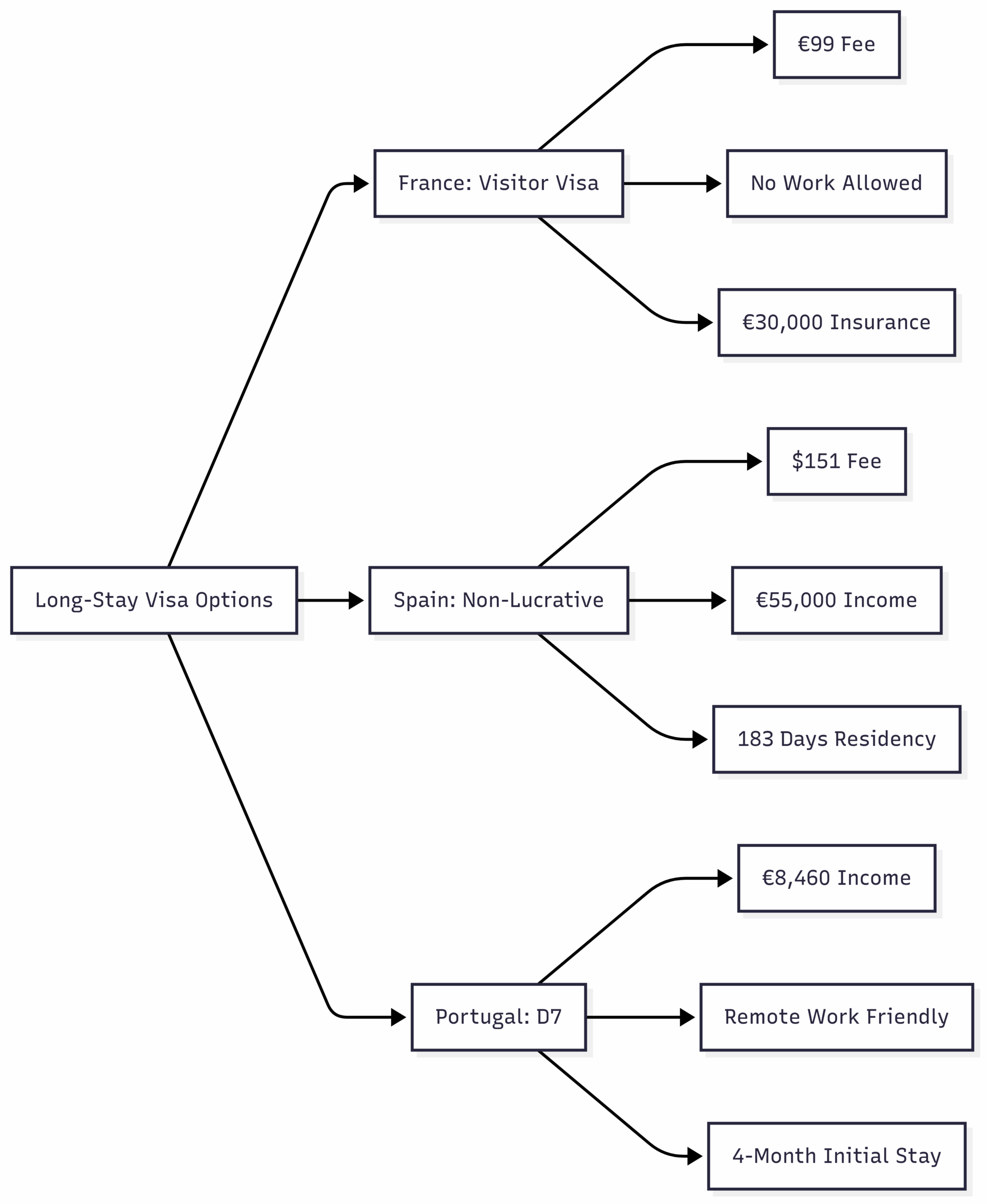
France: Long-Term Visitor Visa
- Purpose: For individuals wishing to reside in France for up to 12 months without working.
- Requirements:
- Completed application form
- ID photos
- Valid passport (issued <10 years, valid 3 months post-return, 2 blank pages)
- Notarized letter promising not to work
- Proof of income (e.g., pension, bank statements showing sufficient funds)
- Private health insurance (minimum €30,000 coverage, including evacuation)
- Proof of accommodation (e.g., lease or letter)
- Cost: €99
- Process: Apply at a French consulate with an appointment. Applications must be submitted within 3 months of arrival. Use France-Visas for guidance.
Spain: Non-Lucrative Residence Visa
- Purpose: For retirees or those with sufficient savings to live in Spain without working.
- Requirements:
- Annual income of at least €55,000 (or equivalent savings)
- Private health insurance from a Spanish-authorized provider
- Doctor’s note confirming good health
- Criminal background check (translated into Spanish)
- Application form, passport, photos
- Cost: $151 USD for U.S. citizens
- Process: Apply at a Spanish consulate in your home country, often with legal assistance. Requires 183 days in Spain annually for tax residency.
Portugal: D7 Passive Income Visa
- Purpose: For individuals with passive income (e.g., pensions, investments, remote work).
- Requirements:
- Annual income of €8,460
- Private health insurance
- Clean criminal background check
- Letter of intent
- Proof of accommodation
- 2 passport photos
- Cost: Varies by consulate
- Process: Apply at a Portuguese consulate. Portugal is more accepting of remote work income than Spain.
Chart: Long-Stay Visa Comparison
Considerations
Long-stay visas require significant documentation and planning. Contact the relevant embassy or consulate for specific requirements, as rules vary. Digital nomads should note that Portugal’s D7 visa is particularly accommodating for remote work income.
Option 4: Obtain a Student Visa
Student visas are an accessible option for those enrolled in recognized educational programs. These visas typically allow stays of up to one year and may permit limited work.
Key Countries
- Spain: Numerous language schools offer programs that qualify for student visas. Requirements include enrollment proof, financial means, and health insurance. Apply at a Spanish consulate.
- Germany: Offers low-cost or free post-secondary education. Requires proof of €11,208 in a blocked bank account and enrollment in a recognized program. Allows 120 full days or 240 half days of work annually.
Process
- Enroll in a recognized program (e.g., university, language school).
- Gather documents: passport, enrollment letter, proof of funds, health insurance.
- Apply at the consulate in your home country.
- Costs vary but are generally €60–€100.
Pros and Cons
| Pros | Cons |
|---|---|
| Accessible for students of all ages | Requires enrollment and tuition fees |
| Permits limited work in some countries | Extensive paperwork (e.g., bank accounts, addresses) |
| Renewable for multi-year programs | Not ideal for non-students |
Option 5: Secure a Working Holiday Visa
Working holiday visas are designed for young travelers (typically under 30, though age limits are relaxing) to work and travel for 1–2 years. These are available to citizens of Australia, Canada, New Zealand, South Korea, and others from specific Schengen countries.
Options
- Ireland (Non-Schengen): Offers a 12-month visa for current or recent students with no work restrictions. Apply with proof of enrollment or graduation.
- Portugal: Provides a 12-month visa, allowing 6 months of work or 4 months of study. Requires proof of enrollment or recent graduation.
- Other Countries: Nations like France, Germany, and the Netherlands offer working holiday visas to select nationalities. Check country-specific eligibility.
Process
- Apply at the consulate with proof of age, nationality, and (if required) student status.
- Fees range from €60–€150.
- Provide health insurance and proof of funds.
Option 6: Freelancer/Digital Nomad Visa
With the rise of remote work, many European countries now offer freelancer or digital nomad visas for those with stable online income. These are ideal for remote workers, freelancers, or entrepreneurs.
Key Countries
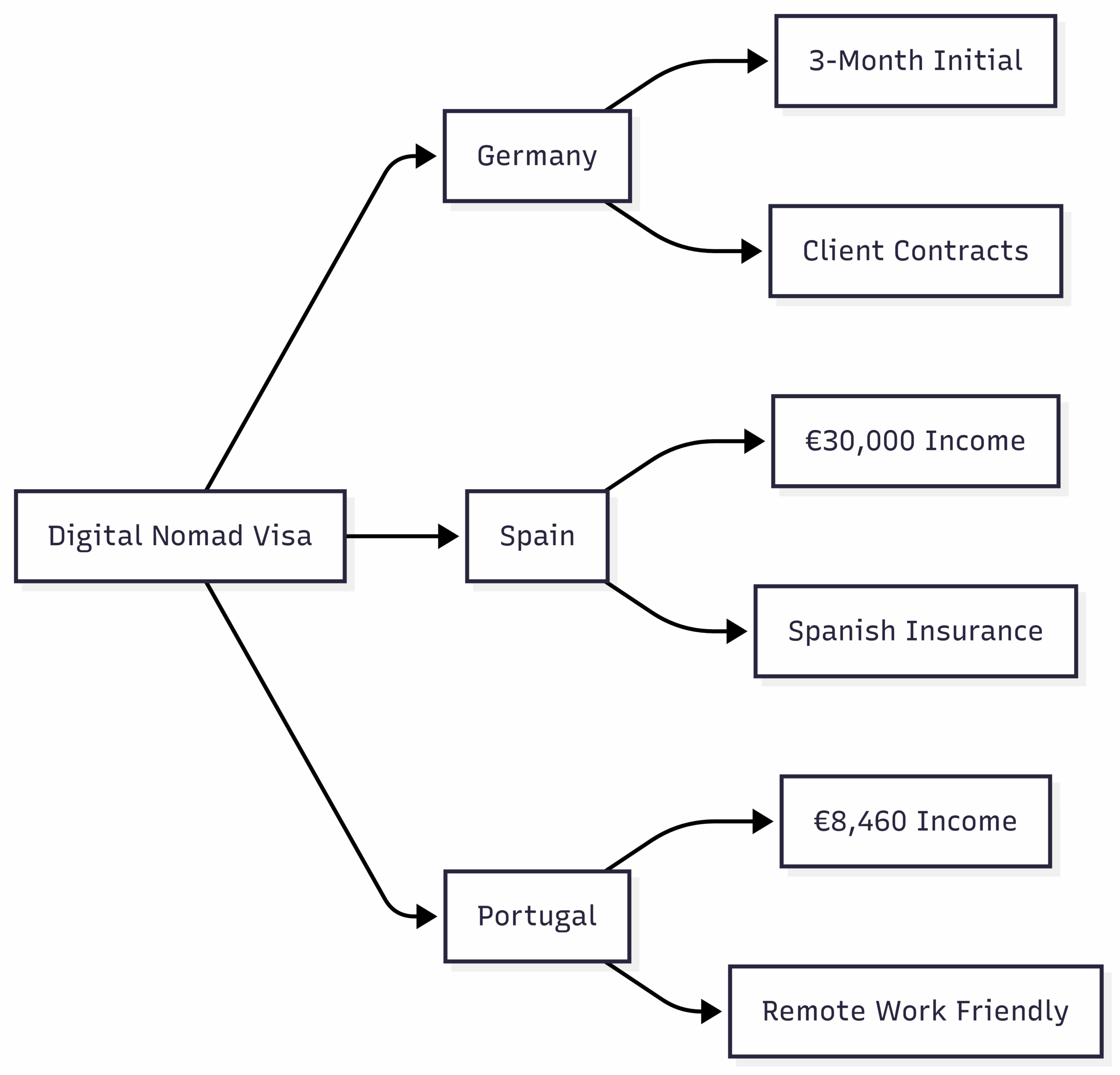
- Germany: Offers a 3-month freelancer visa, extendable to a 3-year residency permit. Requires proof of income, clients, and health insurance. Apply after arrival for certain nationalities (e.g., U.S., Canada).
- Spain: Launched in 2023, requires €30,000 annual income, private health insurance, and a clean background check.
- Portugal (D7): Accepts remote work income with a low threshold (€8,460/year).
- Others: Albania, Croatia, Cyprus, Czechia, Estonia, Greece, Hungary, Iceland, Italy, Latvia, Malta, Norway, Romania, and Turkey offer similar programs.
Requirements
- Proof of income (varies by country, e.g., €30,000 for Spain, €8,460 for Portugal)
- Private health insurance
- Clean criminal record
- Business plan or client contracts (for freelancer visas)
- Application fees: €50–€200
Chart: Digital Nomad Visa Income Requirements
Option 7: Marriage or Family Reunification
Marrying a European citizen or joining a family member in Europe can grant residency. Marriage visas allow you to stay while the application is processed, potentially leading to permanent residency. Requirements include proof of relationship, financial stability, and accommodation. This option is complex and should only be pursued for genuine relationships.
Practical Tips for Success
- Research Early: Visa requirements vary by country and nationality. Check embassy websites or SchengenVisaInfo for updates.
- Prepare Documentation: Gather passports, bank statements, insurance, and accommodation proof well in advance.
- Consult Embassies: Contact consulates for clarification on bilateral agreements or visa rules.
- Use Calculators: Track Schengen days with the EU’s calculator to avoid overstaying.
- Get Insurance: Policies like SafetyWing’s Nomad Insurance cover medical emergencies and trip interruptions, essential for long-term travel.
- Avoid Overstaying: Fines, deportation, or bans can result from overstaying. Countries like Germany and Switzerland enforce rules strictly.
Conclusion
Staying in Europe beyond 90 days is achievable through strategic planning and legal pathways. Whether you hop between Schengen and non-Schengen countries, leverage bilateral agreements, or apply for long-stay, student, working holiday, or digital nomad visas, each option offers unique benefits tailored to your goals. Start by assessing your purpose—tourism, study, work, or residency—and research country-specific requirements. With careful preparation, you can unlock extended adventures or a new life in Europe without breaking immigration rules.
Please share this How to (Legally) Stay in Europe for More Than 90 Days with your friends and do a comment below about your feedback.
We will meet you on next article.
Until you can read, 9 Non-CRS Countries to Keep Your Banking Private