Why Asynchronous Work Will Become the New Normal
The modern workplace is undergoing a profound transformation. As remote work becomes increasingly prevalent, traditional notions of synchronized schedules and real-time collaboration are giving way to a more flexible, efficient, and inclusive model: asynchronous work. This approach, where team members collaborate without the need for simultaneous online presence, is reshaping how businesses operate, empowering employees, and driving productivity across industries. With 94% of workers craving flexible hours and 77% of remote employees reporting higher productivity in asynchronous setups, according to a 2021 Buffer survey, this model is not just a trend—it’s poised to become the new normal.
In this comprehensive guide, we’ll explore what asynchronous work is, its benefits and challenges, how it differs from synchronous and remote work, and the best practices for implementing it effectively. We’ll also examine the tools that make asynchronous work seamless and why this approach is critical for the future of work.
What Is Asynchronous Work?
Asynchronous work is a working model where tasks and communication occur without requiring team members to be online or available at the same time. Unlike synchronous work, which relies on real-time interactions like meetings or instant messaging, asynchronous work allows employees to contribute at their convenience, aligning tasks with their personal productivity peaks and schedules.
This model thrives on tools and strategies that support delayed communication, such as email, project management platforms, shared documents, and recorded meetings. For example, a team member in Tokyo can update a project on a shared platform like Trello, and a colleague in New York can review and respond to it hours later, ensuring continuous progress without overlapping schedules.
Key Characteristics of Asynchronous Work
- Flexibility in Timing: Employees work when they’re most productive, regardless of time zones.
- Reduced Real-Time Meetings: Communication happens through written updates, recordings, or shared documents.
- Focus on Documentation: Clear, detailed records ensure transparency and accessibility.
- Autonomy and Trust: Employees manage their schedules and tasks independently.
Asynchronous work is particularly suited for distributed teams, where time zone differences make synchronous collaboration challenging. It’s also ideal for roles requiring deep focus, such as programming, writing, or design, where uninterrupted time is critical for high-quality output.
Synchronous vs. Asynchronous Work: A Detailed Comparison
To understand why asynchronous work is gaining traction, it’s essential to compare it with synchronous work, the traditional model where collaboration happens in real-time. Below is a table outlining the key differences between the two approaches:
| Aspect | Synchronous Work | Asynchronous Work |
|---|---|---|
| Definition | Collaboration requiring real-time interaction, such as meetings or instant messaging. | Work done independently, with communication delayed and not requiring simultaneous presence. |
| Timing | Fixed schedules; team members must be available simultaneously. | Flexible schedules; team members work at their own pace. |
| Communication | Immediate, often through video calls, phone calls, or live chats. | Delayed, via email, shared documents, or recorded messages. |
| Meetings | Frequent real-time meetings for updates and decisions. | Minimal meetings, with updates shared via documentation or recordings. |
| Productivity | Can be disrupted by constant interruptions and meeting fatigue. | Promotes deep focus and reduces interruptions, enhancing productivity. |
| Team Coordination | Reliant on real-time availability, which can delay progress. | Uses tools like Trello or Asana for seamless coordination across time zones. |
| Best For | Tasks requiring instant feedback, brainstorming, or crisis management. | Distributed teams, deep work, and projects with flexible timelines. |
The Stress of Synchronous Work
Synchronous work, while effective for certain tasks, often leads to stress and inefficiency. Constant notifications from instant messaging apps like Slack or Skype create pressure to respond immediately, even when the matter isn’t urgent. This reactive environment can disrupt focus, causing employees to prioritize communication over critical tasks. According to Adobe researchers, workers spend up to 80% of their workday on communication, including 6 hours on email and 15% in meetings, leaving little time for deep work.
Moreover, synchronous work can exacerbate burnout. The expectation to be “always on” leads to mental fatigue, with 49% of U.S. employees reporting virtual meeting fatigue, per a survey. This stress is particularly pronounced in remote settings, where the lack of physical boundaries between work and home amplifies the pressure to stay connected.
The Freedom of Asynchronous Work
Asynchronous work flips this dynamic. By allowing employees to respond to communications on their own schedule, it reduces the pressure of instant replies and fosters thoughtful, high-quality responses. For instance, scheduling specific times to address emails ensures nothing is missed while preserving uninterrupted focus for other tasks. This approach empowers employees to prioritize their work, leading to better outcomes and lower stress levels.
Asynchronous Work vs. Remote Work: Clarifying the Difference
Asynchronous work and remote work are often conflated, but they are distinct concepts. Remote work refers to working from a location outside a traditional office, such as a home or co-working space. It doesn’t inherently imply flexibility in timing—remote teams may still rely on synchronous meetings. Asynchronous work, however, focuses on when work is done, prioritizing flexibility in timing over location.
Here’s a visual representation of how these concepts overlap and differ:
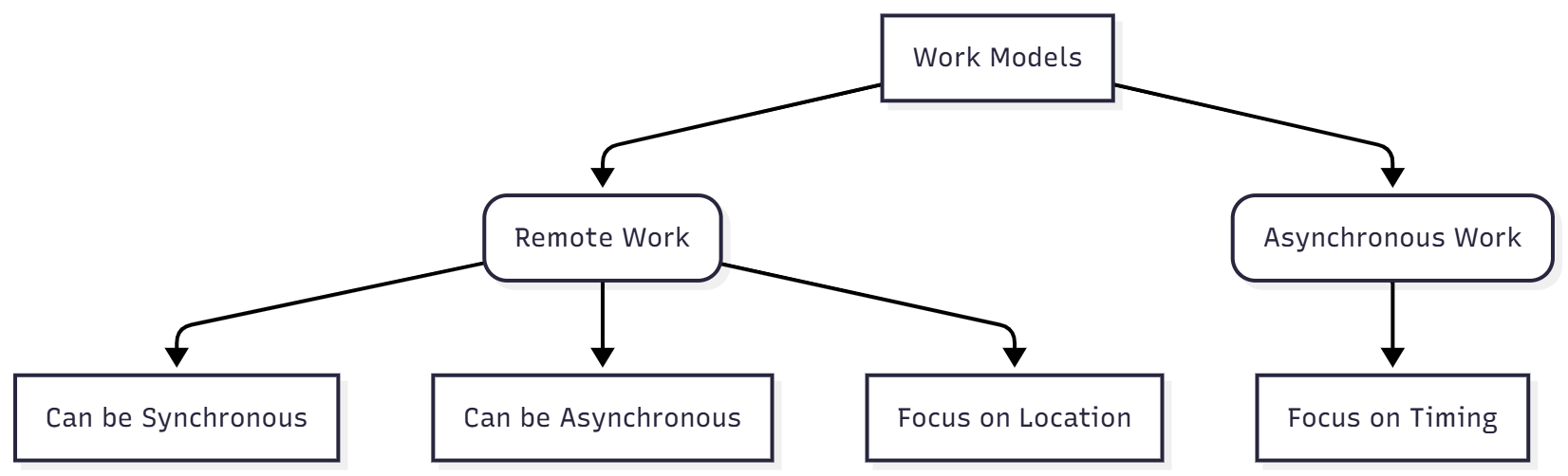
For example, a remote team in different time zones might still hold daily Zoom stand-ups (synchronous), while an asynchronous team could work from the same office but communicate via shared documents without real-time meetings. The combination of asynchronous and remote work is particularly powerful, enabling global collaboration without the constraints of synchronized schedules.
The Benefits of Asynchronous Work
Asynchronous work offers a host of benefits that align with the needs of modern employees and organizations. Below are the key advantages, supported by real-world examples:
1. Flexibility in Work Hours
Employees can work during their most productive hours, whether early morning or late at night. For instance, a parent might choose to work while their children are at school, ensuring they balance family responsibilities without compromising work quality.
2. Improved Work-Life Balance
By allowing employees to schedule work around personal commitments, asynchronous work reduces stress and burnout. A 2021 survey found that 61% of knowledge workers reported lower burnout with async workflows. Employees can take breaks for exercise, errands, or family time without feeling pressured to be “on” all the time.
3. Global Collaboration
Asynchronous work enables seamless collaboration across time zones. A developer in India can complete a task and hand it off to a colleague in Canada, ensuring projects progress 24/7. This is particularly valuable for companies like Remote, which operates with over 1,000 employees across 70 countries, leveraging async principles to maintain efficiency.
4. Fewer Interruptions
By minimizing real-time communication, asynchronous work protects employees’ focus time. This is critical for “deep work,” where uninterrupted concentration leads to higher-quality output. For example, a programmer can code without being interrupted by a Slack message demanding an instant reply.
5. Better Documentation
Asynchronous communication relies on written records, such as emails or shared documents, which reduces ambiguity and ensures clarity. This documentation serves as a reference for all team members, regardless of when they access it.
6. Reduced Meeting Fatigue
With 51% of employees receiving irrelevant meeting invitations, per a survey, asynchronous work cuts down on unnecessary meetings. Tools like recorded meetings and AI-generated summaries (e.g., Krisp’s AI Meeting Assistant) allow team members to catch up without attending live sessions.
7. Enhanced Productivity
Employees working at their peak productivity hours produce higher-quality work. A 2021 Buffer survey found that 77% of remote workers reported higher productivity in asynchronous setups, as they could focus on tasks without constant interruptions.
Challenges of Asynchronous Work and How to Overcome Them
While asynchronous work offers significant benefits, it’s not without challenges. Below are the primary hurdles and strategies to address them:
| Challenge | Solution |
|---|---|
| Delayed Feedback | Set clear response deadlines and use project management tools to track progress. |
| Miscommunication | Encourage detailed documentation and FAQs to clarify expectations. |
| Lack of Team Cohesion | Schedule virtual team-building activities or informal async chats. |
| Isolation | Use tools like Slack for “watercooler” channels to foster social connections. |
| Tracking Progress | Implement platforms like Trello or Jira for transparent task management. |
| Maintaining Urgency | Set specific timelines and use notifications to highlight deadlines. |
| Time Zone Coordination | Establish “core hours” for overlap and use meeting recordings for accessibility. |
For example, to combat delayed feedback, a team might set a 24-hour response window for non-urgent queries, ensuring progress without micromanaging. Tools like Krisp’s AI Meeting Assistant, which provides transcriptions and summaries, help team members stay informed without attending every meeting.
Best Practices for Implementing Asynchronous Work
To successfully transition to an asynchronous work model, organizations must adopt deliberate strategies and tools. Here are six best practices to ensure success:
1. Establish Clear Communication Guidelines
Define response times, preferred tools (e.g., Slack for updates, email for formal communication), and protocols for urgent matters. A “How We Communicate” document can outline time zones, expected working hours, and procedures for offline periods.
2. Leverage Project Management Tools
Platforms like Asana, Trello, and Jira enable teams to assign tasks, track progress, and share updates without real-time check-ins. These tools ensure transparency and accountability across distributed teams.
3. Prioritize Documentation
Create a centralized repository for all documentation using tools like Google Docs, Notion, or Confluence. Regularly update processes, meeting outcomes, and guidelines to keep everyone aligned.
4. Use Meeting Recordings and Transcriptions
Tools like Krisp’s AI Meeting Assistant provide recordings, transcriptions, and summaries, allowing team members to review discussions at their convenience. This reduces the need for live attendance and ensures no one misses critical information.
5. Set Clear Deadlines
Provide specific timelines for tasks and deliverables to maintain momentum. Automated notifications in project management tools can remind team members of upcoming deadlines.
6. Foster Trust and Accountability
Empower employees to manage their schedules while holding them accountable for results. Celebrate contributions to build morale and reinforce a culture of trust.
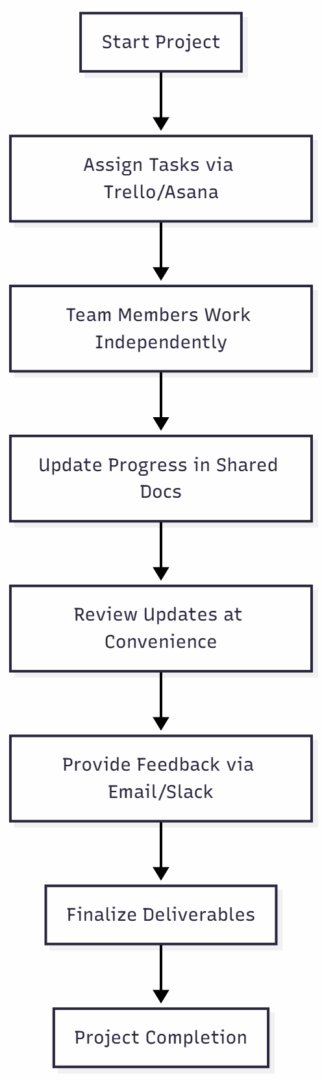
Here’s a flowchart illustrating an effective asynchronous workflow:
Tools That Power Asynchronous Work
The right technology is critical for asynchronous work. Below are four essential tools, their features, and how they support async workflows:
| Tool | Key Features | Price | How It Supports Async Work |
|---|---|---|---|
| Google Docs | Real-time collaboration, commenting, version history, accessible on all devices. | Free; Google Workspace starts at $6/user/month. | Enables collaborative editing and feedback at any time. |
| Slack | Channels, integrations, file sharing, searchable message history. | Free; paid plans start at $7.25/user/month. | Facilitates delayed communication and team recognition. |
| Trello | Boards for task tracking, automation, integrations with Slack and Google Drive. | Free; paid plans start at $5/user/month. | Tracks progress and reduces the need for real-time check-ins. |
| Loom | Screen, voice, and face recording, shareable videos, integrations with Slack. | Free; paid plans start at $8/user/month. | Allows video-based updates for asynchronous communication. |
Krisp’s AI Meeting Assistant
Krisp deserves special mention for its role in async workflows. Its features include:
- AI Meeting Transcription: Provides written records of discussions, accessible anytime.
- Meeting Recording: Allows team members to review full meetings at their convenience.
- AI Meeting Summary: Delivers concise summaries of key points and action items.
- Meeting Notes: Organizes takeaways for clarity and follow-up.
Krisp’s pricing starts with a free plan, with premium features available at $8/user/month. These tools ensure that distributed teams stay aligned without relying on real-time attendance.
Why Asynchronous Work Is the Future?
Asynchronous work is not just a response to the rise of remote work—it’s a fundamental shift in how we approach productivity, collaboration, and employee well-being. Here’s why it’s poised to become the new normal:
1. Aligns with Global Workforces
With companies increasingly hiring talent across borders, asynchronous work eliminates the barriers of time zones. It allows organizations to tap into global talent pools without the logistical challenges of synchronized schedules.
2. Supports Employee Well-Being
By reducing meeting fatigue and enabling flexible schedules, asynchronous work lowers stress and burnout. The World Health Organization reports a 25% increase in anxiety and depression among workers since the pandemic, making mental health a priority. Async work answers this call by giving employees control over their time.
3. Enhances Productivity
The ability to focus without interruptions leads to higher-quality output. The “flow state,” where employees are fully immersed in their tasks, is more achievable in async environments, as interruptions from meetings or instant messages are minimized.
4. Promotes Inclusivity
Asynchronous work levels the playing field for introverts, extroverts, and employees in different time zones or with varying personal responsibilities. It supports diversity, equity, inclusion, and belonging (DEIB) initiatives by ensuring everyone has an equal opportunity to contribute.
5. Future-Proofs Organizations
As remote and hybrid work models become standard, asynchronous work provides a scalable framework for managing distributed teams. Companies like Remote have proven that async workflows can drive efficiency and morale, making them a competitive advantage.
Interesting Facts About Asynchronous Work
- Communication Overload: Adobe researchers found workers spend 6 hours daily on email and 80% of their workday communicating.
- Meeting Fatigue: 49% of U.S. employees experience virtual meeting fatigue, and 51% receive irrelevant meeting invites.
- Productivity Boost: Remote workers in async setups work 1.4 more days per month than office-based counterparts, per a study.
- Employee Preferences: 79% of professionals believe virtual meetings are as productive or more productive than in-person ones.
Conclusion
Asynchronous work is transforming the workplace, offering a flexible, inclusive, and productive alternative to traditional synchronous models. By empowering employees to work on their terms, reducing unnecessary meetings, and leveraging tools like Krisp, Trello, and Google Docs, organizations can unlock the full potential of their global workforce.
While synchronous collaboration will always have a place for tasks like brainstorming or crisis management, asynchronous work is better suited for the demands of modern, distributed teams. As businesses continue to adapt to a globalized, remote-friendly world, asynchronous work will not only become the norm—it will redefine how we work, collaborate, and thrive.
What are your thoughts? Is your workplace ready to embrace asynchronous work as the new normal? Share your insights in the comments below.
Please share this Why Asynchronous Work Will Become the New Normal with your friends and do a comment below about your feedback.
We will meet you on next article.
Until you can read, How and Why To Get A Good Night’s Sleep As A Digital Nomad