Books of the Bible and Their Authors (Complete List)
The Bible was written by approximately 35–40 distinct human authors over roughly 1,500 years. Some books identify their authors directly in the opening verse. Others carry traditional attributions supported by internal evidence and early church testimony. A smaller number remain genuinely anonymous, with authorship still debated by scholars.
This guide covers all 66 books — 39 in the Old Testament and 27 in the New Testament — with each book’s traditional author, genre, and where significant, the alternative perspectives held by modern scholarship.
How Authorship Works in the Bible
Understanding Bible authorship requires holding two things in tension. Traditional attribution reflects longstanding church and Jewish tradition, often with real historical support. Scholarly consensus sometimes differs, identifying anonymous compilers, editorial schools, or pseudepigraphical authorship (writing in the name of a revered figure).
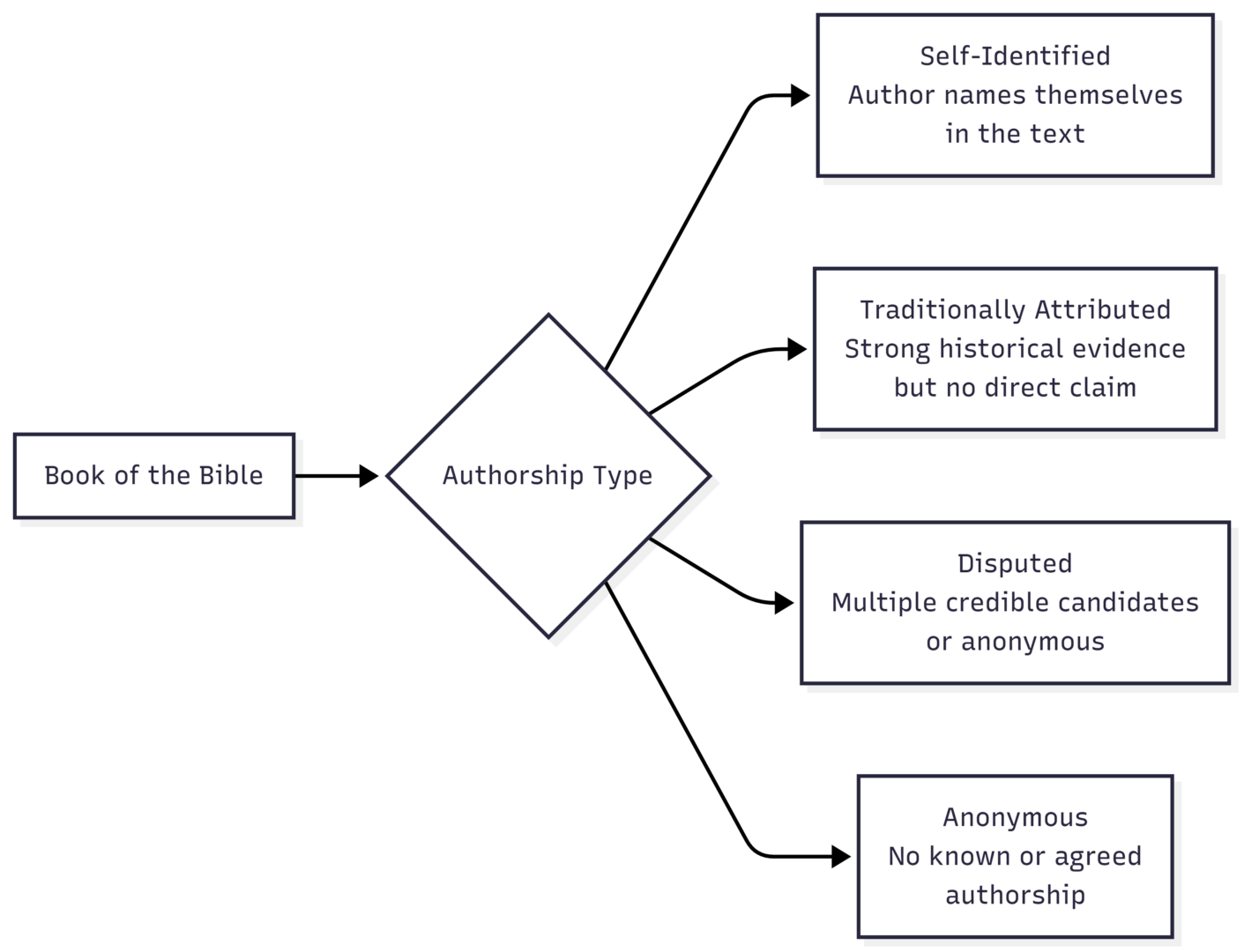
Both traditional and scholarly perspectives have value. Traditional authorship grounds a book in its historical setting. Scholarly analysis often reveals how texts were compiled, edited, and transmitted. This guide presents both where relevant.
Old Testament Books and Their Authors (39 Books)
The Law — The Pentateuch (Genesis to Deuteronomy)
Moses is the traditional author of all five books, supported by cross-references throughout the Old and New Testaments. Modern scholarship generally views the Pentateuch as compiled from multiple source traditions (commonly labeled J, E, D, and P) over centuries, reaching final form during or after the Babylonian exile.
| Book | Traditional Author | Genre | Notes on Authorship |
|---|---|---|---|
| Genesis | Moses | Law/Narrative | Not explicitly named; authorship inferred from cross-references (Exod 17:14; John 5:46) |
| Exodus | Moses | Law/Narrative | Moses identified by name throughout; records his own appointment as leader |
| Leviticus | Moses | Law | Named in opening verse: “The LORD called to Moses” (Lev 1:1) |
| Numbers | Moses | Law/Narrative | Named in opening verse: “The LORD spoke to Moses in the wilderness of Sinai” (Num 1:1) |
| Deuteronomy | Moses (with Joshua for last 8 verses) | Law | Moses identified in opening verse; Joshua likely wrote the account of Moses’ death (Deut 34:5–12) |
Historical Narrative (Joshua to Esther)
| Book | Traditional Author | Alternative / Scholarly View |
|---|---|---|
| Joshua | Joshua | Anonymous; Early Church attributed the book to Joshua except his death report (Josh 24:29–33) |
| Judges | Samuel | Samuel fits the internal evidence, but the repeated phrase “no king in Israel” may postdate Samuel’s death |
| Ruth | Samuel | Genealogy closing the book (Ruth 4:18–22) suggests authorship after David’s reign; Nathan or an anonymous author also proposed |
| 1 Samuel | Samuel, Gad, Nathan | Jewish tradition: Samuel wrote until his death; Gad and Nathan continued |
| 2 Samuel | Samuel, Gad, Nathan | Originally one book with 1 Samuel; separated by Septuagint translators |
| 1 Kings | Jeremiah | Jeremiah fits the timeline; Ezra and Ezekiel also proposed |
| 2 Kings | Jeremiah | Originally one book with 1 Kings; Jeremiah is traditional attribution |
| 1 Chronicles | Ezra | “The Chronicler” is technically anonymous; Ezra supported by near-identical text in 2 Chr 36:22–23 and Ezra 1:1–3 |
| 2 Chronicles | Ezra | Originally one book with 1 Chronicles |
| Ezra | Ezra | Not explicitly stated; Ezra–Nehemiah originally a single unified work |
| Nehemiah | Nehemiah | Not definitively stated; Ezra may have compiled it as part of a unified Ezra–Nehemiah work |
| Esther | Mordecai | Author anonymous; internal familiarity with Persian court life; Ezra or Nehemiah also proposed |
Poetry and Wisdom Literature (Job to Song of Songs)
| Book | Traditional Author | Notes |
|---|---|---|
| Job | Unknown | Possibly Job, Elihu, Moses, or Solomon; date and authorship uncertain |
| Psalms | David (73 psalms), Asaph (12), Sons of Korah (11), Solomon (2), Heman (1), Ethan (1), Moses (1); 49 anonymous | A collection compiled across many centuries |
| Proverbs | Solomon (ch. 1–29), Agur (ch. 30), Lemuel (ch. 31) | Compiled later than Solomon’s reign; Ecclesiastes may date to 3rd century BC |
| Ecclesiastes | Solomon | Opening identifies “Teacher, son of David, king in Jerusalem” (Eccl 1:1); some passages don’t fit Solomon’s context |
| Song of Songs | Solomon | Named explicitly: “The Song of songs, which is Solomon’s” (Song 1:1) |
Major Prophets (Isaiah to Daniel)
| Book | Traditional Author | Notes |
|---|---|---|
| Isaiah | Isaiah | Named in opening verse (Isa 1:1); scholarly consensus identifies two or three distinct authors across chapters 1–39 and 40–66 based on historical context and literary style |
| Jeremiah | Jeremiah | Named in opening verse (Jer 1:1); scribe Baruch ben Neriah assisted with composition |
| Lamentations | Jeremiah | Not named in text; tone and theological perspective align closely with Jeremiah; Baruch’s involvement also likely |
| Ezekiel | Ezekiel | Named in the text (Ezek 1:3; 24:24) |
| Daniel | Daniel | Self-identified (Dan 8:15); scholarly debate over whether the book reflects 6th-century authorship or a 2nd-century composition under Daniel’s name |
Minor Prophets (Hosea to Malachi)
All twelve Minor Prophets are named as authors in their books’ opening verses. Scholarly consensus views most as products of prophetic schools that compiled and edited the works over time.
| Book | Author | Opening Verse Identification |
|---|---|---|
| Hosea | Hosea | “The LORD’s word that came to Hosea the son of Beeri” (Hos 1:1) |
| Joel | Joel | “The LORD’s word that came to Joel, the son of Pethuel” (Joel 1:1) |
| Amos | Amos | “The words of Amos, who was among the herdsmen of Tekoa” (Amos 1:1) |
| Obadiah | Obadiah | “The vision of Obadiah” (Obad 1:1) |
| Jonah | Jonah | Named; some scholars consider the book a later literary composition rather than Jonah’s own record |
| Micah | Micah | “The LORD’s word that came to Micah of Morasheth” (Mic 1:1) |
| Nahum | Nahum | “The book of the vision of Nahum the Elkoshite” (Nah 1:1) |
| Habakkuk | Habakkuk | “The revelation which Habakkuk the prophet saw” (Hab 1:1) |
| Zephaniah | Zephaniah | “The LORD’s word which came to Zephaniah” (Zeph 1:1) |
| Haggai | Haggai | “The LORD’s word came by Haggai the prophet” (Hag 1:1) |
| Zechariah | Zechariah | Named in opening verse (Zech 1:1) |
| Malachi | Malachi | Named as “my messenger” — some scholars debate whether Malachi is a proper name or a title |
New Testament Books and Their Authors (27 Books)
The Gospels
All four Gospels are technically anonymous — none names its author within the text. Traditional attributions come from early church testimony beginning in the 2nd century. Modern scholarship largely accepts these attributions while noting that Matthew and Luke almost certainly drew from Mark and a hypothetical shared source called “Q.”
| Book | Traditional Author | Notes |
|---|---|---|
| Matthew | Apostle Matthew | Anonymous; Matthew identified through his role as tax collector (Matt 9:9, 10:3) |
| Mark | John Mark | Not an apostle; disciple of Peter; credited with recording Peter’s eyewitness accounts |
| Luke | Luke (physician, companion of Paul) | Author collected eyewitness testimony (Luke 1:2); same author as Acts |
| John | Apostle John (son of Zebedee) | Author refers to himself as “the disciple whom Jesus loved” (John 13:23) |
Acts and the Pauline Epistles
Luke–Acts was likely a single work divided due to scroll length. Both volumes open with a greeting to Theophilus (Luke 1:3; Acts 1:1), and the narrative of Acts picks up where Luke ends.
Paul is the most prolific New Testament author. Thirteen epistles bear his name. Scholars widely accept seven as undisputed; six are disputed, with some attributing them to later disciples writing in Paul’s name.
| Book | Author | Authorship Status | Notes |
|---|---|---|---|
| Acts | Luke | Accepted | Same author as Luke’s Gospel |
| Romans | Paul | Undisputed | Self-identified in Rom 1:1 |
| 1 Corinthians | Paul | Undisputed | Sosthenes named as co-sender (1 Cor 1:1) |
| 2 Corinthians | Paul | Undisputed | Timothy named as co-sender; disputed as co-author |
| Galatians | Paul | Undisputed | Self-identified in Gal 1:1 |
| Ephesians | Paul | Disputed | Some scholars identify as pseudepigraphical |
| Philippians | Paul | Undisputed | Timothy named as co-sender |
| Colossians | Paul | Disputed | Timothy named; some scholars attribute to a Pauline school |
| 1 Thessalonians | Paul, Silvanus, Timothy | Undisputed | All three co-identified in opening verse |
| 2 Thessalonians | Paul, Silvanus, Timothy | Disputed | Some scholars see post-Pauline authorship |
| 1 Timothy | Paul | Disputed | Part of the “Pastoral Epistles”; style differs from undisputed letters |
| 2 Timothy | Paul | Disputed | Pastoral Epistle |
| Titus | Paul | Disputed | Pastoral Epistle |
| Philemon | Paul | Undisputed | Written during Paul’s imprisonment in Rome |
| Hebrews | Unknown | Anonymous | Suggested authors: Paul, Luke, Barnabas, Apollos, Priscilla; most scholars consider it anonymous |
General Epistles and Revelation
| Book | Traditional Author | Notes |
|---|---|---|
| James | James (half-brother of Jesus) | Self-identified as “servant of God and of the Lord Jesus Christ” (Jas 1:1); known as “James the Just” |
| 1 Peter | Apostle Peter | Self-identified in opening verse (1 Pet 1:1) |
| 2 Peter | Apostle Peter | Self-identified (2 Pet 1:1); some scholars consider it pseudepigraphical due to stylistic differences from 1 Peter |
| 1 John | Apostle John | Author unnamed; strong stylistic agreement with the Gospel of John |
| 2 John | Apostle John | Author calls himself “the Elder” (2 John 1:1) |
| 3 John | Apostle John | Author calls himself “the Elder” (3 John 1:1) |
| Jude | Jude (half-brother of Jesus) | Self-identified as “brother of James” (Jude 1:1); traditionally the half-brother of Jesus |
| Revelation | Apostle John | Author named as John four times (Rev 1:1, 4, 9; 22:8); whether this is the Apostle John or “John of Patmos” remains debated |
Traditional vs. Scholarly Authorship: A Summary
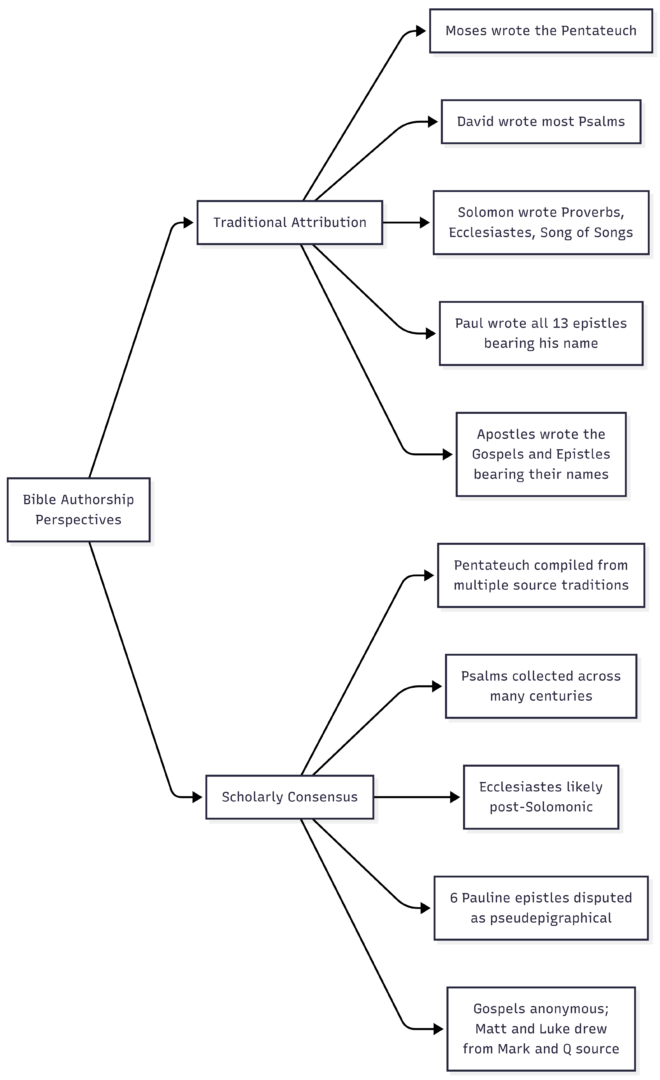
Key Facts About Bible Authorship
The Bible’s composition spans roughly 1,500 years, from the earliest Mosaic writings to the final New Testament letters. Across that span, several patterns stand out:
The most prolific authors. Paul wrote or is credited with 13 New Testament letters. David is attributed with 73 of the 150 Psalms. Moses is traditionally credited with the first five books of the Bible.
The most disputed books. Hebrews (New Testament) and Ecclesiastes (Old Testament) have the most contested authorship. Both carry traditional attributions — Paul and Solomon respectively — that modern scholarship largely questions without reaching a clear alternative.
Books with multiple confirmed authors. Psalms (at least seven identified contributors), Proverbs (three named authors), and 1–2 Thessalonians (three co-identified authors) are the clearest examples of collaborative authorship.
Truly anonymous books. Job, Hebrews, and the books of Kings and Chronicles (where “the Chronicler” is unknown) have no confirmed authorship. Ruth and Esther are also anonymous despite traditional attributions to Samuel and Mordecai.
The dual authorship principle. Traditional Christian theology holds that every book of the Bible carries dual authorship — a human writer working within a specific historical and literary context, and the Holy Spirit guiding the composition. This view, sometimes called plenary inspiration, means that questions of human authorship do not diminish the theological authority of the text.
Understanding who wrote the Bible — and how — enriches reading rather than undermining it. Knowing that Jeremiah wrote with his scribe Baruch during the fall of Jerusalem gives weight to the urgency of Lamentations. Knowing that Luke was a physician traveling with Paul illuminates the precision and compassion of his Gospel. The human voices in scripture are not incidental to its message — they are part of how it was given.
Please share this Books of the Bible and Their Authors (Complete List) with your friends and do a comment below about your feedback.
We will meet you on next article.
Until you can read, Isaiah Chapter Summaries (1-66)