Isaiah Chapter Summaries (1–66): Complete Overview of Every Chapter
The Book of Isaiah spans two major movements: a sustained call to repentance and warning of judgment in chapters 1–39, and a shift toward comfort, redemption, and cosmic renewal in chapters 40–66. Isaiah addresses the immediate crises of Assyrian and Babylonian aggression while pointing forward to a coming Servant, a redeemed people, and a recreated world. This guide provides a chapter-by-chapter summary of every section, organized by the book’s structural divisions.
Structure of Isaiah at a Glance
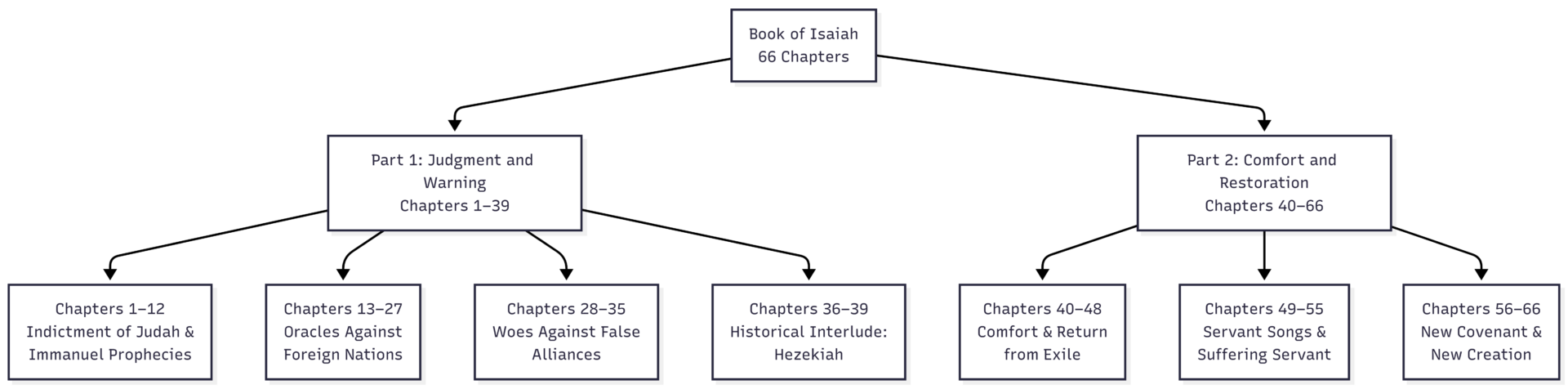
Part 1: Judgment and Warning (Chapters 1–39)
This section confronts Israel and Judah with their covenant failures — idolatry, injustice, and hypocritical worship — while pronouncing judgment on surrounding nations and holding out conditional promises of restoration.
Chapters 1–12: God’s Indictment and the Immanuel Prophecies
Chapter 1 — The Rebellion of Judah Isaiah opens with God’s case against Judah: they have rebelled, become corrupt, and worship him with rituals while practicing injustice. God announces punishment through war and desolation but extends an offer — repent, and the nation can be cleansed.
Chapter 2 — The Future Glory and Present Failure of Zion A vision of the mountain of the Lord where all nations one day stream to worship. Set against that future glory is the present reality: Judah trusts in idols, wealth, and military power. God will humble the proud and the arrogant in a coming day of judgment.
Chapter 3 — The Leadership Crisis God will strip Jerusalem of its capable leaders — judges, warriors, prophets, officials — and replace them with incompetent and oppressive figures. The people will suffer famine and siege. A contrast is drawn between the fate of the righteous and the wicked.
Chapter 4 — The Branch of the Lord A brief, luminous promise: a coming messianic Branch will arise in glory. God will cleanse Zion of its sins and bloodshed and restore the city to holiness and security, covering it with his own presence as in the days of the Exodus.
Chapter 5 — The Vineyard Song and Six Woes God compares Israel to a vineyard he planted and tended, which only produced bad fruit. Six woes follow, directed at specific sins: greed, drunkenness, moral perversion, pride, cynical wisdom, and corruption of justice. Foreign invaders will be God’s instrument of punishment.
Chapter 6 — Isaiah’s Commission The foundational vision of the entire book. Isaiah sees God enthroned in the temple, surrounded by seraphim crying “Holy, holy, holy.” He is undone by the vision, cleansed by a burning coal, and commissioned to preach. The disturbing commission: he will preach, and the people will not listen — hardening their own hearts — until judgment strips the land bare, leaving only a holy remnant.
Chapter 7 — The Sign of Immanuel Syria and Israel form an alliance against Judah, and King Ahaz panics. God tells Isaiah to reassure Ahaz: the alliance will fail. He offers Ahaz a sign, which Ahaz refuses. God gives the sign anyway: a young woman will bear a son named Immanuel (God with us). Before that child reaches maturity, both threatening kingdoms will be devastated — but Assyria will then threaten Judah itself.
Chapter 8 — Maher-Shalal-Hash-Baz Isaiah’s own son bears a prophetic name (“the spoil speeds, the prey hastens”) confirming that Damascus and Samaria will fall to Assyria before the child can speak. The people are warned not to consult mediums and necromancers, but to fear God alone. The chapter closes with a promise of light breaking into deep darkness.
Chapter 9 — The Birth of the Wonderful Counselor One of Isaiah’s most famous prophecies: a child will be born who will sit on David’s throne and govern with justice and righteousness forever. His titles — Wonderful Counselor, Mighty God, Everlasting Father, Prince of Peace — announce a ruler unlike any earthly king. The second half of the chapter pronounces escalating judgment on Israel for its persistent refusal to repent.
Chapter 10 — The Woe of Assyria Assyria is God’s instrument of judgment — but Assyria does not know it, and arrogantly credits the devastation to its own power. God will punish Assyria for its pride when his work is done. A remnant of Israel will return to the Lord. Jerusalem will be delivered from the Assyrian siege, and the Assyrian king will fall.
Chapter 11 — The Root of Jesse From the stump of David’s line, a new shoot will grow. This coming ruler will be filled with the Spirit of the Lord — wisdom, understanding, counsel, might, knowledge, and the fear of the Lord — and will judge with perfect righteousness. Under his reign, predator and prey will lie down together. The scattered people of Israel will be gathered from the nations and restored.
Chapter 12 — A Song of Thanksgiving A short hymn of praise looking forward to the day when God’s people will celebrate their salvation. They will draw water joyfully from the wells of salvation and proclaim God’s greatness among the nations.
Chapters 13–27: Oracles Against the Nations
Chapter 13 — The Fall of Babylon The first and most prominent oracle against a foreign nation. Babylon — the empire that will eventually exile Judah — is condemned. God marshals an army of nations to execute judgment. The day of the Lord imagery: cosmic upheaval, universal terror, the world punished for its wickedness.
Chapter 14 — The Taunt Against Babylon’s King A biting taunt song against the king of Babylon, who sought to ascend to the heights and is brought to Sheol instead. The passage contains the famous “Lucifer” imagery — the fallen morning star — used as a metaphor for the king’s catastrophic pride. Israel will be freed from captivity. Assyria and Philistia also receive judgment.
Chapters 15–16 — The Burden of Moab Moab is devastated. Chapter 15 depicts its cities wailing; chapter 16 appeals to Moab to seek Judah’s shelter for its refugees, then pronounces that its pride will fade and judgment will fall.
Chapter 17 — Damascus and Israel Judged Damascus and northern Israel — the two kingdoms that threatened Judah in chapter 7 — are condemned together to ruin and scattering. A remnant will return to God.
Chapter 18 — A Message to Cush A brief oracle to distant Cush: God is watching. Cush will one day bring offerings to Mount Zion.
Chapter 19 — The Judgment and Salvation of Egypt Egypt receives both judgment and remarkable promise. God will strike Egypt with internal strife, failed harvests, and confusion of leadership. But also: God will send Egypt a savior, heal the land, and make Egypt his people. A highway will one day connect Egypt, Assyria, and Israel — three former enemies — worshiping God together.
Chapter 20 — The Sign of the Naked Prophet Isaiah walks naked and barefoot for three years as a living prophetic sign. This is what will happen to Egypt and Cush when Assyria defeats them. Judah should not rely on these nations for military help.
Chapters 21–23 — Further Oracles Babylon receives another fall oracle (chapter 21). Jerusalem is rebuked and the “key of David” passes from corrupt Shebna to faithful Eliakim (chapter 22). Tyre, the great commercial city, will fall silent for 70 years then be restored, its profits eventually dedicated to God (chapter 23).
Chapters 24–27 — The Isaiah Apocalypse A sweeping vision of universal judgment and cosmic renewal. Chapter 24 depicts the earth emptied and shattered by God’s judgment on all humanity for its rebellion. Chapter 25 praises God for destroying the oppressor and making a feast for all nations, wiping away every tear. Chapter 26 is a song of trust — the righteous wait for God, confess their failures, and anticipate resurrection. Chapter 27 closes with God defeating the serpent and gathering his scattered people from every direction.
Chapters 28–35: Woes Against False Alliances
Chapters 28–31 — Woes on Israel and Judah Four woe oracles: against Ephraim’s drunken pride (28), Jerusalem’s blind ritualism (29), and Judah’s futile alliance with Egypt (30–31). Each warning is interleaved with a flash of future blessing — a cornerstone in Zion, God waiting to be gracious, Assyria ultimately destroyed.
Chapter 32 — The Righteous King A righteous king is coming who will rule with justice and protection. His kingdom will bring genuine moral clarity — the fool will no longer be called noble. Before that day, a season of calamity falls on the complacent. Then the Spirit is poured out, the land becomes fruitful, and righteousness reigns.
Chapter 33 — Prayer, Judgment, and Zion’s Glory The people cry to God in distress. God will rise up, consuming the nations. The sinners in Zion are terrified. But the righteous — those who walk blamelessly — will dwell securely in Zion and see the King in his beauty.
Chapters 34–35 — Desolation and the Highway of Holiness Chapter 34 pronounces total desolation on Edom and the nations that oppose God — a scene of blood, fire, and wild creatures inhabiting ruin. Chapter 35 is the radiant contrast: desert and wilderness burst into bloom, the weak are strengthened, the blind see, the deaf hear, the lame leap. A highway called the Way of Holiness cuts through the wilderness, and the ransomed of the Lord travel it to Zion with singing.
Chapters 36–39: Historical Interlude — Hezekiah
Chapter 36 — The Assyrian Threat Sennacherib’s commander stands before Jerusalem’s walls and delivers a terrifying psychological assault — mocking Hezekiah’s trust in God, comparing the Lord to the defeated gods of other nations, and urging surrender. The people say nothing.
Chapter 37 — Hezekiah’s Prayer and God’s Answer Hezekiah tears his robes, goes to the temple, and prays. Isaiah sends word: God has heard. That night, an angel of the Lord strikes down 185,000 Assyrian soldiers. Sennacherib retreats and is later killed by his own sons.
Chapter 38 — Hezekiah’s Illness Hezekiah is told he will die from his illness. He weeps and prays. God grants him fifteen more years and gives a sign: the shadow on the sundial moves backward. Hezekiah writes a poem of praise for his recovery.
Chapter 39 — Hezekiah’s Folly Envoys arrive from Babylon, and Hezekiah shows them everything — all his treasures, armories, and storehouses. Isaiah confronts him: everything he has shown will one day be carried to Babylon. Hezekiah’s misplaced pride becomes the hinge between the two halves of the book.
Part 2: Comfort and Restoration (Chapters 40–66)
The tone shifts completely. The judgment has been declared; now God speaks comfort. Babylon’s exile is coming — but so is liberation. A Servant will come. A New Creation awaits.
Chapters 40–48: Comfort and the Promise of Return
Chapter 40 — Comfort, My People “Comfort, comfort my people, says your God.” The exile is ending. God is coming like a shepherd to lead his people home. He is incomparable — nations are a drop in the bucket before him, the idols are nothing — and those who wait on him will renew their strength, soaring on wings like eagles.
Chapter 41 — God’s Challenge to the Nations God challenges the nations and their idols to prove they can predict or explain history. They cannot. He has called Abraham, his servant; he will strengthen and help Israel; he will bring justice through a figure he is raising up from the east (pointing toward Cyrus).
Chapter 42 — The First Servant Song God introduces his Servant: gentle but persistent, he will bring justice to the nations without breaking a bruised reed or extinguishing a faint flame. He will be a light to the Gentiles, opening blind eyes and freeing prisoners. Israel is then rebuked for being a blind and deaf servant — failing to see what God is doing.
Chapters 43–44 — Redemption and Idolatry’s Foolishness God declares his love for Israel: “Fear not, for I have redeemed you; I have called you by name, you are mine.” He will gather his people from every direction. He alone is God — before him no god was formed, and after him none will come. Chapter 44 exposes the absurdity of idolatry with devastating irony: a man cuts a tree, uses half for firewood to warm himself, and makes a god with the other half.
Chapter 45 — Cyrus, God’s Anointed God names Cyrus — a Persian king not yet born — as his anointed instrument to subdue nations, liberate the Jewish exiles, and fund the rebuilding of Jerusalem and the temple. The sovereignty behind this choice is absolute: “I am the Lord, and there is no other.”
Chapters 46–47 — The Fall of Babylon’s Gods Babylon’s gods, Bel and Nebo, are carried as burdens on carts — helpless idols. God, by contrast, carries his people. Chapter 47 taunts Babylon directly: the proud empire that enslaved God’s people will be stripped of its glory, its sorceries and astrology powerless to save it.
Chapter 48 — Stubborn Israel Urged to Listen God rebukes Israel’s stubbornness and hypocrisy. He has acted for his name’s sake, not theirs. He calls them to leave Babylon — but closes with a warning: there is no peace for the wicked.
Chapters 49–55: The Servant Songs and the Suffering Servant
Chapter 49 — The Second Servant Song The Servant speaks: called from birth, he was equipped by God to restore Israel and bring salvation to the ends of the earth. He expresses discouragement — his labor seems wasted — but trusts in God’s vindication. God reassures Zion: her children will return, her walls will be rebuilt, her oppressors will become her servants.
Chapter 50 — The Third Servant Song The Servant speaks again of obedience and suffering. He was not rebellious; he gave his back to those who struck him, his cheeks to those who pulled out his beard. He was not disgraced — God helped him. Those who fear God in darkness are urged to trust in him.
Chapter 51–52 — Awake, Awake A series of “awake” calls — to the remnant trusting in God, to Jerusalem in ruins, and finally to God himself to act as he acted in the Exodus. God’s arm will redeem his people. Jerusalem will be freed. The herald announces: “Your God reigns!” The scattered people will be gathered, and the nations will see God’s salvation.
Chapter 53 — The Suffering Servant The climax of the Servant Songs. The Servant is despised and rejected, a man of suffering, familiar with grief. He was pierced for our transgressions, crushed for our iniquities. By his wounds we are healed. He was led like a lamb to the slaughter, silent before his accusers. God laid on him the iniquity of us all. He was cut off from the land of the living — but God will prolong his days. He will justify many, bearing their iniquities.
Chapter 54 — Zion Restored God speaks to Zion as to a barren woman who will now have more children than she can count. God’s steadfast love will not depart from her. Her children will be taught by God and established in righteousness. No weapon formed against her will prosper.
Chapter 55 — Come, Everyone Who Thirsts A great invitation: come to the waters, buy wine and milk without money and without price. Seek the Lord while he may be found. God’s ways are not our ways; his word will not return empty but will accomplish everything he intends. The people will go out in joy and be led in peace.
Chapters 56–66: The New Covenant and New Creation
Chapter 56 — The Outcasts Welcomed Foreigners and eunuchs — categories excluded from earlier covenant arrangements — are welcomed into God’s house if they keep his covenant. God’s house will be a house of prayer for all nations. The corrupt leaders of Israel are rebuked as blind watchmen, sleeping shepherds caring only for themselves.
Chapter 57 — The Righteous and the Wicked The righteous die without anyone noticing their significance; they enter into peace. The wicked pursue idols and adulterous worship on every hill and under every tree. God will expose and judge them — but he also dwells with the contrite and humble in spirit, reviving and healing them.
Chapter 58 — True and False Fasting The people fast and wonder why God doesn’t notice. He tells them: their fasting coexists with oppression, exploitation, and quarreling. True fasting is to loose the bonds of wickedness, share bread with the hungry, and house the homeless. Those who fast in this way will be healed, their light will break forth, and God will guide them continually.
Chapter 59 — The Sins That Separate Israel’s sins have created a wall between them and God — hands stained with blood, lips speaking lies, feet swift to run to evil. Justice is absent; the one who departs from evil is preyed upon. God sees and is displeased. He comes himself as a warrior, putting on righteousness as a breastplate, and acts to bring salvation where no human arm was sufficient.
Chapter 60 — The Glory of Zion Arise, shine — your light has come. While darkness covers the nations, God’s glory rises over Zion, and the nations stream to her light. Wealth flows in. The gates of Zion stand open day and night. God himself will be Zion’s everlasting light.
Chapter 61 — The Year of the Lord’s Favor The anointed one speaks: he has been sent to bring good news to the poor, bind up the brokenhearted, proclaim liberty to captives, and announce the year of the Lord’s favor. The desolate places will be rebuilt. God’s people will be called priests of the Lord. Righteousness will spring up before all nations.
Chapter 62 — Praying for Zion Isaiah pledges not to be silent until God makes Jerusalem a praise in all the earth. God gives Zion a new name: Hephzibah (“My delight is in her”). The people are called to prepare the way; the redeemed of the Lord are coming home.
Chapter 63–64 — God’s Mercy and Isaiah’s Prayer Chapter 63 recalls God’s faithfulness in the Exodus, then laments how Israel grieved his Spirit and suffered his discipline. Chapter 64 is a prayer of raw desperation: tear open the heavens and come down. We have all become like one who is unclean; our iniquities carry us away like the wind. Yet you are our Father. Act for your name’s sake.
Chapter 65 — God’s Answer: New Heavens and New Earth God responds. He has been holding out his hands to a rebellious people all day. He will distinguish between the faithful and the apostate. He will create new heavens and a new earth — the former things will not be remembered. In that place, the sound of weeping will be heard no more. People will build houses and live in them, plant vineyards and eat their fruit. The wolf and the lamb will feed together. The curse will be gone.
Chapter 66 — The Final Judgment and Eternal Worship The book concludes with God declaring that heaven is his throne and earth his footstool — no human temple can contain him. He looks instead to the humble and contrite. He will gather the nations and peoples to see his glory. From one new moon to another, from one Sabbath to another, all flesh will come to worship before him.
Thematic Summary Table
| Chapters | Theme | Key Passage |
|---|---|---|
| 1–5 | Israel’s indictment | “Come now, let us reason together” (1:18) |
| 6 | Isaiah’s commission | “Here am I, send me” (6:8) |
| 7–12 | Immanuel prophecies | “Unto us a child is born” (9:6) |
| 13–23 | Oracles against nations | Fall of Babylon foretold (13) |
| 24–27 | Apocalyptic vision | Death swallowed up forever (25:8) |
| 28–35 | Woes and contrasts | Way of Holiness (35:8) |
| 36–39 | Hezekiah historical section | Assyrian army destroyed (37:36) |
| 40–48 | Comfort and return | “They shall mount up with wings” (40:31) |
| 49–55 | Servant Songs | “By his wounds we are healed” (53:5) |
| 56–66 | New Covenant and New Creation | New heavens and new earth (65:17) |
Isaiah is unique among prophetic books in its scope — moving from the failure of one nation in one historical crisis all the way to the renewal of all creation. Every major theme of biblical theology finds expression somewhere in its 66 chapters: judgment, covenant, Messiah, the nations, the defeat of death, and the restoration of the world.
Please share this Isaiah Chapter Summaries (1-66) with your friends and do a comment below about your feedback.
We will meet you on next article.
Until you can read, The Best Bible for Beginners: 5 Easy to Read Versions