Can Architects Work from Home?
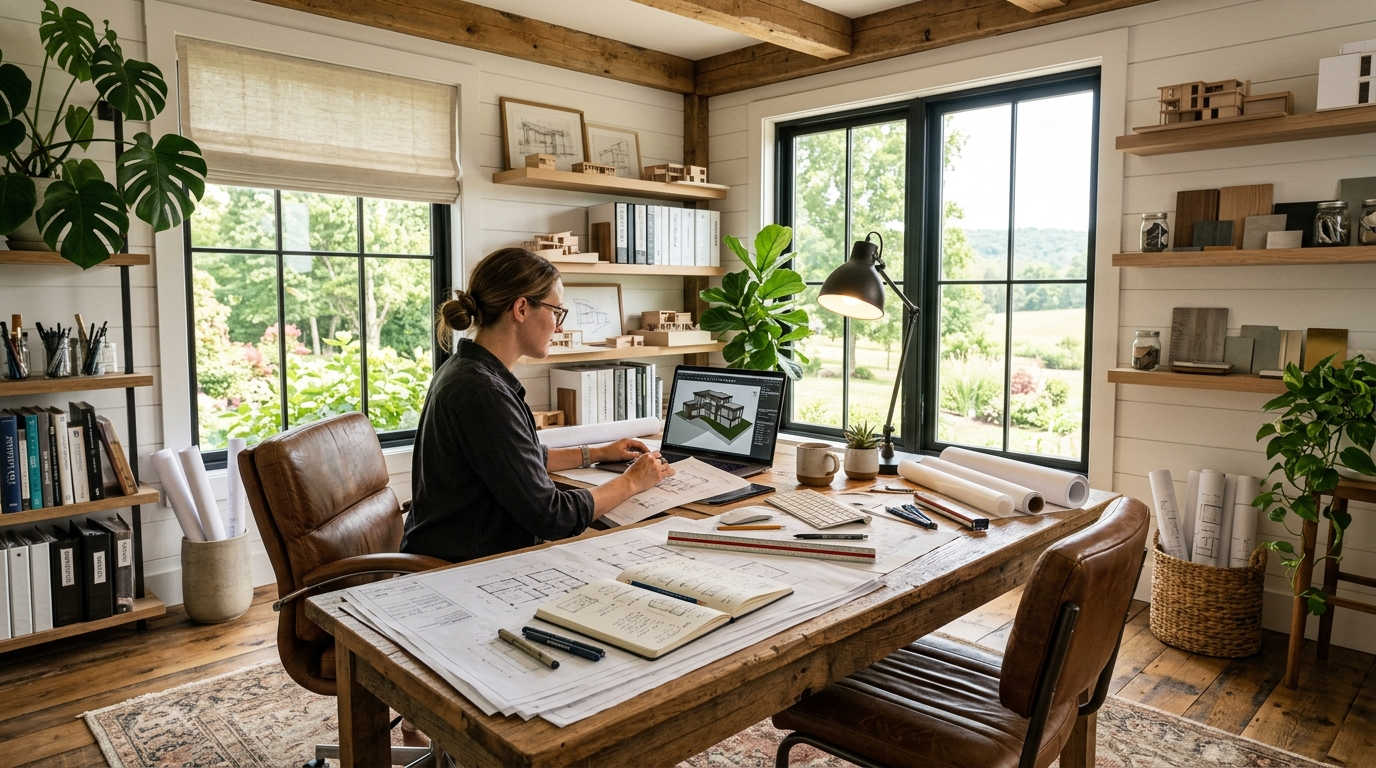
Yes — architects can work from home, and a growing share of the profession already does. Cloud-based Building Information Modeling (BIM), high-performance CAD software, virtual reality tools, and digital project management platforms have made remote and hybrid architecture roles a mainstream reality rather than an exception.
While site visits and client presentations occasionally require physical presence, the vast majority of architectural work — design, modeling, documentation, rendering, coordination — can be executed entirely from a home office.
How Remote Work Changed Architecture
Architecture was long considered an office-bound profession, built around shared drafting tables, in-person design charrettes, and daily site access. That perception shifted sharply after 2020. According to a survey by the American Institute of Architects (AIA), remote working among architects increased by nearly 70% in subsequent years. Firms that resisted flexible work before were forced to prove remote workflows could sustain project quality — and most found that they could.
Several firms had already operated remotely for years before this shift. J Kretschmer Architect hired its first remote worker in 2005. Margulies Perruzzi Architects incorporated remote work long before it became common.
Saam Architecture built its entire operation around what it calls “radical flexibility,” operating a distributed team and reaching an annual revenue of $5.7 million without a traditional office model. These examples confirmed what the broader industry would later discover: the architecture profession adapts well to remote work when the right tools and culture are in place.
Which Architecture Tasks Can Be Done Remotely?
Not every architectural task translates equally well to a home setting, but the majority do. The table below maps common tasks to their remote feasibility.
| Task | Remote Feasibility | Notes |
|---|---|---|
| Conceptual design & sketching | High | Digital whiteboards and SketchUp replace physical drafting |
| CAD drafting (2D/3D) | High | AutoCAD, Revit, ArchiCAD work via cloud license |
| BIM modeling & coordination | High | Platforms like BIM 360 enable real-time team sync |
| Rendering & visualization | High | V-Ray, Lumion, Twinmotion run on high-spec home workstations |
| Project documentation | High | Cloud storage and PDF annotation tools handle review cycles |
| Client meetings & presentations | High | Zoom, Teams, and Matterport virtual tours replace in-person sessions |
| Construction document production | High | Fully software-driven; no physical materials required |
| Research & code compliance | High | ICC Digital Codes and UpCodes accessible online |
| Site inspections | Low | Physical presence typically required |
| Material sampling & mockups | Low | In-person handling is usually necessary |
| Final deliverable sign-off | Medium | Possible remotely with digital tools; some firms prefer in-office |
The practical approach used by firms like Saam Architecture is to bring staff in-office only for finalizing physical deliverables — models, large-format drawing sets, and client presentation packages — while keeping all production work remote.
Architecture Roles Best Suited to Remote Work
Some specializations within architecture are more naturally suited to remote environments than others:
BIM Modelers and Coordinators — Building and managing 3D information models, resolving system clashes, and coordinating across disciplines. This work is almost entirely software-based and transfers cleanly to remote environments.
Visualization Artists and Renderers — Dedicated 3D rendering, animation, and virtual reality walkthroughs. These roles require no client-facing presence and are widely performed remotely or as freelance.
Drafters and Production Architects — Producing construction drawings, specifications, and documentation packages. Production-focused roles are well-suited to remote because the work is output-driven and measurable.
Project Managers (Architecture) — Managing schedules, budgets, RFI logs, and stakeholder communication. Project management software makes this feasible from anywhere with reliable internet.
Freelance Architects — Independent practitioners can serve clients across regions and time zones with no physical office requirement.
Energy Efficiency and Sustainability Architects — Energy modeling using tools like eQUEST and EnergyPlus is fully software-based and remote-compatible.
Roles involving regular site inspections, hands-on client collaboration, or mentorship of junior staff tend to retain more in-person requirements.
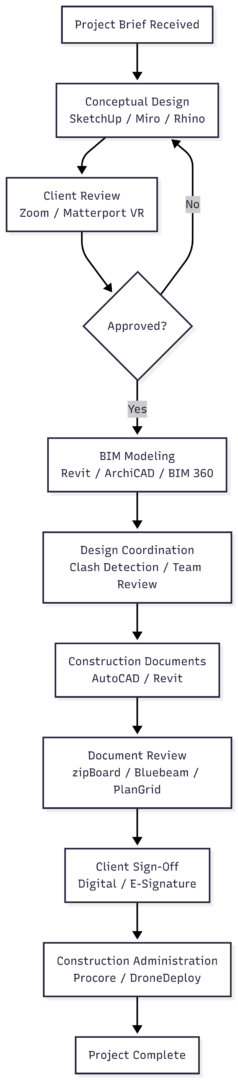
Remote Work Workflow for Architects
What You Need to Work from Home as an Architect
A home setup capable of running professional architecture software requires deliberate investment. Here are the core requirements:
Hardware
| Component | Minimum Spec | Recommended Spec |
|---|---|---|
| Processor (CPU) | Intel Core i7 / AMD Ryzen 7 | Intel Core i9 / AMD Ryzen 9 |
| RAM | 32 GB | 64 GB |
| GPU | NVIDIA RTX 3060 | NVIDIA RTX 4080 / A-series Quadro |
| Storage | 512 GB SSD | 1 TB NVMe SSD + 2 TB HDD |
| Display | Single 27″ 1440p | Dual 27″ 4K monitors |
| Internet | 100 Mbps | 500 Mbps+ (fiber preferred) |
A dedicated GPU is non-negotiable for real-time rendering, and dual monitors significantly improve multi-document workflows. Stable, high-bandwidth internet is essential for handling large Revit or ArchiCAD files on cloud platforms.
Software Stack
- Design and Modeling: AutoCAD, Revit, ArchiCAD, SketchUp, Rhino
- Rendering: V-Ray, Lumion, Twinmotion, Enscape, Corona
- BIM Collaboration: Autodesk BIM 360, Trimble Connect
- Project Management: Procore, Monday.com, Asana, Microsoft Project
- Document Review: zipBoard, Bluebeam Revu, PlanGrid
- Communication: Zoom, Microsoft Teams, Slack
- File Storage and Security: Dropbox Business, Google Drive, BIM 360 Docs
- Remote Desktop (if firm requires VPN access): TeamViewer, AnyDesk, Parsec
- Virtual Site Visits: Matterport, DroneDeploy, IrisVR, Enscape
7 Benefits of Remote Work for Architects
1. Access to Global Opportunities Remote work removes geography as a barrier. Architects can take on projects across regions and countries, connect with international firms, and tap into markets that would be inaccessible from a single office location. This is especially significant for architects in emerging markets seeking access to higher-value work.
2. Faster Project Turnarounds Eliminating commutes and reducing in-person meeting overhead leads to measurable productivity gains. Research from McKinsey suggests remote professionals average 20–25% higher productivity than their on-site counterparts when workflows are well structured.
3. Improved Work-Life Balance Flexible scheduling allows architects to work during their most productive hours, manage personal commitments without burning vacation time, and reduce chronic stress associated with long commutes and rigid office hours.
4. Reduced Overhead for Firms Architecture firms operating hybrid or fully remote models save significantly on office real estate, utility costs, and physical infrastructure. These savings can be redirected toward talent acquisition, software investment, or client development.
5. Wider Talent Pool Remote-friendly firms can hire the best candidates regardless of location. This expands access to specialized skills — a BIM coordinator in one city, a visualization expert in another — without relocation requirements.
6. Lower Commuting Costs Architects working from home save on daily transportation. Over a year, this compounds into meaningful financial savings and also aligns with sustainability goals increasingly important to the profession.
7. Scheduling Flexibility Freelancers and employees alike can structure their days around peak productivity windows, client time zones, and personal priorities — without the friction of fixed office hours.
5 Considerations for Remote Collaboration in Architecture
1. Hardware and Software Setup Setting up a capable workstation is the foundation. Beyond the specs above, firms need to manage software licensing for remote users, ensure VPN access where required, and provide remote IT support. Cloud-based licensing (Autodesk, for example, has moved to subscription models) simplifies much of this.
2. Data Security Architecture projects contain sensitive client data, proprietary designs, and confidential development plans. Remote environments introduce risks around data transmission and unauthorized access. Tools like NordLayer for corporate VPN, VeraCrypt for file encryption, and multi-factor authentication (Google Authenticator, Authy) provide layered protection.
3. Technical Limitations Large BIM files can strain slower connections. Cloud optimization, compressed file formats, and streaming services like Parsec or Paperspace allow architects to access high-performance workstations remotely when local hardware is insufficient.
4. Site Visit Limitations Physical site inspection remains difficult to replicate. Drone services like DroneDeploy and 360° scanning tools like Matterport partially bridge this gap, providing detailed aerial and ground-level data captures that remote architects can analyze without being present.
5. Communication and Collaboration Quality Remote teams can lose the informal knowledge transfer that happens naturally in shared office environments — overhearing a design discussion, sketching at a table together, reading body language in client meetings. Intentional communication protocols, regular video check-ins, and asynchronous review tools (zipBoard, Bluebeam) compensate for these gaps, but they require deliberate effort from team leaders.
What Practitioners Say
Real architects working remotely consistently highlight a few recurring patterns:
- Experience level matters. Early-career architects benefit significantly from in-office time — the informal learning that happens by proximity to senior colleagues is difficult to replicate remotely. Most remote-friendly firms require new hires to work in-office for 30 to 90 days before transitioning to hybrid or full remote.
- Production roles go remote more easily than design leadership roles. Retail remodel production, documentation, and rendering are cited as the tasks most commonly performed remotely without quality loss.
- Hybrid is the dominant model. A 3-in / 2-out or 2-in / 3-out schedule appears frequently in practitioner accounts — enough in-office time for meaningful collaboration, enough home time for focused production work.
- Firm culture determines feasibility more than technology. Remote work functions well when leadership is genuinely committed to it, technology infrastructure is properly resourced, and trust has been established between team members.
Harvard Study: Remote Task Feasibility Across Project Phases
A 2022 study by students from the Harvard Graduate School of Design surveyed architects on which tasks could be performed remotely across project phases. Results showed broad support:
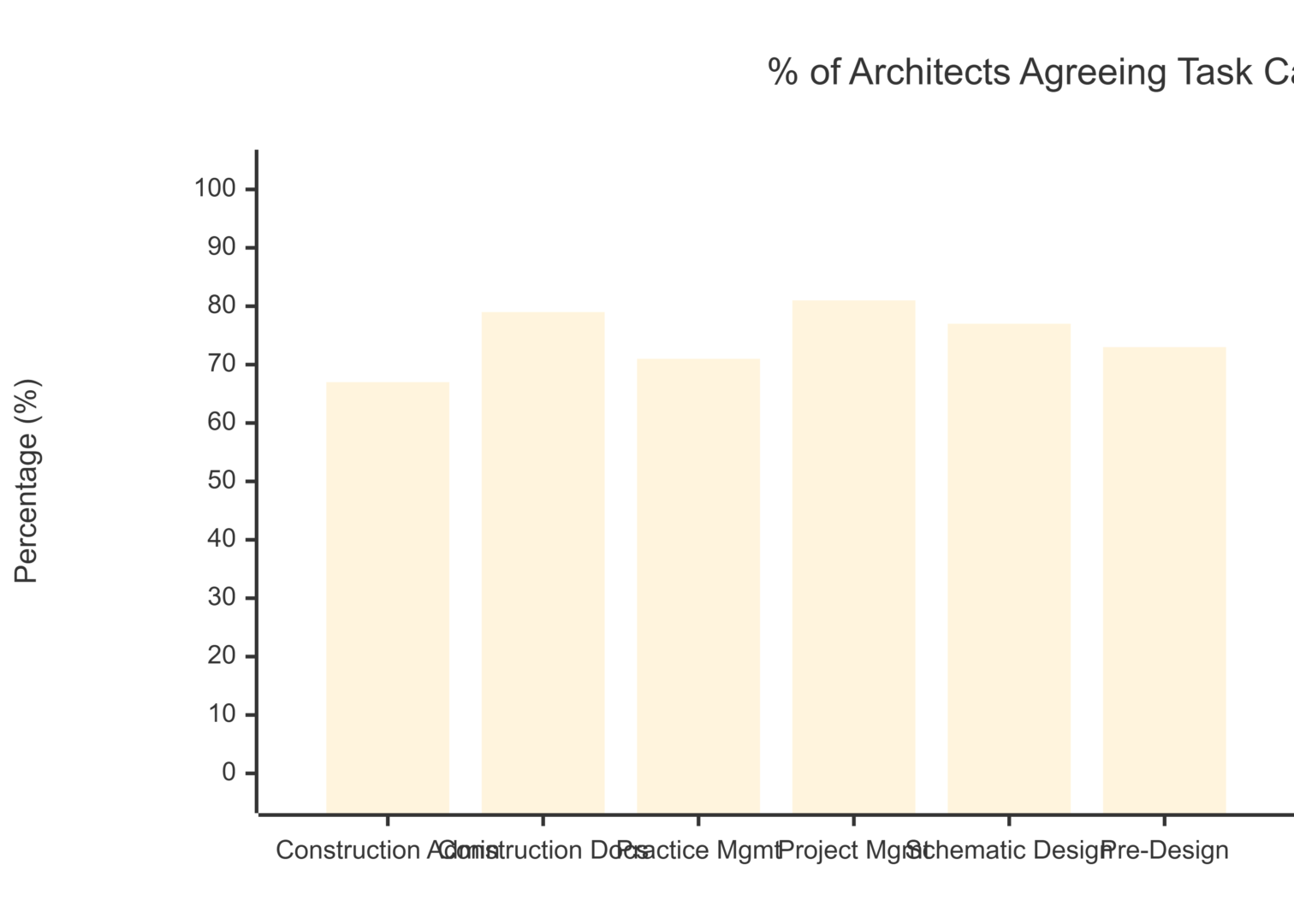
Project management and construction documentation saw the highest agreement for remote feasibility, while construction administration — which involves site coordination — had the lowest, though still a strong majority.
How to Find Remote Architecture Work
Build a strong digital portfolio. Platforms like Behance, Archinect, or a personal portfolio site built with Wix or Squarespace are the primary vehicles for attracting remote employers and freelance clients. Include renders, CAD drawings, project narratives, and process documentation.
Target remote-friendly firms. Networks like Archinect, LinkedIn architecture groups, and direct outreach to firms known for distributed teams are productive channels. Firms in technology-forward sectors — retail, healthcare interiors, corporate fit-out — tend to have more established remote workflows.
Develop remote collaboration proficiency. Being fluent in BIM 360, Revit cloud worksharing, Procore, and virtual presentation tools is now a differentiator. Certifications in these platforms strengthen a remote-focused application.
Use dedicated remote job boards. Remote.co, We Work Remotely, FlexJobs, and the Indeed Remote Architecture filter surface roles specifically structured for distributed work. Upwork and Toptal are viable for freelance engagements.
FAQs
Yes, particularly in production-focused, BIM, visualization, or freelance roles. Fully remote positions in design leadership or construction administration are less common but exist, especially in larger distributed firms.
Industry estimates suggest 35–40% of architects now work at least part-time remotely, with fully remote arrangements more common in visualization, documentation, and freelance specializations.
Architects specializing in healthcare facility design, large-scale commercial development, sustainable design, and project management tend to command the highest salaries due to project complexity and liability scope.
Licensing requirements depend on the scope of work and jurisdiction. BIM modelers, drafters, and visualizers can work without licensure. Architects signing and sealing construction documents must hold a license in the relevant jurisdiction.
With caveats. Experienced practitioners transition to remote work more easily. Junior architects are strongly advised to spend their early years in-office to absorb mentorship, project workflow, and professional judgment that formal education does not teach.
The architecture profession has crossed a threshold. Remote and hybrid work is no longer a pandemic accommodation — it is a structural feature of how modern firms operate.
For architects equipped with the right tools, skills, and discipline, working from home offers expanded opportunity, greater flexibility, and a more sustainable professional life. The infrastructure is there; the question is whether you are ready to use it effectively.
Please share this Can Architects Work from Home? with your friends and do a comment below about your feedback.
We will meet you on next article.
Until you can read, Numbers Bible Trivia Quiz With Questions & Answers