Can I Work from Home as an Accountant? (The Modern Reality)
Yes — and it is increasingly the norm rather than the exception. Accounting is one of the most remote-compatible professions because the work is almost entirely digital. Financial records, tax documents, payroll systems, audit trails, and client communications have all moved to cloud-based platforms, which means the physical office is no longer a requirement for the vast majority of accounting functions.
This guide covers which accounting roles work best remotely, what they pay, the tools and credentials you need, and how to find and succeed in a remote accounting position.
Why Accounting Is Well-Suited for Remote Work
Several structural factors make accounting a strong fit for remote and hybrid arrangements:
It is a digital profession. Cloud accounting software, secure file sharing platforms, and virtual communication tools now handle everything that once required physical presence — filing, reconciliation, reporting, audit review, and client meetings.
Demand is high. Accounting firms face a significant talent shortage as experienced professionals retire and the qualified pipeline struggles to keep pace. Firms actively compete for candidates with remote-friendly offers to expand their geographic reach and attract talent.
Work is independent by nature. Much of accounting — tax preparation, bookkeeping, financial analysis, payroll processing — involves focused individual work on software systems rather than constant in-person collaboration.
AI augments rather than replaces. Automation handles routine data entry and reconciliation, but qualified accountants are still required for accuracy verification, judgment calls, regulatory compliance, and client-facing advisory work. This keeps the profession stable regardless of technology shifts.
Remote Accounting Roles and Salaries
Almost every accounting specialty can be performed remotely. The table below covers the most common remote-eligible roles with approximate annual salaries.
| Role | Avg. Annual Salary | Remote Suitability | Notes |
|---|---|---|---|
| Bookkeeper | $50,000–$58,000 | Very High | Cloud-based tools make this near-fully remote |
| Tax Preparer | $52,000–$62,000 | Very High | Documents exchanged and filed electronically |
| Accounting Clerk | $48,000–$54,000 | High | Data entry and reconciliation done via software |
| Payroll Accountant | $58,000–$68,000 | High | Managed through digital payroll systems |
| Accountant (General) | $57,000–$68,000 | High | Financial tracking, reports, tax documents |
| Accounting Specialist | $50,000–$60,000 | High | Processing and reporting via cloud platforms |
| Property Accountant | $65,000–$78,000 | Moderate–High | Tenant records, payments, owner reports |
| Financial Analyst | $70,000–$85,000 | High | Data-driven role, mostly software-based |
| Accounting Manager | $82,000–$95,000 | Moderate–High | Team oversight can be done via digital tools |
| Auditor | $85,000–$100,000 | Moderate | Cloud audit platforms now support remote review |
| CPA | $85,000–$105,000+ | High | Wide range of remote-eligible functions |
| Virtual CFO / Consultant | $100,000–$180,000+ | Very High | Senior advisory role, often fully remote |
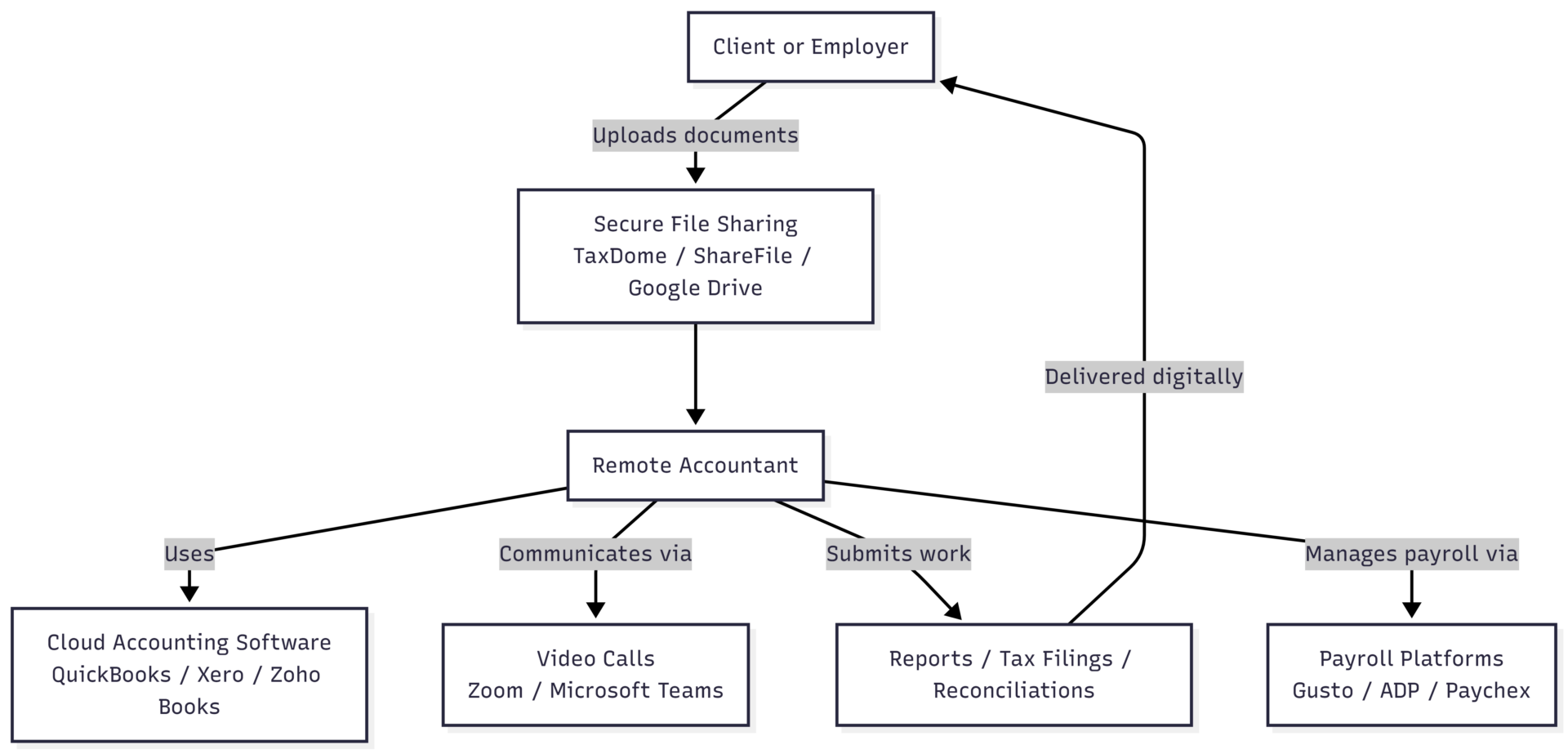
Remote Accounting Workflow
Essential Tools for Remote Accountants
Having the right software stack is non-negotiable for remote accounting work. The table below covers the primary categories and leading tools in each.
| Category | Tools | Approx. Cost |
|---|---|---|
| Cloud Accounting | QuickBooks Online, Xero, Zoho Books, FreshBooks | $15–$90/month |
| Tax Software | Intuit ProConnect, Drake Tax, TaxSlayer Pro | $300–$1,500+/year |
| Secure File Sharing | TaxDome, ShareFile, Citrix, Google Drive | $20–$65/month |
| Payroll Processing | Gusto, ADP, Paychex, Rippling | $40–$150/month |
| Communication | Zoom, Microsoft Teams, Slack | Free–$20/user/month |
| Document Management | DocuSign, Adobe Sign, Dropbox | $10–$25/month |
| Time Tracking | Toggl, Harvest, Clockify | Free–$12/month |
| Password / Security | LastPass, 1Password, VPN | $3–$10/month |
Most remote accounting roles require proficiency in at least one cloud accounting platform (QuickBooks Online and Xero are the most widely used), a communication tool, and a secure file exchange system. Specific tools depend on the employer or client base.
Credentials That Open Remote Accounting Roles
Certifications significantly improve access to remote roles, particularly senior and fully remote positions where employers rely on credentials to assess competence without in-person verification.
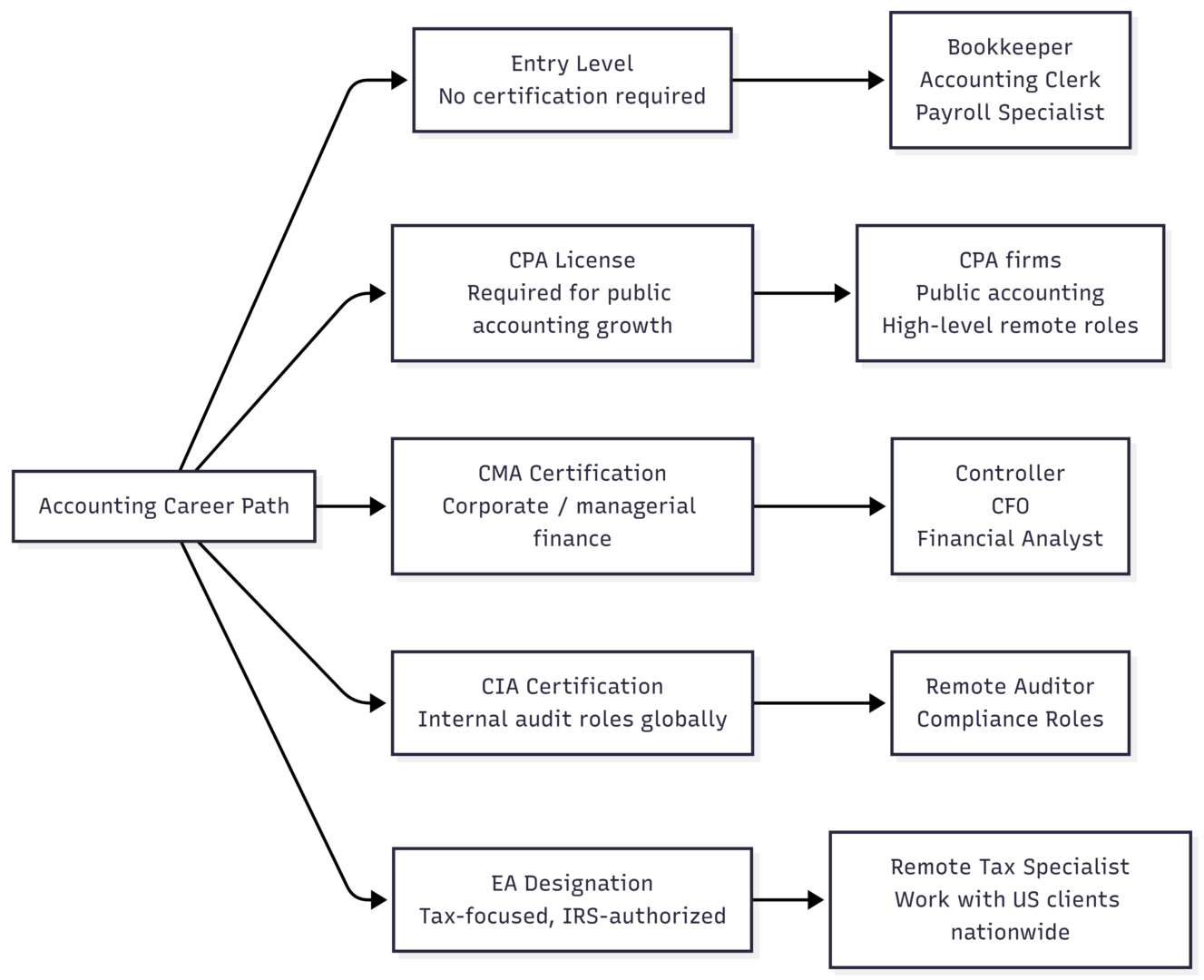
CPA (Certified Public Accountant): The most recognised credential in the profession. Required for many senior roles in public accounting, and a strong differentiator for any remote position. Opens access to the widest range of remote opportunities.
CMA (Certified Management Accountant): The gold standard for corporate and managerial finance roles. Relevant for remote Controller, CFO, and financial analyst positions.
CIA (Certified Internal Auditor): Global credential for audit professionals. Positions you for remote auditing roles with multinational companies and firms using cloud-based audit platforms.
EA (Enrolled Agent): IRS-authorised credential for tax professionals. As an EA you can work with clients anywhere in the US, making this one of the most location-independent designations in the field.
Skills Required for Remote Accounting Success
Technical accounting knowledge is the baseline. Remote work adds a layer of professional skills that become more critical without in-person oversight.
| Skill | Why It Matters Remotely |
|---|---|
| Cloud software proficiency | The primary work environment — no physical systems to fall back on |
| Written communication | Email, reports, and async updates replace hallway conversations |
| Time management | No office structure means self-imposed deadlines and scheduling |
| Self-discipline | Output-based accountability with minimal supervision |
| Data security awareness | Handling sensitive financial data outside a secured office environment |
| Attention to detail | Errors that would be caught in-office need to be caught independently |
| Video communication | Client and team meetings happen exclusively via video or call |
Pros and Cons of Remote Accounting
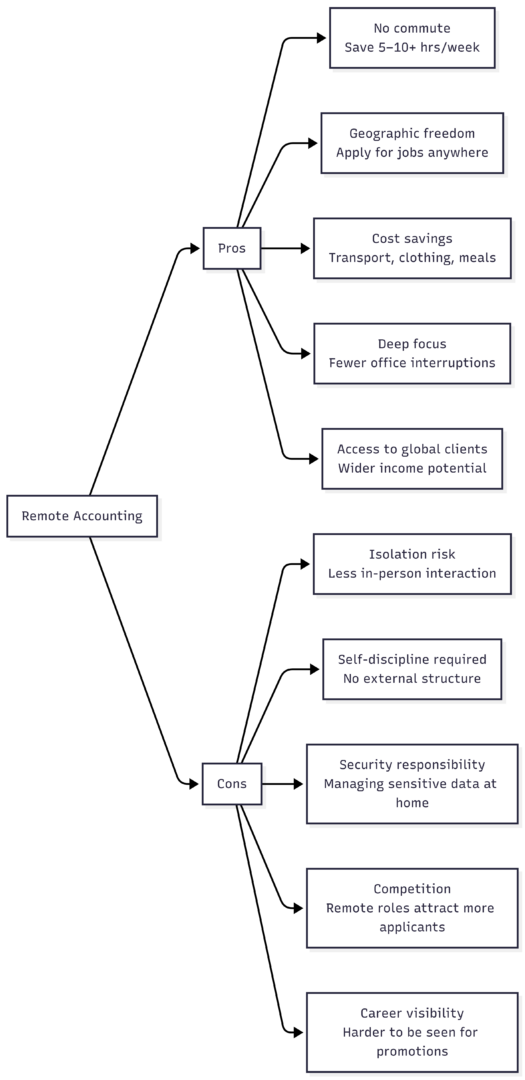
Pros in practice: Eliminating a daily commute saves significant time and money. Many accountants report higher focus quality when working from home — deep tasks like financial analysis, tax preparation, and report writing benefit from uninterrupted time. Location independence also allows access to employers and clients in higher-paying markets regardless of where you live.
Cons to plan for: Remote accounting roles attract more applicants than equivalent in-office roles, making competition tighter. Data security is a genuine responsibility — financial data is sensitive, and remote workers must maintain secure systems, use VPNs where required, and follow client and regulatory data handling protocols. Career visibility requires more intentional communication and relationship-building with managers and colleagues.
How to Find Remote Accounting Jobs
General job boards:
- LinkedIn — filter “Remote” under location; accounting firms post regularly
- Indeed — search “remote accountant” or role-specific terms
- FlexJobs — curated remote listings, accounting category is substantial
Niche accounting job boards:
- Accountingfly — dedicated remote accounting job board
- Going Concern — industry-specific news and job listings
- CPA.com career resources
Freelance and contract platforms:
- Upwork — strong demand for bookkeepers, tax preparers, and financial analysts
- Fiverr — better for defined, packaged services (tax return prep, bookkeeping packages)
- Toptal — high-end freelance finance and accounting talent
Direct firm applications: Companies like Intuit (TurboTax), 1-800Accountant, and remote-first accounting firms regularly hire for fully remote roles. Their career pages are worth checking directly.
Setting Up for Remote Accounting Work
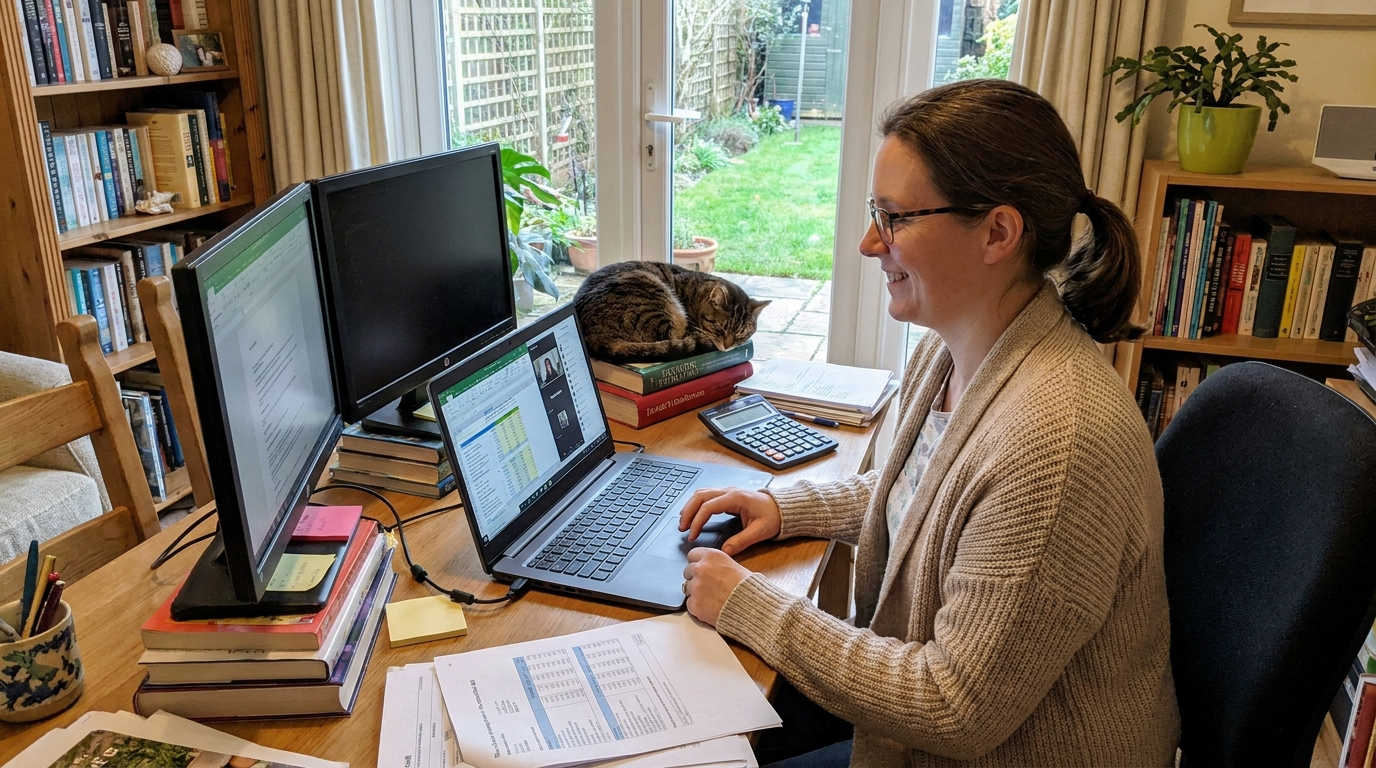
Workspace: A private, dedicated space matters in accounting. Client conversations about financial data, sensitive tax situations, or payroll details require a room with a door — not a shared living area. Your setup should include a reliable computer, a second monitor (helpful for working across multiple software windows), and a quality headset for calls.
Technology checklist:
- High-speed internet — minimum 100 Mbps download / 20 Mbps upload for reliable video calls and cloud software
- VPN — required by many firms for secure access to company systems
- Cloud accounting software — set up and tested before your start date
- Secure password manager — essential given the volume of client system logins
- Encrypted file storage — for any sensitive documents stored locally
Schedule and accountability: Remote accounting requires self-imposed structure. Block time for focused work, client communication, and administrative tasks. Use calendar tools to manage deadlines across multiple clients or projects. For firms with distributed teams, regular check-ins and clear deliverable timelines replace the visibility that comes naturally in an office setting.
Remote Accounting: Realistic Expectations
Roughly 20–30% of accounting positions are currently fully remote, with many more offering hybrid arrangements. Entry-level roles are more likely to start hybrid or in-office before transitioning to remote eligibility. Senior roles — financial analysts, accounting managers, CPAs, and virtual CFOs — have greater access to fully remote arrangements because their output is measurable and their expertise verifiable through credentials.
Remote accounting is not universally available across all specialties or geographies. Some audit functions still require in-person fieldwork. Some firms require in-office presence during peak tax seasons. And some roles are classified as remote but include periodic travel to client sites or firm offices.
That said, the direction is clear: accounting is one of the few professions where remote work is structurally compatible with the full scope of professional responsibilities, and the proportion of remote-eligible roles continues to grow.
FAQs
No. Many remote roles — bookkeeping, payroll, accounts payable/receivable, accounting clerk — do not require CPA licensure. However, a CPA significantly expands access to higher-paying and more senior remote positions.
Yes, though many firms prefer hybrid arrangements for newer employees to facilitate onboarding and training. Fully remote entry-level roles exist but are more competitive.
Data security and self-discipline are the two most commonly cited challenges. Handling sensitive client financial data outside a secured office environment requires intentional security practices, and managing output without in-person accountability requires strong time management.
Yes. Platforms like Upwork have strong demand for bookkeepers and tax preparers. Freelance accounting allows full location independence but requires business development skills — finding clients, managing contracts, and handling your own billing.
Conclusion
Remote accounting is not a future possibility — it is a present reality across nearly every accounting specialty. The profession’s digital foundation, demand for qualified talent, and the widespread adoption of cloud-based tools have made working from home a standard option for accountants at every experience level.
To position yourself competitively: build proficiency in the core cloud accounting platforms, pursue relevant certifications for your specialty, demonstrate strong written communication and self-management skills, and target job boards that specifically list remote accounting roles. With the right credentials and setup, remote accounting offers genuine career flexibility and access to a significantly wider range of opportunities than geography-constrained office roles.
Please share this Can I Work from Home as an Accountant? (The Modern Reality) with your friends and do a comment below about your feedback.
We will meet you on next article.
Until you can read, What Internet Speed Do I Need to Work From Home?