
Cayman Islands Digital Nomad Visa: How to Apply
Discover the Cayman Islands Digital Nomad Visa (Global Citizen Concierge Program), its requirements, application process, and why this Caribbean paradise is ideal for remote workers.
The Cayman Islands, a British Overseas Territory in the Caribbean, once offered an enticing opportunity for remote workers through its Global Citizen Concierge Program (GCCP), commonly referred to as the Cayman Islands Digital Nomad Visa. This program allowed high-earning remote professionals and their families to live and work in a tropical paradise for up to two years. With its pristine beaches, robust infrastructure, and tax-neutral environment, the Cayman Islands was a standout destination for digital nomads seeking a blend of professional productivity and an idyllic lifestyle. Although the program has been discontinued, this guide explores its details, requirements, application process, and the unique advantages it offered, providing insight into why it was a top choice for remote workers.
What Was the Cayman Islands Digital Nomad Visa?
The Cayman Islands Digital Nomad Visa, officially known as the Global Citizen Concierge Program, was launched to attract financially independent remote workers, entrepreneurs, and their families to live in the Cayman Islands for up to two years. Unlike traditional tourist visas, which restrict work, this visa allowed remote professionals to legally work for employers or clients outside the Cayman Islands while enjoying the islands’ high quality of life, reliable internet, and tax-free environment.
Located south of Cuba and west of Jamaica, the Cayman Islands consist of three islands: Grand Cayman, Little Cayman, and Cayman Brac. Known for their economic stability, offshore financial services, and vibrant “CaymanKind” culture, the islands offered an appealing setting for digital nomads. The GCCP stood out for its extended duration—up to two years with multiple entries—and its inclusivity, allowing extended family members such as parents, grandparents, siblings, and children to join the primary applicant.
Why Choose the Cayman Islands for Remote Work?
The Cayman Islands was not a typical backpacker destination but rather a premium location for remote workers seeking a stable, high-end lifestyle. Here’s why it was a top choice:
- Tropical Paradise: With world-renowned Seven Mile Beach, crystal-clear waters, and a tropical marine climate featuring warm, rainy summers (May to October) and cooler, dry winters (November to April), the islands offered a vacation-like atmosphere year-round.
- Robust Infrastructure: The Cayman Islands boasted reliable broadband internet with speeds ranging from 512 Kbps to 300 Mbps, provided by companies like Logic, Flow, C3, and Digicel. For example, C3 offered a 100 Mbps fiber connection for $89.99 and a 1,000 Mbps option for high-speed needs.
- Tax-Neutral Environment: The islands imposed no income, corporate, capital gains, payroll, or withholding taxes, making it a financial haven for remote workers and entrepreneurs.
- Safety and Stability: The Cayman Islands maintained low crime rates and successfully managed the COVID-19 pandemic, offering a secure environment with minimal health risks.
- High Quality of Life: From international-standard schools to top-tier medical facilities and a welcoming community, the islands provided a comfortable and family-friendly lifestyle.
- Cultural and Culinary Appeal: The “CaymanKind” hospitality, combined with a vibrant food scene featuring dishes like conch stew, coconut shrimp, and green turtle stew, made the islands a cultural delight.
Cost of Living Comparison
The cost of living in the Cayman Islands was higher than in many countries, including the United States. Below is a comparison of key expenses:
| Item | United States | Cayman Islands | Comparison |
|---|---|---|---|
| Apples (1 kg) | $2.20–$6.61 | $7.01–$10.57 | 99% more |
| Bread (500g) | $1.53–$3.41 | $3.60–$5.52 | 84% more |
| Bananas (1 kg) | $1.08–$2.20 | $5.26–$18.50 | 624% more |
| Eggs (12) | $1.75–$3.99 | $5.23–$7.19 | 116% more |
| Meal for 2 (mid-range) | $35–$70 | $75.08–$179.82 | 142% more |
| Cappuccino | $3–$5 | $4.20–$7.19 | 42% more |
| Gasoline (1L) | $0.53–$0.76 | $1.27–$1.52 | 116% more |
| 1-Bedroom Rent (City Center) | $650–$2,000 | $1,198.77–$2,002.08 | 20% more |
| Internet (Cable/ADSL) | $35–$80 | $71.93–$131.86 | 77% more |
Source: General cost of living data comparison
The higher costs were offset by the tax-free environment and premium lifestyle, making the Cayman Islands a worthwhile investment for those meeting the income thresholds.
Eligibility Requirements for the Cayman Islands Digital Nomad Visa
The GCCP was designed for high-earning remote workers and business owners. To qualify, applicants had to meet the following criteria:
- Valid Passport: A passport valid for at least six months was required.
- Minimum Income:
- $100,000 annually for individuals.
- $150,000 annually for couples.
- $180,000 annually for families (an adult or couple with one or more dependents).
- Remote Work: Applicants had to be employed by or own a business outside the Cayman Islands or work as freelancers with foreign clients. Self-employed individuals or freelancers without sufficient documentation were not eligible.
- Health Insurance: Proof of health insurance covering at least the first 30 days in the Cayman Islands was mandatory, with a requirement to obtain local insurance thereafter.
- Clean Criminal Record: A police clearance certificate, issued within the last six months and including fingerprint verification, was required for all applicants over 18.
The high income threshold was the primary barrier for many applicants, but the requirements were otherwise straightforward compared to other digital nomad visas.
Application Process for the Cayman Islands Digital Nomad Visa
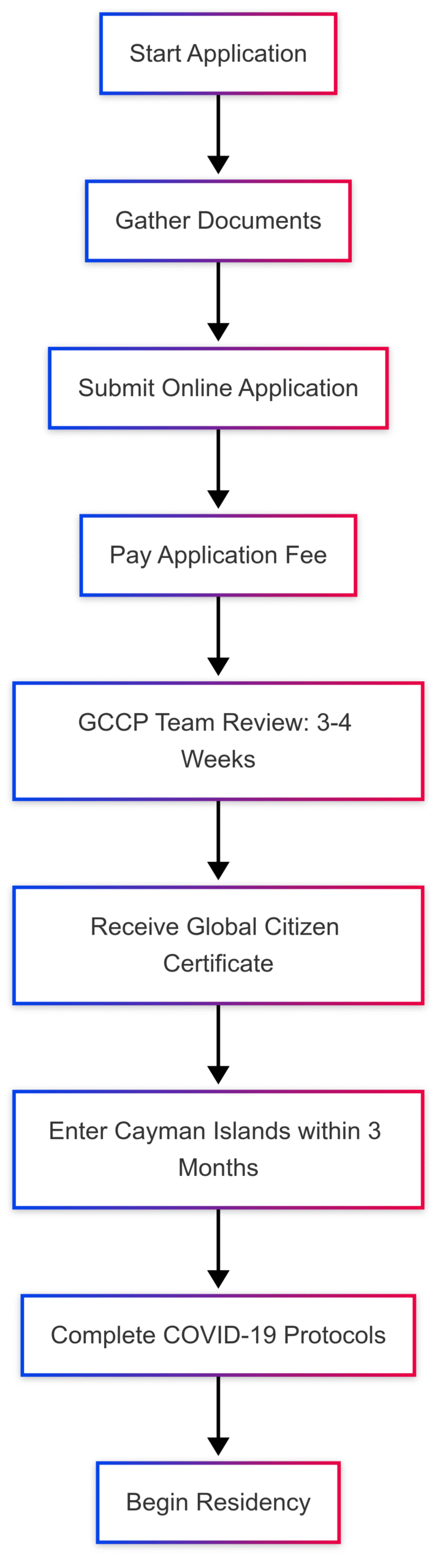
The application process for the GCCP was entirely online, making it convenient and accessible from anywhere in the world. Below is a detailed breakdown of the steps:
Step 1: Gather Required Documents
Applicants needed to prepare and digitize the following documents, ensuring all were in English or accompanied by certified translations:
- Passport: A clear copy of the passport’s bio page (valid for at least six months).
- Proof of Employment: A letter on company letterhead detailing the applicant’s position, length of employment, and annual salary.
- Proof of Company Existence: A Certificate of Good Standing, Certificate of Incorporation, or business registration, along with company website and social media details.
- Bank Statements: Six months of bank statements to verify financial stability.
- Notarized Bank Reference: A statement from a bank manager confirming the applicant’s credit standing, account duration, and average balance.
- Police Clearance: A certified background check with fingerprint verification, issued within the last six months.
- Health Insurance: Proof of coverage for at least the first 30 days in the Cayman Islands.
- For Dependents:
- Copies of passports.
- Evidence of relationship (e.g., marriage certificate, birth certificates, or adoption papers).
- Police clearance for those over 18.
- Proof of health insurance.
Step 2: Submit the Online Application
Applications were submitted through the official GCCP website. Applicants uploaded their documents and paid a non-refundable application fee:
- $1,469 per year for an individual or couple.
- $500 per additional dependent per year.
- A 7% credit card fee applied if paying by card.
Payments were made in Cayman Islands Dollars (KYD), though US dollars were widely accepted, with non-domestic credit card transactions charged in USD.
Step 3: Await Approval
The GCCP team reviewed applications for completeness and accuracy, with processing typically taking 3–4 weeks. Upon approval, applicants received an official Global Citizen Certificate, granting permission to live and work remotely in the Cayman Islands for up to two years. Applicants had to enter the islands within three months of approval.
Step 4: Comply with Entry Requirements
During the COVID-19 pandemic, additional entry protocols applied, including:
- COVID-19 Testing: Tests upon arrival at Owen Roberts International Airport and on day 15.
- Quarantine: A mandatory 14-day quarantine with a personal monitoring device, followed by a negative test result and approval from the Medical Officer of Health.
- Travel Cayman Application: Approved visa holders had to apply for travel authorization through Travel Cayman.
Application Timeline
Costs Associated with the Cayman Islands Digital Nomad Visa
The GCCP required annual fees, which were non-refundable:
| Category | Cost (USD) |
|---|---|
| Individual or Couple | $1,469 per year |
| Each Additional Dependent | $500 per year |
| Credit Card Fee | 7% of total application fee |
These fees covered the visa’s processing and were required annually for the duration of the two-year visa. No refunds were issued for denied applications.
Benefits of the Cayman Islands Digital Nomad Visa
The GCCP offered several advantages that made it unique among digital nomad visas:
- Extended Stay: At two years, it was one of the longest digital nomad visas available, with the option to renew.
- Family Inclusivity: Unlike many programs that limited dependents to spouses and children, the GCCP allowed extended family members, including parents, grandparents, and siblings.
- Tax-Free Environment: No income or corporate taxes provided significant financial benefits.
- Flexible Travel: Visa holders could enter and exit the Cayman Islands without restrictions on travel frequency.
- Concierge Services: The program offered tailored support for accommodation, activities, and relocation logistics.
- World-Class Infrastructure: High-speed internet, modern amenities, and a safe environment supported both work and leisure.
Cayman Enterprise City (CEC) Global Corporate Citizen Programme
In addition to the GCCP, the Cayman Islands offered the Global Corporate Citizen Programme through Cayman Enterprise City (CEC), targeting entrepreneurs and business owners. This program provided a five-year renewable work/residency visa (Zone Employment Certificate) with no minimum income requirement, making it more accessible than the GCCP. Key benefits included:
- Tax Neutrality: No corporate or personal income taxes, nor capital gains taxes.
- 100% Foreign Ownership: Businesses could be fully owned by foreigners, with a Zone Trade Certificate to operate globally.
- Duty-Free Imports: No import duties on business-related equipment or personal items within the first six months of residency.
- Comprehensive Support: CEC’s Global Mobility Team assisted with travel, housing, banking, and more.
- Community Networking: Access to events, corporate social responsibility programs, and a vibrant business community.
The CEC program was ideal for those looking to establish a global business in a tax-neutral jurisdiction while enjoying the Cayman Islands’ lifestyle.
Comparison of GCCP and CEC Programs
| Feature | GCCP (Digital Nomad Visa) | CEC (Global Corporate Citizen) |
|---|---|---|
| Duration | Up to 2 years, renewable | Up to 5 years, renewable |
| Minimum Income | $100,000–$180,000/year | None |
| Eligible Applicants | Remote employees, business owners | Entrepreneurs, business owners |
| Family Inclusion | Extended family | Limited to immediate family |
| Tax Benefits | No income tax | No corporate or personal taxes |
| Business Operation | Remote work only | Global business operation allowed |
Living as a Digital Nomad in the Cayman Islands
The Cayman Islands offered a lifestyle that blended work and leisure seamlessly. Digital nomads could work from beachside cafes, modern co-working spaces, or luxury accommodations while enjoying activities like snorkeling, scuba diving, and exploring local cuisine. The islands’ high-speed internet ensured connectivity for remote work, while the absence of income taxes maximized earnings.
Expat Community
The Cayman Islands attracted a diverse expat population, with significant numbers from:
| Rank | Country | Total Expatriates |
|---|---|---|
| 1 | Jamaica | 55,600 |
| 2 | United States | 15,800 |
| 3 | United Kingdom | 13,000 |
| 4 | Honduras | 8,900 |
| 5 | Canada | 8,300 |
Source: Expat population data (1990–2019)
This diverse community fostered a welcoming environment for newcomers, supported by the “CaymanKind” culture.
Challenges and Considerations
While the Cayman Islands was an attractive destination, there were challenges to consider:
- High Cost of Living: Expenses like groceries, dining, and rent were significantly higher than in the U.S., requiring careful budgeting despite the tax-free environment.
- Income Threshold: The GCCP’s high income requirements ($100,000–$180,000) excluded many freelancers and lower-earning remote workers.
- COVID-19 Protocols: Strict entry requirements, including testing and quarantine, added complexity during the pandemic.
- Program Discontinuation: As of 2024, the GCCP is no longer available, limiting options for digital nomads seeking similar opportunities.
Frequently Asked Questions
What was the cost of the Cayman Islands Digital Nomad Visa?
The visa cost $1,469 per year for an individual or couple, plus $500 per additional dependent, with a 7% credit card fee. Fees were non-refundable.
How long did the visa last?
The visa was valid for up to two years, with the option to renew.
Could family members join?
Yes, extended family members, including parents, grandparents, siblings, and children, could be included as dependents.
Was it possible to apply from abroad?
Yes, the application process was entirely online, allowing applications from anywhere in the world.
What was the difference between a digital nomad visa and a tourist visa?
A tourist visa allowed stays of up to 30 days (or six months with a visa for certain nationalities) but prohibited work. The digital nomad visa permitted remote work for up to two years.
Did U.S. citizens need a visa to enter the Cayman Islands?
U.S. citizens could visit for up to 30 days without a visa but needed the GCCP for remote work.
Conclusion
The Cayman Islands Digital Nomad Visa (Global Citizen Concierge Program) was a premier option for high-earning remote workers seeking to live and work in a Caribbean paradise. Its two-year duration, family inclusivity, tax-free benefits, and straightforward online application process made it a standout choice. Although the program is no longer available as of 2024, its legacy highlights the Cayman Islands’ appeal as a destination for digital nomads, with its stunning beaches, reliable infrastructure, and welcoming community. For those interested in similar opportunities, the Cayman Enterprise City’s Global Corporate Citizen Programme offers an alternative for entrepreneurs, providing long-term residency and business benefits in a tax-neutral environment. The Cayman Islands remains a beacon of opportunity for those seeking to blend work and a world-class lifestyle.
Please share this Cayman Islands Digital Nomad Visa: How to Apply with your friends and do a comment below about your feedback.
We will meet you on next article.
Until you can read, Canada Visa Targets Digital Nomads To Work Remotely