Croatia Digital Nomad Visa – Requirements and Application
Discover the Croatia Digital Nomad Visa: eligibility, requirements, application process, costs, and benefits for remote workers. Live and work in Croatia!
Croatia, with its stunning Adriatic coastline, rich cultural heritage, and affordable cost of living, has emerged as a top destination for digital nomads. The Croatia Digital Nomad Visa, officially a temporary residence permit, allows non-EU/EEA citizens to live and work remotely in this Mediterranean gem for up to 18 months. Introduced in January 2021, this program has attracted remote workers worldwide, offering tax exemptions, family accompaniment options, and access to Croatia’s vibrant lifestyle. This guide provides a detailed overview of the visa, including eligibility, requirements, application process, costs, and tips for living as a digital nomad in Croatia.
What is the Croatia Digital Nomad Visa?
The Croatia Digital Nomad Visa is a temporary residence permit designed for third-country nationals (non-EU/EEA/Swiss citizens) who work remotely for a company or their own business not registered in Croatia. It allows digital nomads to live in Croatia for up to 18 months, with the possibility of a six-month extension if the initial permit is granted for less than 18 months. Unlike traditional visas, this permit does not allow holders to work for Croatian companies or provide services to employers in Croatia.
Key Features
- Duration: Up to 18 months (initial permit up to 12 months, extendable by 6 months).
- Eligibility: Non-EU/EEA citizens working remotely for foreign employers or their own foreign-registered companies.
- Tax Benefits: Exemption from Croatian income tax on foreign-sourced income.
- Family Inclusion: Close family members, including spouses, common-law partners, and children, can join via family reunification.
- Schengen Access: As part of the Schengen Area, Croatia allows visa holders to travel freely across other Schengen countries.
Croatia’s Appeal for Digital Nomads
Croatia ranks 23rd on the VisaGuide.World Digital Nomad Index with a score of 2.63, reflecting its appeal due to:
- Internet Speed: 88.81 Mbps (average mobile and broadband).
- Cost of Living: Approximately €720/month, significantly lower than many EU countries.
- Healthcare: 8.1% of GDP spent on healthcare, ensuring quality medical services.
- Safety: Low crime rates and a stable political environment.
- Culture and Lifestyle: A blend of Mediterranean, Central European, and Balkan influences, with 14 UNESCO Intangible Cultural Heritage elements.
History of the Croatia Digital Nomad Visa
The concept of the Croatia Digital Nomad Visa was born during the economic challenges of the COVID-19 pandemic. Dutch entrepreneur Jan de Jong, visiting Croatia in 2020, proposed a residence program to boost the economy by attracting remote workers. His idea gained traction after discussions with Croatia’s Ministry of Home Affairs, Ministry of Foreign Affairs, and Ministry of Tourism. Launched in January 2021, the visa has since become a cornerstone of Croatia’s strategy to attract digital nomads, offering a unique blend of affordability, connectivity, and cultural richness.
Eligibility Requirements
To qualify for the Croatia Digital Nomad Visa, applicants must meet the following criteria:
- Citizenship: Must be a non-EU/EEA/Swiss citizen (third-country national).
- Age: 18 years or older.
- Employment: Work remotely via communication technology for a company or own business not registered in Croatia, with no services provided to Croatian employers.
- Income: Minimum monthly income of €3,295 (approximately 2.5 times the average monthly net salary in Croatia, as per the Croatian Bureau of Statistics). Alternatively, proof of funds totaling €39,540 for 12 months or €59,310 for 18 months.
- Health Insurance: Valid private or travel health insurance covering the entire stay in Croatia.
- Criminal Record: A clean criminal background check from the home country or any country where the applicant resided for over one year before arriving in Croatia.
- Address: A temporary or permanent address in Croatia (e.g., hotel booking, lease agreement).
Additional Notes
- Language: No specific language proficiency is required, but documents must be in Croatian or English. Proficiency in English or Croatian can streamline communication.
- Education: No formal education requirement, though a bachelor’s degree may enhance application credibility.
- Family Members: For each accompanying family member, the income requirement increases by 10% of the average monthly net salary (€329.50 per person).
Benefits of the Croatia Digital Nomad Visa
The visa offers several advantages, making Croatia an attractive destination for digital nomads:
- Tax Exemption: Income earned from foreign employers or businesses is exempt from Croatian income tax, though applicants must comply with tax obligations in their home country.
- Extended Stay: Live in Croatia for up to 18 months, with access to the Schengen Area for travel.
- Family Reunification: Spouses, common-law partners (with proof of cohabitation for 3+ years or a child together), and children can join via a family reunification permit.
- Affordable Living: Monthly living costs average €720, significantly lower than Western European countries (e.g., 35-40% less than France).
- Cultural Richness: Access to Croatia’s UNESCO sites, historic towns, and vibrant festivals.
- High-Quality Infrastructure: Fast internet (88.81 Mbps) and reliable public transport, including buses and trains in major cities like Zagreb and Split.
Limitations
- Non-Renewable: The visa cannot be extended beyond 18 months. A new application can be submitted six months after the previous permit expires, requiring a 90-day departure from Croatia.
- No Path to Permanent Residency: The visa does not count toward the continuous residency required for permanent residence or citizenship (4-5 years).
- Employment Restriction: Holders cannot work for Croatian companies.
Application Process
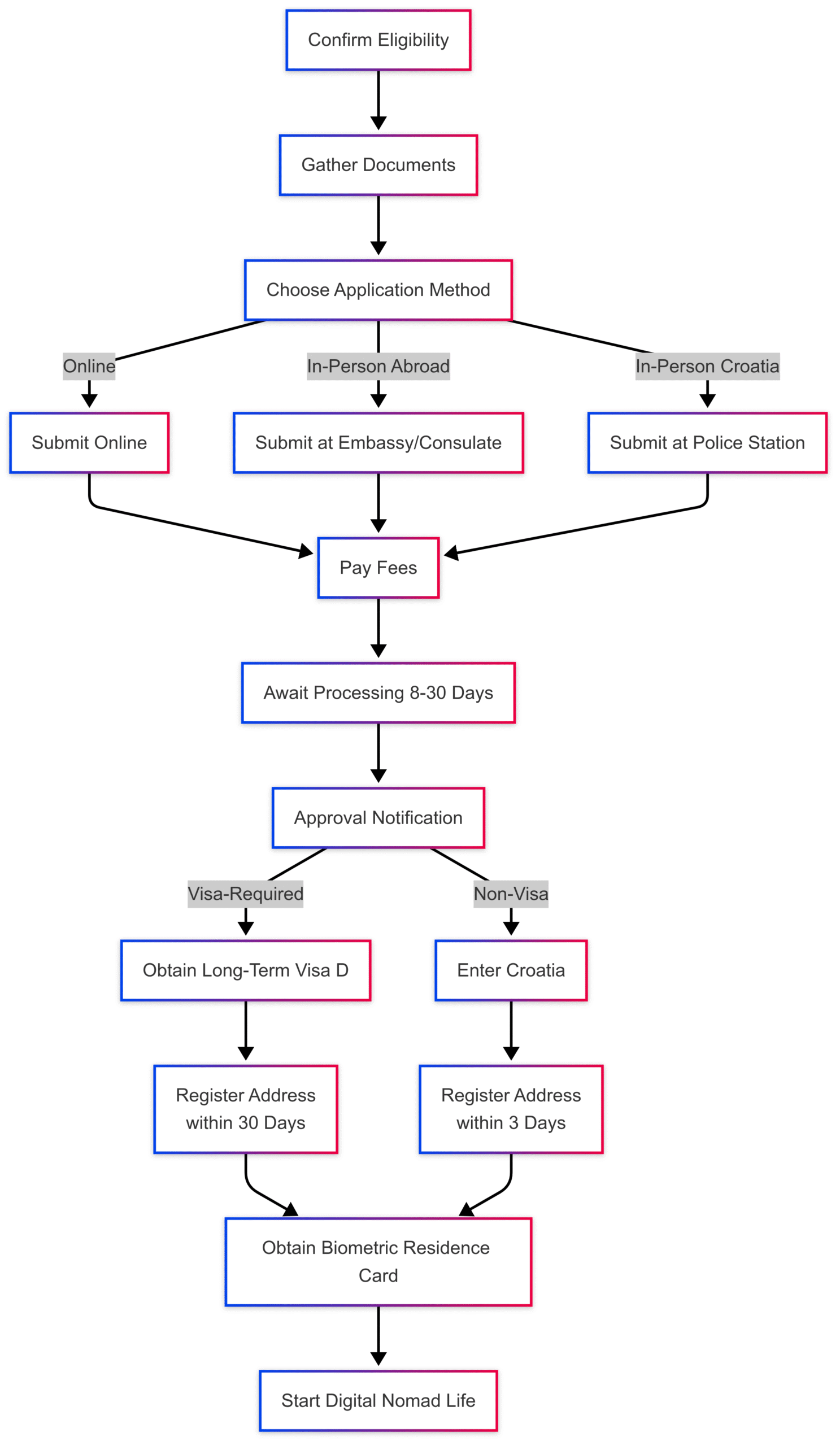
The application process for the Croatia Digital Nomad Visa is straightforward, with options to apply online, at a Croatian embassy/consulate, or at a local police station in Croatia. Below is a step-by-step guide:
Step 1: Confirm Eligibility
Ensure you meet all eligibility criteria, including citizenship, income, and remote work status.
Step 2: Gather Required Documents
Applicants must submit the following documents in Croatian or English, with translations notarized if necessary:
- Application Form: Form 1a (available online or at embassies/police stations).
- Passport Copy: Valid for at least three months beyond the intended stay.
- Proof of Purpose:
- Employment contract or service contract with a foreign employer.
- Statement from the employer or applicant confirming remote work via communication technology.
- For self-employed individuals, a copy of the company’s registration with foreign authorities (e.g., tax or business court) and proof of remote work.
- Proof of Income:
- Bank statement showing €39,540 (12 months) or €59,310 (18 months), or
- Bank statement proving regular monthly income of €3,295, or
- Payslips for the last six months.
- Health Insurance: Proof of private or travel health insurance valid in Croatia for the entire stay.
- Criminal Background Check: Legalized document from the home country or country of residence for the past year (e.g., FBI background check for U.S. citizens).
- Croatian Address: Lease agreement, hotel booking, or confirmation of intended residence.
- Passport Photo: 30×35 mm, taken in Croatia for accuracy.
Step 3: Choose Application Method
- Online: Submit via the Croatian Ministry of Interior’s website. Documents must be in PDF format (max 2MB).
- In-Person (Abroad): Apply at a Croatian embassy or consulate. Contact the embassy in advance to confirm requirements and epidemiological restrictions.
- In-Person (Croatia): If legally residing in Croatia (e.g., on a tourist visa), apply at the local police station corresponding to your temporary address.
Step 4: Pay Administrative Fees
Fees vary depending on the application method:
- At Embassy/Consulate:
- Temporary Stay: €55.74
- Long-Term Visa (D): €93.00
- Biometric Residence Card: €41.14
- At Police Station:
- Temporary Stay: €46.45
- Administrative Fee (Residence Permit): €9.29
- Biometric Residence Card: €31.85 (€59.73 for accelerated issuance)
- Online Banking:
- Temporary Stay: €46.45 (IBAN: HR1210010051863000160, Model: HR64, Reference: 5002-713-OIB or travel document number).
- Biometric Residence Card: €31.85 (€59.73 for accelerated issuance, IBAN: same, Model: HR65, Reference: 7005-485-OIB or case number).
- SWIFT Code for international payments: NBHRHR2XXXX.
Step 5: Submit Application
- Online submissions receive automatic confirmation, with further communication from a caseworker.
- In-person submissions are reviewed at the embassy or police station. Additional documents may be requested.
Step 6: Await Processing
Processing typically takes 8-30 days, though additional document requests may extend this period. Applicants should remain in contact with their caseworker and avoid leaving Croatia during processing to prevent Schengen visa complications.
Step 7: Post-Approval Steps
- Visa-Required Nationals: Obtain a long-term visa (D) or biometric residence permit from the embassy/consulate.
- Non-Visa Nationals: Enter Croatia under the Aliens Act provisions.
- Register Address: Within 3 days of arrival (or 30 days of approval for visa-required nationals), register your address at the local police station using Form 16a and a lease agreement, title deed, or landlord statement.
- Obtain Biometric Residence Card: Visit the police station with a 30×35 mm photo, biometric data (fingerprints, signature), and proof of fee payment. A temporary white card is issued, replaced by the biometric card within three weeks.
Step 8: Celebrate
Once approved, you’re ready to enjoy Croatia as a digital nomad!
Costs Breakdown
The following table summarizes the costs associated with the Croatia Digital Nomad Visa:
| Application Method | Item | Cost (EUR) | Cost (USD, Approx.) |
|---|---|---|---|
| Embassy/Consulate | Temporary Stay | 55.74 | 61.66 |
| Long-Term Visa (D) | 93.00 | 102.87 | |
| Biometric Residence Card | 41.14 | 45.51 | |
| Police Station | Temporary Stay | 46.45 | 51.37 |
| Administrative Fee | 9.29 | 10.27 | |
| Biometric Residence Card | 31.85 (59.73 accelerated) | 35.22 (66.06 accelerated) | |
| Additional Costs | Health Insurance | 500-1,000/year | 553-1,106/year |
| Background Check | 50-100 | 55-110 | |
| Translation/Notary | 50-200 | 55-221 |
Note: Costs are approximate, based on exchange rates (1 EUR ≈ 1.106 USD). Always check the official government website for updated fees.
Family Accompaniment
Close family members, including spouses, common-law partners (3+ years cohabitation or with a child), and children, can join digital nomads through a family reunification permit. Required documents include:
- Marriage certificate or proof of common-law relationship.
- Birth certificates for children.
- Additional income proof (10% increase per family member, i.e., €329.50/month).
Family applications must be submitted after the primary applicant’s permit is approved, or they will be rejected.
Tax Obligations
Digital nomads are exempt from Croatian income tax on foreign-sourced income, as per Article 9 of Croatia’s tax code. However:
- Passive Income: Taxable in Croatia (e.g., investments, rental income).
- Home Country Taxes: Applicants must comply with their home country’s tax laws. For example, U.S. citizens must file annual tax returns and may need to submit an FBAR (Foreign Bank Account Report).
- Double Taxation Treaties: Croatia has agreements with several countries to prevent double taxation. Check the list here.
Living as a Digital Nomad in Croatia
Croatia offers a vibrant lifestyle for digital nomads, blending affordability, connectivity, and cultural richness. Below are key aspects of life in Croatia:
Cost of Living
- Monthly Estimate: €720 (excluding rent).
- Rent: €459/month (furnished studio in city center), €805/month (larger apartment).
- Dining: Basic lunch menu costs €12.
- Currency: Euro (EUR, 1 USD ≈ 0.9 EUR).
Internet and Infrastructure
- Internet Speed: 88.81 Mbps (mobile and broadband average).
- Public Transport: Extensive bus networks connect cities and villages. Trains operate in Zagreb, Split, and Rijeka.
- Mobile Providers: Reliable options include A1, Tele2, and Hrvatski Telekom.
Popular Destinations
Croatia’s cities and towns cater to diverse digital nomad preferences:
| City | Highlights | Why for Nomads? |
|---|---|---|
| Zagreb | Capital city with vibrant culture, fast internet, and coworking spaces. | Ideal for networking and urban lifestyle. |
| Split | Coastal city with beaches, historic sites, and a growing nomad community. | Perfect for work-life balance. |
| Dubrovnik | UNESCO World Heritage site, medieval walls, Game of Thrones filming locations. | Scenic and inspiring, though pricier. |
| Hvar | Car-free island town with beaches and cafes. | Tranquil, great for focused work. |
| Rovinj | Artistic coastal town with a creative vibe. | Ideal for creative projects. |
| Zadar | Ancient ruins, digital nomad village, and stunning landscapes. | Affordable and community-focused. |
Attractions
- Dubrovnik: Explore Old Town and Pile Gate.
- Plitvice Lakes National Park: Emerald lakes and waterfalls, home to diverse wildlife.
- Pula: Roman amphitheater (Pula Arena) from the 1st century.
- Hvar: 16th-century cathedral and hilltop fortress.
Challenges and Considerations
While the Croatia Digital Nomad Visa is appealing, consider the following:
- Non-Renewable: The 18-month limit and six-month gap between applications restrict long-term stays.
- Schengen Clock: Time spent in Schengen countries during the permit counts toward the 90-day limit in a 180-day period.
- Application Rejections: Approximately 30% of applications are suspended or rejected due to incomplete documentation or unmet requirements.
- Seasonal Costs: Summer months (July-August) are pricier due to tourism.
Tips for a Successful Application
- Prepare Documents Early: Obtain background checks and legalizations in your home country, as they can be challenging to secure from Croatia.
- Notarize Translations: Ensure all non-English/Croatian documents are translated and notarized.
- Secure Accommodation: Have a confirmed address (e.g., lease or hotel booking) ready for the application.
- Budget for Fees: Plan for visa, insurance, and translation costs (up to €1,500 total).
- Consult Experts: For complex cases, consider hiring a Croatian immigration lawyer (e.g., Marko, contact via [x.ai/legal]).
Conclusion
The Croatia Digital Nomad Visa offers a unique opportunity to live and work in a Mediterranean paradise with fast internet, affordable living, and a rich cultural heritage. With a straightforward application process, tax exemptions, and family accompaniment options, it’s an attractive choice for remote workers. However, the non-renewable nature and residency restrictions require careful planning. By preparing thoroughly and meeting all requirements, digital nomads can enjoy up to 18 months in Croatia’s vibrant cities and stunning coastlines. Start your application today and embrace the Croatian lifestyle!
Please share this Croatia Digital Nomad Visa – Requirements and Application with your friends and do a comment below about your feedback.
We will meet you on next article.
Until you can read, Cayman Islands Digital Nomad Visa: How to Apply