Digital Nomad Tax Deductions: All You Must Know
Discover essential digital nomad tax deductions, from remote offices to laptops and WiFi, to maximize savings and stay compliant.
Digital nomads, the modern-day entrepreneurs who leverage technology to run businesses from anywhere in the world, face unique challenges and opportunities when it comes to taxes. Unlike traditional business owners tied to a single location, digital nomads navigate a complex landscape of tax obligations across borders. Fortunately, tax deductions can significantly reduce their taxable income, provided they understand what qualifies as a deductible expense. This comprehensive guide explores the key tax deductions available to digital nomads, offering actionable insights to maximize savings while ensuring compliance with tax laws. From remote office expenses to laptops and international travel considerations, we cover everything you need to know to optimize your tax strategy as a location-independent professional.
Understanding Tax Deductions for Digital Nomads
Tax deductions are expenses that reduce your taxable income, lowering the amount of tax you owe. For digital nomads, deductions are critical because their lifestyle often involves unique costs that traditional office-based businesses may not incur. The IRS and tax authorities in countries like Canada, Australia, and the UK generally allow deductions for expenses that are ordinary (common and accepted in your trade) and necessary (helpful and appropriate for your business). These criteria apply whether you’re working from a coworking space in Bali, a café in Lisbon, or an Airbnb in Tokyo.
Digital nomads, often self-employed or operating small businesses, must be meticulous about tracking expenses and maintaining records. Deductions can include everything from equipment like laptops to operational costs like internet access. However, the nomadic lifestyle introduces complexities, such as determining your tax home and navigating international tax rules. Below, we dive into the primary categories of deductions available to digital nomads, with practical examples and tips to ensure compliance.
The Remote Office: Deductions for Workspaces
Unlike traditional businesses with fixed offices, digital nomads often work from temporary or shared spaces. These workspaces come with costs that may qualify as tax deductions, provided they meet the “ordinary and necessary” standard.
Coworking Spaces and Office Rentals
Coworking spaces have become a staple for digital nomads, offering flexible, professional environments with high-speed internet, meeting rooms, and networking opportunities. The costs associated with coworking memberships or day passes are generally deductible as business expenses. For example, if you pay $300 per month for a coworking membership in Chiang Mai, Thailand, or $50 for a day pass in a London workspace, these expenses can reduce your taxable income.
Additional coworking-related expenses may also qualify, including:
- Conference room rentals: Fees for booking meeting rooms for client presentations or team calls.
- Printing and office supplies: Costs for printing documents, purchasing stationery, or other supplies used exclusively for business.
- Networking events: Fees for events hosted at coworking spaces, such as workshops or professional meetups, if they relate to your business.
However, not all coworking-related costs are deductible. Transportation to and from the coworking space, such as taxi fares or parking fees, typically does not qualify as a business expense unless the travel is directly tied to a specific business purpose (e.g., meeting a client). To claim these deductions, maintain detailed records, such as receipts or invoices, and ensure the expenses are tied to your business activities.
Home Office Deductions for Digital Nomads
For digital nomads, the concept of a “home office” is tricky because their primary residence may change frequently. In the U.S., the IRS allows a home office deduction if a specific area of your home is used exclusively and regularly for business. For nomads, this could apply to a dedicated workspace in a long-term rental or a portion of an Airbnb used solely for work.
To calculate the deduction, you can use the simplified method ($5 per square foot, up to 300 square feet, for a maximum of $1,500) or the regular method (a percentage of your rent, utilities, and other home expenses based on the portion of the space used for business). For example, if you rent an apartment for $2,000 per month and use 20% of the space as a dedicated office, you could deduct $400 per month using the regular method.
However, digital nomads who move frequently may struggle to meet the “exclusive and regular use” requirement. If your “home” is constantly changing, the IRS may not consider it a stable tax home, which complicates the deduction. Consulting a tax professional familiar with nomadic lifestyles can help clarify eligibility.
Airbnb as a Business Expense
Many digital nomads rely on Airbnb or similar platforms for short-term accommodations. Whether these stays qualify as deductible business expenses depends on your tax home—the primary place where you conduct your business. For most nomads, their tax home is fluid, following them as they travel. In this case, Airbnb stays are typically considered personal expenses, not business ones, because they replace traditional housing costs.
However, there are exceptions. If you have a fixed tax home (e.g., a permanent residence in New York) and travel temporarily for business (e.g., a month-long project in Barcelona), the cost of an Airbnb in Barcelona could qualify as a travel expense. To be deductible, the expense must be:
- Reasonable and necessary: Common and accepted in your line of work.
- Temporary: The trip must be short-term, typically less than one year.
- Business-related: The travel must be directly tied to your business activities.
For example, a freelance web developer based in Chicago who travels to London for a two-week client project could deduct the cost of an Airbnb rental, meals, and transportation related to the project. However, if you’re a full-time nomad with no fixed tax home, Airbnb costs are unlikely to qualify unless you can demonstrate a specific business purpose.
Foreign Earned Income Exclusion (FEIE) and Housing
For U.S. digital nomads, the Foreign Earned Income Exclusion (FEIE) offers significant tax savings. If you spend at least 330 days outside the U.S. in a 12-month period, you may exclude up to $126,500 of your income from U.S. federal taxes (2024 limit, adjusted annually). Additionally, you may qualify for a housing exclusion to deduct a portion of your housing costs, including rent or Airbnb expenses, above a baseline amount.
To qualify for the FEIE, you must meet one of two tests:
- Physical Presence Test: Spend at least 330 days outside the U.S. in a 12-month period.
- Bona Fide Residence Test: Establish residency in a foreign country for an entire tax year.
The housing exclusion can cover a portion of Airbnb or rental costs, but strict rules apply. For example, the deduction is limited to a percentage of your foreign-earned income and varies by location (high-cost cities like London have higher limits). Keeping detailed records of your travel dates and expenses is critical to substantiate these claims.
Digital Devices: Laptops, Phones, and More
Digital nomads rely heavily on technology, and the costs of devices and connectivity are often deductible as business expenses. These fall into two categories: capital expenses (long-term assets like laptops) and operating expenses (ongoing costs like internet fees).
Laptops and Computer Equipment
Laptops, tablets, and related accessories (e.g., laptop bags, external monitors, or keyboards) are considered capital expenses because they are durable assets used in your business. These are deductible if they are necessary and reasonable for your work. For example, a graphic designer needs a high-performance laptop for editing software, making the full cost deductible if used exclusively for business.
If you use a device for both personal and business purposes, you can only deduct the business-use percentage. For instance, if your laptop costs $2,000 and you use it 70% for work and 30% for personal activities (e.g., streaming movies), you can deduct $1,400. In the U.S., Canada, Australia, and the UK, tax authorities require you to estimate and document the business-use percentage.
To maximize deductions, consider the following:
- Depreciation: For expensive equipment, you may need to depreciate the cost over several years rather than deducting it all at once. The IRS’s Section 179 deduction allows some businesses to deduct the full cost of equipment in the year of purchase, up to a limit.
- Accessories: Items like laptop stands, chargers, or software subscriptions (e.g., Adobe Creative Cloud) are also deductible if used for business.
Phones and SIM Cards
Phones are another essential tool for digital nomads, and their costs are deductible under similar rules. If you purchase a $1,000 smartphone used 80% for business (e.g., client calls, emails, or managing projects), you can deduct $800. Accessories like cases or headphones may also qualify if used primarily for work.
SIM cards and data plans are considered operating expenses. For example, purchasing a local SIM card in Thailand for $20 to access mobile data for client meetings is fully deductible if used exclusively for business. International roaming plans or data packages for work-related tasks also qualify. To avoid complications, track usage and maintain receipts, especially for plans that combine personal and business use.
WiFi and Internet Costs
Reliable internet access is the backbone of a digital nomad’s business. Costs for WiFi, such as monthly subscriptions, prepaid data plans, or café WiFi fees, are deductible as operating expenses. For example, if you pay $50 per month for a portable WiFi hotspot to work while traveling, this is a legitimate business expense.
To ensure deductibility:
- Use a dedicated payment method (e.g., a business credit card) to track internet expenses.
- Document the business purpose, such as emails or invoices showing work conducted while using the WiFi.
- If you share internet costs (e.g., splitting a WiFi bill with a roommate), only deduct your business-use portion.
Record-Keeping: The Key to Successful Deductions
Self-employed digital nomads are more likely to face tax audits, making meticulous record-keeping essential. Without proof of expenses, deductions can be disallowed, leading to penalties or higher tax bills. Follow these best practices to stay organized:
- Use a Dedicated Payment Method: Pay for business expenses with a separate credit card or bank account to avoid mixing personal and business transactions. For example, a business credit card statement can serve as a clear record of coworking fees or laptop purchases.
- Track Currency: If you work in multiple countries, record expenses in the original currency and convert them to your home currency for tax purposes. Currency fluctuations can affect deductions, so use consistent exchange rates (e.g., the IRS’s annual average rates).
- Save Receipts and Invoices: Digitize receipts using apps like Expensify or Evernote to avoid losing paper copies. Include notes on the business purpose of each expense.
- Use Accounting Software: Tools like QuickBooks or Wave can categorize expenses, track income, and generate reports for tax season.
- Maintain a Business Expense Log: Create a spreadsheet to log expenses, including date, amount, currency, and purpose. Below is an example of how to structure your log:
| Date | Expense Type | Amount | Currency | Business Purpose |
|---|---|---|---|---|
| 2025-03-15 | Coworking Membership | $250 | USD | Monthly access to workspace in Bali |
| 2025-04-02 | Laptop Purchase | $1,800 | USD | Primary device for web development |
| 2025-04-10 | SIM Card | $20 | THB | Local data for client calls in Thailand |
International Tax Considerations
Digital nomads operating across borders face additional complexities, as tax rules vary by country. Below are key considerations for common scenarios:
U.S. Digital Nomads
U.S. citizens are taxed on their worldwide income, regardless of where they live. However, the FEIE and housing exclusion can significantly reduce tax liability for nomads living abroad. Additionally, tax treaties between the U.S. and other countries may prevent double taxation. Consult a tax professional to navigate these rules and avoid surprises.
Canadian Digital Nomads
In Canada, the Canada Revenue Agency (CRA) allows deductions for business expenses similar to the IRS. However, nomads must establish their tax residency to determine whether they owe taxes in Canada or another country. If you’re a non-resident, you may only be taxed on Canadian-sourced income.
Australian and UK Digital Nomads
Australia and the UK have similar rules for business expense deductions, requiring expenses to be wholly and exclusively for business purposes. Nomads must also monitor residency status, as spending too much time in these countries could trigger tax obligations.
Visualizing Tax Residency Rules
To illustrate how tax residency impacts deductions, consider the following flowchart for U.S. digital nomads:
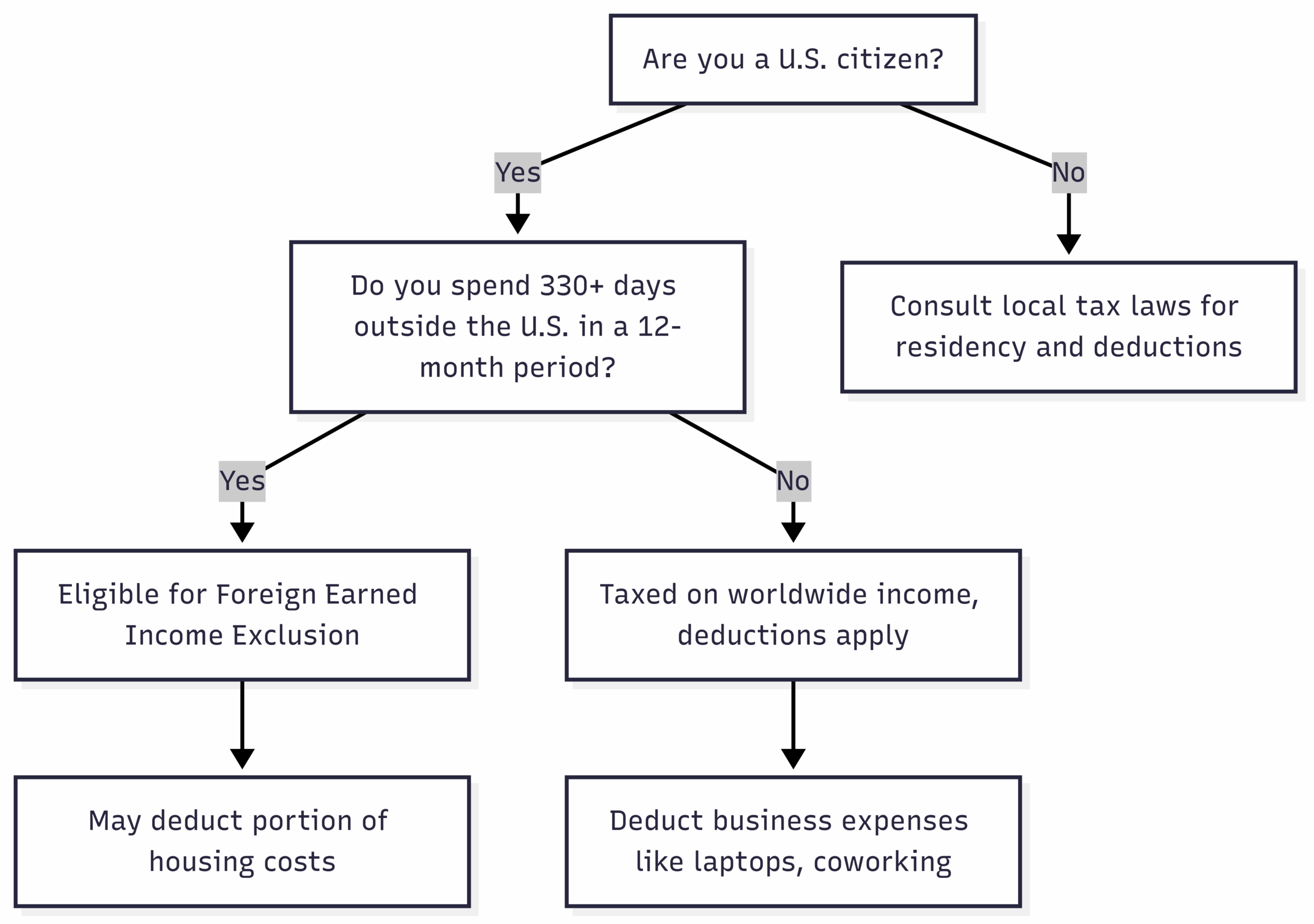
This chart simplifies the decision-making process for U.S. nomads but applies broadly to other nationalities with similar residency tests.
Maximizing Deductions: Additional Opportunities
Beyond the core deductions discussed, digital nomads may qualify for other expenses, depending on their business activities. Examples include:
- Professional Development: Costs for online courses, certifications, or industry conferences.
- Marketing and Advertising: Expenses for website hosting, domain names, or social media ads.
- Travel for Business: Flights, hotels, or meals tied to specific business trips (not general nomadic travel).
- Insurance: Premiums for business-related insurance, such as liability or equipment coverage.
To identify all possible deductions, consider using a business expense checklist tailored to digital nomads. These tools help track expenses and ensure you don’t miss out on savings.
Common Pitfalls to Avoid
Digital nomads often make mistakes that can lead to disallowed deductions or audits. Avoid these pitfalls:
- Mixing Personal and Business Expenses: Using the same credit card for personal and business purchases complicates record-keeping and raises red flags during audits.
- Overestimating Business Use: Claiming 100% of a laptop’s cost when it’s used 50% for personal activities is a common error. Be honest and conservative in your estimates.
- Ignoring Local Tax Laws: If you spend significant time in a foreign country, you may owe taxes there, even if you qualify for the FEIE.
- Poor Record-Keeping: Failing to save receipts or document the business purpose of expenses can lead to disallowed deductions.
Conclusion: Optimize Your Tax Strategy
Digital nomads have access to a wide range of tax deductions, from coworking memberships to laptops and internet costs. By understanding what qualifies as an “ordinary and necessary” expense and maintaining meticulous records, you can significantly reduce your tax liability. The Foreign Earned Income Exclusion offers additional savings for U.S. nomads living abroad, while careful planning can help nomads in other countries navigate residency and deduction rules.
To ensure compliance and maximize savings, consider working with a tax professional who specializes in digital nomad finances. Tools like expense trackers, accounting software, and business credit cards can simplify the process, allowing you to focus on growing your business while exploring the world. By taking advantage of these deductions, you can keep more of your hard-earned income and thrive as a location-independent professional.
Please share this Digital Nomad Tax Deductions: All You Must Know with your friends and do a comment below about your feedback.
We will meet you on next article.
Until you can read, Accounting & bookkeeping for digital nomads (+Finance Tips)