How do you decide where to travel?
Discover how to choose your next travel destination with our guide. Learn key factors, tips, and tools to make the perfect travel decision.
Traveling opens doors to new cultures, cuisines, landscapes, and experiences, but with nearly 200 countries and countless destinations to choose from, deciding where to go next can feel overwhelming. Whether you’re torn between European gems like Lisbon, Venice, Nice, or Napoli, or dreaming of Asian adventures in South Korea, Thailand, or Indonesia, the decision-making process requires balancing personal preferences, practical constraints, and a sprinkle of inspiration. This 3500-word guide offers a structured approach to help you confidently choose your next travel destination, complete with practical tips, decision-making frameworks, and tools to streamline the process.
Why Choosing a Travel Destination Is Challenging
The world is vast, and each destination offers unique experiences. From the historic canals of Venice to the vibrant street markets of Bangkok, the sheer variety can paralyze even seasoned travelers. Social media platforms like Instagram and Pinterest bombard us with stunning visuals, while friends’ travel stories and online forums add to the inspiration overload. Add in practical considerations like budget, time, and weather, and it’s easy to feel stuck in a decision-making loop. This guide breaks down the process into actionable steps, ensuring you make a choice that aligns with your desires and constraints.
Step 1: Define Your Travel Style and Preferences
Before diving into logistics, understanding your travel style is crucial. Your preferences shape the kind of experience you’ll enjoy most, so take time to reflect on what drives your wanderlust.
Interests
What excites you about travel? Are you drawn to:
- History and Culture: Exploring ancient ruins like Pompeii near Napoli or museums in Lisbon.
- Nature and Adventure: Hiking in Indonesia’s jungles or snorkeling in Thailand’s Andaman Sea.
- Food and Culinary Experiences: Sampling street food in South Korea or savoring gelato in Venice.
- Relaxation: Lounging on the beaches of Nice or Bali.
- Unique Events: Attending Venice’s Carnival or Thailand’s Songkran festival.
Travel Type
Do you prefer a relaxing getaway, an adrenaline-pumping adventure, or a deep cultural immersion? For example:
- A relaxing trip might lead you to Nice’s Mediterranean coast.
- An adventurous trip could mean trekking in Indonesia’s Komodo National Park.
- Cultural immersion might draw you to South Korea’s temples or Naples’ vibrant street life.
Comfort Level
Consider how comfortable you are with unfamiliar environments. If you’re new to international travel, destinations like Lisbon or Thailand, known for their welcoming vibe and developed tourism infrastructure, might be ideal. More experienced travelers might opt for off-the-beaten-path spots like Indonesia’s lesser-known islands.
Travel Companions
Your travel companions influence your choice. Solo travelers have more flexibility but may prioritize safety and ease of navigation. Couples might seek romantic destinations like Venice, while groups or families may prefer places with diverse activities, such as Lisbon or South Korea.
Step 2: Evaluate Practical Factors
Once you’ve clarified your preferences, practical considerations help narrow down your options. These factors ensure your trip is feasible and enjoyable.
Budget
Travel costs vary widely. According to recent data, average daily travel costs (including accommodation, food, and activities) for your shortlisted destinations are:
| Destination | Average Daily Cost (USD) | Notes |
|---|---|---|
| Lisbon, Portugal | $100–$150 | Affordable accommodation, moderate food costs |
| Venice, Italy | $150–$250 | Higher costs due to tourism and gondola rides |
| Nice, France | $120–$200 | Mid-range, with pricier dining options |
| Napoli, Italy | $100–$180 | Affordable, but day trips (e.g., Pompeii) add costs |
| South Korea | $80–$150 | Budget-friendly street food, moderate hotels |
| Thailand | $50–$120 | Very affordable, especially outside Bangkok |
| Indonesia | $40–$100 | Low costs, but remote islands can be pricier |
Tip: Use tools like Google Flights or Skyscanner to find affordable airfares. For example, users on platforms like X often cite finding flights to Japan for under $1000 as a deciding factor.
Time Availability
How much time can you dedicate to your trip, including travel time? Short trips (5–7 days) suit closer destinations or those with minimal time differences to avoid jet lag. For instance:
- Europe (Lisbon, Venice, Nice, Napoli): Ideal for 5–10 days, with flight times from the U.S. averaging 7–10 hours.
- Asia (South Korea, Thailand, Indonesia): Better for 10+ days due to longer flights (12–20 hours from the U.S.) and jet lag.
Travel Time
Long flights can eat into your vacation. For example:
- From the U.S. East Coast, Lisbon is ~7 hours, while Indonesia can take 20+ hours with connections.
- From Europe, Asian destinations are more accessible (8–12 hours).
Seasonality and Weather
Weather significantly impacts your experience. Here’s a quick overview of your shortlisted destinations:
| Destination | Best Time to Visit | Weather Considerations |
|---|---|---|
| Lisbon | April–June, Sept–Oct | Mild, sunny, fewer crowds |
| Venice | Feb–May, Sept–Nov | Avoid summer heat and crowds |
| Nice | May–Sept | Warm, ideal for beaches |
| Napoli | April–June, Sept–Oct | Hot summers, mild winters |
| South Korea | April–May, Sept–Oct | Pleasant, avoid humid summers |
| Thailand | Nov–Feb | Dry season, cooler temperatures |
| Indonesia | April–Oct | Dry season, ideal for islands |
Tip: Avoid peak tourist seasons to save money and enjoy fewer crowds. For example, visiting Venice in February for Carnival can combine unique experiences with lower costs.
Restrictions
Check visa requirements, health advisories, and safety concerns. For instance:
- EU destinations (Lisbon, Venice, Nice, Napoli) often require no visa for U.S. or Canadian citizens for short stays.
- South Korea and Thailand offer visa-free entry for many nationalities, while Indonesia may require a visa on arrival.
- Research health precautions, like vaccinations for tropical destinations like Indonesia.
Step 3: Research and Brainstorm Destinations
With your preferences and constraints in mind, it’s time to explore potential destinations.
Create a Bucket List
Write down all the places you’re curious about. For example, the original poster mentioned Lisbon, Venice, Nice, Napoli, South Korea, Thailand, and Indonesia. Your list might include:
- Europe: Rich in history and culture, with easy intra-continental travel.
- Asia: Diverse landscapes, affordable costs, and vibrant cultures.
Research Destinations
Dive into research to match destinations with your interests:
- Travel Blogs and Forums: Platforms like Reddit or X provide real traveler insights. For example, users praise Lisbon for its affordability and vibrant culture, while Venice is lauded for its unique canals but criticized for high costs.
- YouTube and Social Media: Watch “Top Things to Do” videos for your shortlisted destinations. For instance, Napoli’s proximity to Pompeii and the Amalfi Coast makes it a versatile choice.
- Travel Apps: Use tools like TripAdvisor, Culture Trip, or GEEO’s Trip Search to filter destinations by interests (e.g., wildlife, history).
Leverage Online Tools
- Google Flights: Use the map view to compare flight prices across destinations.
- Skyscanner: Find deals by setting flexible dates or destinations.
- Kayak: Compare accommodation and flight bundles.
- Weather Apps: Check historical weather data to ensure pleasant conditions.
Example: Comparing European Destinations
Let’s compare the original poster’s European options:
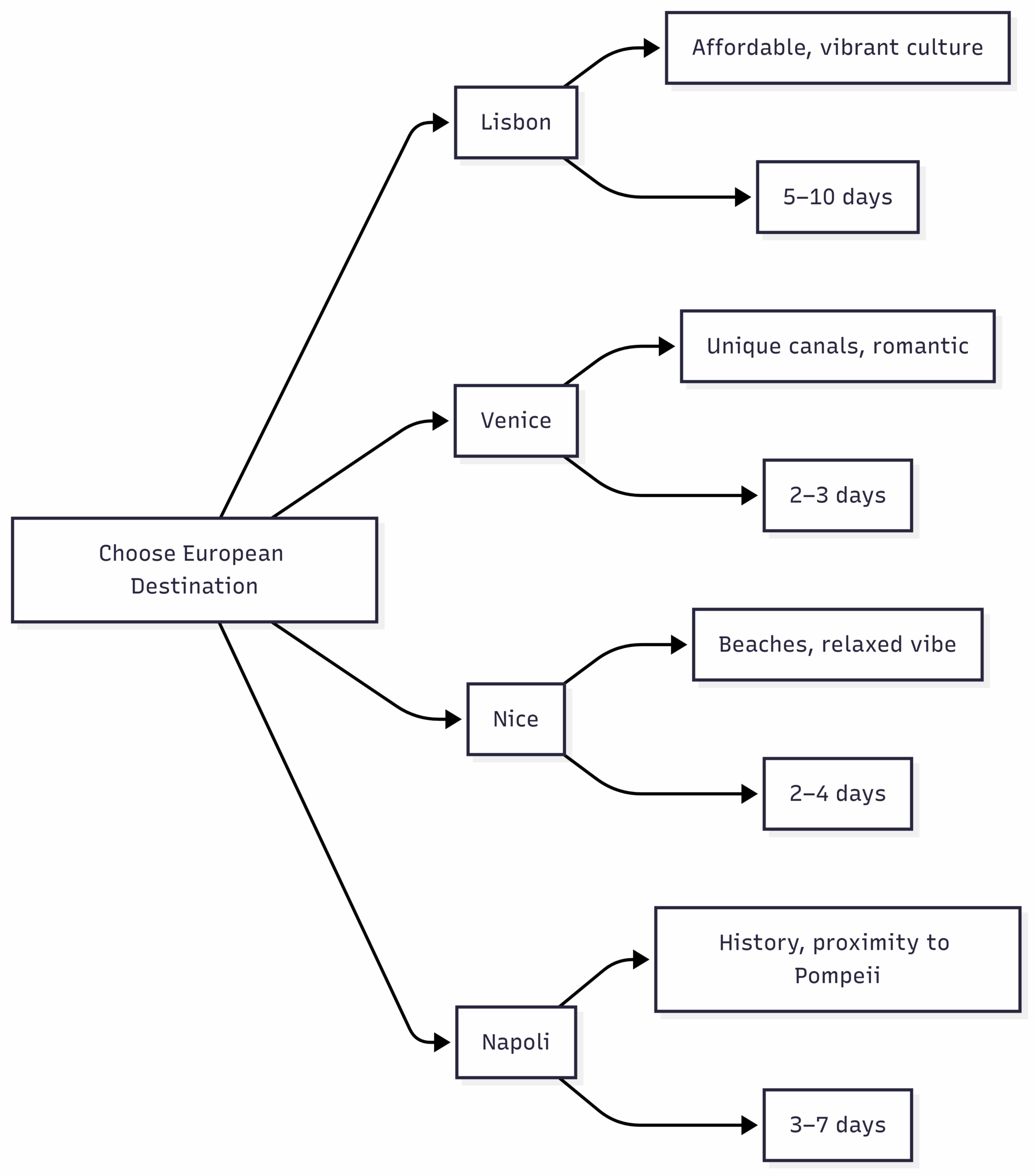
Analysis:
- Lisbon: Offers the most activities (castles, trams, beaches), ideal for longer trips.
- Venice: Best for short, romantic getaways but pricier.
- Nice: Perfect for beach lovers, moderate costs.
- Napoli: Great for history buffs, with day trips to Pompeii or Amalfi.
Step 4: Prioritize and Finalize Your Choice
With research in hand, it’s time to narrow down your options and make a decision.
Prioritize Your Bucket List
Rank your destinations based on:
- Excitement Factor: Which place sparks the most joy? As one X user noted, “Go with the place that excites you the most, even if it’s the most expensive.”
- Alignment with Preferences: Does the destination match your interests and travel style?
- Practical Fit: Does it fit your budget, time, and weather preferences?
Compare and Contrast
Create a pros-and-cons list for each destination. Here’s an example for the Asian options:
| Destination | Pros | Cons |
|---|---|---|
| South Korea | Vibrant culture, modern cities, affordable | Language barrier, jet lag |
| Thailand | Budget-friendly, diverse (beaches, temples) | Crowded in peak season |
| Indonesia | Stunning nature, low costs | Longer travel time, infrastructure varies |
Make the Decision
Choose the destination that best balances your desires and constraints. If you’re still torn, consider:
- Deals: A cheap flight or hotel deal can tip the scales, as many X users suggest.
- Novelty: Prioritize a place you’ve never visited, as recommended by users who value new experiences.
- Serendipity: Spin a globe or use a random destination generator for fun, as one user suggested.
Plan Your Itinerary
Once you’ve chosen, start planning:
- Activities: Book key attractions in advance (e.g., Venice’s Doge’s Palace, South Korea’s Gyeongbokgung Palace).
- Accommodation: Use Booking.com or Airbnb for deals.
- Transport: Check public transport options or car rentals, especially for sprawling destinations like Indonesia.
Decision-Making Personalities and How to Overcome Challenges
Travelers often fall into distinct decision-making personalities, each with strengths and pitfalls:
- Maximizing Molly: Seeks the perfect destination, risking decision paralysis. Solution: Set a deadline to choose and focus on one or two key priorities.
- Dream-state Delaney: Loves planning but struggles to commit. Solution: Book a non-refundable flight to lock in the decision.
- Stuck Stacey: Overwhelmed by options. Solution: Use a decision matrix (like the pros-and-cons table above) to simplify choices.
- Sure-thing Shirley: Decides quickly but may overlook details. Solution: Double-check logistics like visas and weather.
Tools and Resources to Aid Your Decision
- GEEO Trip Search: Filters destinations by interests like wildlife or history.
- Google Flights Map View: Visualizes affordable destinations.
- Pinterest: Create a “Want to Go” board for inspiration.
- X and Reddit: Join travel communities for real-time advice.
- Travel Newsletters: Subscribe to Going or Secret Escapes for deal alerts.
Case Study: Choosing Between Lisbon, Venice, Nice, and Napoli
Let’s apply the process to the original poster’s European dilemma:
- Preferences: The poster enjoys cultural immersion and history.
- Practical Factors:
- Budget: Lisbon and Napoli are more affordable than Venice or Nice.
- Time: They have 5–10 days, making Lisbon or Napoli ideal for longer stays.
- Weather: All are pleasant in spring or fall, but Nice offers better beaches.
- Research: YouTube videos highlight Lisbon’s vibrant neighborhoods, Venice’s canals, Nice’s coast, and Napoli’s proximity to Pompeii.
- Decision: Lisbon stands out for its affordability, diverse activities, and cultural richness, making it a strong choice for a 7-day trip.
Case Study: South Korea, Thailand, or Indonesia
For the Asian options:
- Preferences: The poster seeks adventure and culture.
- Practical Factors:
- Budget: Indonesia and Thailand are cheaper than South Korea.
- Time: 10+ days needed due to travel time.
- Weather: November–February is ideal for Thailand and Indonesia.
- Research: Thailand offers beaches and temples, South Korea has modern and traditional blend, and Indonesia boasts natural beauty.
- Decision: Thailand wins for its affordability, diverse activities, and ease of travel.
The Joy of Committing to a Decision
Committing to a destination brings relief and excitement. A study by the Institute for Applied Travel Research found that 95% of travelers feel joy from having a trip to look forward to. Booking your trip—whether it’s a flight to Lisbon or a hotel in Thailand—solidifies your plans and shifts your focus to anticipation and preparation.
Final Tips for a Confident Choice
- Trust Your Gut: If a destination sparks joy, go for it.
- Stay Flexible: Be open to deals or unexpected opportunities.
- Avoid Overcomparison: Once you decide, stop researching alternatives to prevent second-guessing.
- Plan for Future Trips: Your bucket list will always have more destinations, so view this as one of many adventures.
Conclusion
Choosing your next travel destination doesn’t have to be daunting. By defining your travel style, evaluating practical factors, researching thoroughly, and prioritizing based on excitement and feasibility, you can make a decision that feels right. Whether you’re drawn to the historic charm of Lisbon, the romantic canals of Venice, the sunny beaches of Nice, the cultural depth of Napoli, or the vibrant adventures of South Korea, Thailand, or Indonesia, this guide equips you to choose confidently. Start planning today, and let the anticipation of your next journey fuel your wanderlust.
Please share this How do you decide where to travel? with your friends and do a comment below about your feedback.
We will meet you on next article.
Until you can read, Mistakes I’ve Made While Traveling: Lessons Learned