How to Work from Home with Pets
Working from home with pets sounds like a dream until your dog crashes your video call mid-presentation, your cat types gibberish into your report, or your puppy systematically dismantles your charger cable during your most focused work hour of the day. The chaos is real — but so are the solutions.
The key to successfully sharing your home office with a pet is not stricter rules or more shouting. It is a combination of structured routine, proactive energy management, and the right enrichment tools deployed at the right times. This guide covers every practical strategy you need, whether you have one calm senior dog or three littermate puppies with the collective attention span of a goldfish.
Why Pets Struggle When You Work from Home
Before addressing the fixes, it helps to understand why pets act up during remote work hours in the first place.
Pets — especially dogs — are highly routine-dependent animals. Their nervous systems calibrate to predictable patterns: wake, walk, eat, sleep, play, repeat. When you are suddenly home all day but unavailable for interaction, it creates a confusing mixed signal. You are physically present, which their instincts read as playtime, but you are not engaging with them. This conflict between presence and unavailability generates anxiety, attention-seeking behaviors, and escalating mischief.
For multiple dogs or littermates, the problem compounds. Dogs feed off each other’s energy. One anxious dog can trigger the whole pack.
The solution is not to lock pets away and hope for the best. It is to give them a predictable structure that teaches them when you are available and when you are not — and to ensure they have enough mental and physical stimulation to stay calm during your off-limits hours.
Step 1: Burn Energy Before Your Workday Starts
The single most effective thing you can do for a productive workday with pets is to tire them out before it begins. A well-exercised pet is a quiet pet.
Before logging in, take your dog for a genuine walk — not a quick potty trip, but a 20–30 minute walk that involves sniffing, exploring, and moving at a pace that elevates their heart rate. For cats, engage in 10–15 minutes of active play with a wand toy or laser to burn the morning zoomie energy.
This morning energy burn creates a natural rest window that aligns with your first block of focused work. Most dogs, especially adult ones, will sleep for 2–4 hours after a satisfying morning outing.
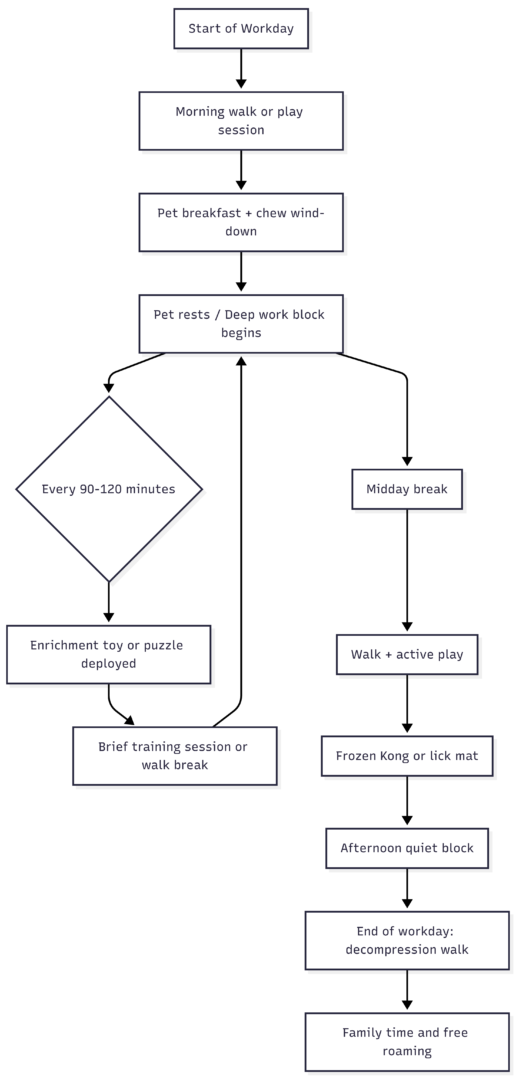
Morning routine timing guide:
| Time | Activity |
|---|---|
| 7:00–7:30 AM | Morning walk or vigorous play session |
| 7:30–8:00 AM | Breakfast + post-meal wind-down chew |
| 8:00–9:00 AM | Pet settles; you begin deep work |
| 10:30 AM | Enrichment break — puzzle toy or snuffle mat |
| 12:30 PM | Midday walk or play + training refresher |
| 1:30 PM | Frozen Kong or lick mat; quiet work resumes |
| 3:00 PM | Backyard potty + short supervised play |
| 5:00–5:30 PM | End of work; long decompression walk |
Step 2: Build a Consistent Daily Routine
Pets thrive on predictability. When your pet knows that 9 AM means quiet time, they stop campaigning for your attention at 9 AM. When they know a walk is coming at noon, the morning waiting period becomes manageable rather than anxiety-inducing.
Consistency is more important than perfection here. The exact times matter less than the sequence being reliable. Feed, walk, enrich, rest — in the same order, every day. Within two to three weeks, most pets adjust their behavior to match the schedule without any additional training effort from you.
For multi-dog households, the schedule also needs to incorporate individual time with each dog. Sibling dogs or bonded pairs can develop codependency — a behavioral issue where dogs become so reliant on each other that they cannot function independently. Scheduling brief one-on-one sessions with each dog, separately, prevents this and builds the kind of individual confidence that makes them easier to manage during your work hours.
Step 3: Use Enrichment Tools Strategically
Enrichment toys are not just distractions — they are the core tool for buying yourself focused, uninterrupted work time. The goal is to give your pet something mentally engaging enough to hold their attention for 20–60 minutes, timed to your most critical work windows or meetings.
The most effective enrichment options:
Frozen Kongs and Stuffed Toys Fill a Kong with a mixture of peanut butter (xylitol-free), canned pumpkin, kibble, or banana, then freeze overnight. A properly frozen Kong can occupy a dog for 30–60 minutes. The freezing is essential — an unfrozen Kong gets emptied in minutes.
Snuffle Mats These fabric mats with ruffled textures are designed for nose work — hiding kibble or treats in the folds for your dog to sniff out. They are notably quieter than hard puzzle toys (important during calls) and provide significant mental stimulation. A typical snuffle mat session provides 15–25 minutes of focused engagement.
Lick Mats Flat silicone mats designed for spreading soft foods like peanut butter, plain yogurt, or wet food. Freeze them for extended engagement. The repetitive licking action also has a calming effect on dogs — it is naturally stress-reducing. Best deployed right before or during a meeting.
Treat-Dispensing Puzzle Toys Interactive puzzles that require dogs to slide, flip, or press components to release kibble. These provide both mental stimulation and slower eating. For multi-dog homes, give each dog their puzzle in a separate room to prevent competitive anxiety and toy theft.
Enrichment effectiveness comparison:
| Enrichment Type | Duration | Noise Level | Best For |
|---|---|---|---|
| Frozen Kong | 30–60 min | Silent | Important calls, deep work |
| Snuffle mat | 15–25 min | Very quiet | Morning or afternoon breaks |
| Lick mat (frozen) | 20–40 min | Silent | Meetings, presentations |
| Treat puzzle toy | 15–30 min | Low–moderate | Pre-meeting warm-up |
| Bully stick / chew | 30–90 min | Silent | Long work blocks |
| DIY cardboard shredder | 15–30 min | Low | Budget-friendly option |
Pro tip: Rotate your enrichment options daily. Dogs habituate quickly to the same toy and lose interest. Keeping four or five toys in rotation — and only bringing each one out one or two times per week — maintains novelty and keeps engagement time high.
Step 4: Teach Your Pet When Work Time Means No Attention
One of the most common mistakes remote workers make is inconsistently responding to attention-seeking behaviors. If your dog whines and you sometimes ignore it and sometimes give in, you have created a variable reward schedule — which is actually the strongest possible reinforcement for persistence. Your dog learns that whining eventually works, so they keep doing it longer and louder.
The behavioral principle here is simple: only reinforce the behavior you want. When your pet whines, nudges, paws, or barks for attention, completely ignore it. No eye contact, no verbal response, no physical contact. The moment they settle and lie down quietly, calmly reward that behavior with a treat, brief praise, or a gentle pat.
This is not about being cold or unkind. It is about being consistent enough that your pet learns the rule. Quiet and settled earns attention. Demanding and loud earns nothing.
Most pets learn this distinction within 1–2 weeks of consistent application. Some adjust faster. The critical requirement is that every person in your household applies the same rule — one family member giving in to whining undoes all the training progress.
Step 5: Set Up Dedicated Pet Spaces
Your pet needs a designated resting area within or near your workspace that signals calm and independence. This is not about confinement — it is about giving them a clearly defined place that is theirs, comfortable, and associated with relaxation rather than exclusion.
Position a dog bed, crate, or cat perch within sight of your desk but not directly underfoot. Pets are social animals — being able to see you while resting satisfies their need for proximity without requiring physical interaction.
Crate training for home office sanity
For dogs, a properly introduced crate is not punishment — it is a den. Dogs are den animals by instinct, and a well-set-up crate becomes a space your dog genuinely seeks out for rest. This is especially valuable for:
- Littermates and sibling dogs who need individual decompression time away from each other
- Puppies who need enforced nap periods to prevent overtired meltdowns
- High-energy dogs who need a clear boundary during your most critical meeting blocks
Sync crate time with your hardest work windows. Crate the dog before the meeting starts, not in response to them barking during it. The crate becomes predictably associated with your work periods, and most dogs adjust within days.
For cats: Unlike dogs, most cats become more vocal and disruptive if locked out of a room. Leave doors open and instead make your workspace uninteresting — no warm laptop to sit on, no desk items to bat around — and provide a cat perch or window seat nearby that is more appealing than your keyboard.
Step 6: Use Breaks Intentionally
One of the underrated benefits of working from home with a pet is that they serve as a built-in reminder to step away from your screen. Remote work without physical boundaries between office and home tends toward overwork — it is easy to never fully disconnect when your desk is always accessible.
Let your pet interrupt that pattern on your terms. Use your scheduled breaks to take a short walk, do 10 minutes of training exercises, or simply sit on the floor with your cat. These micro-recovery moments improve your focus during work blocks and reduce your pet’s cumulative need for attention by the end of the day.
Training sessions — even five minutes of basic obedience or trick reinforcement — double as mental enrichment for your pet and a mental reset for you. Teaching a dog to hold a “place” command (going to and staying on a designated mat until released) is particularly valuable for home office management. A dog with a strong “place” command can be settled during the entire duration of a video call with a single cue.
Managing Disruptions: Practical Damage Control
Even with the best routine, disruptions happen. Here is how to handle the most common ones:
The doorbell problem: Deliveries and visitors trigger barking at the worst possible moment, without fail. Mute your doorbell during work hours or replace it with a smart doorbell that lets you silence alerts on demand. A sign on the door asking visitors to knock softly instead of ringing is surprisingly effective.
The spontaneous call catch: Keep a frozen Kong or a chew in an insulated bag in your office drawer. When an unplanned call comes in, deploy it immediately before the chaos starts. Speed is everything — distract before they realize something interesting is happening, not after.
The meeting crash: If a pet gets in despite preparation, resist the urge to panic or draw attention to the situation. Acknowledge it briefly if your colleagues notice — “Sorry, I work from home with dogs” lands warmly with most people — and calmly move them out without drama. Making the intrusion a major event trains your pet that busting into your calls generates excitement.
When to Prepare Your Pet for Office Return
If you are a hybrid worker or plan to return to an office, begin re-acclimating your pet well in advance. Pets who have become accustomed to all-day human presence can develop separation anxiety when that suddenly ends.
Start by introducing brief periods of deliberate absence — close yourself in another room for 30 minutes, leave the house for an hour without your pet — before resuming your normal presence. Gradually extend these periods. A pet that has practiced alone time regularly during your work-from-home period will handle your office return far more easily than one who has had constant access to you for months.
Final Thoughts
Working from home with pets is genuinely manageable with the right systems in place. The combination of a consistent daily schedule, strategic enrichment deployment, clear behavioral boundaries, and a proper rest setup addresses the root causes of the disruptions rather than just reacting to them.
Start with the morning energy burn and the enrichment toy rotation. Those two changes alone will transform your workday within the first week. Build the rest of the routine around what works for your specific pet’s energy level and personality, and you will find that sharing your home office with a pet becomes less of a liability and more of an actual daily benefit.
A dog that reminds you to take a midday walk, it turns out, is a better coworker than most.
Please share this How to Work from Home with Pets with your friends and do a comment below about your feedback.
We will meet you on next article.
Until you can read, Quick Tips to Reduce Eye Strain When Working From Home