Parable of the Wedding Feast: Verse, Meaning & Lesson
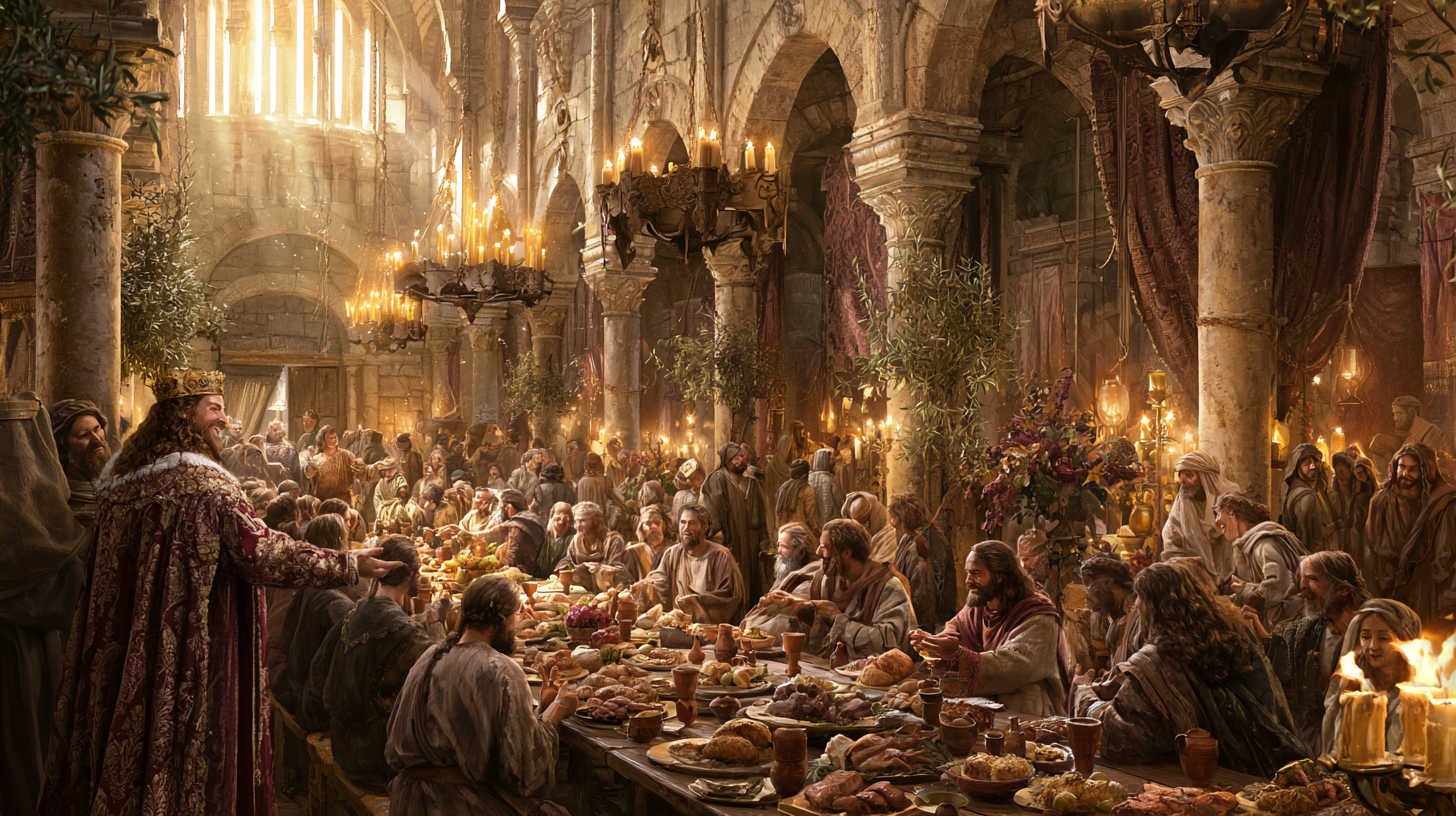
The Parable of the Wedding Feast, found in Matthew 22:1-14, is one of the more sobering stories Jesus told during his final week in Jerusalem. On the surface, it describes a king throwing a wedding banquet for his son. Beneath that surface, it addresses rejection, grace extended to outsiders, and the danger of assuming access to God’s kingdom without meeting his terms.
This guide walks through the full text of the parable, its historical and cultural background, its layered meaning, and the practical lessons it offers today. A summary table and FAQ section are included for quick reference.
The Verse: Matthew 22:1-14
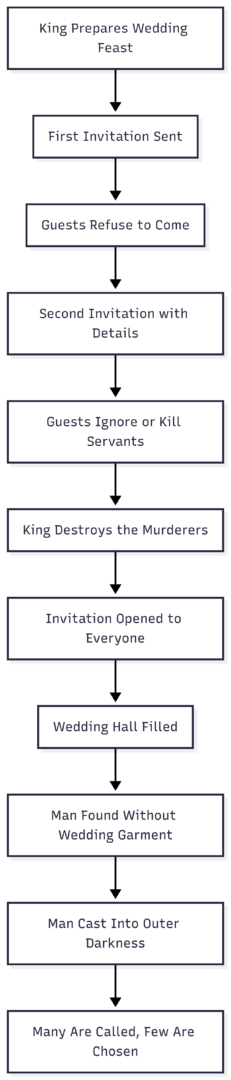
Jesus tells the story of a king who prepares a wedding banquet for his son. He sends servants to summon the invited guests, but they refuse to come. A second round of servants is sent with more detail about the feast, and again the invitation is refused — some guests simply ignore it, while others seize the king’s servants, mistreat them, and kill them.
The king responds with military force, destroying the murderers and burning their city. He then sends his servants into the streets to invite anyone they can find, regardless of status, and the wedding hall fills with guests, described as “both bad and good” (Matthew 22:10).
When the king enters to view the guests, he notices one man who is not wearing a wedding garment. Asked how he got in without one, the man is speechless. The king orders him bound and thrown into “outer darkness, where there will be weeping and gnashing of teeth” (Matthew 22:13). The parable closes with Jesus’s statement: “For many are called, but few are chosen” (Matthew 22:14).
Historical and Cultural Context
Understanding this parable requires some background on first-century Jewish weddings and social customs. Marriages were arranged by parents, and a formal contract was signed well before the actual ceremony. The couple was considered married at that point, but they lived separately while the groom prepared a home, sometimes for an extended period. When everything was ready, the groom would return for his bride, often without advance notice, and the wedding ceremony and banquet would follow.
The wedding banquet itself was among the most significant social events in Jewish life, sometimes lasting up to a week. A royal wedding, hosted by a king for his son, would have been an unmatched event — the ancient equivalent of a modern royal wedding drawing global attention. This context makes the guests’ refusal especially striking: there was no reasonable excuse for turning down such an invitation, which is part of the point Jesus is making.
It was also customary for a host to provide wedding garments for guests who could not supply their own, particularly when the invitation extended to people of varying social status. This detail becomes central to the second half of the parable.
The Meaning of the Parable
The parable operates on several layers, each pointing to a specific aspect of God’s relationship with Israel, the Gentiles, and individual believers.
The King and the Son
The king represents God the Father, and the son being honored at the wedding is Jesus Christ. This aligns with the broader context of Matthew 22, which follows two other parables Jesus told during the same temple confrontation with the chief priests and Pharisees — the parable of the two sons and the parable of the tenants — all delivered in response to the religious leaders questioning his authority.
The Refusal and the New Invitation
The originally invited guests, who repeatedly refuse to attend, represent Israel’s religious leadership rejecting Jesus’s message despite having received the promises of a coming kingdom for centuries. The mistreatment and killing of the king’s servants reflects the historical rejection and murder of prophets sent to call Israel to repentance, including John the Baptist.
The king’s military response, described in verse 7, is widely understood as a prophecy of Jerusalem’s destruction by Rome in AD 70, which occurred roughly 40 years after Jesus spoke this parable. The subsequent invitation extended to “anyone found” on the roads represents the gospel being opened to the Gentiles and to outsiders who had no prior claim on the kingdom, a shift later described directly by Paul in Acts 13:46.
The Wedding Garment
The man without a wedding garment represents someone who wants access to the kingdom on his own terms. In a culture where the host customarily provided garments for guests, refusing to wear the offered garment was not a matter of poverty or oversight; it was a deliberate statement rejecting what the king had provided in favor of showing up as he was.
This detail illustrates the inadequacy of self-righteousness. Scripture repeatedly uses clothing as a metaphor for righteousness — from God replacing Adam and Eve’s inadequate coverings with animal skins in Genesis 3:21, to the white robes described in Revelation 7:14, made white through being washed in the blood of the Lamb. The wedding garment ultimately represents the righteousness of Christ, offered freely, rather than righteousness a person attempts to construct on their own.
Key Lessons from the Parable
| Lesson | Description | Supporting Verse |
|---|---|---|
| Grace extended broadly | The invitation reaches people regardless of status, background, or past behavior | Matthew 22:9-10 |
| Acceptance requires submission | Being invited is not sufficient; the invitation must be accepted on the king’s terms | Matthew 22:11-12 |
| Self-righteousness is rejected | Attempting to approach God unchanged, without accepting his provision, leads to judgment | Isaiah 64:6, Philippians 3:9 |
| Judgment is real | Persistent rejection of the invitation carries serious consequences | Matthew 22:13, Hebrews 10:29-31 |
| Many hear, few respond | Widespread awareness of the invitation does not guarantee a genuine response | Matthew 22:14 |
Comparing the Wedding Feast to the Parable of the Great Banquet
Readers sometimes confuse this parable with the similar Parable of the Great Banquet in Luke 14:15-24. While both stories involve a host, refused invitations, and a subsequent invitation extended to outsiders, there are notable differences.
| Feature | Wedding Feast (Matthew 22) | Great Banquet (Luke 14) |
|---|---|---|
| Host | A king | A private individual |
| Occasion | A wedding for the king’s son | A large dinner |
| Guest treatment | Servants mistreated and killed | Guests offer excuses only |
| Consequence for refusal | City destroyed | Excluded from the banquet |
| Additional detail | Man without wedding garment cast out | No equivalent detail |
| Primary audience | Religious leaders challenging Jesus’s authority | Guests at a Pharisee’s dinner |
The Matthew account carries a sharper edge, including both the destruction of a city and the removal of an improperly dressed guest, making its warning about judgment more explicit than the Luke parallel.
Why the Wedding Garment Detail Matters
Some readers find the punishment of the improperly dressed guest disproportionate to the offense, especially by modern standards where formal dress codes carry little weight. Understanding the custom of hosts providing garments clarifies the point: this was not a matter of the man lacking proper clothing through poverty or oversight, but a deliberate refusal of what was freely offered.
The parallel to salvation is direct. Just as the king supplied the garments needed for entry into the feast, God supplies the righteousness needed for entry into his kingdom through Christ. Refusing that provision while still expecting a place at the table reflects the same posture as the man who assumed his own clothing was sufficient.
Practical Application Today
This parable challenges a few common assumptions:
- Proximity to faith communities is not the same as genuine faith. Being present at the wedding hall did not exempt the man from the dress requirement; likewise, association with religious institutions does not substitute for accepting God’s terms personally.
- Grace is available to everyone, without exception based on background. The servants were instructed to gather “both bad and good” without exercising judgment about who deserved an invitation.
- Acceptance still requires a response. The invitation alone does not save; it must be received according to the terms set by the host, not renegotiated by the guest.
- Indifference carries real consequences. The guests who ignored the invitation in favor of ordinary business were treated no differently from those who were openly hostile — both responses resulted in exclusion.
Frequently Asked Questions
The parable illustrates that God’s invitation to his kingdom is extended broadly, but acceptance requires submitting to his terms rather than approaching him on one’s own terms or self-righteousness.
He represents someone who wants the benefits of the kingdom without accepting the righteousness God provides through Christ, attempting instead to rely on his own merit or effort.
No. While similar in structure, the Wedding Feast in Matthew 22 involves a king, a wedding for his son, the destruction of a city, and the wedding garment detail — none of which appear in the Luke 14 account.
The parable does not give a specific excuse; it simply states they “were not willing to come” (Matthew 22:3), emphasizing that the refusal was a matter of will rather than circumstance.
This phrase distinguishes between the wide reach of God’s invitation and the smaller number of people who genuinely accept it on his terms and remain committed.
While the immediate audience was the religious leadership of Jerusalem, the parable’s warning about assuming access to God’s kingdom without genuine acceptance applies broadly to anyone who hears the gospel invitation, including within the church today.
Final Thoughts
The Parable of the Wedding Feast delivers one of the most direct warnings in Jesus’s teaching: an open invitation does not guarantee entry, and proximity to the feast is not the same as being properly prepared for it. The story moves from a picture of lavish, generous grace — extended to strangers regardless of merit — to a sober reminder that this grace must be received on the terms it is offered, not redefined by the guest.
Read alongside its historical context and its parallel in Luke 14, this parable remains one of the clearest biblical illustrations of both the breadth of God’s invitation and the seriousness of how it must be answered.
Please share this Parable of the Wedding Feast: Verse, Meaning & Lesson with your friends and do a comment below about your feedback.
We will meet you on next article.
Until you can read, The 20 Most Popular Favorite Bible Verses for Women