Why working from home should be standard practice
Working from home has moved far beyond a pandemic-era workaround. It is now a documented driver of measurable business results: higher output per employee, sharply lower turnover, reduced real estate spending, and access to talent that a single office building could never reach. The debate has shifted from “does remote work function?” to “why isn’t every eligible role already structured this way?”
This article breaks down the evidence, the numbers, the objections critics raise, and a practical framework for deciding how much remote work makes sense for a given team.
The Ctrip Experiment: The Study That Changed the Conversation
Much of the modern case for remote work traces back to a landmark controlled experiment led by Stanford economist Nicholas Bloom. Working with James Liang, co-founder of the Chinese travel company Ctrip, Bloom designed a randomized trial rather than relying on surveys or anecdotes, which is what made the results so influential.
Ctrip’s Shanghai call center was dealing with high turnover and expensive office space in one of the world’s priciest cities. More than 500 employees volunteered for the study, and those who met basic requirements — a quiet space at home, at least six months of tenure, and reliable internet — were split into two groups by a simple, unbiased rule: employees with even-numbered birthdays worked from home four days a week, while those with odd-numbered birthdays stayed in the office as the control group.
Over nine months, the results surprised even the skeptics running the study:
- Ctrip saved roughly $1,900 per employee in office-related costs.
- The remote group’s productivity rose by about 13.5%, equivalent to gaining almost an extra day of output per person every week.
- Remote employees took shorter breaks, called in sick less often, and used less vacation time.
- Attrition among remote workers dropped by roughly 50% compared with the office group.
Interestingly, not everyone wanted to stay remote. More than half of the volunteers who worked from home eventually asked to return to the office, citing isolation — particularly younger employees still living with parents. That finding matters: it’s the basis for why most successful remote strategies today are hybrid rather than fully remote, giving people the deep-focus benefits of home work alongside the social contact of an office.
Why It Works: The Core Benefits
For Employers
A larger talent pool. Hiring is no longer bound by commuting distance. Companies can recruit specialists regardless of location, which improves both skill matching and workforce diversity.
Higher output. Fewer interruptions from hallway conversations, impromptu meetings, and open-office noise translate into deeper, more sustained focus. Owl Labs research has found that a majority of remote employees report working more hours than they did in the office, largely because commute time gets reinvested into work.
Stronger retention. Replacing an employee is expensive — Gallup estimates the cost at anywhere from half to twice that person’s annual salary once recruiting, onboarding, and lost productivity are factored in. Offering remote flexibility is now one of the most cost-effective retention tools available, and multiple workforce surveys show a large majority of employees would pick a remote option over an in-office role if given the choice.
Lower overhead. Less office space means lower rent, fewer utilities, less equipment, and reduced spending on desks, parking, and supplies per employee.
Built-in business continuity. A distributed workforce isn’t dependent on a single building. Severe weather, transit disruptions, or another public health event won’t halt operations the way they would for a fully centralized team.
Smaller environmental footprint. Fewer daily commutes and a smaller physical footprint reduce a company’s carbon emissions, supporting broader sustainability commitments.
For Employees
Time back. Cutting a commute reclaims hours every week that can go toward family, exercise, sleep, or simply recovery time.
Better work-life integration. Flexibility over when and where work happens makes it easier to handle caregiving, appointments, and daily life without constant friction against a fixed schedule.
Higher reported productivity. Independent surveys, including research from RingCentral, consistently find that around half of remote employees feel they get more done at home than they did in a traditional office.
Career mobility. Remote-eligible roles open up jobs with companies far outside a person’s home city, region, or even country — a meaningful advantage for people who don’t want to relocate for career growth.
The Business Case, By the Numbers
| Factor | In-Office Impact | Remote/Hybrid Impact |
|---|---|---|
| Productivity | Baseline | Increases of roughly 13–15% reported in controlled studies |
| Employee attrition | Baseline | Roughly 50% lower in the Ctrip trial |
| Office cost per employee (Ctrip case study) | Full cost | Approximately $1,900 saved per employee |
| Commute time reclaimed | 0 hours | Up to 4–5 hours per week |
| Employee preference for remote options | N/A | Majority of surveyed U.S. workers favor remote over in-office |
| Sick days and extended breaks | Baseline | Reported reductions among remote staff |
| Cost Category | Typical Office-Based Expense | Typical Remote Savings |
|---|---|---|
| Real estate / rent | Fixed per-desk cost year-round | Reduced or eliminated with smaller footprint |
| Utilities | Full building usage | Scales down with fewer in-office staff |
| Office equipment & furniture | Full setup per employee | One-time home office stipend, often lower total cost |
| Commuting costs (employee-side) | Daily transport, parking, fuel | Eliminated or greatly reduced |
| Work attire & meals out (employee-side) | Recurring daily cost | Reduced significantly |
| Recruiting radius | Limited to commutable area | Expanded to national or global talent pool |
A Framework for Deciding How Much Remote Work Makes Sense
Not every role or team benefits from the same arrangement. The flowchart below outlines a simple decision path for choosing between fully in-office, hybrid, or fully remote structures.
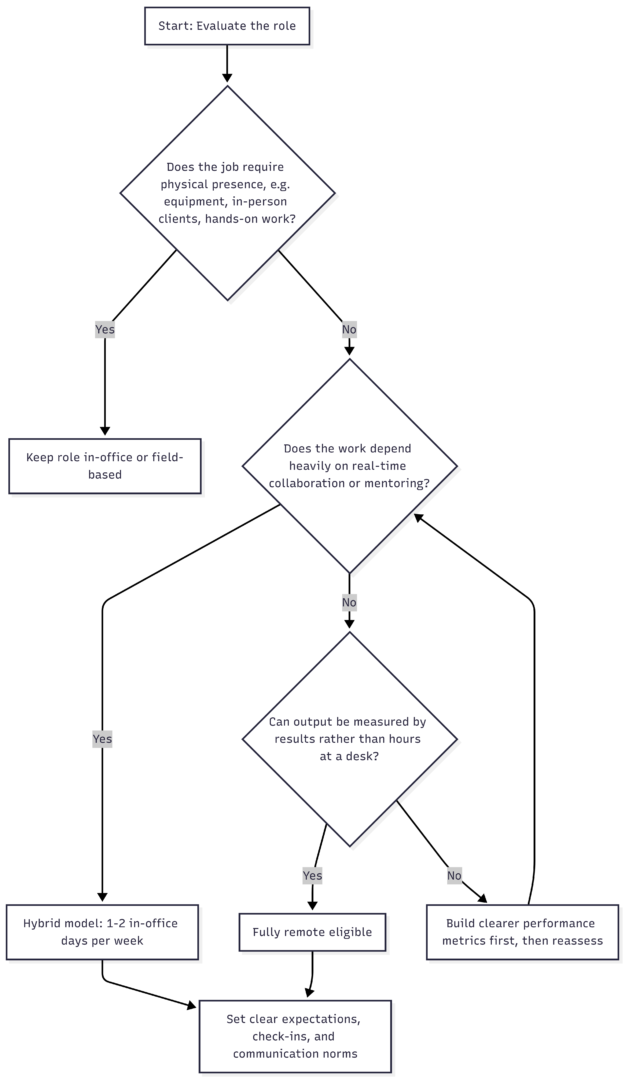
This mirrors what Bloom’s research and subsequent workplace studies suggest: one or two in-office days a week tend to preserve team cohesion while still delivering most of the productivity and cost benefits of remote work. Pushing much further toward isolation, especially for early-career employees, can erode the sense of connection that keeps people engaged.
Addressing the Common Objections
Skepticism about remote work usually centers on a few recurring concerns, and each one has a practical answer.
“There’s no oversight, so people will slack off.” In practice, most remote setups include more monitoring than a traditional office, not less — activity tracking, screen-lock timers, call recording, and manager dashboards are standard in many remote call-center and customer service roles. The controlled data also doesn’t support the slacking narrative: output measurably increased in the Ctrip trial and in subsequent studies.
“Remote work is a security risk.” Company-issued laptops used remotely carry the same firewalls, encryption, and access controls as an in-office machine. Most data breaches originate from phishing and human error, which happen regardless of where someone is sitting, not from the location of the device itself.
“Some people just aren’t cut out for structured self-management.” This is true, but it’s an argument for offering remote work selectively and setting clear performance expectations — not for denying it to an entire workforce. Many companies already treat remote eligibility as a privilege tied to tenure, performance, or role, rather than a blanket policy.
“Isolation hurts younger or newer employees.” This is a legitimate finding, not just a talking point — in the Ctrip study, isolation was the single biggest reason employees asked to return to the office. It’s the strongest argument for hybrid models over fully remote ones, particularly for early-career staff who benefit from in-person mentoring.
What a Successful Hybrid Policy Typically Includes
- Clear expectations for deliverables and response times, not just hours logged
- A defined cadence for in-office days built around team collaboration, not attendance for its own sake
- Reliable technology and a stipend or reimbursement for home office setup
- Regular one-on-one check-ins to prevent isolation, especially for newer employees
- Performance evaluation tied to output and outcomes rather than visibility
The Bottom Line
The data from controlled studies, large-scale surveys, and years of workplace experience point in the same direction: remote and hybrid work options tend to increase productivity, reduce turnover, cut costs for both employers and employees, and widen access to talent. The exceptions are roles that genuinely require physical presence — and even those can often adopt hybrid elements around administrative or planning work.
Making remote work the default for eligible roles isn’t about eliminating the office. It’s about giving teams the flexibility to work where they perform best, while keeping just enough in-person time to preserve collaboration and connection. Companies that build that balance thoughtfully tend to come out ahead — in retention, in cost, and in the quality of people willing to work for them.
Frequently Asked Questions
Controlled research, most notably the Ctrip study led by Nicholas Bloom, found a measurable 13.5% productivity increase among remote workers compared with an in-office control group, not just self-reported improvement.
In the Ctrip case study, the company saved approximately $1,900 per employee over nine months through reduced office space and overhead. Savings scale with the size of the remote workforce and how much physical space is downsized.
Not necessarily. Research suggests one to two in-office days per week tends to preserve team cohesion and reduce isolation, while still capturing most of the productivity and cost benefits associated with remote work.
Company-managed remote devices typically carry the same security controls as in-office machines, including encryption and access restrictions. Most breaches stem from human error like phishing, which is not tied to physical location.
Employees with established roles, clear performance metrics, and reliable home setups tend to benefit most. Newer or early-career employees often benefit more from hybrid arrangements that preserve in-person mentoring and connection.
Jobs that require physical presence, specialized equipment, in-person client interaction, or hands-on collaboration are generally better suited to in-office or field-based structures, though administrative portions of these roles can sometimes still be handled remotely.
Remote work isn’t a perk to be doled out sparingly or a risk to be managed defensively — it’s a workplace design choice backed by real data, and companies that treat it that way are the ones seeing the strongest results in productivity, retention, and cost efficiency.
Please share this Why working from home should be standard practice with your friends and do a comment below about your feedback.
We will meet you on next article.
Until you can read, Parable of the New Cloth and New Wineskins: Verse, Meaning & Lesson