
What is the definition of remote work?
Remote work is an employment arrangement in which workers perform their job duties from a location other than a central company office — typically a home, coworking space, or any location with reliable internet access.
Rather than commuting to a fixed workplace, remote employees use digital tools to collaborate, communicate, and complete tasks. The arrangement may be full-time, part-time, contract-based, or freelance, and it spans industries from software development to healthcare administration.
A formal definition used by many government and HR frameworks describes remote work as a written arrangement in which an employee is scheduled to work at an alternative worksite on a regular and recurring basis, with no expectation of reporting to an agency or corporate office location.
Remote Work vs. Working from Home vs. Telecommuting
These terms are often used interchangeably, but there are meaningful distinctions:
| Term | Definition | Key Characteristic |
|---|---|---|
| Remote work | Performing job duties from any location outside the employer’s office | Location-independent; may be permanent |
| Working from home (WFH) | A specific subset of remote work done from a home environment | Location-specific; may be temporary |
| Telecommuting | Working from home on a defined schedule, usually with regular office days | Schedule-structured hybrid of WFH and office |
| Hybrid work | Splitting time between home and office based on a set schedule | Combines both environments |
| Digital nomad | Full remote work while traveling continuously | Location-independent and geographically mobile |
Working from home temporarily to care for a sick child, for example, does not constitute remote work in the formal sense — it is a short-term accommodation. True remote work involves a sustained, structured arrangement with defined expectations.
Types of Remote Work
Fully Remote
Fully remote employees work 100% of their hours outside any company office. The company may or may not maintain a physical headquarters. Fully remote workers receive the same compensation and benefits as in-office counterparts and participate in meetings, presentations, and team activities through digital platforms. They may live in any city or country, depending on employer policy.
Well-known companies that operate as fully remote organizations include Buffer, Zapier, GitLab, and Hubstaff — each demonstrating that a distributed-first model can sustain high productivity and culture at scale.
Hybrid Remote
Hybrid workers split their week between home and office — commonly two or three days remote, with the rest in-office. A McKinsey study found that nearly 60% of workers with hybrid-compatible roles reported using a hybrid arrangement, and a majority preferred it to either fully remote or fully in-office models.
Flexible Remote
Flexible remote roles are primarily in-office positions that allow occasional remote work — once or twice a week, or during specific circumstances. These are common in industries transitioning toward distributed work without fully abandoning physical office presence.
Freelance and Contract Remote
Freelancers operate independently, taking on project-based work for multiple clients. Freelance remote work is common in digital marketing, writing, design, coding, consulting, and social media management. Some freelancers supplement a full-time role; others build freelancing into their primary income source.
Remote Work Spectrum: Job Suitability
Not every role can be performed remotely. Remote work potential depends on how much a position relies on physical presence, specialized on-site equipment, or in-person interaction.
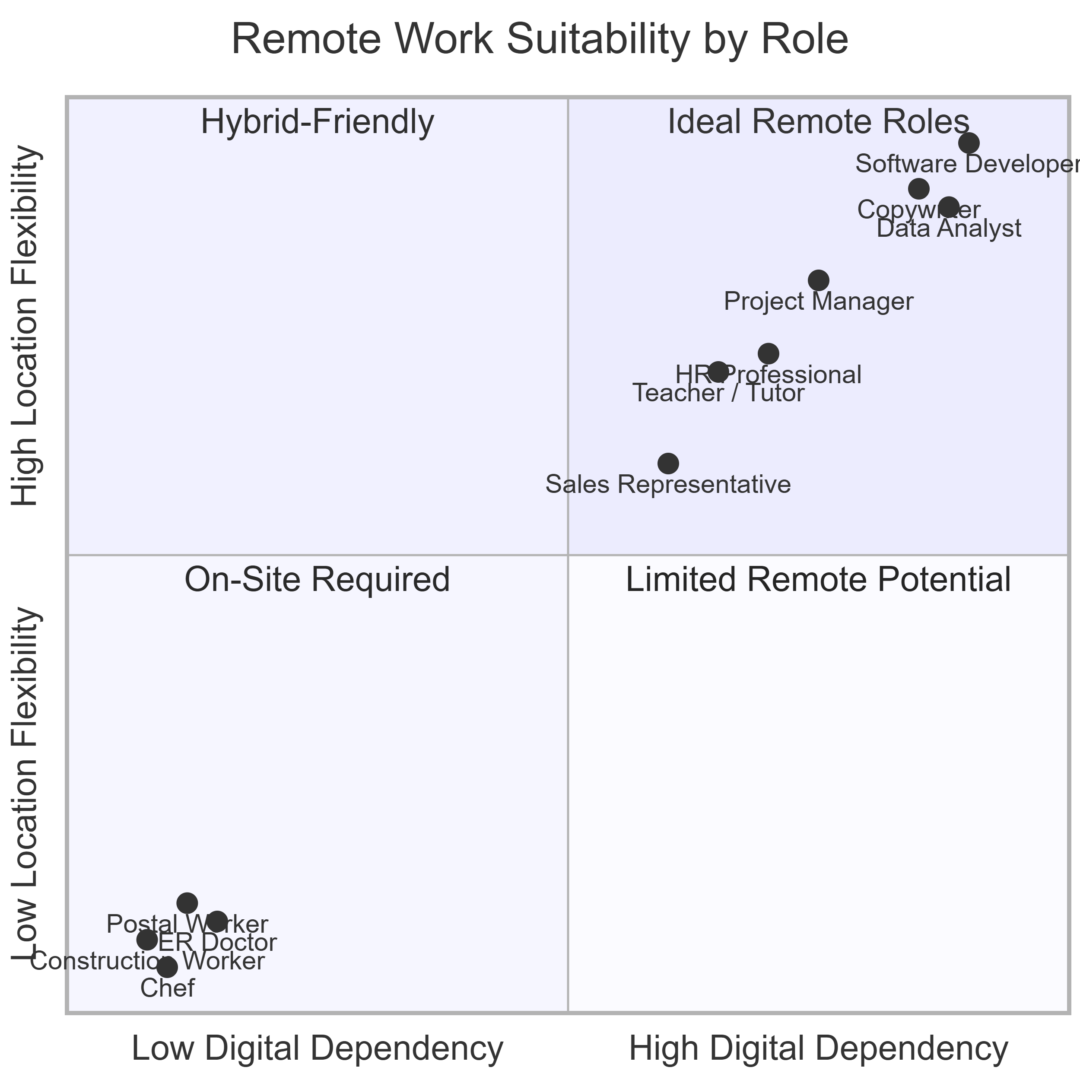
Roles with high remote work potential include software development, data analysis, copywriting, graphic design, accounting, customer service management, virtual assistance, online teaching, and digital marketing. Jobs requiring manual labor, specialized on-site equipment, or direct physical interaction with clients or patients have low remote work potential.
Most In-Demand Fully Remote Careers
According to FlexJobs research, the five most commonly sought fully remote roles are:
- Accountant / Financial Analyst — bookkeeping, tax preparation, and financial reporting via cloud-based platforms
- Engineer (Software / Systems) — development, testing, and deployment managed through version control and cloud infrastructure
- Teacher / Tutor / Instructor — course delivery, curriculum design, and student management through LMS platforms
- Writer / Editor / Copywriter — content production, editing, and publication workflows done entirely in digital environments
- Consultant — strategy, operations, and advisory work delivered through video calls, reports, and digital deliverables
Benefits of Remote Work
For Employees
Flexibility and Work-Life Integration Remote work allows employees to structure their day around personal commitments — school pickups, medical appointments, and personal errands — without exhausting vacation time. A Slack study found that fully remote workers report the highest work-life balance satisfaction compared to fully in-office workers.
Higher Productivity Stanford University research found remote workers were 13% more productive than in-office counterparts, citing fewer interruptions, shorter commutes, and greater schedule autonomy. Separately, 62% of employees self-report feeling more productive when working remotely.
Financial Savings Remote workers eliminate or reduce daily transportation costs, work wardrobe expenses, and lunch spending. Over a year, these savings are substantial — particularly for workers in high cost-of-living metro areas.
Better Health Outcomes Without commute stress and rigid office schedules, remote workers report lower burnout rates, more opportunities for exercise, and improved eating habits. Mental Health America found that 77% of survey respondents said flexible work arrangements would make them feel healthier.
Accessibility Remote work reduces barriers for employees with disabilities who may face transportation challenges or lack proper accommodations in traditional offices. It also opens opportunities for caregivers and parents who need schedule flexibility.
For Employers
Lower Operating Costs American Express saved $15 million in real estate costs by implementing a flexible BlueWork program. Global Workplace Analytics estimates employers save approximately $11,000 annually per employee who works remotely half the time.
Wider Talent Pool Geography no longer limits hiring. Employers can recruit specialized talent from anywhere, improving diversity and the quality of candidates available.
Higher Retention Workers who have remote or hybrid options are significantly less likely to leave. With 80% of workers saying they would turn down a comparable offer that lacked flexible work options, remote-friendly policies have become a competitive hiring differentiator.
Reduced Absenteeism Employees who can work from home when mildly ill or dealing with household emergencies are less likely to take full sick days, reducing unplanned absences.
Challenges of Remote Work
For Employees
| Challenge | Description | Mitigation |
|---|---|---|
| Isolation | Lack of spontaneous social interaction with colleagues | Coworking spaces, virtual social channels |
| Boundary erosion | Difficulty separating work and home life | Defined work hours, separate workspace |
| Self-motivation | No external accountability structure | Time-blocking, productivity tools |
| Communication gaps | Asynchronous availability delays | Clear response-time expectations |
| Limited visibility | Reduced exposure to senior leadership for career growth | Proactive communication, video presence |
For Employers
| Challenge | Description | Mitigation |
|---|---|---|
| Monitoring productivity | Cannot observe work in real time | Output-based performance metrics |
| Culture erosion | Loss of informal team bonding | Intentional virtual culture programming |
| Cybersecurity | More endpoints increase data exposure | VPNs, MFA, endpoint management software |
| Onboarding complexity | New hires lack organic context absorption | Structured digital onboarding programs |
How Remote Work Functions Day to Day
Remote work replaces traditional office tools with digital equivalents:
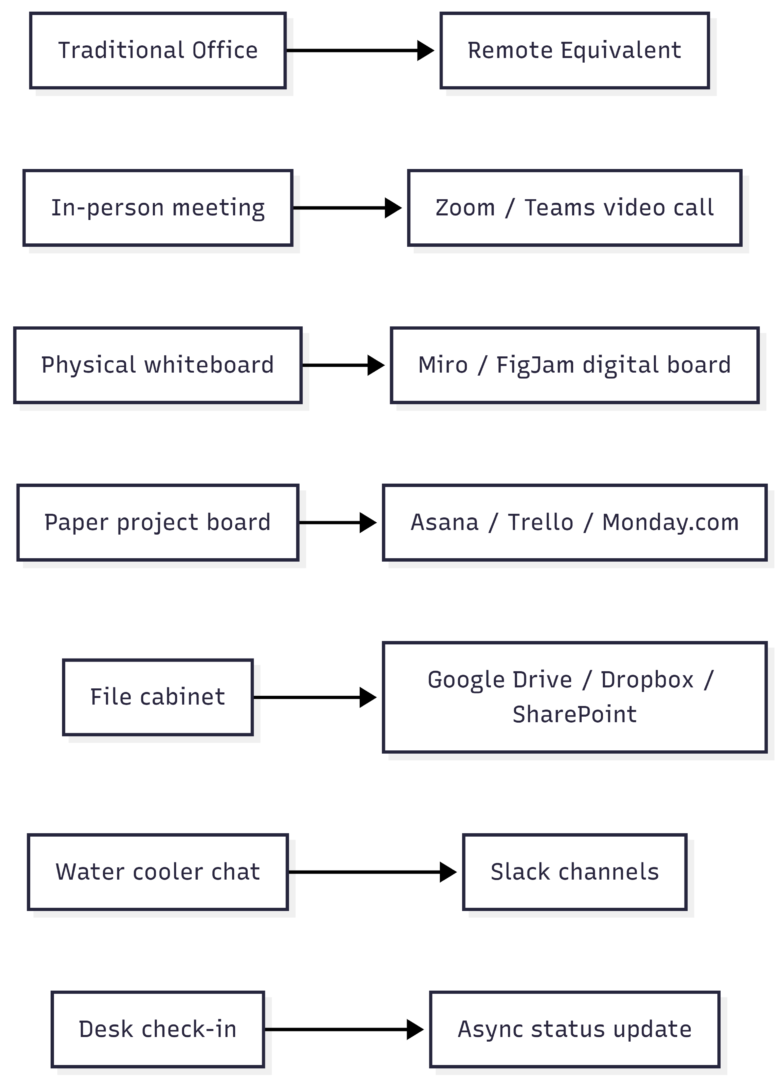
The key shift is from synchronous, presence-based work to output-based, asynchronous collaboration. Remote employees are typically evaluated on deliverables and deadlines rather than hours visible at a desk.
Essential Remote Work Tools
Communication
- Slack — team messaging, channels, and integrations
- Zoom / Microsoft Teams — video conferencing and virtual meetings
- Google Meet — lightweight video calling for Google Workspace users
Project Management
- Asana / Trello / Monday.com — task boards, timelines, and workload tracking
- Notion / Confluence — documentation and knowledge management
- Wrike — comprehensive work management for larger distributed teams
File Collaboration
- Google Drive / Dropbox / SharePoint — cloud storage and real-time document editing
- Figma — collaborative design for visual and UI work
Security
- NordLayer / Cisco AnyConnect — corporate VPN for secure remote access
- 1Password / Bitwarden — password management
- Duo Security / Google Authenticator — multi-factor authentication
Time and Productivity
- Clockify / Toggl — time tracking for billable hours and personal productivity
- Loom — asynchronous video messages to replace quick desk conversations
Job Characteristics Theory and Remote Productivity
A psychological framework called job characteristics theory explains why remote work does not inherently reduce employee performance. The theory identifies five core job characteristics that drive intrinsic motivation:
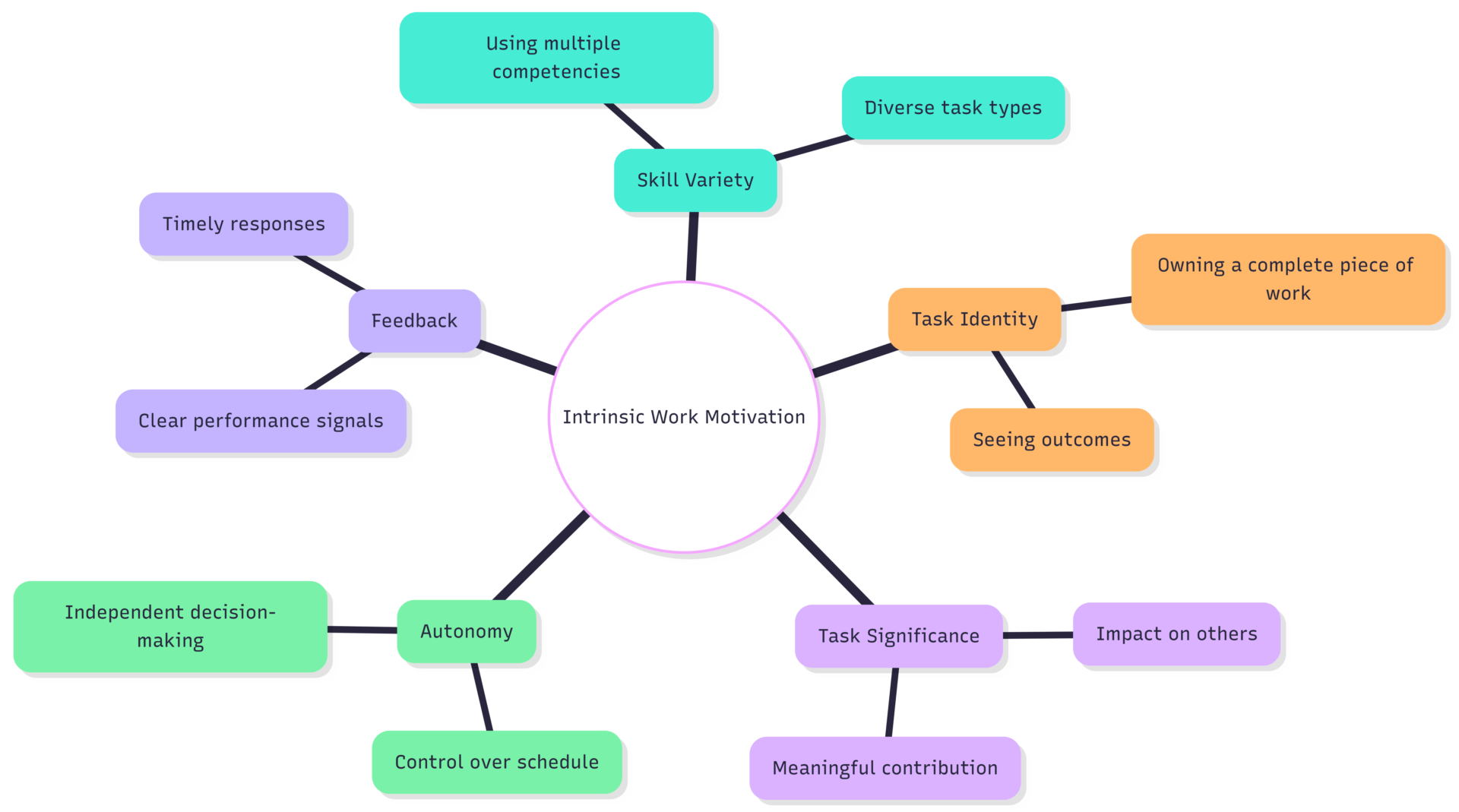
Remote work, when structured well, can enhance autonomy without sacrificing the other four dimensions — potentially increasing rather than reducing engagement. The challenge lies in maintaining task significance and feedback loops when teams are distributed.
Remote Work Best Practices
Establish clear expectations. Define whether remote means flexible hours, core hours, or full schedule equivalence. Ambiguity around availability creates friction.
Invest in the right tools. At minimum, distributed teams need an instant messaging platform, a video conferencing solution, and collaborative project management software.
Build trust over surveillance. Monitoring software creates disengagement. Performance measured by outputs — completed tasks, project milestones, quality standards — builds accountability without micromanagement.
Maintain culture deliberately. Culture does not self-sustain in a remote environment. Virtual social channels, team retrospectives, and optional casual video calls require intentional scheduling.
Seek regular feedback. Remote arrangements benefit from structured check-ins where employees can flag what is and is not working. Iteration is essential, especially in the early months.
How to Find Remote Work
Search remote-specific job boards — We Work Remotely, Remote.co, FlexJobs, and Remotive.io curate positions structured for distributed teams. Filter by role, career level, and time zone compatibility.
Use keyword filters on general boards — On Indeed or LinkedIn, search terms like “remote,” “work from home,” “distributed,” and “fully remote” surface relevant listings within general job databases.
Network in remote-first communities — Slack groups, LinkedIn communities, and subreddits focused on remote work connect job seekers with employers who have established distributed infrastructure.
Ask your current employer — Many roles can be renegotiated toward hybrid or remote arrangements, especially for employees with proven track records. A single flexible day per week often evolves into a broader arrangement over time.
FAQs
Remote work is a formal, ongoing arrangement where an employee is not expected to report to a physical office. Working from home can refer to either remote work or a temporary exception — like caring for a sick child — that does not constitute a permanent change in work structure.
No. Remote work spans accounting, education, healthcare administration, marketing, legal support, customer service, design, writing, and many other fields. Any role where the core tasks can be performed digitally has remote potential.
Evidence generally shows the opposite. Stanford research found a 13% productivity increase among remote workers. However, productivity depends heavily on job design, management approach, and individual working conditions.
A digital nomad is a remote worker who uses location independence to travel continuously — working from different cities or countries while maintaining professional commitments through digital tools and stable internet access.
Global Workplace Analytics estimates $11,000 in annual savings per remote employee working half-time from home, accounting for reduced real estate, utility, and absenteeism costs.
Remote work is not a temporary accommodation or a niche arrangement for a handful of industries. It is a structural feature of the modern labor market, supported by research, adopted by organizations of every size, and now expected by a significant share of the workforce.
Understanding what remote work means — and how to make it function effectively — is essential for both employers building distributed teams and employees navigating their career options.
Please share this What is the definition of remote work? with your friends and do a comment below about your feedback.
We will meet you on next article.
Until you can read, Can Architects Work From Home? A Real-World Perspective