
Why is it so hard to find a remote job?
Discover why finding a remote job is so hard today. Learn about competition, market trends, and strategies to secure work-from-home roles.
The dream of working from home—free from commutes, with flexibility to balance life and work—has captivated millions. Yet, for many, this dream feels increasingly out of reach. Job seekers, from stay-at-home parents to digital nomads, express frustration over the scarcity of remote opportunities, fierce competition, and the emotional toll of endless rejections or scams. So, why is it so hard to find a remote job? This article dives into the root causes, backed by data and real-world insights, and offers practical strategies to navigate the challenging remote job market.
The Remote Job Market: A Perfect Storm
The remote job landscape has transformed dramatically since the COVID-19 pandemic. While 2020 saw a surge in work-from-home opportunities, recent trends show a contraction. Several factors converge to create what one commenter aptly called a “perfect storm” sinking remote work prospects.
1. Shrinking Supply of Remote Jobs
Remote job postings are declining. According to data shared by a user on a popular online forum, only 12% of U.S. jobs were remote last year, yet 50% of job seekers applied for these roles. This imbalance highlights a stark supply-and-demand issue. Many companies, especially larger ones, are pushing for hybrid or fully on-site models. A shift back to office-based work is driven by:
- Employer Preferences: Some organizations believe in-person collaboration boosts innovation and culture. Others face pressure to utilize leased office spaces, as empty buildings offer no tax benefits.
- Tax and Legal Complexities: For smaller or mid-sized companies, hiring remote workers across state or national borders involves navigating complex tax laws, payroll rules, and employment regulations. Larger corporations with established infrastructures handle this better, but smaller firms often avoid remote hires unless candidates possess highly specialized skills.
2. Explosive Competition
The allure of remote work draws a massive pool of applicants. For every remote job, there can be 1,000 to 15,000 applicants, as noted by a job seeker who started their own company after facing such odds. This competition isn’t just local—candidates face global rivals, particularly from regions with lower wage expectations, like India or the Philippines, where skilled workers may accept $700 monthly salaries.
- Global Talent Pool: Remote roles open the door to international applicants, making it harder for candidates in high-cost-of-living (HCOL) areas to compete, especially when employers offer salaries far below local market rates (e.g., $55,000 for a role that would pay $120,000 in a HCOL area).
- Diverse Applicant Profiles: From seasoned professionals to entry-level workers, everyone is vying for the same roles, diluting the chances of standing out.
3. Employer Leverage and Cost-Cutting
Remote jobs are often treated as perks for existing employees rather than opportunities for new hires. Employers, aware of the high demand, can offer lower salaries and hire overqualified candidates at bargain rates. This dynamic is particularly evident in HCOL areas, where companies target talent from lower-cost regions.
- Ghost Jobs and Scams: Some job postings are fake or already filled, used to collect resumes or meet HR quotas. Others are outright scams, asking for upfront payments (e.g., $25 for a background check). These erode trust and waste applicants’ time.
- AI and Automation: Employers are experimenting with AI to replace tasks previously handled by remote workers, particularly in eCommerce and administrative roles, reducing job openings.
4. Skill Mismatch and High Expectations
Remote jobs often demand precise skill sets. Entry-level roles, like data entry or customer service, face overwhelming applications, while specialized roles (e.g., UX design, software engineering) require advanced expertise. Without a standout resume or niche skills, candidates struggle to get noticed.
- Resume Overload: With hundreds of applications per role, many resumes are never reviewed. Applicant Tracking Systems (ATS) filter out candidates who don’t perfectly match keywords.
- Childcare Challenges: For stay-at-home parents, like the original poster (a SAHM in New York), remote work seems ideal, but many companies require childcare during work hours, adding financial strain.
The Emotional and Financial Toll
The struggle to find a remote job isn’t just logistical—it’s deeply personal. Job seekers share stories of desperation:
- One lost their job, car, and apartment, becoming homeless after months of fruitless applications.
- Another, pregnant and living with parents, faced rejections despite strong interviews, questioning what employers even want.
- A parent of a disabled child couldn’t find accessible remote work, despite agency support.
The emotional weight of constant rejections, coupled with financial pressures like relocation or childcare costs, can feel crushing. Scams further erode hope, as applicants waste time on fraudulent listings.
Data Snapshot: Remote Job Trends
To illustrate the challenges, consider this table summarizing key trends in the remote job market:
| Factor | Impact on Remote Jobs |
|---|---|
| Percentage of Remote Jobs | ~12% of U.S. jobs are remote, but attract 50% of applicants. |
| Applicant Volume | 1,000–15,000 applicants per remote role, including global candidates. |
| Salary Disparity | Remote roles often pay 30–50% less than equivalent on-site roles in HCOL areas. |
| Employer Preferences | 60% of companies prefer hybrid/on-site, citing collaboration and office space utilization. |
| Global Competition | Candidates compete with international workers accepting salaries as low as $700/month. |
Source: Aggregated from user insights and industry trends.
Strategies to Secure a Remote Job
Despite the challenges, remote jobs are attainable with the right approach. Here are actionable strategies, drawn from successful job seekers and industry experts:
1. Refine Your Application Materials
- Tailor Your Resume: Keep it one page, ATS-friendly, and customized for each role. Highlight achievements and relevant skills. For example, a project management certification with two years of experience needs clear, quantifiable results (e.g., “Led 5 projects to completion, saving 20% on budgets”).
- Craft Cover Letters: Explain why you’re a fit for the role and passionate about remote work. Address childcare proactively if relevant, assuring employers of your focus.
- Get Feedback: Anonymize your resume and post it on forums like r/resumes for constructive critique.
2. Upskill Strategically
- Marketable Skills: Learn in-demand skills like UX design, software development, or digital marketing. Online platforms like Coursera, Udemy, or Google’s Career Certificates offer affordable options.
- Certifications: A Salesforce or Google certification can boost your resume, especially for entry-level remote roles in tech or customer service.
- Bootcamps or Courses: For faster results, consider tech bootcamps (6–12 months) or free resources like RatRaceRebellion.com’s WFH course.
3. Expand Your Search
- Company Websites: Check careers pages of brands like Nordstrom ($18/hour for remote financial services), CVS, or Capital One for unadvertised remote roles. Filter for “remote” on their job portals.
- Niche Platforms: Use FlexJobs, We Work Remotely, or Wfhalert for vetted listings. Avoid platforms with high scam risks, like generic job boards.
- Local Opportunities: Hybrid roles or local companies may offer remote flexibility after a trial period. Banks and corporate firms often hire for remote customer service after initial in-office training.
4. Network Aggressively
- LinkedIn: Connect with hiring managers, join industry groups, and share content to build visibility. One digital nomad landed teaching gigs by sending creative video applications via LinkedIn.
- Referrals: Ask contacts for introductions to remote-friendly companies. Word-of-mouth referrals cut through application noise.
- Community Engagement: Join UX or tech Slack groups, attend virtual meetups, or engage in online forums to uncover unposted opportunities.
5. Consider Freelancing or Entrepreneurship
- Freelance Platforms: Start on Upwork or Toptal to build a remote portfolio. A UX designer was advised to freelance while maintaining a day job, transitioning to full-time once stable.
- Start a Business: Some, like the original poster, considered launching a side hustle (e.g., tutoring, pet sitting, or eCommerce). This offers control but requires time and investment.
- Gig Economy: Platforms like Aira (remote agents assisting visually impaired clients) or Liveops (contact center work, $22/hour for some) provide flexible income.
6. Be Persistent and Flexible
- Apply Relentlessly: One job seeker applied to 200+ roles over 9 months before landing a remote position with benefits. Another got a call-back months later, leading to promotions.
- Negotiate Remote Terms: Apply to in-office roles and negotiate remote work after proving your value, as one digital nomad did, now working remotely from another country.
- Explore Adjacent Fields: If project management isn’t yielding remote jobs, try related roles like logistics or virtual assistance.
7. Protect Against Scams
- Red Flags: Avoid jobs requiring upfront payments or vague descriptions. Research companies via Glassdoor or LinkedIn.
- Legitimate Options: Companies like Concentrix, Telus International, or Outlier are known for remote opportunities, though some, like Liveops, may involve contractor costs (e.g., background checks).
Case Studies: Overcoming the Odds
Case Study 1: From 300 Applications to Promotions
A job seeker applied to over 200 jobs, tweaking their resume for each. After months, a company called back, hired them, and promoted them twice in a year for a role with flexible remote work. Key Takeaway: Persistence and tailored applications pay off.
Case Study 2: Digital Nomad Success
An economics graduate left a law firm to teach online, using platforms like Superprof ($20–50/hour). They now fund educational programs while living abroad, proving that freelancing and niche skills can unlock a nomadic lifestyle.
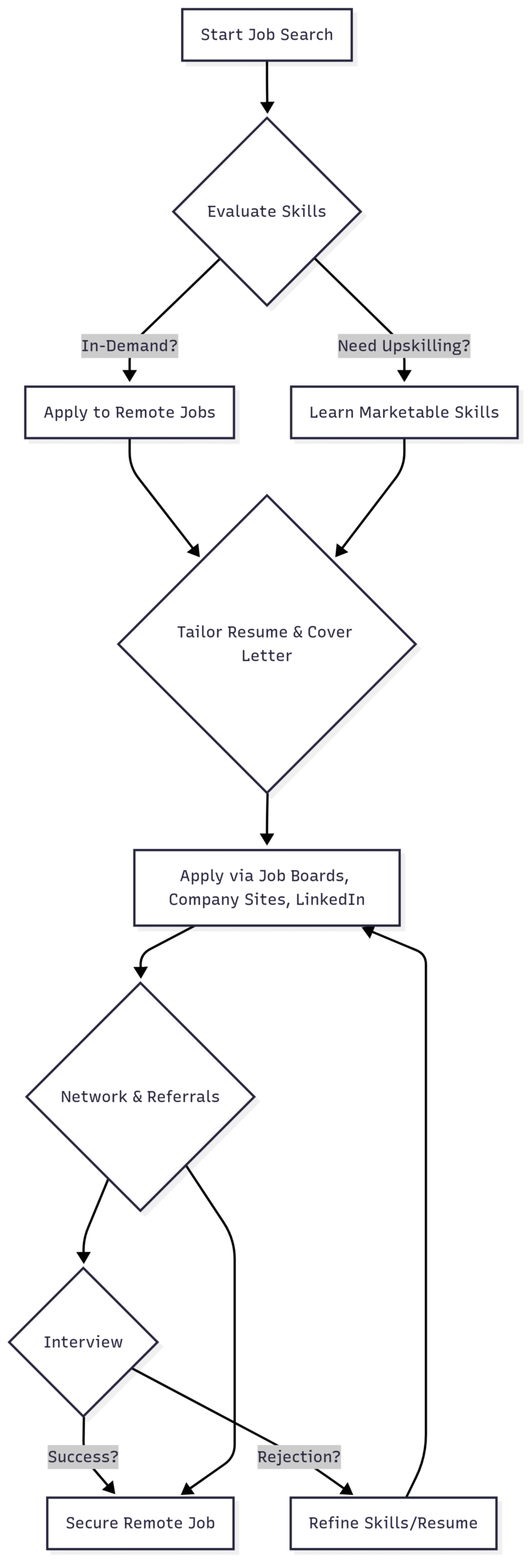
Chart: Remote Job Search Workflow
Below is a flowchart to visualize the process of securing a remote job:
Addressing Specific Challenges for Stay-at-Home Parents
For SAHMs or others with caregiving responsibilities, remote work is often a necessity, not a luxury. However, misconceptions about productivity persist:
- Childcare Requirements: While some companies (e.g., Telus) are lenient, others enforce strict no-childcare-during-work policies. Be transparent about arrangements or seek flexible gigs like tutoring.
- Time Management: Roles like Aira or Liveops offer scheduling flexibility, ideal for parents juggling childcare.
- Alternative Income: If remote jobs remain elusive, consider in-home daycare (state certification required) or gig apps like TaskRabbit, though these may not suit urgent relocation needs.
The Future of Remote Work
While the current market is tough, remote work isn’t disappearing. Startups and tech firms continue hiring remotely, and specialized roles (e.g., UX, engineering) remain viable. However, candidates must adapt:
- Hybrid as a Stepping Stone: Many jobs start in-office but transition to hybrid or remote after proving reliability.
- Globalization: Companies increasingly hire internationally, but this also means competing with lower-wage markets.
- Skill Evolution: AI and automation will reshape remote roles, emphasizing creative and strategic skills over routine tasks.
Conclusion
Finding a remote job is undeniably challenging due to shrinking opportunities, fierce global competition, and employer cost-cutting. Yet, success is possible with persistence, strategic upskilling, and creative networking. Whether you’re a stay-at-home parent needing flexibility or a professional seeking a digital nomad lifestyle, the key is to stand out in a crowded market. Tailor your applications, leverage niche platforms, and consider freelancing or entrepreneurship as viable paths. The remote job market may be a battlefield, but with the right tools and mindset, you can claim your victory.
Please share this Why is it so hard to find a remote job? with your friends and do a comment below about your feedback.
We will meet you on next article.
Until you can read, can digital nomads bring families Portugal




![Latvia Digital Nomad Visa: How to Apply [3 Steps]](https://digiwander.com/wp-content/uploads/2025/05/Storing-Books-5-2-768x432.jpg)
