
can digital nomads bring families Portugal
Discover how digital nomads can bring families to Portugal with the D8 Visa. Learn eligibility, costs, schooling, and family-friendly locations.
Portugal’s Digital Nomad Visa, officially termed the Visto de Estada Temporária para Trabalho Remoto or Visto de Residência para Nómadas Digitais (D8 Visa), has transformed the landscape for remote workers seeking to relocate to one of Europe’s most vibrant and welcoming countries. For digital nomads with families, the D8 Visa stands out due to its family reunification (reagrupamento familiar) provisions, allowing spouses, children, and even dependent parents to join the primary applicant. This article provides an in-depth guide to navigating the D8 Visa process for families, covering eligibility, financial requirements, application steps, schooling options, spousal work restrictions, family-friendly locations, and strategies to overcome common challenges. With Portugal’s high quality of life, affordable living costs, and robust digital infrastructure, the D8 Visa offers a compelling pathway for families to build a new life abroad.
Understanding the D8 Visa and Family Reunification
The D8 Visa caters to non-EU/EEA/Swiss citizens who work remotely for employers or clients outside Portugal. It offers two options: a temporary stay visa (up to one year) or a residency visa (renewable for up to five years, potentially leading to permanent residency or citizenship). The family reunification aspect is a key draw, enabling digital nomads to bring their loved ones, fostering a sense of stability and togetherness in a new country.
Family reunification under the D8 Visa allows eligible family members to obtain residence permits, ensuring they can live legally in Portugal alongside the primary applicant. This provision makes the D8 Visa particularly appealing for digital nomads who wish to relocate with their spouse, children, or dependent parents, offering a structured pathway to integrate families into Portuguese life.
Eligibility for Family Inclusion
To include family members on the D8 Visa, the primary applicant must meet the visa’s core requirements while demonstrating the financial capacity to support their dependents. Eligible family members include:
- Spouse or Partner: Legally married spouses or partners in a stable, documented union (união estável).
- Minor Children: Children under 18, including adopted children.
- Dependent Adult Children: Unmarried children over 18 who are enrolled in full-time education and financially dependent.
- Dependent Parents: Parents of the applicant or spouse who are over 65 or economically dependent.
Key Eligibility Requirements
- Remote Work: The primary applicant must prove they work remotely for entities outside Portugal, such as through employment contracts, freelance agreements, or client contracts.
- Income Threshold: A minimum monthly income of €3,480 (four times Portugal’s minimum wage in 2025) is required. For family inclusion, additional income is needed:
- Spouse: Add 50% (€5,220 total monthly income).
- Each Child or Dependent Parent: Add 30% (€3,132 per dependent).
- Savings: A minimum bank balance of €10,416 (12 times the minimum wage of €868) is required for the primary applicant. For families:
- Spouse: Add 50% (€15,624 total).
- Each Dependent: Add 25% (€2,604 per dependent).
- Clean Criminal Record: The primary applicant and adult family members must provide a clean criminal record certificate from their home country or country of residence for the past five years.
- Health Insurance: All family members need international health insurance with a minimum coverage of €30,000, valid for at least one year.
- Age: The primary applicant must be at least 18 years old.
These requirements ensure that families can sustain themselves without relying on Portuguese public resources, aligning with the country’s immigration policies.
Application Process for Family Reunification
The D8 Visa application process involves two main stages: obtaining the visa at a Portuguese consulate and, for those seeking long-term residency, converting it into a residence permit in Portugal. Family members can apply for reunification either simultaneously with the primary applicant or after the primary applicant’s visa is approved.
Step-by-Step Process
- Gather Documents: Collect all required documents for the primary applicant and family members. Non-EU documents must be apostilled and translated into Portuguese (tradução certificada).
- Submit Application: Apply at the Portuguese Consulate or Embassy in your country of residence or citizenship. In some regions, applications are handled by VFS Global, an official partner of Portuguese embassies. Check the Portuguese Ministry of Foreign Affairs visa portal for consulate-specific details.
- Book an Appointment: Schedule a visa interview at the consulate or VFS Global center, where biometric data (fingerprints, photo, and signature) will be collected.
- Visa Approval: The consulate reviews the application, consulting Portugal’s Agência para a Integração, Migrações e Asilo (AIMA). Processing typically takes 60–90 days.
- Enter Portugal: Once approved, the visa is stamped in your passport. For the residency visa, you have 120 days to enter Portugal and apply for a residence permit at AIMA.
- Residence Permit: Schedule an AIMA appointment to convert the visa into a two-year residence permit, renewable for three additional years. Family members must also attend AIMA appointments for their permits.
For detailed guidance, visit AIMA’s official website or consult relocation services like Jobbatical, which specializes in family reunification under the D8 Visa.
Required Documentation
The documentation for family inclusion builds on the primary applicant’s requirements, with additional proof of family ties and financial support. All documents must be apostilled and translated into Portuguese.
Primary Applicant Documents
- Valid passport (valid for at least six months beyond the intended stay).
- Completed and signed D8 Visa application form (formulário de visto nacional).
- Two recent passport-sized photos.
- Proof of remote work (e.g., employment contract, freelance agreements).
- Proof of income (bank statements for the past three months showing €3,480/month).
- Savings proof (bank statement showing at least €10,416).
- Health insurance (international policy with €30,000 coverage).
- Clean criminal record certificate.
- Proof of accommodation (rental agreement, property deed, or host’s invitation letter).
- Motivation letter (carta de motivação) explaining reasons for moving to Portugal.
- Signed declaration agreeing to comply with Portuguese immigration laws.
Additional Family Member Documents
- Valid passport for each family member.
- Proof of family relationship (e.g., marriage certificate for spouses, birth certificates for children, or proof of dependency for parents).
- Proof of dependency (e.g., proof of full-time student status for adult children or economic dependency for parents).
- Health insurance for each family member (€30,000 coverage).
- Clean criminal record certificate for adult family members.
- Additional financial proof (bank statements showing increased income for dependents).
- Cover letter for dependents, referencing the primary applicant’s documentation.
Financial Requirements Table
| Family Composition | Monthly Income Required | Savings Required |
|---|---|---|
| Single Applicant | €3,480 | €10,416 |
| Applicant + Spouse | €5,220 | €15,624 |
| Per Child/Dependent Parent | +€3,132 | +€2,604 |
This table illustrates the escalating financial requirements based on family size, ensuring applicants can support their dependents.
Processing Time and Costs
Processing Time
- Visa Application: 60–90 days, including AIMA’s review. Delays may occur due to high application volumes or incomplete documentation.
- Residence Permit: 60–90 days after the AIMA appointment in Portugal.
Costs
- Visa Application Fee: €75–€90 per person, depending on the visa type (temporary stay or residency).
- Residence Permit Fee: Approximately €180 per person for the initial permit, plus €72 for document issuance.
- Additional Costs:
- Apostille fees (vary by country).
- Document translation (€20–€50 per document).
- Health insurance (starting at €14/month per person).
- Portuguese tax number (NIF) acquisition (free or low-cost via relocation services).
These costs are manageable but require careful budgeting, especially for larger families.
Schooling Options for Children
Portugal offers diverse schooling options for children of D8 Visa holders, catering to both local integration and international education needs. However, challenges like language barriers and limited spots in international schools require proactive planning.
Public Schools (Escolas Públicas)
- Overview: Free for residents’ children aged 6–18, with instruction primarily in Portuguese.
- Pros: Ideal for cultural immersion and cost savings.
- Cons: Non-Portuguese-speaking children may need language tutoring (aulas de português).
- Enrollment: Contact local municipalities (câmaras municipais) or the Ministry of Education. Required documents include proof of residence (comprovativo de morada) and academic records.
International Schools (Escolas Internacionais)
- Overview: Available in Lisbon, Porto, and the Algarve, offering English or bilingual curricula (e.g., IB, British, or American systems).
- Annual Fees: €5,000–€20,000.
- Popular Options:
- St. Julian’s School (Lisbon): British curriculum, ages 3–18.
- Oporto British School (Porto): IB program, ages 4–18.
- Nobel International School Algarve: Mixed curricula, ages 3–18.
- Challenges: Competitive enrollment requires applying 6–12 months in advance.
- Enrollment Needs: Proof of residence and academic records.
Private Portuguese Schools
- Overview: Offer Portuguese curricula with some English-language programs.
- Fees: €3,000–€10,000/year.
- Pros: More affordable than international schools, with some bilingual options.
- Cons: Limited availability in smaller cities.
Homeschooling
- Overview: Legal but requires registration with local authorities and adherence to national education standards.
- Pros: Flexible for families prioritizing custom curricula.
- Cons: Requires significant parental involvement and compliance with regulations.
Schooling Options Chart
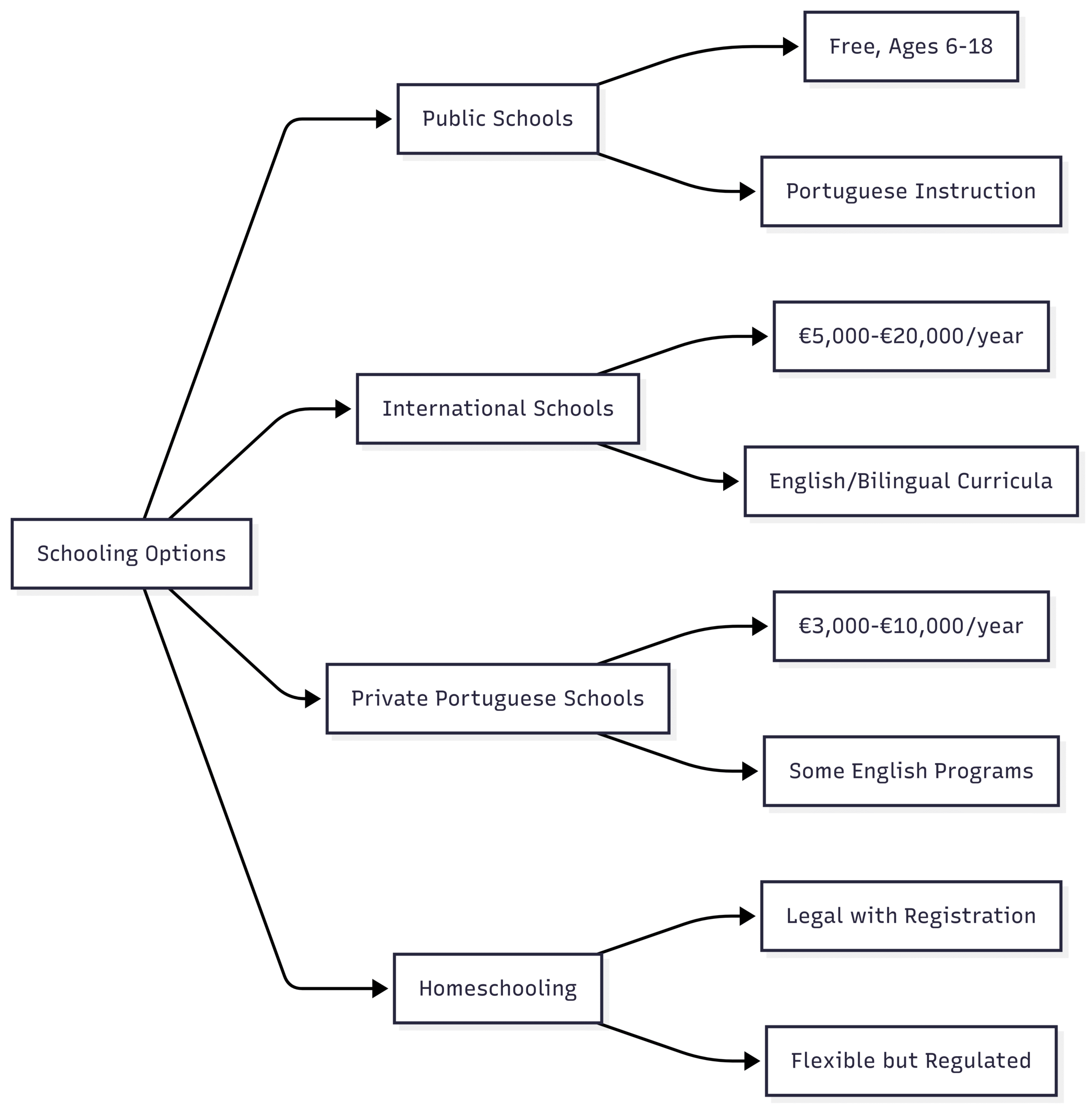
This chart outlines the main schooling options, helping families visualize their choices based on cost, language, and flexibility.
Challenges and Solutions
- Language Barriers: Non-Portuguese-speaking children may struggle in public schools. Consider language tutoring or international schools for a smoother transition.
- Enrollment Timing: International school spots are limited. Contact schools directly and secure proof of residence early.
- Resources: Expat communities on platforms like InterNations can provide school recommendations and enrollment tips.
Spousal Work Restrictions
A notable challenge for families is the restriction on spousal employment under the D8 Visa. Unlike Spain’s Digital Nomad Visa, which allows family members to work for local employers, Portugal’s D8 Visa imposes stricter rules.
- Remote Work Only: Spouses included via family reunification receive residence permits but are limited to remote work for non-Portuguese entities, similar to the primary applicant. They cannot take local jobs or provide services to Portuguese clients or companies.
- Alternative Options:
- Apply for a separate work visa (visto de trabalho) or job-seeker visa (visto para procura de trabalho) for local employment, requiring a job offer or proof of qualifications.
- Explore entrepreneurial ventures or freelance platforms (plataformas freelance) for remote income.
- Non-Habitual Resident (NHR) Tax Regime: Spouses with remote income may qualify for the NHR regime, offering reduced taxes (e.g., 20% on Portuguese-sourced income) or exemptions on foreign income for 10 years.
Note on Conflicting Information: Some online sources, such as social media discussions, suggest that family members can work locally under the D8 Visa. However, official guidelines from AIMA and immigration experts confirm that local employment is restricted unless a separate work visa is obtained. Always verify with AIMA or an immigration lawyer (advogado de imigração) to avoid compliance issues.
Strategies to Overcome Restrictions
- Remote Work Opportunities: Platforms like Upwork or LinkedIn can help spouses secure remote contracts.
- Entrepreneurial Ventures: Starting an online business (negócios online) aligns with visa restrictions and offers flexibility.
- Professional Guidance: Consult relocation services like Movingto for visa options or tax advice under the NHR regime.
Family-Friendly Locations in Portugal
Portugal offers a variety of family-friendly locations that balance affordability, safety, and access to schools and amenities. Each region caters to different lifestyles, from urban vibrancy to coastal relaxation.
Top Locations
Lisbon:
- Overview: The capital offers vibrant expat communities, international schools, and coworking spaces (espaços de coworking). Neighborhoods like Estoril and Cascais are family-oriented with beaches and parks.
- Rent: €1,200–€2,000/month for a three-bedroom apartment.
- Pros: Access to top international schools and urban amenities.
- Cons: Higher living costs and competitive housing market.
Porto:
- Overview: Known for affordability and cultural charm, with international schools and family-friendly areas like Foz do Douro.
- Rent: €800–€1,500/month for a three-bedroom.
- Pros: Lower costs than Lisbon, with a growing expat community.
- Cons: Fewer international school options.
Algarve:
- Overview: Ideal for families seeking a sunny, relaxed lifestyle. Lagos and Albufeira offer international schools and expat networks.
- Rent: €700–€1,200/month.
- Pros: Family-friendly with a warm climate.
- Cons: Limited coworking spaces compared to urban areas.
Madeira:
- Overview: The Digital Nomad Village in Ponta do Sol provides community support, schools, and scenic beauty.
- Rent: €600–€1,000/month.
- Pros: Affordable and tranquil.
- Cons: Remote location with fewer urban amenities.
Braga:
- Overview: A budget-friendly option with a growing expat community and good schools.
- Rent: €500–€900/month.
- Pros: Low cost of living.
- Cons: Limited international school options.
Housing Costs Chart
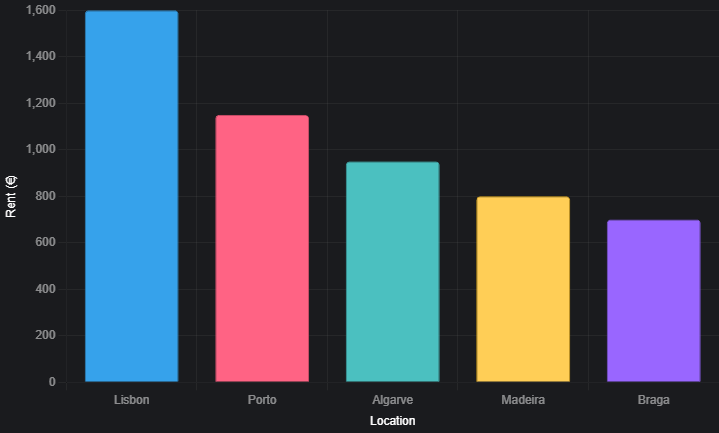
This chart compares monthly rent for three-bedroom apartments across family-friendly locations, aiding families in budgeting for housing.
Housing Challenges
- Availability: High-demand areas like Lisbon and the Algarve may have limited rental options. Use platforms like Idealista or relocation services for long-term rentals.
- Requirements: Rentals require a Portuguese tax number (NIF) and proof of income. Start searching 3–6 months in advance.
Additional Considerations for Families
Healthcare
D8 Visa holders initially rely on private health insurance but gain access to Portugal’s Serviço Nacional de Saúde (SNS) after obtaining residency. The SNS is high-quality and affordable, with private options available for English-speaking doctors.
Tax Benefits
The Non-Habitual Resident (NHR) tax regime can reduce tax burdens for the primary applicant and spouse, offering exemptions on foreign income or a 20% tax rate on Portuguese-sourced income for 10 years. Professional tax advice (aconselhamento fiscal) is recommended.
Language
While English is widely spoken in urban areas, learning basic Portuguese via schools like CIAL Centro de Línguas facilitates integration, particularly for school enrollment and navigating bureaucracy.
Expat Communities
Join groups like Expats in Portugal for networking, school recommendations, and housing tips. These communities provide invaluable support for settling in.
Citizenship Pathway
After five years of residency, families can apply for permanent residency or Portuguese citizenship, requiring an A2-level Portuguese test (teste de português A2). Newborns to parents with one year of residency may qualify for citizenship.
Overcoming Common Challenges
- Bureaucracy: Portuguese bureaucracy can be slow and complex. Hiring an immigration lawyer or using services like Movingto can streamline the process.
- School Enrollment: International school spots fill quickly. Contact schools early and secure proof of residence.
- Housing: Competitive markets require early planning. Use relocation services or platforms like Idealista.
- Spousal Employment: Plan for remote work or explore freelance opportunities to bypass local work restrictions.
Why Choose the D8 Visa for Your Family?
The D8 Visa offers digital nomad families a unique opportunity to enjoy Portugal’s high quality of life, from its affordable living costs to its excellent schools and safe communities. With family reunification provisions, robust digital infrastructure, and a pathway to long-term residency, Portugal is an ideal destination for remote-working families. For a seamless application process, consider consulting experts like Jobbatical, who specialize in family reunification under the D8 Visa.
By addressing financial requirements, schooling options, and spousal work restrictions, families can confidently plan their move to Portugal, embracing a lifestyle that balances work, family, and adventure in one of Europe’s most welcoming countries.
Please share this can digital nomads bring families Portugal with your friends and do a comment below about your feedback.
We will meet you on next article.
Until you can read, How to become a digital nomad as an accountant