
6 Reasons Why Remote Work Is Here To Stay
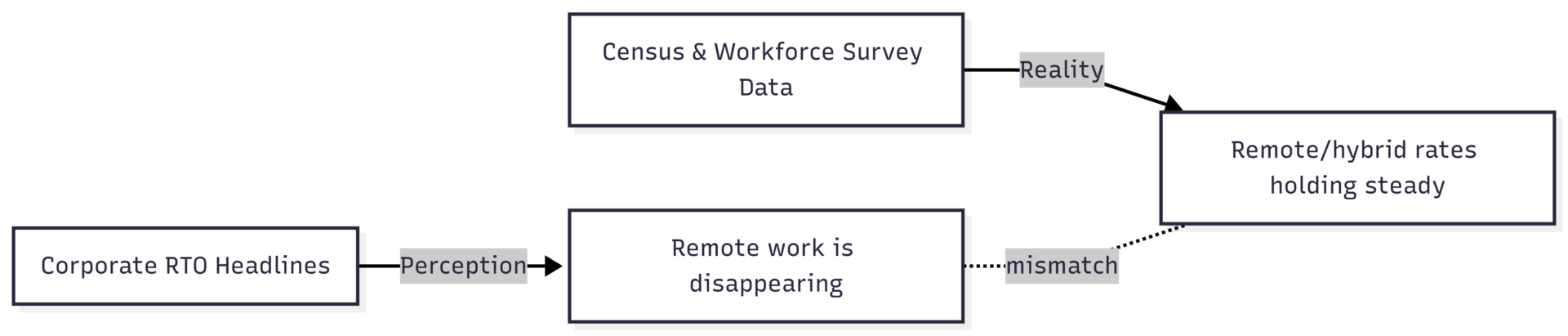
Return-to-office mandates make headlines. High-profile CEOs criticize remote work publicly, and some large employers have pushed for a full return to in-person schedules. Yet despite the noise, the underlying data tells a different story: the share of the workforce working remotely or in a hybrid arrangement has held remarkably steady, with only a fraction of large companies actually requiring five days a week in office. The predicted collapse of remote work simply hasn’t shown up in the numbers.
This article breaks down the six core reasons remote work has proven durable rather than temporary, along with the real challenges — mental health, career visibility, and legal gray areas — that come with a distributed workforce, and what employers, workers, and policymakers can do about them.
The State of Remote Work Today
Roughly a quarter of the U.S. workforce spends at least part of the workweek at home, and average weekly hours worked remotely have barely shifted year over year. Surveys of large companies consistently find that only a small minority — commonly cited around 3% — operate fully in-office, five days a week. The gap between corporate rhetoric and actual workplace policy is significant.
1. Productivity Spikes
Corporate leaders widely predicted that productivity would collapse without direct, in-person oversight. It didn’t. Once employees stopped losing time, money, and energy to commutes, office small talk, and rigid scheduling, that capacity didn’t vanish — it got redirected into actual work. Multiple large-scale studies conducted during and after the shift to remote arrangements found productivity held constant or increased, and self-reported work engagement is consistently higher among remote employees than among their in-office counterparts.
The mechanism is fairly intuitive: fewer interruptions, more control over when peak-focus hours happen, and less time lost to logistics that don’t contribute to output.
2. Flexibility Benefits
Remote work delivered something employees had been requesting for years — not just flexibility in where they work, but when. As employer culture has gradually shifted from valuing visible hours toward valuing completed output, workers report feeling more trusted to structure their day around their own energy and responsibilities, provided deadlines are met.
Remote vs. Hybrid vs. Full In-Office: Quick Comparison
| Model | Typical Schedule | Best Fit For | Key Trade-off |
|---|---|---|---|
| Fully remote | 0 days in office | Roles with minimal need for physical collaboration | Requires strong async communication discipline |
| Hybrid | 2–3 days in office | Teams that benefit from periodic in-person alignment | Coordinating shared office days across the team |
| Full in-office | 5 days in office | Roles requiring hands-on equipment or constant real-time collaboration | Least flexibility; highest overhead |
3. Cost Savings
Overhead dropped sharply for organizations that shifted meaningfully toward distributed work — office leases ended, real estate footprints shrank, and in some cases physical offices were eliminated entirely. Estimates of savings run as high as several thousand dollars per employee moved to remote status, once rent, utilities, and office supplies are factored in.
That freed-up capital doesn’t just disappear into margin — many organizations have redirected it toward R&D, marketing, and more competitive compensation packages, which matters in a hiring environment where top candidates increasingly weigh flexibility alongside salary.
Where the Savings Typically Go
| Category | Common Reallocation |
|---|---|
| Real estate and utilities | Reduced office footprint; smaller shared workspace |
| Recruitment budget | Larger hiring bonuses, broader sourcing |
| R&D and innovation | Reinvested in product or service development |
| Employee benefits | Expanded wellness stipends, equipment allowances |
4. Better Access to Talent
Remote work removes the geographic ceiling on hiring. Companies are no longer limited to whoever happens to live within commuting distance — they can recruit talent from other states, other countries, or lower cost-of-living regions without asking anyone to relocate. Workers, in turn, can take a role at a major company without moving to a large city at all.
The result is a better match between skills and roles on both sides: organizations pick from a genuinely competitive talent pool rather than whoever’s locally available, and quality of hire tends to improve as a direct consequence. One payroll and HR software company that shifted from a large downtown office to a small shared workspace reported job postings drawing multiples more applicants than before the switch — evidence that a national or global applicant pool changes recruiting outcomes meaningfully.
5. Hybrid Work as a Middle Ground
Organizations don’t have to choose between fully on-site and fully distributed. A growing number of companies and employees have settled on hybrid arrangements — specific days set aside for in-person collaboration, with the rest of the week worked remotely. This structure preserves the parts of in-person work that genuinely benefit from physical presence (spontaneous problem-solving, relationship-building, complex planning sessions) while keeping most of the flexibility and cost benefits of remote work intact.
Some companies have gone further, replacing certain in-office days with structured no-meeting blocks dedicated specifically to coaching and collaboration — recognizing that distributed teams need more deliberate mentorship than co-located ones, not less.
6. Local Economic Boosts
Remote professionals spend their time and money differently than employees locked into a daily commute. Instead of routing spending toward downtown business districts or along a commute corridor, remote workers spend closer to home — supporting local restaurants, services, and retail in communities that previously saw little benefit from a resident’s paycheck. At scale, this shift represents a real redistribution of economic activity away from central business districts and toward residential communities.
The Real Challenges of Remote Work
None of this means remote work is friction-free. The durability of the trend doesn’t cancel out its genuine downsides, and ignoring them is how “remote work is here to stay” turns into “remote work is quietly damaging retention and wellbeing.”
Mandates vs. Reality
Despite high-profile return-to-office pushes, overall remote and hybrid rates have leveled off rather than declined sharply. The disconnect suggests that mandates alone struggle to hold when employees remain unconvinced that daily in-office presence adds real value to their specific role.
Work-Life Blur
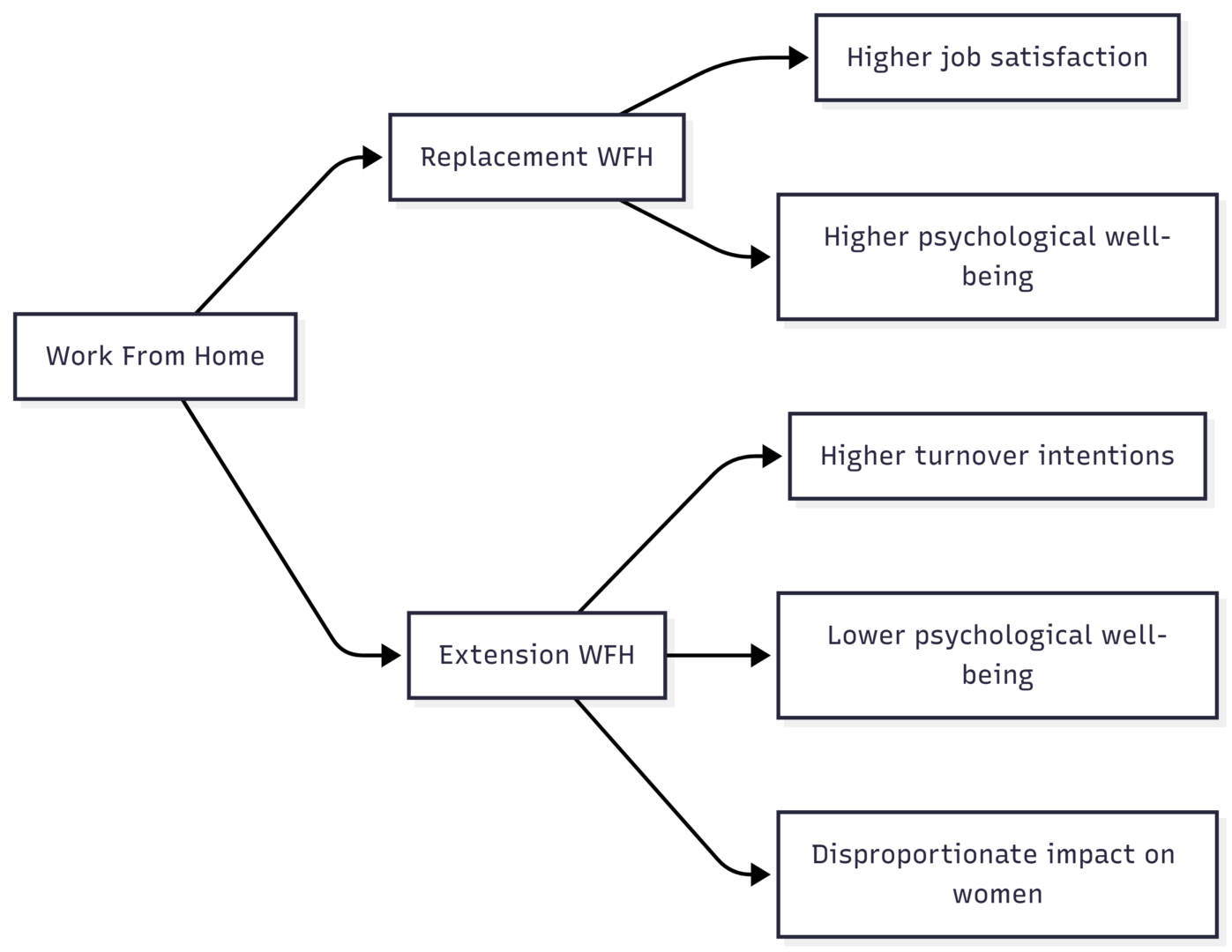
Communication tools that make remote collaboration possible — chat apps, video conferencing, shared documents — also make it harder to fully disconnect. Research distinguishes between “replacement” remote work (working from home during normal hours, in place of commuting to an office) and “extension” remote work (working outside normal hours because a screen is always within reach).
Replacement remote work is consistently linked to higher psychological well-being and job satisfaction. Extension work tells a very different story — it’s linked to increased turnover intentions and reduced well-being, and the effect is disproportionately larger for women, who report meaningfully worse mental health outcomes when extension work bleeds into caregiving and family time.
Career Growth and Visibility
Reduced face-to-face time can affect mentorship access and promotion visibility, particularly for employees who don’t proactively build relationships with leadership across a screen. This isn’t inevitable, but it does require more intentional effort from both managers and employees than passive office proximity used to provide.
Choice Matters More Than Location
Whether an employee chose to work remotely or was simply assigned to it changes the outcome significantly. Employees who opt into remote work report higher job autonomy, higher satisfaction, and lower turnover intentions than those placed into it involuntarily.
But access to that choice isn’t distributed equally — when workers who prefer remote or hybrid arrangements are forced back into the office, they don’t all respond the same way. Workers with more outside options are more likely to simply leave for a better-fitting role, while workers with fewer options — often women and workers from historically marginalized groups — are more likely to stay in a mismatched arrangement despite the added strain.
That imbalance means expanding equitable access to remote work isn’t just a perk decision; it has a meaningful, uneven effect on wellbeing across the workforce.
An Emerging Entry-Level Concern
There’s growing evidence that the combination of remote work and AI-assisted tooling has shifted hiring priorities toward experienced candidates over entry-level ones, since senior remote hires require less in-person ramp-up and oversight.
This is a genuine downside worth tracking — it suggests remote work’s benefits aren’t distributed evenly across career stages, and organizations serious about long-term talent pipelines need a deliberate strategy for bringing junior employees into distributed teams successfully.
What Employers Can Do
| Action | Purpose |
|---|---|
| Run regular employee engagement surveys | Surface poor communication, unclear expectations, and resourcing gaps early |
| Hire directly into remote roles when possible | Employees who choose remote work from the start report better outcomes than those reassigned later |
| Train managers on communication and accommodation | Especially important for supporting employees with mental health or disability-related needs |
| Cap meeting length and avoid back-to-back scheduling | Reduces video-call fatigue and protects time to actually process work |
| Encourage a pause on after-hours messaging | Directly limits the “extension” work pattern linked to burnout |
| Build in structured mentorship time | Compensates for the loss of passive, in-office visibility |
What Policymakers Are Weighing
Several countries have already passed “right to disconnect” laws, giving employees legal protection from professional retaliation if they don’t respond to messages outside working hours. No U.S. state currently has such a law in effect, though legislation has been proposed and reintroduced in more than one state legislature.
Other proposed measures include stronger enforcement of existing wage-and-hour protections, with penalties scaled to company size and duration of employment, and funding for community-based organizations to provide employer education and outreach — shifting some of the compliance burden away from individual workers.
The Legal Landscape Is Still Catching Up
Courts and regulators are still working out how existing labor protections apply to a home-based workplace. Employees who face discrimination or termination tied to a mental health condition may have recourse under disability discrimination law, though the burden of proof — showing an employer knew about the condition and that the employee could still perform the job’s essential functions — remains high.
Separately, established labor law around non-employee access for union organizing (originally built around isolated workplaces like logging camps) is increasingly being applied to remote workers, who are similarly cut off from the ordinary flow of workplace information. Some regulatory bodies have also ruled that employees may distribute union-related material over an employer’s own communication systems when no other reasonable channel exists.
Frequently Asked Questions
Overall rates have leveled off rather than dropped sharply. High-profile mandates from a handful of large employers create disproportionate media attention relative to their actual share of the workforce.
The data doesn’t support that. Multiple large-scale studies found productivity held steady or improved after the shift to remote work, largely due to fewer interruptions and reduced time lost to commuting and office logistics.
It depends heavily on how the time is used. Working from home during normal hours (replacement WFH) is linked to better psychological well-being. Working outside normal hours because of always-on communication tools (extension WFH) is linked to worse outcomes, particularly for employees balancing caregiving responsibilities.
Yes. Employees who opt into remote work report meaningfully better outcomes — higher autonomy, satisfaction, and lower turnover intent — than those assigned to it without a say.
Cap meeting lengths, discourage after-hours messaging, train managers on communication and accommodation, and consider hiring directly into remote roles rather than reassigning existing staff.
Several countries have passed formal right-to-disconnect legislation. No U.S. state currently has one in effect, though proposals have been introduced in more than one state legislature.
Final Thoughts
The headlines about mass returns to the office don’t match what the underlying workforce data actually shows. Remote and hybrid arrangements have proven durable because they solve real problems — cost, flexibility, and access to talent — that in-office mandates don’t undo simply by requiring badge swipes five days a week.
The work ahead isn’t convincing employers that remote work works; it’s building the guardrails — clear communication norms, equitable access, and legal protections around after-hours boundaries — that let its benefits outweigh its genuine risks.
Please share this 6 Reasons Why Remote Work Is Here To Stay your friends and do a comment below about your feedback.
We will meet you on next article.
Until you can read, The 6 Core Features of an Effective Remote Work Policy