
The 6 Core Features of an Effective Remote Work Policy
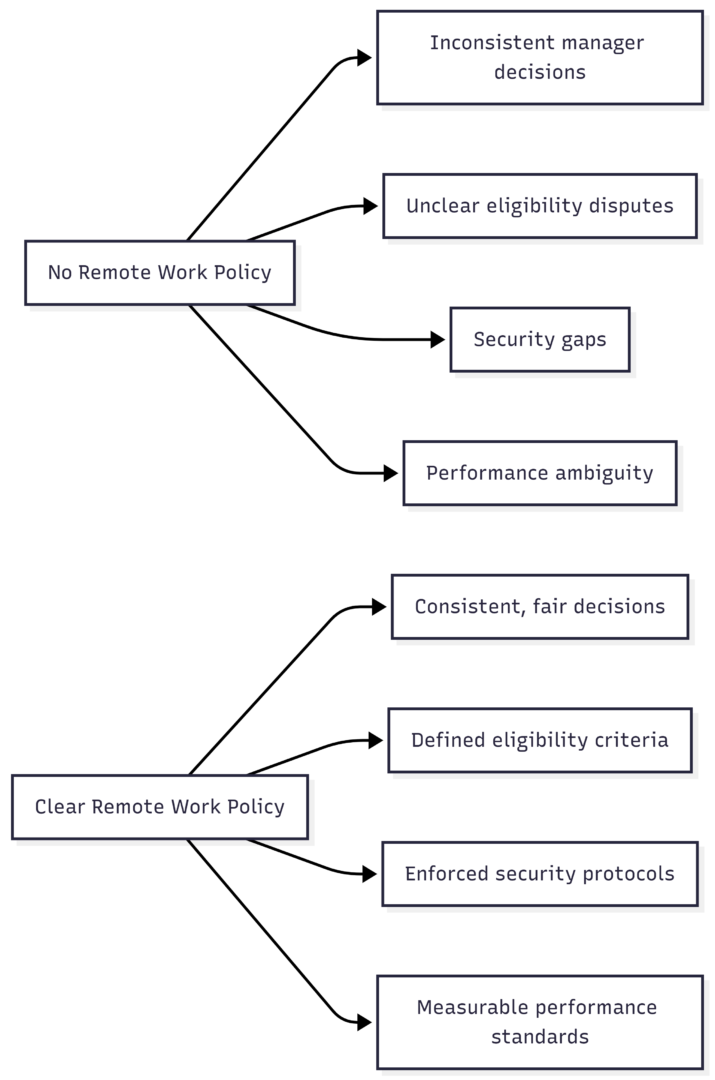
A remote work policy isn’t paperwork — it’s the operating manual that keeps a distributed team functioning without constant improvisation. When it’s missing or vague, decisions default to individual managers, which creates inconsistency, resentment, and eventually disputes nobody saw coming.
When it’s done well, both employer and employee know exactly what’s expected, which removes most of the friction that makes remote arrangements feel risky in the first place.
This guide breaks down the six core features every remote work policy needs, plus the surrounding elements — security, compliance, performance tracking, and emergency planning — that turn a basic document into one that actually holds up under real-world conditions.
Why a Remote Work Policy Matters
Remote work brings real advantages: lower overhead, a larger talent pool, and — according to repeated productivity studies — output that holds steady or improves compared to in-office work. But those benefits only materialize when expectations are explicit. Without a policy, businesses end up managing remote work reactively, solving the same disputes over and over because nothing was defined up front.
The 6 Core Features of an Effective Remote Work Policy
1. Clear Eligibility Requirements
The single most common failure point in a remote work program is never clearly defining who qualifies. Without explicit criteria, employees assume the decision sits with their individual manager’s discretion — which breeds inconsistency and interdepartmental conflict fast.
A solid policy starts with an organization-wide review of every role, sorted into one of three categories:
| Eligibility Category | Description | Example Roles |
|---|---|---|
| Fully remote-compatible | Can be performed entirely off-site with no operational loss | Software engineering, content writing, customer support (chat/email) |
| Partially compatible | Requires a defined on-site/off-site split | Sales, HR, hybrid technical roles requiring occasional equipment access |
| On-site only | Requires physical presence for core function | Manufacturing, in-person healthcare delivery, facilities management |
Document this at the role level, not the individual level — deciding eligibility person-by-person is exactly the discretion trap that creates disputes. Once a role is classified, everyone in that role is treated consistently.
2. Scheduling and Availability
Qualifying for remote work doesn’t automatically mean setting your own hours. Even fully remote-eligible roles usually need some baseline availability so the rest of the team can rely on them for meetings, handoffs, and time-sensitive collaboration.
A clear policy typically defines:
- Core hours — the specific block of time (e.g., 10 a.m.–3 p.m. local time) when team members must be reachable
- Response time expectations — how quickly someone should reply to chat messages versus email versus a formal request
- Flexibility bands — for roles that need minimal real-time interaction, how much latitude they have to set their own schedule within the workday
This section also directly shapes hiring. Roles with strict scheduling requirements will naturally filter out candidates who need heavy flexibility, while roles with looser requirements open the applicant pool to people balancing other commitments — parents, caregivers, or people in different time zones. Getting this right during hiring saves both sides friction later.
3. Employer-Provided Equipment
Depending on the role, remote employees may need company-owned hardware — laptops, monitors, VPN-enabled devices, specialized software licenses — to do their job securely. The policy needs to spell out three things clearly: what the company provides, what the employee is expected to supply themselves, and who’s responsible for maintenance, loss, or damage.
Sample Equipment and Reimbursement Table
| Item | Provided By | Reimbursement Policy |
|---|---|---|
| Laptop / primary work device | Company | Company owns and maintains; replaced on standard refresh cycle |
| Monitor / peripherals | Company (optional) or employee | Stipend or one-time allowance, typically $150–$400 |
| Home internet | Employee | Partial monthly reimbursement, commonly $25–$75/month |
| VPN / security software | Company | Mandatory install; company-managed licensing |
| Office furniture (desk, chair) | Employee, with optional stipend | One-time allowance, commonly $100–$500 |
Getting this section right isn’t just about convenience — it directly affects data security. Company-owned, IT-managed devices are far easier to secure with encryption, remote wipe capability, and monitored VPN access than an employee’s personal machine. This is a decision worth making in close collaboration with IT before finalizing the policy, since the cybersecurity exposure of remote work is materially higher than an office network.
4. Productivity Thresholds and Performance Standards
Even though remote employees frequently outperform in-office benchmarks on productivity studies, a policy still needs explicit performance standards. Ambiguity about what “good performance” looks like is one of the fastest ways to end up in a dispute that could have been avoided with a clear metric from day one.
The policy should specify:
- What metric measures success for each role (output completed, calls made, tickets resolved, revenue generated — whatever fits the function)
- How that metric will be tracked and by what tool
- How often performance will be reviewed
- What happens if standards aren’t met — a defined path, not an ad hoc conversation
The principle to hold onto: judge remote work by results, not by hours logged online. A policy that ties performance to output rather than activity avoids the trap of micromanagement, which consistently damages morale and engagement in remote settings without improving actual results.
5. Remote Work Revocation Rights
Every effective policy includes a clause stating plainly that the company retains the right to revoke remote work privileges at any time, for legitimate business reasons. This matters because many employees come to see remote work as a fixed part of their compensation rather than a flexible arrangement — and if that expectation isn’t corrected up front, revoking it later (even for good reason) can feel punitive and damage trust.
Stating this clearly at the outset protects both sides: the business can offer remote work generously without fear of losing the ability to adjust as circumstances change, and employees know from day one that the arrangement is conditional, not a permanent guarantee. Pair this clause with a reasonable notice period (commonly two to four weeks) for any change in status, so the transition doesn’t feel abrupt even when it’s necessary.
6. Confidentiality and Data Security Requirements
Once an employee leaves the office, the business loses physical control over their working environment — no locked door, no clean-desk policy enforced by a manager walking by. That makes confidentiality one of the highest-risk gaps in any remote arrangement.
Requiring a pre-approved home workspace sounds appealing but is nearly impossible to enforce consistently — there’s no reliable way to confirm an employee is actually using that space every day. A more effective approach puts responsibility directly on the employee, backed by specific, enforceable requirements:
- Screens must be locked or devices closed when unattended in public or shared spaces
- Sensitive documents may not be discussed or displayed in public settings (cafés, shared coworking spaces, public transit)
- Company devices must use approved VPN and multi-factor authentication for any access to internal systems
- Personal devices may not be used to store or transmit confidential company data without prior IT approval
Spell these out explicitly in the policy — not as a vague “use good judgment” clause, but as specific, checkable requirements employees can be held to.
Supporting Elements Every Modern Policy Should Also Address
The six core features above form the foundation, but a complete policy typically layers in a few additional areas that materially affect how well the policy holds up in practice.
Security and Compliance
Beyond confidentiality basics, the policy should require multi-factor authentication, define approved software for handling sensitive data, and address compliance with relevant employment laws — which can vary significantly if remote employees work across state or international borders. Tax liability and insurance coverage should also be addressed explicitly, since these can create real legal exposure if left ambiguous.
Communication Standards
Name the specific approved platforms for chat, video, and file sharing — not just “use whatever’s convenient.” Ambiguity here creates the exact fragmentation remote teams struggle with most: some people on Slack, others on email, updates lost between the two.
Emergency and Contingency Planning
A strong policy also anticipates disruption — a natural disaster, an internet outage, a building closure. Define how work continues in those scenarios, what alternate arrangements are acceptable, and how communication will flow if normal channels go down.
Building and Rolling Out the Policy
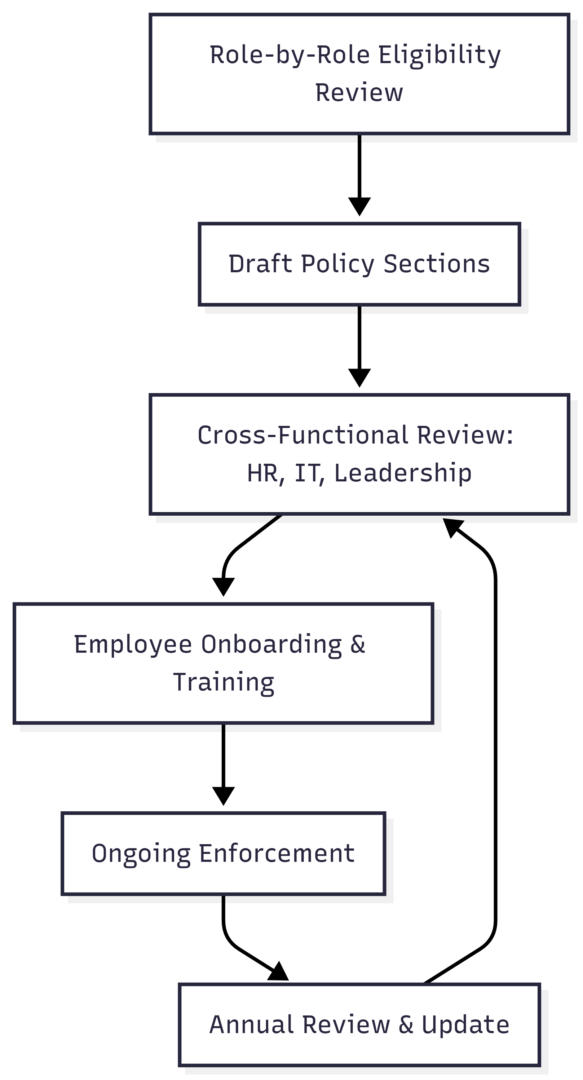
- Involve multiple levels of management in drafting it. HR anchors legal compliance, department leads bring operational reality, and leadership ties the policy to broader business continuity goals. Teams that have input into shaping their own remote work guidelines tend to view the resulting policy as fairer and more workable than one handed down without consultation.
- Train on it at onboarding, not just once. Walk new hires through the full policy, cover workspace setup and equipment requests, demonstrate the approved communication tools, and confirm they understand the security requirements before granting system access. Provide refresher training whenever the policy changes materially.
- Review it at least annually. Remote work norms, applicable laws, and available technology all shift over time. A policy written once and never revisited will drift out of sync with reality — collect employee feedback through periodic surveys and audit for compliance gaps regularly.
Remote Work Policy Checklist
| Component | Included? |
|---|---|
| Role-by-role eligibility classification | ☐ |
| Core hours and response time expectations | ☐ |
| Equipment provisioning and reimbursement terms | ☐ |
| Defined performance metrics per role | ☐ |
| Revocation clause with notice period | ☐ |
| Explicit confidentiality and data security requirements | ☐ |
| Approved communication platforms named | ☐ |
| Compliance and tax liability addressed | ☐ |
| Emergency/contingency plan | ☐ |
| Annual review schedule set | ☐ |
Frequently Asked Questions
At minimum, cover eligibility criteria, scheduling and communication expectations, equipment and reimbursement terms, performance standards, a revocation clause, and confidentiality requirements — the six core features outlined above.
Most policies reserve the right to revoke remote work status for legitimate business reasons, provided the clause is stated clearly in the policy and reasonable notice is given. This should be communicated during onboarding, not introduced after the fact.
HR (for legal compliance), IT (for security and equipment), department leadership (for operational fit), and ideally employee feedback gathered through a survey or review process before finalizing.
An annual review is a reasonable baseline, with ad hoc updates whenever laws, tools, or business needs change significantly enough to affect existing terms.
Yes — obligations can shift depending on where an employee is physically working, particularly across state or country lines. This should be addressed explicitly in the policy and reviewed with legal or tax counsel rather than left implicit.
By defining in advance how work continues during disruptions — outages, natural disasters, office closures — a policy prevents ad hoc scrambling and keeps operations running with minimal disruption.
Final Thoughts
A remote work policy is ultimately a trust document — it defines the terms both employer and employee are agreeing to, so neither side has to guess. The six core features covered here — eligibility, scheduling, equipment, performance standards, revocation rights, and confidentiality — form the foundation of a policy that can actually be enforced fairly and consistently.
Layer in security, compliance, and contingency planning on top, review it regularly, and it becomes far more than a compliance document — it becomes the framework that lets a remote team operate with clarity and confidence.
Please share this The 6 Core Features of an Effective Remote Work Policy your friends and do a comment below about your feedback.
We will meet you on next article.
Until you can read, 5 Types of Technology to Better Manage Your Remote Team