
The 22 Most Popular Bible Verses About Love
Love is the most repeated theme in Scripture, running from Genesis through Revelation as both a description of God’s character and a command for how people are meant to treat one another.
This guide collects 22 of the most searched and most quoted Bible verses about love, organized by category, along with the biblical background — including the Greek vocabulary behind “love” — that most lists leave out.
Why the Bible Talks About Love So Much
Scripture doesn’t treat love as a single emotion. It’s described as an attribute of God’s own character (“God is love,” 1 John 4:8), a command given to His people, and a practical standard for behavior that gets defined in surprisingly specific terms — patient, kind, not self-seeking. Understanding biblical love means holding all three of these together: love as identity, love as command, and love as action.
The Four Greek Words Behind “Love”
English uses one word — “love” — for everything from romantic affection to loyalty to charity. Koine Greek, the language of the New Testament, used at least four distinct words, and understanding the difference sharpens what many of these verses are actually saying.
| Greek Term | Type of Love | Example Verse |
|---|---|---|
| Agape | Unconditional, self-giving love | 1 Corinthians 13:4–7 |
| Phileo | Friendship, affectionate love | John 15:13–15 |
| Storge | Familial, natural affection | Romans 12:10 (root word) |
| Eros | Romantic, passionate love | Song of Solomon 8:6–7 |
Most of the well-known “love chapter” language in 1 Corinthians 13 uses agape — the term for love as a deliberate commitment and action, not a feeling that rises and falls with circumstance. That distinction is part of why the passage reads more like a list of behaviors than a description of an emotion.
22 Popular Bible Verses About Love
The verses below are grouped by theme rather than listed at random, since most readers are searching for a verse that fits a specific situation — grief, marriage, friendship, or simply wanting to understand God’s character better. All quotations are from the King James Version.
Defining What Love Actually Is
- 1 Corinthians 13:4–7 (KJV) — “Charity suffereth long, and is kind; charity envieth not… beareth all things, believeth all things, hopeth all things, endureth all things.”
- 1 Corinthians 13:13 (KJV) — “And now abideth faith, hope, charity, these three; but the greatest of these is charity.”
- Colossians 3:14 (KJV) — “And above all these things put on charity, which is the bond of perfectness.”
- Romans 13:8 (KJV) — “Owe no man any thing, but to love one another: for he that loveth another hath fulfilled the law.”
- 1 Corinthians 16:14 (KJV) — “Let all your things be done with charity.”
God’s Love for Us
- 1 John 4:19 (KJV) — “We love him, because he first loved us.”
- 1 John 4:8 (KJV) — “He that loveth not knoweth not God; for God is love.”
- John 3:16 (KJV) — “For God so loved the world, that he gave his only begotten Son.”
- Romans 8:38–39 (KJV) — nothing in creation “shall be able to separate us from the love of God, which is in Christ Jesus our Lord.”
- Lamentations 3:22–23 (KJV) — “It is of the Lord’s mercies that we are not consumed… they are new every morning: great is thy faithfulness.”
- 1 John 3:1 (KJV) — “Behold, what manner of love the Father hath bestowed upon us, that we should be called the sons of God.”
- Isaiah 49:15 (KJV) — “Can a woman forget her sucking child… Yea, they may forget, yet will I not forget thee.”
Our Love for God
- Mark 12:30 (KJV) — “Thou shalt love the Lord thy God with all thy heart, and with all thy soul, and with all thy mind, and with all thy strength.”
- John 14:15 (KJV) — “If ye love me, keep my commandments.”
- 1 Corinthians 2:9 (KJV) — the things God has prepared “for them that love him.”
- Deuteronomy 6:5 (KJV) — “Thou shalt love the Lord thy God with all thine heart, and with all thy soul, and with all thy might.”
Love for Others
- 1 Peter 4:8 (KJV) — “Above all things have fervent charity among yourselves: for charity shall cover the multitude of sins.”
- John 15:13 (KJV) — “Greater love hath no man than this, that a man lay down his life for his friends.”
- 1 John 4:20 (KJV) — “If a man say, I love God, and hateth his brother, he is a liar.”
- Ephesians 4:2 (KJV) — “With all lowliness and meekness, with longsuffering, forbearing one another in love.”
Love in Marriage
- Ephesians 5:25 (KJV) — “Husbands, love your wives, even as Christ also loved the church, and gave himself for it.”
- Ecclesiastes 4:9–12 (KJV) — “Two are better than one… a threefold cord is not quickly broken.”
Breaking Down the “Love Chapter”: 1 Corinthians 13
No list of love verses is complete without a closer look at 1 Corinthians 13, widely known as “the love chapter” and one of the most-read passages at weddings worldwide. Paul structures the chapter in three parts: love’s necessity, love’s characteristics, and love’s permanence.
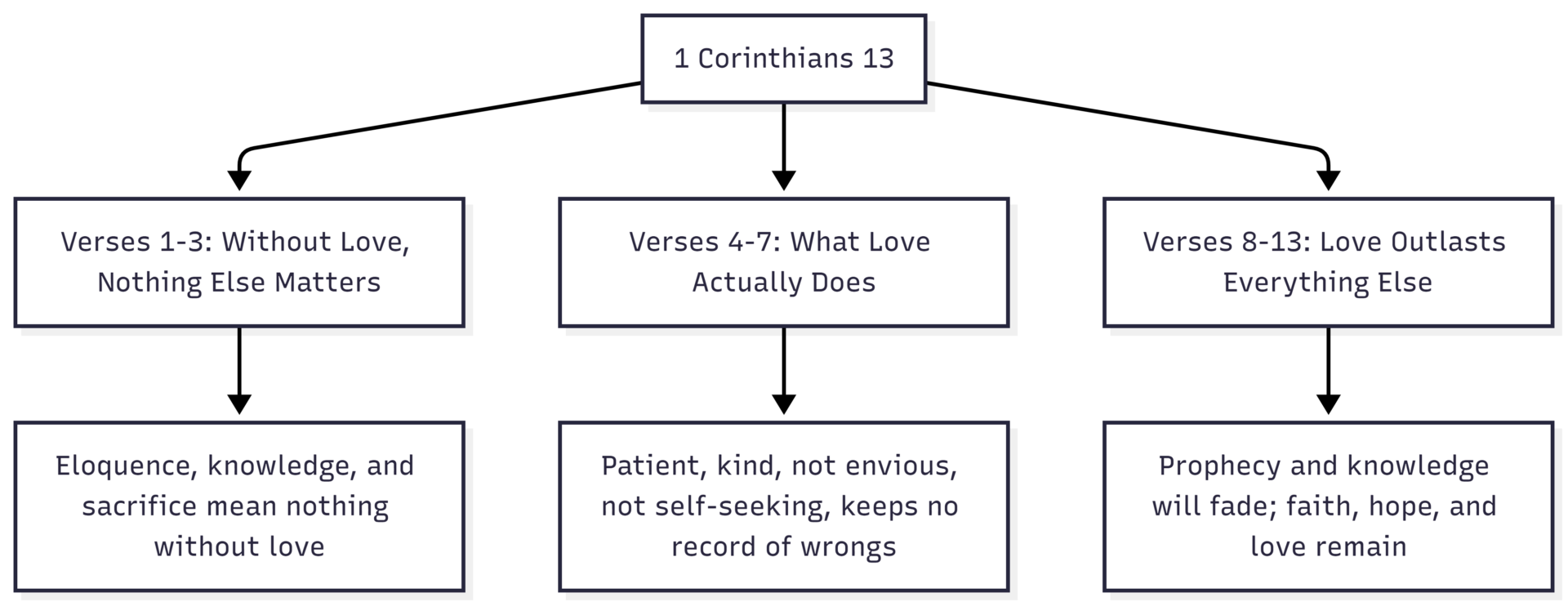
The middle section — verses 4 through 7 — is the most frequently quoted, largely because it defines love almost entirely through action rather than emotion. Every verb in that passage describes a choice: to be patient, to not keep score, to protect, to trust, to persevere. That framing is part of why the passage works as well for marriage as it does for friendship, parenting, or any long-term relationship that requires more than a feeling to sustain it.
Comparing How Love Is Described Across Scripture
| Context | Defining Verse | Key Characteristic |
|---|---|---|
| Romantic love | Ephesians 5:25 | Sacrificial, modeled after Christ and the church |
| Friendship | John 15:13 | Willingness to lay down one’s life |
| Family love | Romans 12:10 | Devotion and honor |
| Love for enemies | Matthew 5:44 | Extending love beyond comfort or fairness |
| Love for God | Deuteronomy 6:5 | Total — heart, soul, and strength |
| Love as identity | 1 John 4:8 | Not just something God does, but who God is |
How to Use These Verses
These verses aren’t just quotable lines — they’re meant to shape behavior in specific, recurring situations. A few practical applications:
- In conflict: 1 Corinthians 13:5 (“keeps no record of wrongs”) is a useful check before revisiting an old argument during a new disagreement.
- In grief or uncertainty: Romans 8:38–39 addresses the fear that circumstances can separate a person from God’s love — a common concern during hardship.
- In marriage prep or renewal: Ephesians 5:25 and 1 Corinthians 13:4–7 are the two most commonly paired verses for wedding ceremonies and vow renewals, precisely because together they cover both sacrifice and daily behavior.
- In parenting: Colossians 3:14 (“the bond of perfectness”) is often used to reframe family conflict — love as the thing that holds a household together even when individual moments are difficult.
- In community life: 1 Peter 4:8 (“love covers a multitude of sins”) is frequently cited in the context of forgiveness within close relationships, not as an excuse to ignore harm, but as a call toward grace over resentment.
Frequently Asked Questions
1 Corinthians 13:4–7 is consistently the most quoted, largely because of its use at weddings and its detailed, behavior-based definition of love.
Agape refers to unconditional, self-giving love — the kind most often used to describe God’s love and the standard set in 1 Corinthians 13. Phileo refers to warm, affectionate friendship love, seen in verses like John 15:13–15.
Scripture doesn’t use the modern term “self-love,” but Mark 12:31 assumes a baseline level of self-regard when it commands loving “thy neighbour as thyself” — the command presumes healthy self-care as the standard being compared to, not something to override.
1 Corinthians 13:4–7 and Ecclesiastes 4:9–12 are the two most commonly chosen wedding readings, since one defines love’s character and the other describes partnership’s practical strength.
Yes, particularly in its description of God’s love (Romans 5:8, 1 John 4:19), which is presented as preceding and independent of human merit. Human love is called to reflect that same pattern, though Scripture also expects love to coexist with honesty, accountability, and boundaries rather than unlimited tolerance of harm.
Common Misunderstandings About Biblical Love
A few misconceptions come up often enough to be worth addressing directly:
- “Love is just a feeling” vs. “Love is a choice.” Much of the New Testament’s language about love — especially the verbs in 1 Corinthians 13 — describes deliberate action rather than an emotional state. This doesn’t mean feelings are irrelevant; it means Scripture treats love as sustainable specifically because it doesn’t depend on feelings staying constant.
- “Love means never disagreeing.” Ephesians 4:15 pairs love with truth-telling (“speaking the truth in love”), which suggests honest correction is compatible with, and sometimes required by, genuine love — not a betrayal of it.
- “If I truly loved someone, I’d tolerate anything.” Biblical love is repeatedly paired with boundaries and accountability elsewhere in Scripture (see Proverbs 27:6, on the value of honest correction from a friend), which complicates any reading of love as unconditional tolerance of harmful behavior.
- “Love for God and love for others are separate commands.” Jesus explicitly links them in Matthew 22:37–39, calling love of God the greatest commandment and love of neighbor the second, “like unto it” — treating them as inseparable rather than competing priorities.
Letting These Verses Shape Daily Life
Reading a list of verses about love is easy. Living them out consistently is the harder — and more central — call of the whole Bible. Whether the context is a marriage, a friendship, a family relationship, or a person’s relationship with God, the pattern across every verse above stays the same: love is described less as a feeling to be found and more as a decision to be made, repeatedly, especially when it’s inconvenient. Pick one verse from this list that speaks to your current season, write it somewhere visible, and let it shape one specific choice today.
Please share this The 22 Most Popular Bible Verses About Love your friends and do a comment below about your feedback.
We will meet you on next article.
Until you can read, 10 Key Bible Verses on Family