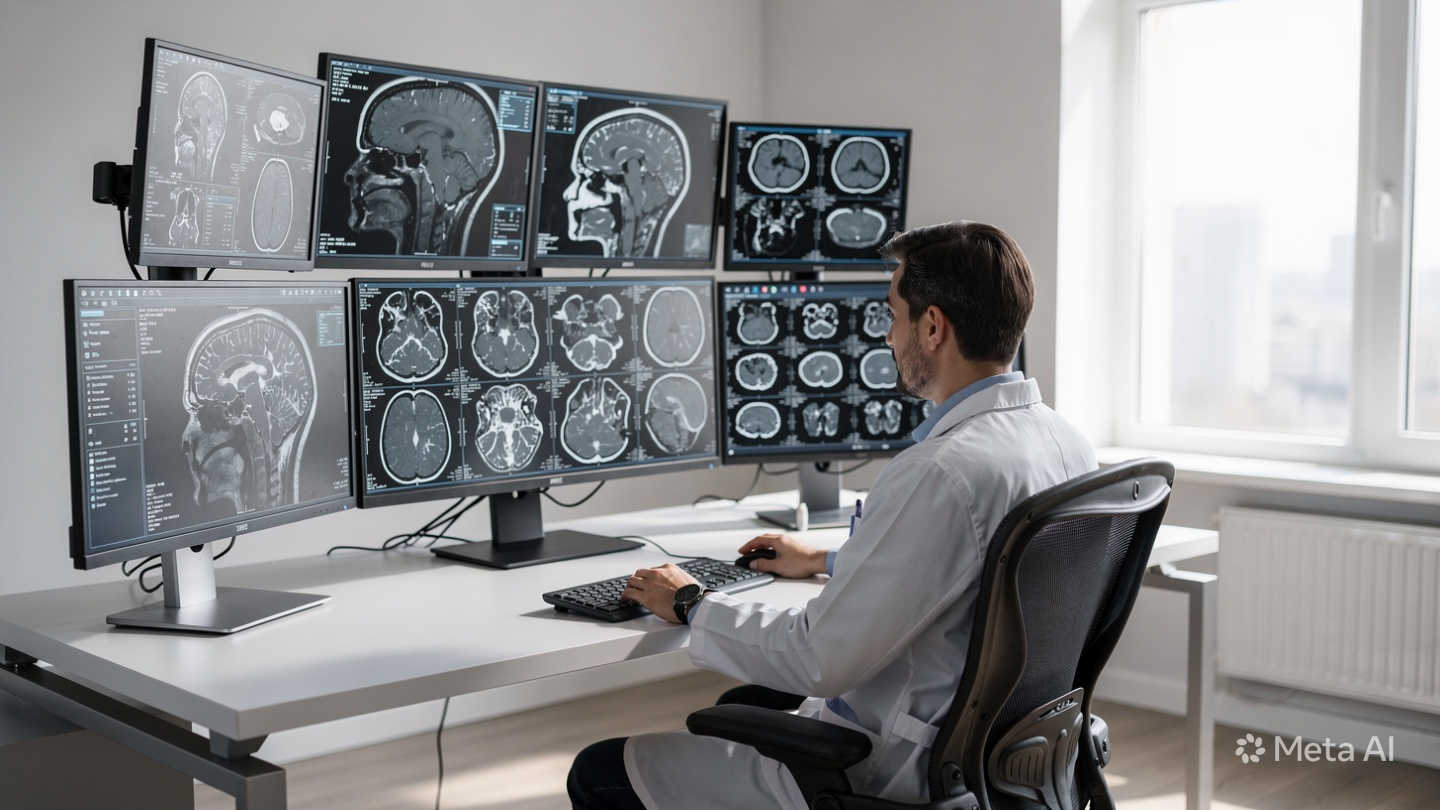
Can Radiologists Work from Home?
Yes — and at significant scale. Research from the Journal of the American College of Radiology found that 82% of radiology practices now allow remote or hybrid work arrangements, and approximately 36% of radiologists already work fully remotely. This is not a niche workaround. Teleradiology has become a mainstream practice model across hospitals, clinics, and imaging centers worldwide.
The key distinction: radiologists cannot bring imaging equipment home. MRI machines, CT scanners, and X-ray systems remain on-site at hospitals. What radiologists do from home is read the images those machines produce, interpret findings, write reports, and consult with referring physicians — all of which can be done securely and efficiently from a properly equipped home workstation.
What Is Teleradiology?
Teleradiology is the remote transmission, storage, and interpretation of medical images. A radiologist in one location reads scans produced at a hospital or imaging center in another, returning a diagnostic report without physical presence.
The concept has existed since the 1940s, when images were transmitted via telephone lines. Today it is supported by high-speed internet, cloud platforms, AI-assisted diagnostics, and enterprise-grade security systems — making remote reading as accurate and reliable as on-site interpretation for the vast majority of diagnostic tasks.

Which Radiology Roles Can Be Done Remotely?
Not all radiology subspecialties translate equally to remote work. The determining factor is whether the role requires physical intervention or real-time hands-on image guidance.
| Radiology Role | Remote Eligible? | Notes |
|---|---|---|
| Diagnostic Radiologist | Yes — fully | Primary teleradiology role |
| Neuroradiologist | Yes — fully | Subspecialty reads done remotely |
| Musculoskeletal Radiologist | Yes — fully | CT, MRI reads done remotely |
| Pediatric Radiologist | Yes — fully | Image interpretation remote-compatible |
| Breast Imaging (Mammography) | Partial | Screening reads remote; biopsies on-site |
| Interventional Radiologist (IR) | No | Image-guided procedures require physical presence |
| Fluoroscopy Specialist | No | Real-time contrast procedures require on-site |
| Nuclear Medicine | Partial | Image reads remote; isotope administration on-site |
Diagnostic radiologists — the largest segment of the profession — can perform the full scope of their core duties remotely. Interventional radiologists and specialists performing hands-on procedures must remain on-site for procedural work.
Technology That Makes Remote Radiology Possible
Teleradiology depends on a stack of integrated systems working together. Understanding these tools is essential for any radiologist considering the transition.
PACS (Picture Archiving and Communication System)
PACS is the foundational technology of teleradiology. It stores, retrieves, manages, and distributes medical images in digital format, eliminating physical film and enabling instant image access from any location.
Key PACS capabilities for remote work:
- Secure access to high-resolution imaging studies from any authorised device
- Integration with electronic health records (EHR) and hospital information systems (HIS)
- Prior study retrieval for comparative reads and disease progression tracking
- Multi-user access enabling subspecialist consultations across locations
DICOM (Digital Imaging and Communications in Medicine)
DICOM is the universal image format standard used by all medical imaging equipment. It ensures that images from any device — regardless of manufacturer — can be viewed, interpreted, and shared across systems without compatibility issues.
DICOM also embeds metadata (patient information, imaging parameters, acquisition settings) within the image file, providing radiologists with the clinical context needed for accurate reporting. Encryption and authentication protocols built into DICOM protect images during transmission.
Cloud-Based Reporting Platforms
Cloud platforms have replaced local server dependencies, enabling real-time image access from any device with authorised login. These platforms support instant collaboration between radiologists, specialists, and referring physicians, with built-in reporting tools that reduce turnaround time. Multi-factor authentication and advanced encryption maintain compliance with data protection regulations.
AI-Assisted Diagnostics
AI tools in teleradiology serve two primary functions: computer-aided detection (CAD) and workflow prioritisation.
CAD systems analyse images for patterns associated with specific conditions — nodule detection in chest CT, fracture identification in bone imaging, lesion flagging in MRI — supporting radiologist accuracy rather than replacing clinical judgment. Workflow AI sorts incoming studies by urgency, ensuring emergency cases reach the reading queue first.
Currently, an estimated 57% of radiologists do not use AI tools regularly, but adoption is accelerating as systems demonstrate diagnostic value and integrate more seamlessly into existing PACS workflows.
Remote Access and Security Infrastructure
| Technology | Purpose | Compliance Standard |
|---|---|---|
| HIPAA-Compliant VPN | Encrypted data transmission | HIPAA (US), GDPR (EU) |
| Multi-Factor Authentication | Identity verification for system access | SOC 2, HIPAA |
| End-to-End Encryption | Protects images during transfer and storage | DICOM, HIPAA |
| Remote Desktop Software | Access to on-site workstations without local data storage | HIPAA-compatible |
| Secure Messaging Platforms | HIPAA-compliant physician consultation | HIPAA |
Home Workstation Requirements and Costs
A professional teleradiology home setup requires more than a standard computer. Diagnostic quality depends on medical-grade display hardware and stable high-speed connectivity.
| Component | Specification | Approx. Cost |
|---|---|---|
| Diagnostic Monitor | 3MP–5MP medical-grade display (e.g. Barco, NEC) | $1,500–$6,000 per display |
| Computer / Workstation | High-performance CPU, 32–64 GB RAM, dedicated GPU | $2,000–$5,000 |
| PACS-Compatible Software | Vendor-provided or DICOM viewer licence | $0–$500/year (often employer-provided) |
| Internet Connection | Minimum 100 Mbps / 50 Mbps upload, fibre preferred | $50–$150/month |
| VPN / Security Software | HIPAA-compliant enterprise VPN | Employer-provided or $10–$30/month |
| Ergonomic Chair | Medical-grade lumbar support for extended reads | $500–$2,000 |
| Lighting / Glare Control | Controlled ambient lighting, anti-glare panels | $100–$500 |
| UPS Battery Backup | Prevents data loss during power interruption | $150–$400 |
Total estimated setup investment: $4,500–$14,000+ depending on monitor quality and whether the employer provides software and VPN access. Many teleradiology companies and health systems provide or subsidise equipment for contracted radiologists.
Remote Radiologist Salary
Remote radiologists earn compensation comparable to on-site positions. Average annual salary in the United States ranges from $300,000 to $400,000, with variation based on the following factors:

Some teleradiology companies offer per-click or per-wRVU (work relative value unit) compensation models at $30–$40 per wRVU, which can increase total earnings substantially for high-volume readers. Independent contractors typically earn higher hourly rates but are responsible for their own benefits, malpractice insurance, and tax obligations. Many teleradiology groups offer benefits packages including health insurance, retirement contributions, CME allowances, and technology stipends.
Benefits of Working From Home as a Radiologist
Schedule flexibility. Remote radiologists often set their own hours or choose shift blocks across different time zones. Studies show 84% of radiologists cite flexible scheduling as a major advantage of teleradiology.
Reduced burnout. Burnout affects approximately 54% of radiologists, driven by long hours, night shifts, and mounting workloads. Remote work allows radiologists to structure shifts around personal wellbeing, reduce commute-related fatigue, and reclaim time previously lost to hospital overhead activities. Studies indicate a 13–22% productivity increase in radiologists who transitioned to remote work.
Faster report turnaround. Without hospital interruptions — rounds, hallway consultations, departmental meetings — many radiologists complete reads more efficiently. Teleradiology systems also enable 24/7 coverage across time zones, reducing patient wait times for results.
Geographic independence. Remote radiologists can live anywhere while working for employers in higher-paying markets. Hospitals in underserved areas gain access to subspecialty expertise they could not recruit locally.
Elimination of commute. Saving one to two hours daily in commute time represents a significant quality-of-life improvement for radiologists in major metropolitan areas.
Challenges of Remote Radiology
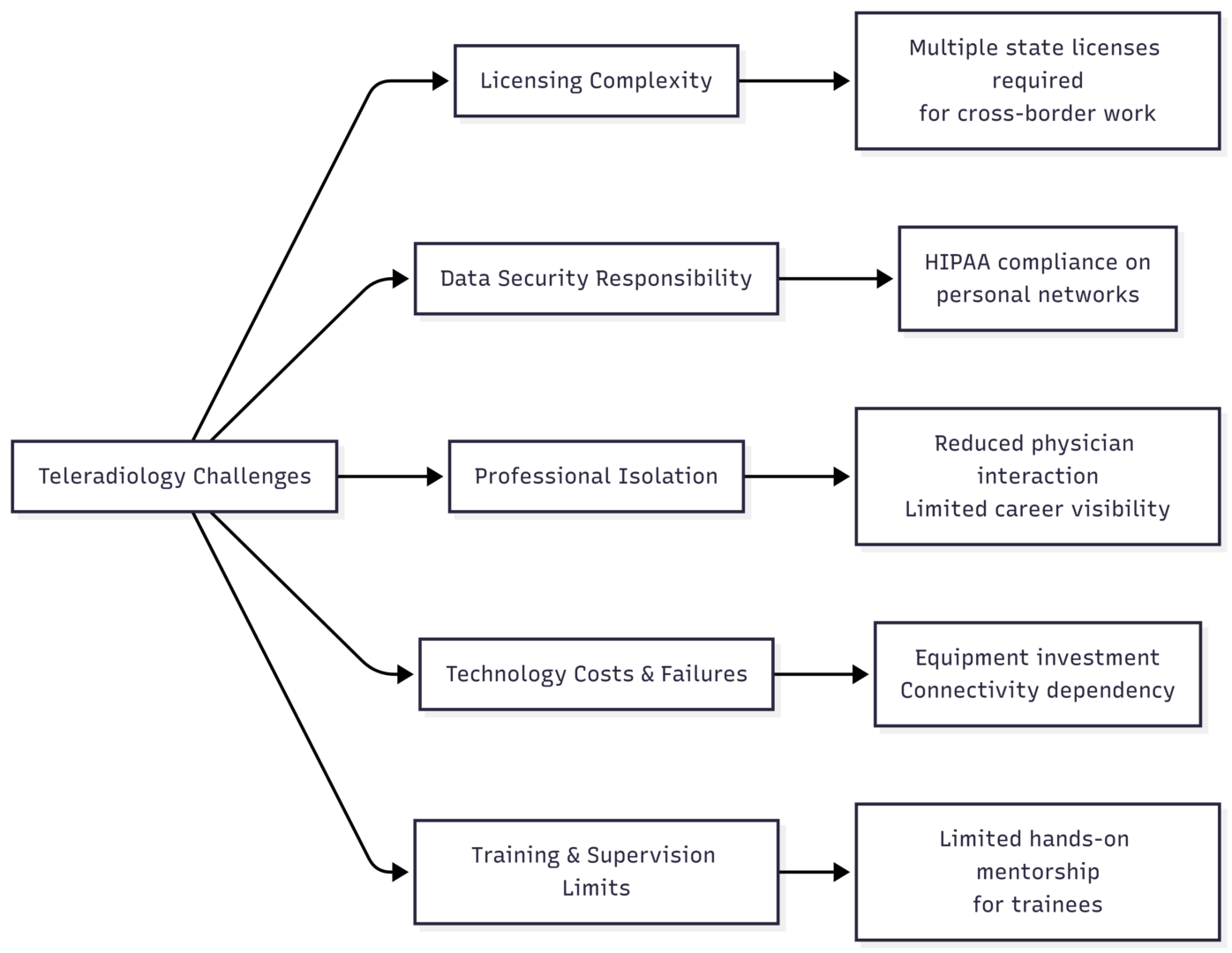
Licensing complexity. Radiologists must hold a valid medical licence in every state where they read images. Working for multiple facilities across different states requires maintaining licences in each, a process that is both administratively complex and costly. Many teleradiology companies assist with multi-state credentialing, but the ongoing maintenance cost remains a factor.
Data security. Handling sensitive patient imaging data outside a hospital’s secured IT environment places compliance responsibility partly on the radiologist. HIPAA-compliant VPNs, encrypted storage, and multi-factor authentication are non-negotiable requirements, not optional additions.
Professional isolation. Remote radiologists have fewer spontaneous interactions with referring physicians, colleagues, and trainees. This can reduce clinical visibility within the healthcare system and limit informal networking and mentorship opportunities.
Technology dependency. A system outage, internet failure, or software problem at home stops work entirely. Unlike an on-site radiologist who can switch workstations, a remote radiologist depends on a single home setup. Redundant internet connections and a reliable IT support arrangement are worth the investment.
Trainee supervision limits. Radiology residency and fellowship training relies heavily on in-person mentorship. Fully remote models make real-time teaching and supervision significantly harder. Most training programs use hybrid arrangements to preserve mentorship quality, with 77% of trainees and 63% of faculty supporting hybrid over fully remote training models.
How to Transition to a Remote Radiology Career
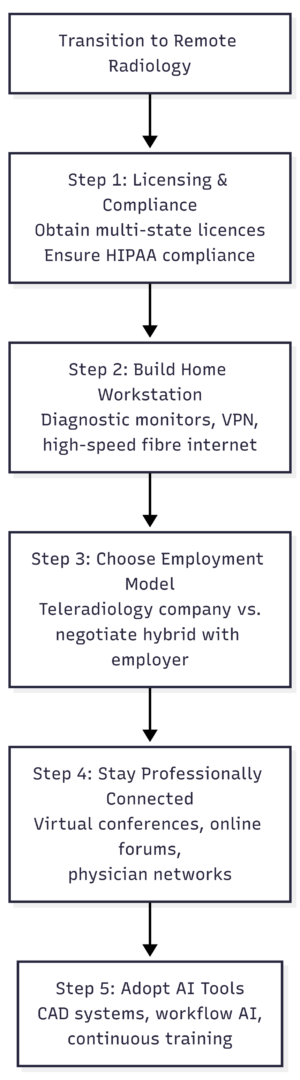
Step 1 — Licensing and compliance. Identify which states or jurisdictions your target employers operate in and begin the multi-state licensing process early. The Interstate Medical Licensure Compact (IMLC) streamlines multi-state licensing for eligible physicians. Confirm your HIPAA compliance training is current.
Step 2 — Workstation setup. Invest in medical-grade diagnostic monitors, a high-performance workstation, and fibre-optic internet. A UPS battery backup protects against data loss. Confirm your home network meets HIPAA transmission security requirements before handling patient data.
Step 3 — Employment model. Teleradiology companies (NightHawk Radiology, vRad, Radiology Partners, StatRad) offer structured remote positions with credentialing support, tech infrastructure, and defined compensation. Alternatively, negotiate a remote or hybrid arrangement with your current hospital or group practice based on your track record.
Step 4 — Professional visibility. Actively participate in virtual CME, professional society meetings, and online radiology communities. Remote work does not have to mean professional isolation, but maintaining visibility requires intentional effort.
Step 5 — AI proficiency. Familiarity with AI-assisted diagnostic tools is increasingly expected in teleradiology. Learn which CAD systems integrate with your PACS environment and stay current with developments in AI-assisted workflow prioritisation.
FAQs
Generally yes — average salaries are comparable at $300,000–$400,000 annually. Independent contractor arrangements often pay more per case but exclude benefits. Some specialised remote roles pay premiums for night shift and weekend coverage.
Not for procedural work. Image-guided procedures require physical presence in the interventional suite. Some IR physicians do remote diagnostic reads alongside their procedural schedule in hybrid arrangements.
Multi-state licensing and the initial home workstation investment are the most commonly cited barriers. Teleradiology companies that provide credentialing support and equipment significantly reduce this friction.
The evidence strongly suggests permanent. Remote reading rates did not decline after pandemic-era pressure eased, and most major radiology groups have built teleradiology into their standard staffing model.
Conclusion
Radiologists can work from home, and a substantial proportion already do. Teleradiology is supported by mature, secure technology — PACS, DICOM, cloud platforms, AI diagnostics, and HIPAA-compliant infrastructure — that makes remote diagnostic imaging as accurate and reliable as on-site reading for the vast majority of subspecialties.
The profession offers remote work salaries of $300,000–$400,000 annually, meaningful flexibility benefits, and access to a growing global market for subspecialty expertise. The primary challenges — multi-state licensing, home workstation investment, and data security compliance — are manageable with preparation and the right employer support.
For diagnostic radiologists considering the shift, the question is no longer whether remote work is viable. It is which model, employer, and setup best fits your career goals.
Please share this Can Radiologists Work from Home? with your friends and do a comment below about your feedback.
We will meet you on next article.
Until you can read, Can I Work from Home as an Accountant? (The Modern Reality)