The 20 Most Popular Bible Verses About Patience
The Bible presents patience as essential quiet strength—a fruit of the Spirit, a response to trials, and a reflection of God’s own character. These verses provide guidance for waiting on God’s timing, persevering through difficulties, and extending grace to others. They emphasize that patience produces maturity, hope, and stronger relationships while aligning believers with Christ’s example.
This article compiles the 20 most referenced Bible verses on patience, grouped by key themes, with context, explanations, and applications for daily life. Use them for personal study, encouragement during seasons of waiting, or teaching others.
Table of Top 20 Bible Verses on Patience
| Rank | Verse Reference | Theme | Key Insight |
|---|---|---|---|
| 1 | Romans 12:12 | Endurance in Trials | Rejoice in hope, patient in affliction, constant in prayer |
| 2 | Galatians 6:9 | Perseverance in Good | Do not grow weary; harvest comes in due season |
| 3 | Romans 8:25 | Hopeful Waiting | Wait patiently for unseen promises |
| 4 | Ephesians 4:2 | Relational Patience | Bear with one another in love |
| 5 | Psalm 37:7 | Waiting on the Lord | Be still and wait patiently |
| 6 | 1 Corinthians 13:4 | Love’s Foundation | Love is patient |
| 7 | James 1:3-4 | Faith Testing | Trials produce steadfastness and maturity |
| 8 | Colossians 3:12-13 | Christian Character | Clothe yourselves with patience and forgiveness |
| 9 | Isaiah 40:31 | Renewed Strength | Those who wait on the Lord renew strength |
| 10 | Proverbs 14:29 | Wisdom in Response | Slow to anger shows understanding |
| 11 | Lamentations 3:25-26 | God’s Goodness | Good to wait quietly for the Lord |
| 12 | Galatians 5:22-23 | Fruit of the Spirit | Patience as evidence of Spirit’s work |
| 13 | Psalm 27:14 | Courageous Waiting | Wait for the Lord; take courage |
| 14 | Hebrews 10:36 | Endurance for Promise | Need endurance to receive what is promised |
| 15 | Proverbs 16:32 | Self-Control | Better to rule your spirit than take a city |
| 16 | James 5:7-8 | Farmer’s Example | Patient like a farmer awaiting rains |
| 17 | Romans 5:3-4 | Suffering to Hope | Suffering produces perseverance, character, hope |
| 18 | 2 Peter 3:9 | God’s Patience | Lord is patient, not wanting any to perish |
| 19 | Ecclesiastes 7:8 | Better End | Patience better than pride |
| 20 | 1 Thessalonians 5:14 | Community Care | Be patient with everyone |
This table highlights the most impactful verses based on their frequency and resonance in Christian teaching.
Waiting on God’s Timing: Trusting Divine Schedules
Many verses address the challenge of waiting when outcomes are uncertain.
Psalm 37:7 (ESV): “Be still before the Lord and wait patiently for him; fret not yourself over the one who prospers in his way, over the man who carries out evil devices!”
This Psalm encourages quiet trust amid injustice or inequality. Fretting leads to evil, while patient waiting positions believers to inherit God’s promises. In practice, this means resisting comparison on social media or anxiety over delayed career or family goals.
Psalm 27:14 (ESV): “Wait for the Lord; be strong, and let your heart take courage; wait for the Lord!”
David’s words link patience with courage. Waiting is active—strengthened by prayer and remembrance of past faithfulness.
Isaiah 40:31 (ESV): “But they who wait for the Lord shall renew their strength; they shall mount up with wings like eagles; they shall run and not be weary; they shall walk and not faint.”
This promise transforms passive waiting into expectant renewal. Those exhausted by delays find supernatural stamina through dependence on God.
Lamentations 3:25-26 (ESV): “The Lord is good to those who wait for him, to the soul who seeks him. It is good that one should wait quietly for the salvation of the Lord.”
Jeremiah wrote amid destruction, yet affirmed God’s goodness in seasons of silence. Quiet waiting involves seeking rather than demanding.
Habakkuk 2:3 (ESV): “For the revelation awaits an appointed time… Though it linger, wait for it; it will surely come and will not delay.”
Prophetic visions often require patience. This verse reassures that God’s appointed times are reliable.
Jeremiah 29:11 (ESV): “For I know the plans I have for you, declares the Lord, plans for welfare and not for evil, to give you a future and a hope.”
Often quoted in waiting seasons, this reminds believers of benevolent purpose behind delays.
Enduring Trials: Patience Through Suffering
Trials test and refine patience, leading to growth.
James 1:3-4 (ESV): “For you know that the testing of your faith produces steadfastness. And let steadfastness have its full effect, that you may be perfect and complete, lacking in nothing.”
James teaches that faith under pressure builds endurance, culminating in spiritual maturity. View difficulties as opportunities rather than obstacles.
Romans 5:3-4 (ESV): “Not only that, but we rejoice in our sufferings, knowing that suffering produces endurance, and endurance produces character, and character produces hope.”
Paul outlines a chain reaction: suffering → perseverance → character → hope. This progression sustains believers through long-term challenges like illness, loss, or opposition.
Hebrews 10:36 (ESV): “For you have need of endurance, so that when you have done the will of God you may receive what is promised.”
Endurance is required to claim inheritance. This motivates consistency in obedience despite fatigue.
James 5:7-8 (ESV): “Be patient, therefore, brothers, until the coming of the Lord. See how the farmer waits for the precious fruit of the earth, being patient about it, until it receives the early and the late rains. You also, be patient. Establish your hearts…”
The farmer analogy illustrates seasonal patience. Crops require time, irrigation, and trust in natural processes—mirroring spiritual fruitfulness.
Romans 12:12 (ESV): “Rejoice in hope, be patient in tribulation, be constant in prayer.”
This triplet offers a practical triad for hard times: hope fuels joy, patience handles affliction, and prayer maintains connection.
Extending Grace: Patience with Others
Patience manifests relationally through humility and forgiveness.
Ephesians 4:2 (ESV): “With all humility and gentleness, with patience, bearing with one another in love.”
Unity in the church demands patient tolerance of differences. Humility prevents prideful reactions.
Colossians 3:12-13 (ESV): “Put on then, as God’s chosen ones, holy and beloved, compassionate hearts, kindness, humility, meekness, and patience, bearing with one another and, if one has a complaint against another, forgiving each other; as the Lord has forgiven you, so you also must forgive.”
Patience is part of the believer’s new wardrobe. It pairs with forgiveness, mirroring God’s mercy.
1 Thessalonians 5:14 (ESV): “And we urge you, brothers, admonish the idle, encourage the fainthearted, help the weak, be patient with everyone.”
Pastoral instruction requires tailored responses and universal patience.
Proverbs 14:29 (ESV): “Whoever is slow to anger has great understanding, but he who has a hasty temper exalts folly.”
Patience signals wisdom; quick anger reveals foolishness and escalates conflict.
Proverbs 16:32 (ESV): “Whoever is slow to anger is better than the mighty, and he who rules his spirit than he who takes a city.”
Self-mastery through patience surpasses military conquest.
Proverbs 15:18 (ESV): “A hot-tempered man stirs up conflict, but he who is slow to anger quiets contention.”
Patient responses de-escalate disputes.
Love, God’s Character, and the Fruit of the Spirit
1 Corinthians 13:4 (ESV): “Love is patient and kind; love does not envy or boast; it is not arrogant.”
Patience heads the love chapter. Without it, other gifts lose value.
Galatians 5:22-23 (ESV): “But the fruit of the Spirit is love, joy, peace, patience, kindness, goodness, faithfulness, gentleness, self-control; against such things there is no law.”
Patience grows through the Holy Spirit, not willpower alone.
2 Peter 3:9 (ESV): “The Lord is not slow to fulfill his promise as some count slowness, but is patient toward you, not wishing that any should perish, but that all should reach repentance.”
God’s patience models salvation opportunity. Human impatience often forgets this mercy.
Psalm 103:8 (ESV): “The Lord is merciful and gracious, slow to anger and abounding in steadfast love.”
Divine slowness to anger provides repeated chances for growth.
Biblical Examples of Patience
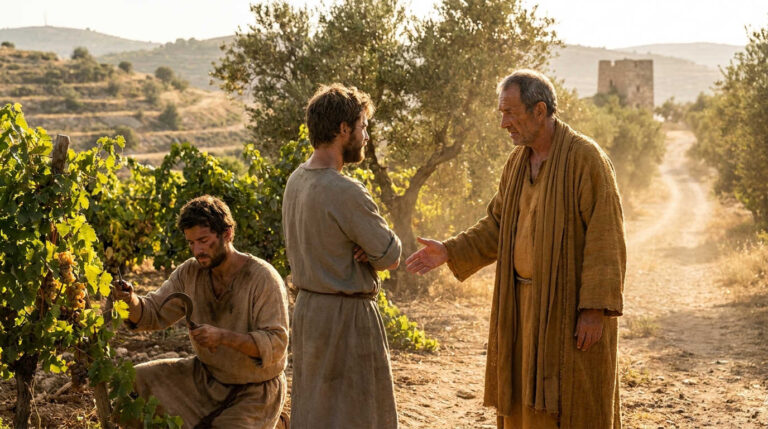
Jacob (Genesis 29:20): Serving seven years for Rachel “seemed like only a few days to him because of his love.” Love empowered endurance despite deception.
Saul’s Impatience (1 Samuel 13:8-14): Offering sacrifices prematurely cost him the kingdom, contrasting with David’s patient waiting.
Prodigal Son’s Father (Luke 15): Patiently watching for return demonstrated compassionate waiting.
Abraham and Hebrews 6:15: Patient waiting obtained the promise after decades.
These narratives show patience’s rewards and impatience’s costs.
Mind Map: Themes of Patience in the Bible
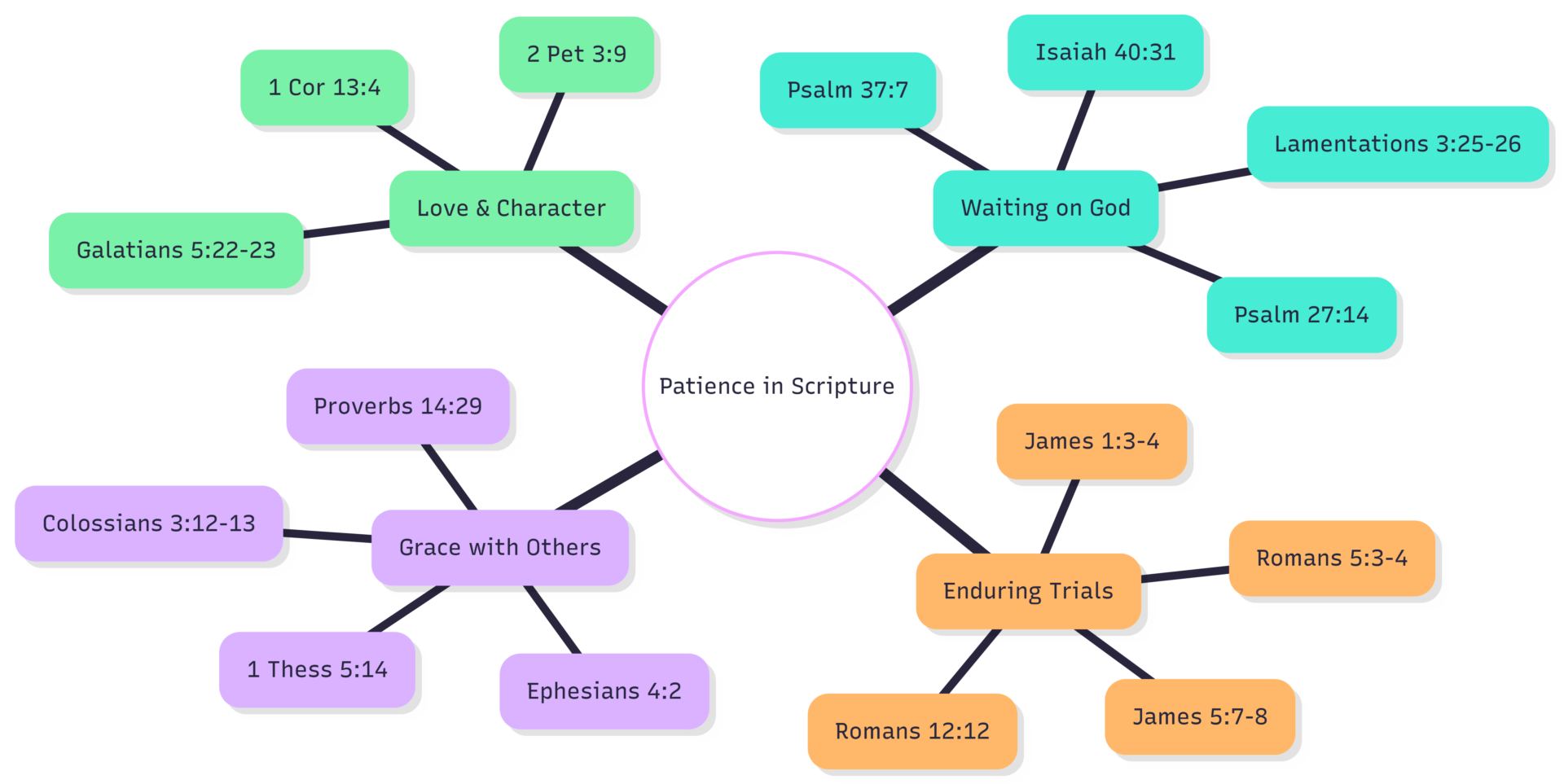
This diagram illustrates how patience interconnects across personal, relational, and spiritual dimensions.
Practical Applications for Cultivating Patience
- In Waiting: Journal promises and past faithfulness during delays. Practice stillness through prayer and meditation on Scripture.
- In Trials: Reframe suffering using Romans 5:3-4. Focus on small daily obedience.
- With People: Pause before reacting. Pray for difficult individuals and remember God’s patience with you.
- Daily Habits: Memorize key verses. Use waiting times (traffic, lines) for gratitude or intercession.
- Community: Share testimonies of God’s timing. Support others in their waiting seasons.
Patience counters cultural instant gratification. It builds resilience, deepens faith, and enhances witness. As James notes, full development comes through steadfastness.
These 20 verses equip believers to navigate life’s uncertainties with grace and hope. Return to them regularly for strength. Patience is not passive resignation but active trust in God’s perfect plan, producing maturity that glorifies Him.
Please share this The 20 Most Popular Bible Verses About Patience with your friends and do a comment below about your feedback.
We will meet you on next article.
Until you can read, The 20 Most Popular Bible Verses About Mothers Love