
Cross-Cultural Communication in the Digital Era
Digital technology has permanently reshaped how humans connect across cultures. The barriers that once kept markets, teams, and conversations geographically siloed have largely dissolved. Video calls bridge continents in seconds. Project management tools sync teams across a dozen time zones. AI-powered translation eliminates language walls in real time. Yet the promise of frictionless global communication has also exposed a stubborn truth: technology removes distance, but it cannot remove cultural difference. Knowing how to navigate that difference is now one of the most valuable skills in business and professional life.
What Is Cross-Cultural Communication?
Cross-cultural communication is the practical exchange of meaning between individuals or groups shaped by distinct cultural backgrounds—different languages, values, social norms, religious frameworks, and lived experiences. In a business context, it encompasses everything from the words chosen in an email to the silence observed before a decision, from the directness of feedback to the formality of a greeting.
Digital-first cross-cultural communication extends this to platforms and tools: email, video conferencing, instant messaging, asynchronous collaboration software. The “digital-first” framing matters because these platforms strip away many of the contextual cues that help humans interpret meaning—body language, physical space, ambient tone. What remains is text, video thumbnails, emojis, and response timing, all of which carry radically different meanings depending on who is reading them and where they grew up.
A foundational concept here is the distinction between high-context and low-context cultures, first articulated by anthropologist Edward Hall:
- High-context cultures (many East Asian, Middle Eastern, and Latin American societies) rely heavily on shared background, implicit meaning, relationship history, and tone. Much goes unsaid because it is assumed to be understood.
- Low-context cultures (Northern European, North American) favor explicit, direct, verbally stated communication. If it is not written down or said aloud, it may not register as real.
Neither approach is superior. But when a low-context communicator sends a blunt, bullet-pointed email to a high-context recipient, the message may land as rude or dismissive—even if its content is entirely professional. This is the core tension that digital communication amplifies.
The Challenges of Digital Intercultural Communication
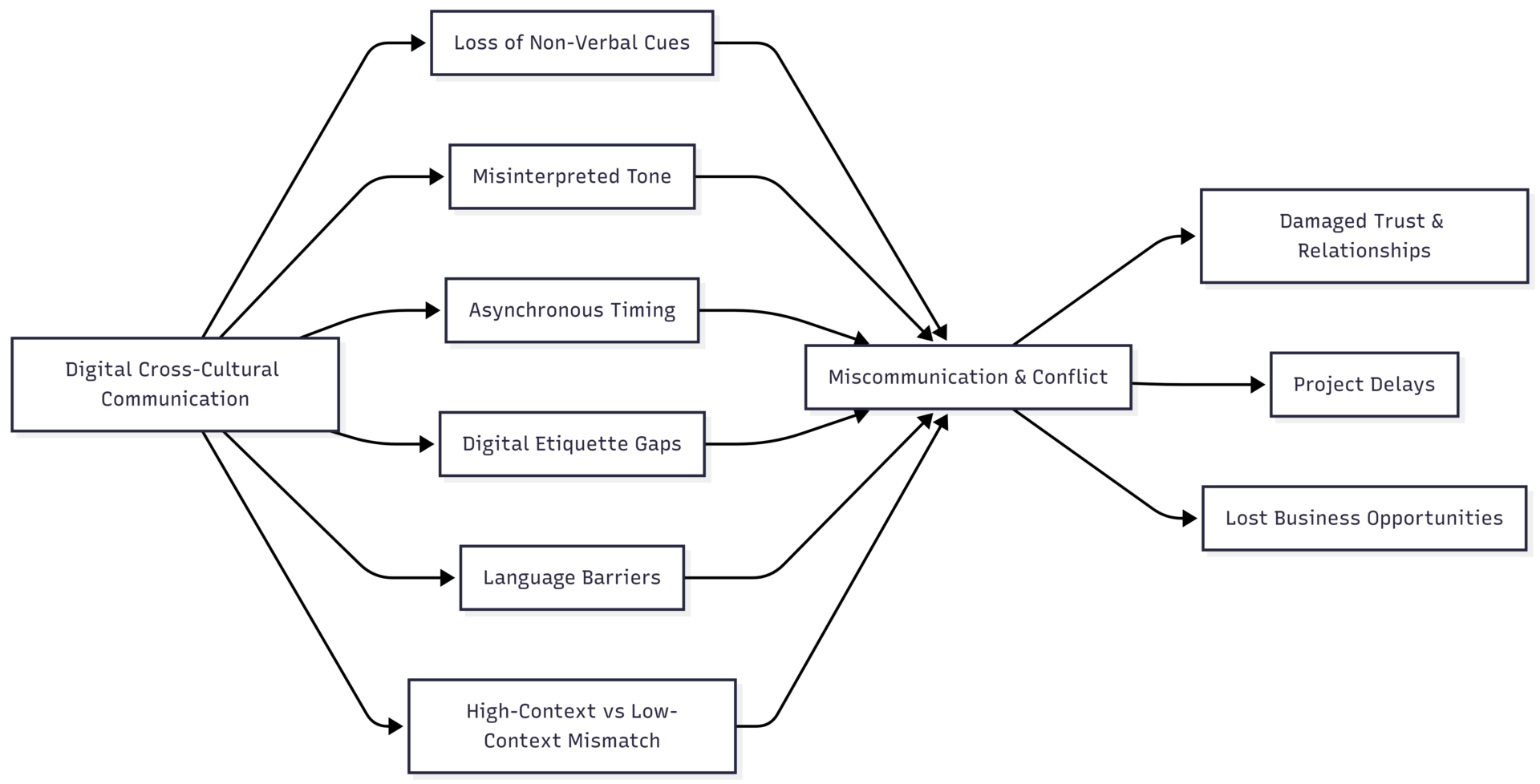
1. Loss of Non-Verbal Cues
Research consistently shows that a large portion of human communication is non-verbal—facial expression, eye contact, posture, gesture. Text-based channels eliminate all of this. A curt reply that would seem perfectly normal spoken aloud, with a smile and a wave, becomes ambiguous or even hostile in an email. For cultures where relational warmth is expected as a baseline, text-only communication can feel cold and transactional before any actual exchange of information begins.
2. Misinterpreted Tone
Sarcasm, irony, humor, and directness do not translate universally. A British colleague’s dry humor may be interpreted as genuine frustration by an American counterpart. A German manager’s direct feedback—which within German professional culture signals respect and clarity—may feel harsh or even insulting to a colleague from a culture that values face-saving indirectness. Digital communication removes the vocal delivery that would otherwise soften or contextualize these moments.
3. Asynchronous Timing
Collaborating across time zones means messages often travel across hours of silence. In cultures where prompt response signals engagement and respect, a 12-hour gap in reply time can register as disinterest or disorganization—even when the recipient is simply asleep. Establishing clear norms around response expectations is not optional; it is foundational to cross-cultural digital collaboration.
4. Digital Etiquette (Netiquette) Gaps
Standards for appropriate communication vary. Some cultures expect formal salutations even in Slack. Others treat instant messaging as informal and conversational by definition. Some expect decisions to be communicated to senior stakeholders first, via hierarchical channels, before being discussed openly on a shared project platform. Violating these unspoken rules—even accidentally—can damage trust or create political friction that has nothing to do with the work itself.
5. Language Barriers Beyond Vocabulary
Even when a common language (usually English) is agreed upon, nuance suffers. Non-native speakers may use technically correct words in culturally incorrect contexts. Marketing copy, social media posts, and customer communications are especially vulnerable. A phrase with neutral or positive connotations in one dialect may carry entirely different weight in another. Automated translation tools catch vocabulary errors but rarely catch cultural register errors.
Real-World Failure: The McDonald’s Chinese Ad Example
Consider a real and instructive case. McDonald’s, one of the world’s most sophisticated global marketing operations, ran a targeted Instagram ad in Chinese aimed at a Chinese-American audience in the San Francisco Bay Area. The copy was written in Mandarin and was grammatically correct. But native Chinese speakers in the comments were confused: the phrasing felt unnatural, like something written by someone who learned Chinese academically but had not lived it. One commenter wrote: “Please find someone who knows real Chinese to write your ad.”
The brand had addressed language. It had not addressed culture. The words were accurate. The register—the specific idioms, rhythms, and implied context that native speakers intuit without thinking—was off. This distinction between linguistic competence and cultural competence is the most common failure mode in global digital marketing, and it applies equally to internal team communication, customer support, and partner relations.
Key Benefits of Getting Cross-Cultural Communication Right
When organizations invest deliberately in this capability, the returns are concrete:
| Benefit | What It Looks Like in Practice |
|---|---|
| Global talent access | Teams recruit the best candidates worldwide, not just locally |
| Market expansion | Products and messaging resonate authentically with new audiences |
| Faster decision-making | Fewer misunderstandings mean fewer clarification loops |
| Stronger partnerships | International clients and vendors trust organizations that respect their context |
| Employee retention | Inclusive communication cultures reduce friction and attrition on global teams |
| Innovation | Diverse perspectives, when genuinely integrated, generate more creative solutions |
Essential Tools for Digital-First Cross-Cultural Teams
The right technology stack does not replace cultural intelligence, but it creates the conditions for it to function.
Communication Platforms
- Zoom / Microsoft Teams / Google Meet — Video conferencing that restores facial expression and vocal tone to asynchronous environments. For cross-cultural teams, defaulting to video over text reduces misinterpretation significantly.
- Slack / Microsoft Teams (messaging) — Instant messaging with searchable history. Particularly useful when teams need to maintain a record of decisions across time zones.
Language and Translation
- DeepL — Higher contextual accuracy than Google Translate for European languages, particularly for nuanced business communication.
- Grammarly — Catches tone and clarity issues in English, useful for non-native writers communicating in a second language.
- Google Translate — Sufficient for broad comprehension; insufficient for published content or sensitive communications.
Project Management and Collaboration
- Asana / Trello / Monday.com — Visual task management that reduces reliance on email threads, making project status clear across language and timezone barriers.
- Miro / Mural — Visual collaboration tools that reduce the cognitive load of language by using diagrams, sticky notes, and frameworks that transcend verbal communication.
Cultural Training
- CultureWizard — Corporate cultural training with profiles for over 100 countries, covering communication styles, hierarchy expectations, and meeting norms.
- GlobeSmart — Comparative cultural profiles that help teams understand specific areas of difference before they become friction points.
Best Practices for Cross-Cultural Digital Collaboration
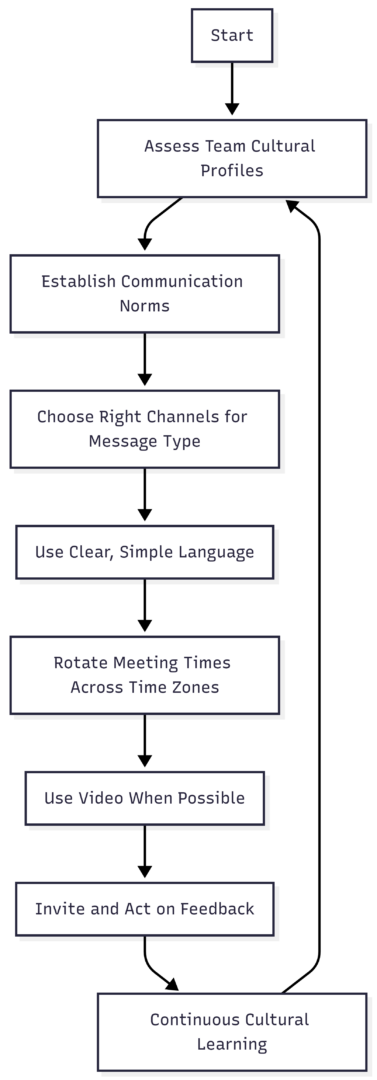
Use Clear, Simple Language
Strip out idioms, slang, and regionally specific metaphors. Phrases like “we need to hit it out of the park,” “let’s circle the wagons,” or “throw it against the wall and see what sticks” are genuinely puzzling to non-native English speakers and to speakers of other English dialects. This is not dumbing down communication; it is respecting the audience enough to ensure the message lands as intended.
Default to Video for High-Stakes Conversations
Feedback, conflict resolution, negotiation, and relationship-building should happen on video whenever possible. Seeing a face restores the non-verbal context that text strips away and gives both parties the social signals they need to calibrate tone, empathy, and intent.
Rotate Meeting Times
When a team spans multiple time zones, scheduling all meetings in a timezone convenient to the headquarters forces the same people to join at 6 a.m. or 11 p.m. every week. Rotating meeting times distributes this burden equitably and signals that all team members’ time and comfort are valued.
Adapt Your Communication Style, Not Just Your Language
Pay attention to how counterparts communicate and mirror some of their preferences. If a colleague tends toward formal salutations and longer, more contextual emails, respond in kind. If a partner prefers concise, action-oriented messages, match that rhythm. Style-switching is a skill, and it signals respect.
Be Explicit About Process and Expectations
In cross-cultural teams, never assume shared understanding of how decisions get made, who needs to be informed, what “done” means, or how feedback should be delivered. Make these things explicit at the start of a project, in writing, and revisit them when friction emerges.
Leverage Visuals Thoughtfully
Diagrams, process maps, and visual frameworks reduce the cognitive load of cross-language communication. However, some visuals carry cultural baggage: certain colors (white as mourning in some East Asian cultures, green as luck or environmental in others), hand gestures, directional symbols, and human figures can all trigger unintended associations. When in doubt, test visuals with local cultural advisors before publishing.
Do’s and Don’ts: Quick Reference
| Do | Don’t |
|---|---|
| Use clear, literal language | Rely on idioms, slang, or humor that doesn’t translate |
| Invest in cultural sensitivity training | Assume shared cultural norms without verifying |
| Use AI translation as a first draft, not a final output | Publish auto-translated content without human review |
| Establish written communication norms at project start | Leave response time and formality expectations implicit |
| Rotate meeting times across time zones | Always schedule in headquarters timezone |
| Use video for complex or sensitive conversations | Default to text for high-stakes communication |
| Actively seek feedback from international team members | Wait for complaints to surface on their own |
| Hire cultural consultants for market-specific content | Assume linguistic fluency equals cultural fluency |
Measuring Communication Effectiveness Across Cultures
Progress in cross-cultural communication cannot be managed without being measured. Useful signals include:
- Employee engagement scores segmented by region and cultural background
- Project delivery rates on international teams versus domestic teams
- Customer satisfaction scores in markets where cross-cultural communication is a factor
- Incident frequency — tracked instances of miscommunication, escalations, or cultural friction
- Training completion rates and pre/post competency assessments for cultural fluency programs
These metrics rarely appear on a dashboard in isolation. They need to be tracked longitudinally and contextualized against organizational changes, market conditions, and team composition shifts.
Common Roadblocks and How to Address Them
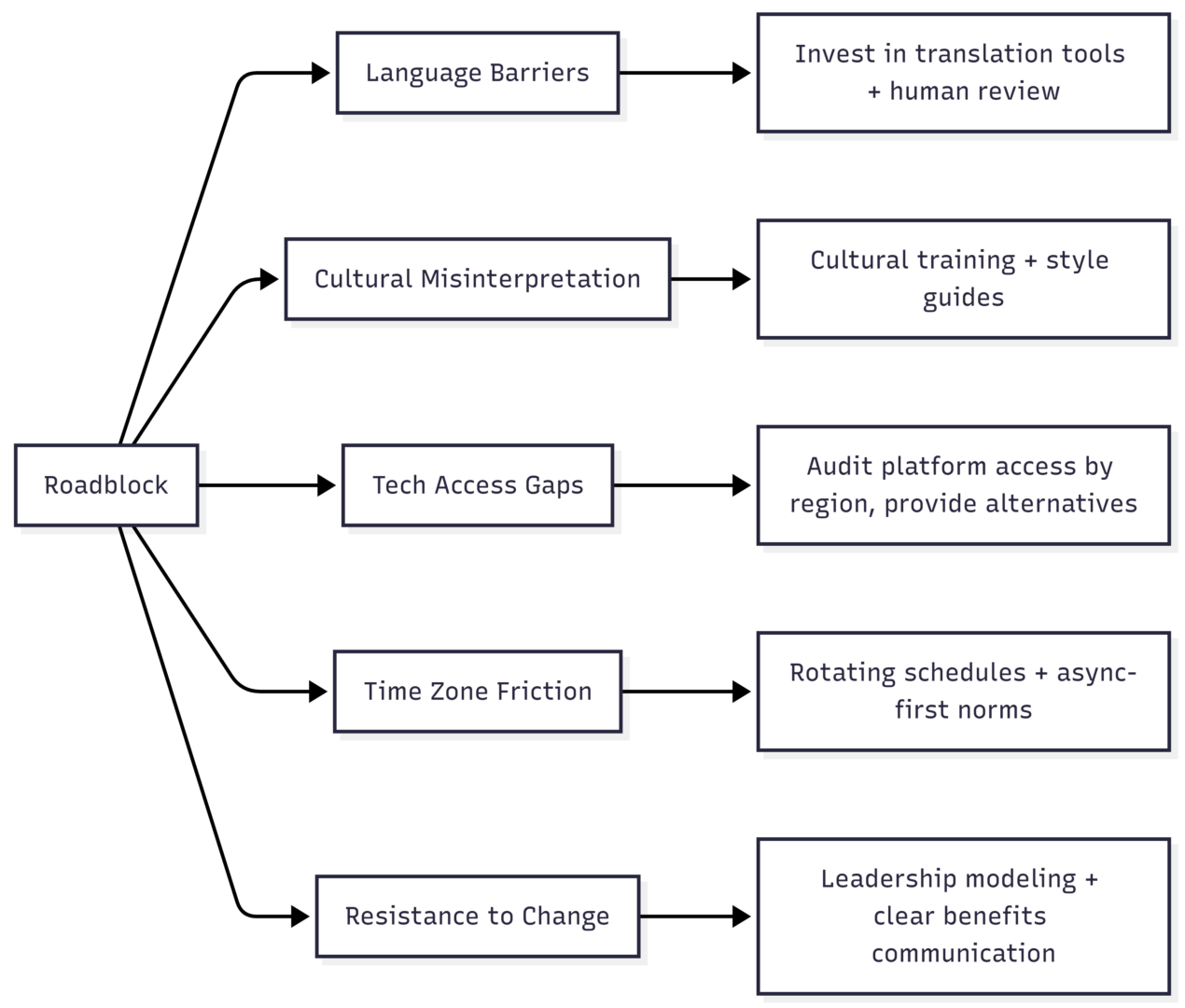
Technology access is often overlooked. In global organizations, digital tools that work seamlessly in one region may face bandwidth restrictions, government filters, or device incompatibility in another. Organizations that design communication infrastructure only around their best-connected offices systematically disadvantage teams in other markets.
Resistance to change is rarely about culture and usually about fear—of looking incompetent, of making mistakes publicly, of losing status. Creating psychological safety for cross-cultural mistakes, and modeling that safety at the leadership level, is the most effective intervention.
Applying This to Digital Marketing Strategy
Cross-cultural communication is not only an internal HR or operations concern. It is central to digital marketing strategy in any organization operating across markets. The questions that apply to a team Slack message apply equally to a social ad, a landing page, an email campaign, or a customer service interaction:
- Who is the specific cultural audience?
- What is the expected communication register—formal, casual, direct, indirect?
- Are there idioms, humor styles, or visual cues in this content that could misfire?
- Has this content been reviewed by someone who is from the culture, not just fluent in the language?
- Does the platform itself (Instagram, WeChat, LINE, WhatsApp) carry cultural associations that affect how the message is received?
Brands that answer these questions before publishing avoid the kinds of failures—mistranslated copy, culturally tone-deaf imagery, formality mismatches—that generate backlash and erode trust in markets that may have taken years to enter.
Step-by-Step Implementation Guide
- Audit current practices — Survey team members across regions to identify specific communication friction points. Look for patterns: are delays clustering around particular time zones? Are misunderstandings concentrated in a particular channel or content type?
- Build cultural profiles — Use tools like CultureWizard or GlobeSmart to map the specific cultural communication norms of the countries and communities your organization works with. Document these in a shared, accessible resource.
- Establish written communication norms — Create a team communication guide that covers: preferred channels by message type, expected response times by urgency level, meeting scheduling conventions, and tone and formality expectations. Revisit annually.
- Invest in training — Prioritize cultural sensitivity and digital communication training, particularly for managers and customer-facing roles. Tie completion to performance reviews, not just voluntary participation.
- Choose the right tools — Match platforms to your team’s actual connectivity, language, and workflow needs rather than defaulting to whatever the headquarters team prefers.
- Monitor and iterate — Track the metrics described above. Hold quarterly retrospectives specifically focused on cross-cultural communication effectiveness.
Conclusion
The organizations that will lead in global markets are not necessarily those with the largest budgets or the most sophisticated technology. They are the ones that have built genuine cultural intelligence into their communication practices—at the team level, the marketing level, and the leadership level. Digital tools make global reach possible. Cultural competence makes global reach meaningful.
Cross-cultural communication is not a soft skill at the margins of business strategy. It is the infrastructure on which global collaboration is built. Getting it right requires investment, curiosity, humility, and a willingness to adapt—not just your language, but your assumptions about how meaning itself is made.
References available on request. This article draws on academic frameworks from communication theory (Craig, 1999; Bitzer, 1968; Lanigan, 1977), business communication research (Dumbrava, 2010), and applied digital marketing practice.
Please share this Cross-Cultural Communication in the Digital Era with your friends and do a comment below about your feedback.
We will meet you on next article.
Until you can read, Best Video Conferencing App: Complete Guide for Every Team