The Ultimate Guide To Digital Nomad In Portugal
Portugal has emerged as a global beacon for digital nomads, seamlessly blending its historical charm, vibrant culture, and modern infrastructure to create an unparalleled environment for remote work. By 2025, Portugal’s proactive policies, such as the D8 Digital Nomad Visa, robust digital connectivity, and a burgeoning tech ecosystem, have solidified its status as a top destination. This comprehensive guide provide exhaustive detail—covers every aspect of thriving as a digital nomad in Portugal. From visa intricacies and application processes to in-depth analyses of top destinations, cost breakdowns, healthcare, taxes, and daily life, this resource equips freelancers, remote employees, and entrepreneurs with the tools to make Portugal their productive and fulfilling base. Spanning approximately 9,000 words, this guide offers a deep dive into why Portugal is the ultimate choice for location-independent professionals.
Why Choose Remote Work in Portugal?
Portugal’s appeal for digital nomads lies in its unique convergence of affordability, safety, cultural richness, and lifestyle advantages, setting it apart from other Western European nations. The country’s cost of living remains significantly lower than in cities like Paris, London, or Amsterdam. For a single digital nomad, monthly expenses in urban hubs like Lisbon or Porto range from €1,500 to €2,000, covering rent, utilities, groceries, transportation, and leisure. In contrast, similar lifestyles in Paris often exceed €3,000, making Portugal a budget-friendly yet high-quality option.
Safety is a cornerstone of Portugal’s allure. According to the 2025 Global Peace Index, Portugal ranks among the top five safest countries, with low violent crime rates (0.6 incidents per 1,000 people) and political stability. This security fosters peace of mind, allowing nomads to explore cities like Lisbon’s Alfama district or rural Algarve trails without concern, enhancing both personal well-being and professional focus.
Culturally, Portugal is a tapestry of experiences. Its history, from Roman aqueducts to 15th-century maritime landmarks, offers endless inspiration. Culinary traditions captivate, with coastal towns serving fresh bacalhau (cod) and pastéis de nata, while the Douro Valley produces world-class wines. Cultural immersion is accessible through events like Lisbon’s Fado nights or Porto’s Festa de São João, where locals welcome newcomers. These elements create a vibrant backdrop for nomads, blending work with meaningful leisure.
Portugal’s quality of life is exceptional. The Mediterranean climate delivers over 300 sunny days annually, with temperatures averaging 15°C in winter and 25°C in summer, ideal for outdoor pursuits like surfing in Peniche or hiking in Sintra. Public services, including healthcare ranked among Europe’s best by the WHO, and efficient transportation (e.g., Lisbon’s metro or intercity Alfa Pendular trains) ensure convenience. This environment supports a balanced lifestyle where morning Zoom calls can transition to afternoon beach sessions or evening cultural explorations, reducing stress and boosting productivity.
The country’s digital infrastructure is a key enabler. With average download speeds of 195 Mbps (reaching 1 Gbps in cities), Portugal ranks among Europe’s top 10 for connectivity. Free Wi-Fi in public spaces and co-working hubs like Second Home Lisbon or Porto i/o cater to remote professionals. The growing tech scene, with over 1,500 startups by 2025, fosters collaboration in fields like IT, design, and freelancing. Portugal’s relaxed pace, combined with professional opportunities, makes it a haven for digital nomads seeking both career growth and personal enrichment.
Portugal’s Proactive Remote Work Policies
Portugal’s government has strategically positioned the country as a digital nomad hub through forward-thinking policies tailored to global work trends. The flagship initiative, the D8 Digital Nomad Visa, introduced in 2022 and streamlined by 2025, targets non-EU/EEA citizens engaged in remote work for foreign employers or as freelancers. Requiring a minimum monthly income of €3,480, proof of accommodation, and health insurance, the visa allows an initial one-year stay, renewable for up to five years, with pathways to permanent residency. It also grants Schengen Area mobility and family reunification options.
Since its inception, the D8 Visa has attracted over 50,000 nomads, contributing an estimated €2 billion annually to the economy through housing, services, and tourism. The government complements this with the Non-Habitual Residency (NHR) tax regime, offering up to 10 years of reduced tax rates (e.g., 20% on foreign-sourced income) for eligible residents. This incentivizes long-term settlement, benefiting both nomads and local markets.
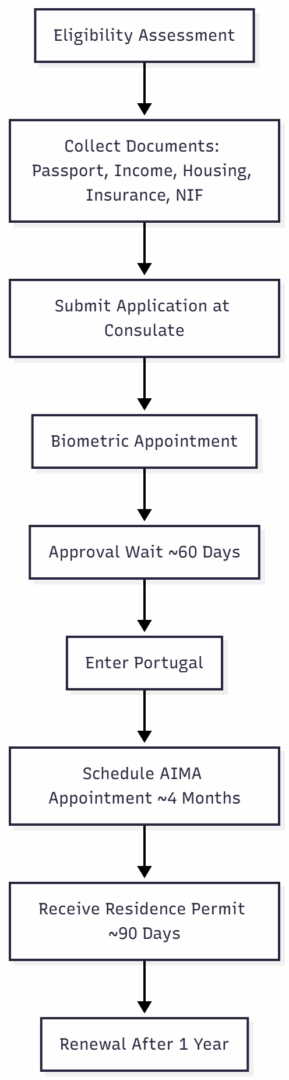
The application process is designed for accessibility: candidates gather documents, submit through Portuguese consulates, attend biometric appointments, and, upon approval, apply for a residence permit via AIMA (Agency for Integration, Migration, and Asylum). By 2025, processing times average 60 days for initial approval, with residence permits issued within 90 days post-appointment. These policies reflect Portugal’s commitment to fostering a global talent hub, balancing economic growth with a welcoming environment for remote professionals.
What Support Do Digital Nomads Receive in Portugal?
Portugal provides a robust support system for digital nomads, encompassing healthcare, tax benefits, housing, and digital infrastructure, ensuring a seamless transition and sustained productivity.
Benefits and Protections
Healthcare Access: D8 Visa holders gain access to the Serviço Nacional de Saúde (SNS), Portugal’s public healthcare system, ranked 12th globally by the WHO. SNS offers affordable consultations (e.g., €7 for GP visits) and comprehensive care. Private health insurance, starting at €20/month through providers like Cigna or Allianz, supplements SNS for faster specialist access.
Tax Incentives: The NHR program provides significant tax relief, taxing foreign income at a flat 20% for up to 10 years, compared to standard rates of 13.25–48%. Freelancers and remote workers benefit, retaining more income for reinvestment or lifestyle.
Work-Life Balance: Portuguese labor laws apply to residents, mandating a 40-hour workweek (8 hours/day) and a minimum of 22 paid vacation days annually. The “right to disconnect” law, enacted in 2022, prohibits employer contact outside work hours, ensuring personal time. A 2025 four-day workweek pilot across 50 companies demonstrated a 20% reduction in stress and 15% productivity increase, signaling a progressive approach.
Flexible Housing Options
Housing caters to diverse needs. Homestays through platforms like Airbnb immerse nomads in local culture, starting at €500/month in smaller towns. Short-term rentals in Lisbon (€1,000–2,000/month) or Porto (€800–1,500/month) offer furnished apartments with high-speed internet. Co-living spaces, such as Outsite in Lisbon, combine accommodation and co-working for €1,200–1,800/month. Dedicated nomad villages, like Ponta do Sol in Madeira, provide community-driven living with free co-working, events, and networking, fostering collaboration.
Strong Digital Infrastructure
Portugal’s internet infrastructure is world-class, with 95% coverage at 100 Mbps and urban areas offering 1 Gbps. Free Wi-Fi in public spaces (e.g., cafés, libraries) and reliable mobile data (e.g., MEO plans at €15/month for 10 GB) ensure connectivity. Co-working spaces, numbering over 200 nationwide, offer flexible memberships (€100–300/month) with amenities like ergonomic desks, meeting rooms, and coffee bars. Tech hubs like Beta-i in Lisbon host events, connecting nomads with local startups and global professionals.
This comprehensive support—healthcare, tax benefits, housing, and connectivity—creates an ecosystem where digital nomads thrive, blending productivity with Portugal’s vibrant lifestyle.
Is Portugal’s Work Culture Suitable for Digital Nomads?
Portugal’s work culture is exceptionally suited for digital nomads, emphasizing balance, relationships, and professional respect. Unlike high-pressure environments in some Western nations, Portugal prioritizes well-being. The standard 40-hour workweek, coupled with 22 paid vacation days, allows ample time for exploration. The “right to disconnect” law ensures boundaries, preventing burnout—a critical factor for nomads managing international clients across time zones.
Interpersonal relationships are central. Portuguese professionals value trust and collaboration, fostering open communication that aligns with the flexible, community-driven ethos of digital nomads. Business etiquette emphasizes punctuality and respect, creating a professional yet relaxed atmosphere. The four-day workweek pilot, adopted by 50 companies by 2025, reduced employee stress by 20% and increased output, signaling a culture that adapts to modern work trends.
For nomads, this translates to an environment where professional commitments harmonize with personal growth. Networking events in co-working spaces and tech hubs facilitate integration, while the relaxed pace encourages creativity. Portugal’s work culture not only accommodates but actively enhances the digital nomad lifestyle.
Portugal’s Digital Nomad Visa (D8)
The D8 Digital Nomad Visa is a tailored solution for non-EU/EEA remote workers, enabling legal residency while employed by foreign entities or as freelancers. It offers an initial one-year stay, renewable for up to five years, with Schengen Area travel privileges and access to public services like healthcare and education. Family reunification is supported, allowing spouses and children to join.
What is the D8 Visa?
The D8 Visa is a residence permit for remote professionals earning income outside Portugal. It facilitates integration through access to local systems and potential permanent residency after five years.
Digital Nomad Portugal Requirements
- Clean Criminal Record: No convictions in home country or Portugal.
- Age: 18 or older.
- Citizenship: Non-EU/EEA/Swiss.
- Employment: Remote work for a foreign employer or self-employment (e.g., freelancing).
- Income: Minimum €3,480/month, verified via contracts or bank statements.
- Accommodation: Proof of housing (e.g., lease agreement, hotel booking).
- Health Insurance: Valid for Portugal, covering €30,000 minimum.
Application Process
- Document Collection: Gather passport, income proof, accommodation details, health insurance, criminal record, motivation letter, Portuguese NIF (tax number), and bank account proof.
- Consulate Submission: Apply at the nearest Portuguese consulate or embassy.
- Biometric Appointment: Attend for fingerprinting and verification.
- Visa Approval: Receive decision within ~60 days.
- Enter Portugal: Arrive within visa validity period.
- Residence Permit: Schedule AIMA appointment within 4 months of arrival.
- Permit Issuance: Receive permit within ~90 days.
Required Documentation For D8 Visa
- Valid passport (minimum 6 months validity).
- Proof of income (e.g., payslips, contracts, bank statements for 3 months).
- Accommodation proof (lease, hotel booking, or host letter).
- Health insurance policy valid in Portugal.
- Criminal record certificate (home country and any country resided in for over a year).
- Motivation letter outlining intent and plans.
- Portuguese NIF, obtainable via tax office or legal services (€10–20).
- Portuguese bank account statement (minimum €8,460 balance).
Processing Times For D8 Visa
- Initial Application: ~60 days at consulate.
- Residence Appointment: Up to 4 months wait for AIMA scheduling.
- Permit Issuance: ~90 days post-appointment.
Cost Breakdown
| Expense | Cost (€) |
|---|---|
| Visa Application Fee | 90.65 |
| Residence Permit Fee | 130 |
| Health Insurance | 20–100/month |
| Accommodation (1 month) | 800–2,000 |
| NIF Acquisition | 10–20 |
| Bank Account Setup | 0–50 |
Best Destinations for Digital Nomads in Portugal – A Comparison of Job Opportunities and Living Costs
Portugal offers a spectrum of destinations, each catering to different nomad preferences, from bustling urban centers to serene coastal retreats. Below is a detailed comparison of top locations, focusing on job opportunities, co-working availability, and living costs.
Lisbon: The Vibrant Capital
Overview: Lisbon, Portugal’s cosmopolitan capital, blends historic charm with a thriving tech scene. Its startup ecosystem, with over 700 startups by 2025, attracts IT professionals, designers, and entrepreneurs. Neighborhoods like Bairro Alto and Cais do Sodré pulse with energy, while Alfama offers cultural immersion.
Job Opportunities: Home to hubs like Beta-i and Unicorn Factory, Lisbon hosts tech meetups, hackathons, and networking events. Freelancers find clients in tech, marketing, and creative sectors. Co-working spaces like Second Home (€200/month) and Liberdade229 offer high-speed internet and community events.
Living Costs: €1,500–2,000/month for a single person. One-bedroom apartment rent averages €1,334 in central areas like Chiado.
Pros: Diverse expat community, abundant co-working, vibrant nightlife.
Cons: Higher costs than other regions, crowded during tourist seasons.
Algarve: A Sunny and Relaxed Retreat
Overview: The Algarve, with towns like Lagos and Faro, offers a laid-back lifestyle with stunning beaches and a growing digital nomad presence. Its 300+ sunny days attract nomads seeking nature alongside work.
Job Opportunities: Emerging co-working spaces like Faro’s Cowork Algarve (€150/month) cater to remote workers. The region’s tourism industry offers freelance opportunities in content creation and hospitality tech.
Living Costs: €1,200–1,800/month. One-bedroom rent ranges €800–1,200 in Lagos or Faro.
Pros: Affordable, relaxed pace, outdoor activities (e.g., surfing, hiking).
Cons: Limited tech ecosystem compared to Lisbon or Porto.
Porto: A Cultural Gem
Overview: Porto, Portugal’s second city, combines medieval charm with a burgeoning tech scene. The Douro River and Ribeira district provide scenic inspiration, while startup hubs drive innovation.
Job Opportunities: Spaces like Porto i/o (€180/month) and Synergy offer collaborative environments. Porto’s tech sector, with companies like Farfetch, supports IT and design freelancers.
Living Costs: €1,200–1,800/month. One-bedroom rent averages €1,000.
Pros: Rich culture, growing tech scene, lower costs than Lisbon.
Cons: Smaller expat community, cooler winters.
| City | Monthly Costs (€) | One-Bedroom Rent (€) | Key Opportunities | Co-Working Spaces |
|---|---|---|---|---|
| Lisbon | 1,500–2,000 | 1,334 | Startups, Networking | Second Home, Liberdade229 |
| Algarve | 1,200–1,800 | 800–1,200 | Co-working, Tourism | Cowork Algarve, Outsite |
| Porto | 1,200–1,800 | 1,000 | Tech, Culture | Porto i/o, Synergy |
Additional Destinations
- Braga: A tech hotbed with over 200 patents annually, offering spaces like Factory Braga (€120/month). Costs: €1,000–1,500/month.
- Peniche: A surfing haven with co-working at Largo (€100/month). Costs: €1,000–1,600/month.
- Sagres: Europe’s southwestern tip, with Coworksurf (€150/month). Costs: €1,100–1,700/month.
- Coimbra: Historic university city with Nest Collective (€130/month). Costs: €1,000–1,500/month.
- Ponta do Sol, Madeira: A dedicated nomad village with free co-working, events, and community. Costs: €1,200–1,800/month.
Cost of Living in Portugal as a Digital Nomad
The cost of living varies by location and lifestyle. Below is a detailed breakdown for a single digital nomad:
| Expense | Cost (€/month) | Notes |
|---|---|---|
| Accommodation | 1,000–2,000 | One-bedroom in city centers; lower in suburbs or smaller towns |
| Utilities (Electricity, Water, Gas) | 180–184 | Includes heating, cooling for a 50m² apartment |
| Groceries | 300–500 | Supermarkets like Continente; higher for organic/specialty |
| Internet/Mobile | 40–90 | 1 Gbps fiber (€30) + 10 GB mobile (€15) |
| Transportation | 30–40 | Public transport (e.g., Lisbon metro €1.65/trip) or bike rentals |
| Dining Out | 100–200 | 2–3 meals/week at mid-range restaurants (€10–15/meal) |
| Co-Working Space | 100–300 | Varies by city and amenities |
| Leisure (Gym, Activities) | 50–100 | Gym membership (€30) + occasional activities (e.g., surfing lessons €20) |
Total Estimated Monthly Cost: €1,200–2,000 (lower in smaller towns like Braga, higher in Lisbon).
Visa-Related Costs:
- Temporary Stay Visa: €75
- Long-Term Visa (D8): €90.65
- Residence Permit: €130
- Health Insurance: €20–100/month
- NIF Acquisition: €10–20
How to Open a Portuguese Bank Account
Opening a bank account is essential for visa applications and daily transactions. Required documents include:
- Portuguese NIF (obtainable via tax office or legal services for €10–20).
- Valid ID (passport).
- Proof of address (e.g., lease agreement or utility bill).
- Proof of employment or income (e.g., contract, bank statements).
Popular banks include Millennium BCP, Santander Totta, and Novo Banco, offering accounts with low or no monthly fees. Setup costs range from €0–50, though third-party services assisting with NIF and banking may charge €269–395. ATMs are widespread, with euro-based transactions; foreign cards may incur fees.
D7 Visa vs. Portugal Digital Nomad Visa (D8 Visa): What are the Differences?
| Visa | Type | Minimum Income (€/month) | Validity | Target Group |
|---|---|---|---|---|
| D7 | Passive Income | 820 | 2 years, renewable | Retirees, passive income earners |
| D8 | Digital Nomad | 3,480 | 1 year, renewable | Remote workers, freelancers |
The D7 suits those with passive income (e.g., investments, pensions), while the D8 targets active remote professionals. Both offer residency pathways, but the D8’s higher income threshold reflects its focus on economic contribution.
Taxes for Digital Nomads in Portugal
Digital nomads residing over 183 days/year are considered tax residents, liable for worldwide income tax at progressive rates (13.25–48%). Non-residents pay only on Portugal-sourced income. The NHR regime offers a 20% flat rate on foreign income for 10 years, requiring:
- Residency status.
- Application within first year of residency.
- Eligible professional activities (e.g., tech, creative services).
Freelancers must register with the Tax Authority, issue “green receipts” (recibos verdes), and pay social security (€20–100/month based on income). Tax advisors, costing €50–200/hour, help navigate compliance.
Health Insurance and Quality of Health Care
D8 Visa holders access the SNS, with low-cost consultations (e.g., €7 GP visits, €15 specialist). Private insurance, recommended for faster access, costs €20–100/month via providers like Cigna, Allianz, or Médis. Portugal’s healthcare system ranks highly, with 7.8 hospital beds per 1,000 people.
| Hospital | Location | Type | Notes |
|---|---|---|---|
| Hospital de Santa Maria | Lisbon | Public | Largest in Portugal |
| Centro Hospitalar São João | Porto | Public | University-affiliated, advanced care |
| Hospital da Luz | Lisbon, Porto, Algarve | Private | Modern facilities, English-speaking staff |
Daily Life in Portugal
Transportation and Mobility
Portugal’s public transport is efficient:
- Lisbon: Metro (€1.65/trip), buses, trams. Monthly pass: €40.
- Porto: Metro and buses, similar pricing.
- Intercity: Alfa Pendular trains (Lisbon–Porto €25, 2.5 hours).
- Ridesharing: Uber/Bolt available in cities (€5–10/ride).
Driving requires a foreign license (valid 6 months) or an international permit. Car rentals cost €20–50/day. Cycling is popular, with bike-sharing in Lisbon (€15/month).
Financial Management
Major banks (Millennium BCP, Santander) offer online banking and multi-currency accounts. ATMs charge €1–3 for foreign cards. Budgeting apps like Revolut are popular among nomads. Average transaction costs: €0–0.50 for domestic transfers.
Food
Supermarkets (Continente, Pingo Doce) offer affordable groceries (€30–50/week). Local markets provide fresh produce (e.g., Mercado da Ribeira in Lisbon). Dining out ranges from €5 (tascas) to €15 (mid-range). Signature dishes: cataplana, francesinha.
Leisure and Recreation
- Gyms: Fitness Hut, Solinca (€30–50/month).
- Outdoor Activities: Surfing in Peniche (€20/lesson), hiking in Gerês National Park, wine tours in Douro (€50–100/day).
- Cultural Sites: Sintra’s Pena Palace (€14), Belém Tower (€6).
Best Seasons:
- Spring (Mar–May): Mild (15–20°C), ideal for sightseeing.
- Summer (Jun–Aug): Warm (25–30°C), perfect for beaches.
- Autumn (Sep–Nov): Cooler, fewer tourists.
- Winter (Dec–Feb): Mild (10–15°C), great for city exploration.
FAQ: D8 Digital Nomad Visa in Portugal
Below is a revised FAQ section for the D8 Digital Nomad Visa in Portugal, replacing the previous FAQ section. It includes complete, concise questions and answers, focusing on clarity and brevity while covering essential details for digital nomads.
FAQ: D8 Digital Nomad Visa in Portugal
€3,480/month from remote work or freelancing, proven by contracts or bank statements.
Yes, spouse and children under 18 (or 21 if students) can join, with additional income of €1,740/month for spouse and €1,044/month per child.
Yes, after 5 years of continuous residency, with basic Portuguese skills and a clean criminal record.
Yes, if staying over 183 days/year, on worldwide income (13.25–48%). NHR program offers 20% flat rate on foreign income for 10 years.
No, the D8 Visa requires income from outside Portugal.
Passport, income proof, accommodation proof, health insurance, criminal record, motivation letter, NIF, and bank statement.
Portugal’s process is straightforward, but Spain and Croatia also offer competitive nomad visas.
Conclusion
Portugal redefines the digital nomad experience, offering affordability, safety, and a vibrant lifestyle. The D8 Visa, robust infrastructure, and diverse destinations—from Lisbon’s tech hubs to Madeira’s nomad villages—create an ideal environment for remote work. With supportive policies, cultural richness, and natural beauty, Portugal is not just a destination but a lifestyle choice for nomads seeking balance and growth.
Please share this The Ultimate Guide To Digital Nomad In Portugal with your friends and do a comment below about your feedback.
We will meet you on next article.
Until you can read, How to Succeed in Your Remote Job Interview