
Digital Nomad Visa vs Tourist Visa, Which One Should I Apply for?
The rise of remote work has transformed how people approach travel and work, giving birth to the digital nomad lifestyle. Whether you dream of coding from a beach in Bali or designing from a café in Lisbon, choosing the right visa is critical to ensuring your plans are legal, sustainable, and stress-free. Two primary options exist for travelers: the Tourist Visa, ideal for short-term leisure trips, and the Digital Nomad Visa, designed for remote workers seeking longer stays with legal work authorization. This article dives deep into the differences between these visas, their benefits, limitations, and how to decide which one aligns with your goals. We’ll also explore specific visa options, eligibility criteria, and practical considerations to help you make an informed choice.
Understanding the Tourist Visa
A Tourist Visa is a short-term travel document that allows individuals to visit a foreign country for leisure, sightseeing, or limited business purposes (e.g., attending meetings or conferences). It is one of the most common visa types and is typically easy to obtain, making it a go-to choice for travelers looking to explore new destinations without long-term commitments.
Key Features of a Tourist Visa
- Duration: Typically allows stays of 30 to 90 days, depending on the country. Some countries offer extensions, but these are often limited.
- Purpose: Designed for tourism, cultural exploration, or short-term visits. Work, including remote work, is generally prohibited.
- Application Process: Simple and fast, often requiring only a valid passport, proof of funds, a return ticket, and sometimes proof of accommodation.
- Cost: Usually low-cost or free, with fees ranging from $0 (visa-exempt entry) to $50-$100 in many cases.
- Restrictions: Prohibits income-generating activities, including remote work for foreign clients. Violating this can lead to fines, deportation, or bans.
When to Choose a Tourist Visa
- Short-Term Travel: If you plan to stay in a country for less than three months, a tourist visa is often sufficient. It’s perfect for vacations, city-hopping, or exploring multiple destinations.
- Leisure and Sightseeing: Ideal for travelers focused on cultural experiences, visiting landmarks, or enjoying local cuisine without work-related intentions.
- Flexible Itinerary: Tourist visas allow you to move freely between countries with minimal bureaucratic hurdles, making them great for spontaneous travelers.
Pros and Cons of a Tourist Visa
| Pros | Cons |
|---|---|
| Easy and quick application process | Limited stay duration (30-90 days) |
| Low or no cost in many countries | Prohibits work, including remote work |
| Flexible for multi-country travel | Limited access to local services (e.g., banking, healthcare) |
| Minimal documentation required | Extensions or renewals can be restricted |
Example Scenario
Imagine you’re a U.S. citizen planning a three-month trip across Southeast Asia, visiting Thailand, Vietnam, and Cambodia. A tourist visa (or visa-exempt entry) allows you to explore bustling markets, ancient temples, and tropical beaches without complex paperwork. However, if you decide to work on your laptop for a U.S.-based client while on a tourist visa, you risk violating immigration laws, which could lead to penalties.
Understanding the Digital Nomad Visa
A Digital Nomad Visa is a specialized visa tailored for remote workers who want to live and work legally in a foreign country while earning income from clients or employers outside that country. Introduced by many countries to attract location-independent professionals, these visas support the growing trend of remote work by offering legal clarity and extended stays.
Key Features of a Digital Nomad Visa
- Duration: Typically allows stays from six months to several years, often renewable. For example, Portugal’s D8 visa allows up to five years with renewals, while Estonia’s digital nomad visa permits a one-year stay.
- Purpose: Explicitly permits remote work for foreign employers or clients, ensuring legal compliance.
- Application Process: More complex than tourist visas, requiring proof of remote employment, a minimum income (often $2,000-$5,000/month), valid health insurance, and sometimes a clean criminal record.
- Cost: Higher than tourist visas, with application fees ranging from $50 to $1,000, depending on the country. Some visas, like Thailand’s Privilege Visa, require substantial upfront payments.
- Benefits: Offers access to local services (e.g., banking, healthcare), potential tax incentives, and pathways to residency in some cases.
When to Choose a Digital Nomad Visa
- Extended Stays: If you plan to live in a country for six months or more, a digital nomad visa provides the necessary duration and stability.
- Legal Work Status: Ensures you can work remotely without risking immigration violations, offering peace of mind.
- Access to Services: Grants access to local banking, healthcare, and coworking spaces, making long-term living more seamless.
- Long-Term Goals: Ideal for those considering residency or a prolonged stay in a specific country, with some visas offering pathways to permanent residency.
Pros and Cons of a Digital Nomad Visa
| Pros | Cons |
|---|---|
| Legal permission for remote work | Complex application with extensive documentation |
| Extended stay duration (6 months to years) | Higher fees and processing times |
| Access to local services and potential tax benefits | Possible tax obligations after extended stays |
| Pathway to residency in some countries | Income or savings requirements may be high |
Example Scenario
Suppose you’re a freelance graphic designer earning $3,500/month from U.S. clients and want to live in Portugal for a year. By applying for Portugal’s D8 Digital Nomad Visa, you can legally work remotely, open a local bank account, and enjoy the country’s vibrant culture. The visa requires proof of income, health insurance, and a clean criminal record, but it ensures you avoid the legal risks associated with working on a tourist visa.
Key Differences Between Digital Nomad and Tourist Visas
To make an informed decision, let’s compare the two visa types across critical factors:
| Factor | Tourist Visa | Digital Nomad Visa |
|---|---|---|
| Duration | 30-90 days, sometimes extendable | 6 months to several years, often renewable |
| Purpose | Leisure, sightseeing, short-term visits | Remote work for foreign employers/clients |
| Work Legality | Prohibited, including remote work | Explicitly permitted for remote work |
| Application Complexity | Simple, minimal documents | Complex, requires proof of income, insurance, etc. |
| Cost | Low or free ($0-$100) | Moderate to high ($50-$5,000) |
| Access to Services | Limited (e.g., travel insurance required) | Broader (e.g., banking, healthcare) |
| Tax Implications | No tax obligations for short stays | Possible tax obligations for extended stays |
| Residency Pathway | Rare or none | Possible in some countries (e.g., Spain, Portugal) |
Decision Flow for Choosing a Visa
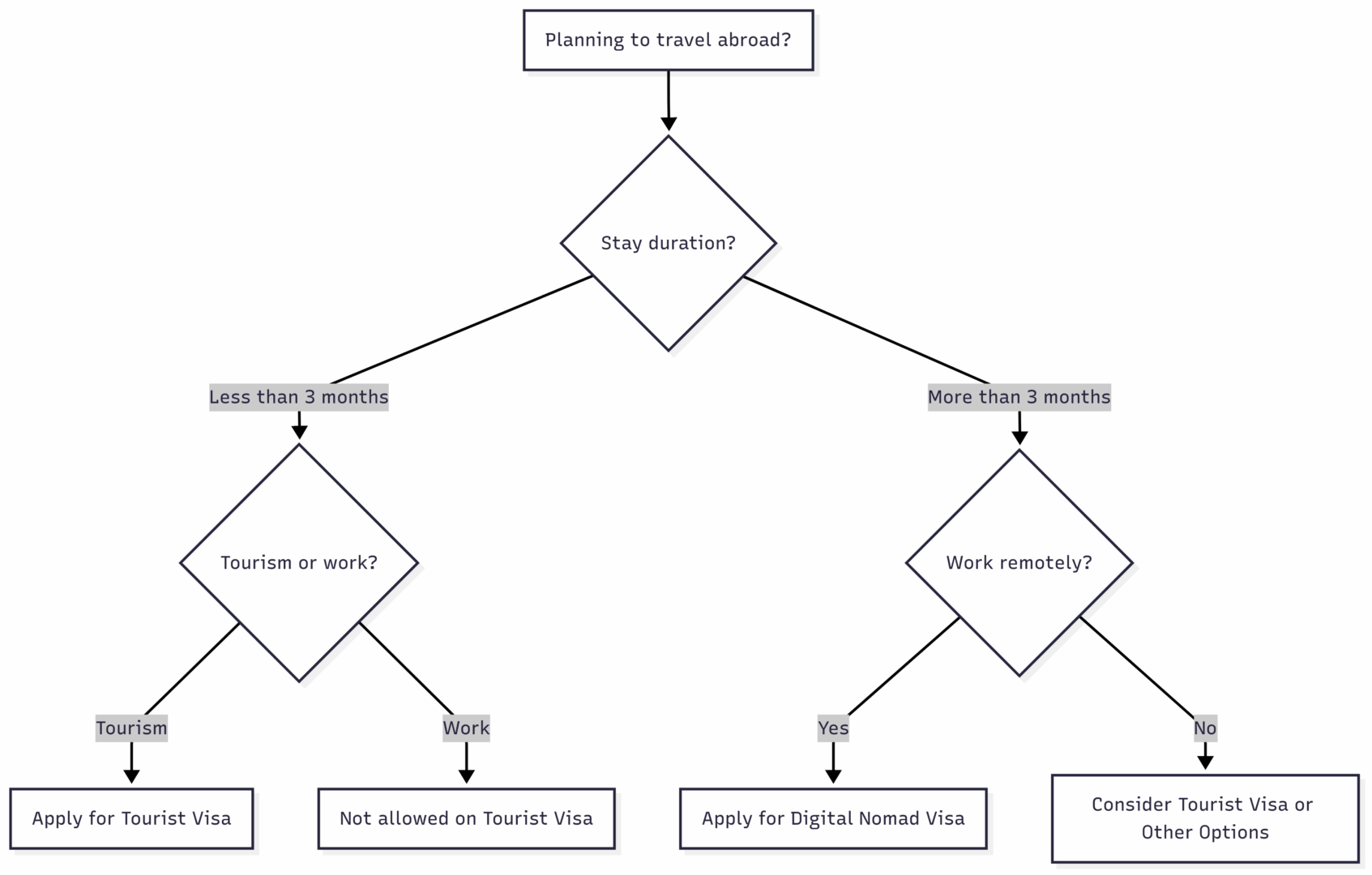
This chart illustrates the decision-making process based on your intended stay duration and whether you plan to work remotely.
Popular Countries Offering Digital Nomad Visas
Over 50 countries now offer digital nomad visas, each with unique requirements and benefits. Below is a detailed comparison of some popular options:
| Country | Visa Name | Duration | Income Requirement | Application Fee | Key Perks |
|---|---|---|---|---|---|
| Portugal | D8 Visa | 1 year (renewable up to 5 years) | $3,755/month | ~$90 | Pathway to EU residency, vibrant culture |
| Spain | Digital Nomad Visa | 1 year (renewable up to 5 years) | $2,980/month | ~$80 | Favorable tax regime (Beckham Law), Mediterranean lifestyle |
| Estonia | Digital Nomad Visa | Up to 1 year | $4,856/month | ~$100 | Tech-forward, e-Residency program |
| Costa Rica | Rentista Visa | 1 year (renewable) | $3,000/month | ~$250 | Tax exemptions, tropical environment |
| Barbados | Welcome Stamp | 1 year | $4,200/month | $2,000 | Tax-free for one year, island lifestyle |
| Indonesia (Bali) | B211A Visa | Up to 5 years | $2,000/month | ~$150 | Long-term stay, affordable living |
| Thailand | Destination Thailand Visa (DTV) | 5 years (180 days per entry) | 500,000 THB (~$14,000) in savings | ~$280 | Family inclusion, no income requirement |
| Mexico | Temporary Resident Visa | Up to 4 years | $3,700/month | ~$40 | Low cost of living, flexible rules |
Notes on Specific Visas
- Thailand’s Destination Thailand Visa (DTV): Ideal for freelancers or self-employed nomads with moderate savings. It allows up to 360 days per year with extensions, but stays over 180 days may trigger tax residency.
- Spain’s Digital Nomad Visa: Offers tax benefits under the Beckham Law (24% tax on income up to €600,000 for six years), making it attractive for high earners.
- Estonia’s e-Residency: While not a visa, it complements the digital nomad visa by providing access to Estonia’s digital infrastructure for business operations.
Practical Considerations for Choosing a Visa
When deciding between a tourist visa and a digital nomad visa, consider the following factors:
- Duration of Stay:
- Short-Term (Under 3 Months): A tourist visa is simpler and more cost-effective for quick trips or multi-country travel.
- Long-Term (6 Months or More): A digital nomad visa offers stability and legal work authorization for extended stays.
- Work Requirements:
- If you plan to work remotely, a digital nomad visa is essential to avoid legal risks. For example, working on a tourist visa in Thailand could lead to deportation or bans.
- If you’re purely traveling for leisure, a tourist visa suffices.
- Budget:
- Tourist visas are budget-friendly, often requiring minimal fees.
- Digital nomad visas may involve higher costs, including application fees and private health insurance. For instance, Barbados’ Welcome Stamp has a $2,000 fee, while Thailand’s DTV is more affordable at ~$280.
- Access to Services:
- Tourist visa holders often rely on travel insurance and foreign bank accounts, limiting integration into local systems.
- Digital nomad visa holders can access local banking, healthcare, and coworking spaces, enhancing their quality of life.
- Tax Implications:
- Tourist visa holders typically face no tax obligations due to short stays.
- Digital nomad visa holders may become tax residents after a certain period (e.g., 183 days in many countries). Countries like Spain and Greece offer tax incentives, while others may impose standard tax rates.
- Long-Term Goals:
- If you aim for residency or citizenship, digital nomad visas in countries like Portugal or Spain may serve as a stepping stone.
- Tourist visas rarely offer such pathways.
Case Studies: Visa Choices in Action
Case Study 1: Short-Term Traveler
Profile: Sarah, a 28-year-old marketing consultant from Canada, wants to explore Europe for two months, visiting France, Italy, and Spain. She plans to take a break from work and focus on sightseeing.
Visa Choice: Tourist Visa (Schengen Visa)
- Reason: Sarah’s trip is short-term and leisure-focused. A Schengen visa allows her to travel freely across 26 European countries for up to 90 days within a 180-day period.
- Process: She applies at a Schengen country embassy with her passport, travel itinerary, proof of funds, and travel insurance. The fee is ~$80.
- Outcome: Sarah enjoys a hassle-free trip, visiting landmarks like the Eiffel Tower and the Colosseum without worrying about work restrictions.
Case Study 2: Digital Nomad
Profile: Alex, a 35-year-old software developer from the U.S., earns $5,000/month working remotely for a U.S. company. He wants to live in Costa Rica for a year to enjoy its beaches and low cost of living.
Visa Choice: Costa Rica’s Rentista Visa (Digital Nomad Visa)
- Reason: Alex needs legal permission to work remotely for an extended period. The visa offers tax exemptions and a one-year stay, renewable for another year.
- Process: He applies at the Costa Rican embassy with proof of income ($3,000/month), health insurance, and a clean criminal record. The fee is ~$250.
- Outcome: Alex settles in a beachside town, joins a coworking space, and legally works without immigration concerns, saving money due to tax exemptions.
Tips for Applying for a Digital Nomad Visa
- Research Country Requirements: Each country has unique eligibility criteria. For example, Estonia requires a higher income ($4,856/month) than Indonesia ($2,000/month). Check official government websites for up-to-date information.
- Prepare Documentation: Common requirements include:
- Valid passport
- Proof of income (bank statements, contracts)
- Health insurance (covering the host country)
- Criminal background check
- Application forms and passport-sized photos
- Apply Early: Processing times vary (days to weeks). Apply well in advance to avoid travel disruptions.
- Consider Professional Help: Immigration consultants, like Siam Legal for Thailand’s DTV, can streamline the process and minimize errors.
- Plan for Taxes: Consult a tax advisor to understand your obligations in the host country and your home country to avoid double taxation.
Conclusion: Making the Right Choice
Choosing between a Tourist Visa and a Digital Nomad Visa hinges on your travel and work goals. If you’re a short-term traveler seeking flexibility and minimal commitment, a tourist visa offers simplicity and affordability. However, if you’re a remote worker planning to live abroad for six months or more, a digital nomad visa provides legal work authorization, access to local services, and potential residency pathways.
As remote work continues to shape global mobility, digital nomad visas are becoming a cornerstone for location-independent professionals. Countries like Portugal, Spain, and Thailand are leading the charge, offering tailored programs to attract digital nomads. By carefully evaluating your duration, work needs, budget, and long-term aspirations, you can select the visa that best supports your journey.
Ready to take the next step? Research your destination’s visa options, gather your documents, and start your adventure with confidence. Whether you’re chasing sunsets or building a new life abroad, the right visa will pave the way for a seamless experience.
Please share this Digital Nomad Visa vs Tourist Visa, Which One Should I Apply for? with your friends and do a comment below about your feedback.
We will meet you on next article.
Until you can read, 7 Beach Destinations for Digital Nomads in Croatia