
5 Easy Ways to Increase Productivity in Your Daily Life
Most productivity problems are not caused by laziness or poor time management. They are caused by the wrong assumptions about how human focus actually works. We assume multitasking saves time. It does not. We assume longer hours produce more output. They do not. We assume motivation comes before starting. It comes after.
The five strategies in this guide are built on how the brain actually operates — not how we wish it did. Each one is immediately actionable, and together they form a compounding system that meaningfully increases what you accomplish without requiring more hours in your day.
Why Most Productivity Advice Fails
Generic advice tells you to wake up earlier, eliminate distractions, and stay focused. That is accurate but incomplete. It tells you what to do without explaining why the opposite behaviors feel so natural — or how to practically override them.
Productivity is not a personality trait. It is a set of skills and systems. Skills improve with practice and the right structure. Systems reduce the cognitive load of deciding how to work so that mental energy goes toward actual work.
The five strategies below address the most common failure points: task-switching, attention fatigue, environmental clutter, undefined goals, and the paralysis of large projects.
1. Stop Multitasking — Monotask Instead
The appeal of multitasking is logical. If you can do two things at once, you should get twice as much done. The problem is that the brain does not actually work in parallel on complex tasks. What feels like multitasking is your brain rapidly alternating between tasks — and each switch carries a cognitive cost.
Neuroscience research consistently shows that task-switching reduces performance on both tasks. Every time you shift attention, the brain needs time to re-load the context of the new task, disengage from the previous one, and rebuild concentration. This transition cost — sometimes called the “switching tax” — takes anywhere from a few seconds to over 20 minutes depending on task complexity.
The cumulative effect over a full workday is significant. Heavy multitaskers make more errors, miss more details, and take longer to complete individual tasks than people who work sequentially.
What to do instead: monotask deliberately.
- Identify your three most important tasks for the day before starting work.
- Work on one task exclusively until it reaches a natural stopping point or your allotted time block ends.
- Close browser tabs, notifications, and applications unrelated to the current task.
- Use a physical or digital note to capture interrupting thoughts without acting on them immediately.
The cognitive principle is simple: your brain’s available processing capacity is finite, like bandwidth. When you load it with a single task, that task gets everything. When you split it, everything suffers.
2. Take Breaks on a Schedule
The instinct to power through without breaks to maximize output is understandable and consistently wrong. Research on sustained cognitive work shows a predictable pattern: performance starts high, holds relatively steady for a period, then begins a gradual decline that continues until the task ends or a break occurs.
Short breaks reset this curve. A five to fifteen minute break mid-task restores attention capacity and extends the window of high performance rather than wasting time. Workers who take structured breaks maintain consistent performance across longer periods compared to those who do not.
The mechanism is physiological. Sustained attention creates metabolic waste products in the prefrontal cortex — the region responsible for focus, decision-making, and working memory. Rest allows the brain to clear these and restore optimal function. Working through this accumulation produces an experience that feels like pushing through, but measurably produces lower quality output and more errors.
Effective break structures:
| Method | Work Block | Break | Best For |
|---|---|---|---|
| Pomodoro Technique | 25 minutes | 5 minutes | Short tasks, creative work |
| 52/17 Method | 52 minutes | 17 minutes | Deep analytical work |
| 90-Minute Ultradian | 90 minutes | 20 minutes | Complex projects, writing |
| Hourly minimum | 60 minutes | 5–10 minutes | General knowledge work |
During breaks: step away from your screen, move your body if possible, and avoid switching to social media — which activates similar attention networks as work and provides no restoration.
3. Keep a Clean, Intentional Workspace
The relationship between physical environment and cognitive performance is well-documented. Visual clutter is not merely an aesthetic problem — it is a processing one. Every object in your visual field that is unrelated to your current task competes for a small amount of your brain’s attention. A cluttered desk creates dozens of these low-level attention requests simultaneously.
Research from Princeton Neuroscience Institute demonstrated that physical clutter in the visual field competes with task-relevant stimuli for neural representation, reducing the brain’s capacity to process and focus. In practice, this means your messy desk is subtly degrading your focus throughout the day even when you are not consciously noticing the mess.
Workspace optimization principles:
- Remove everything from your desk that is not relevant to today’s work.
- Position your monitor, keyboard, and essential tools within arm’s reach. Everything else belongs off the surface.
- End each day with a five-minute desk reset. This is not cleaning for its own sake — it is preparation for tomorrow’s focus.
- Control digital clutter with the same discipline as physical clutter. A desktop covered in files and a browser with 40 open tabs imposes the same attention tax.
- Personalize with one or two items that are genuinely restorative to you — a plant, a photo, a small object — rather than accumulating decoration by default.
The workspace principle extends beyond the desk. If you work from home, designate specific areas for work and non-work activities. The physical separation trains your brain to enter and exit work mode based on location, reducing the mental cost of transitioning between roles.
4. Set Clear Goals with Real Deadlines
Goals without deadlines are wishes. The psychological mechanism behind deadlines is well understood: approaching time pressure activates the brain’s motivational systems in ways that open-ended tasks do not. The mild urgency of a deadline focuses attention, reduces procrastination, and sharpens prioritization.
This works for self-imposed deadlines too, not just external ones. Research on self-regulation shows that people who assign deadlines to their own tasks complete more of them than those who leave timing undefined — even when no external accountability exists.
The second problem with goals is scope. “Finish the report” and “complete the project” are not actionable goals. They are categories. When you sit down to work, you need to know specifically what done looks like at the end of this session.
The goal-setting framework that works:
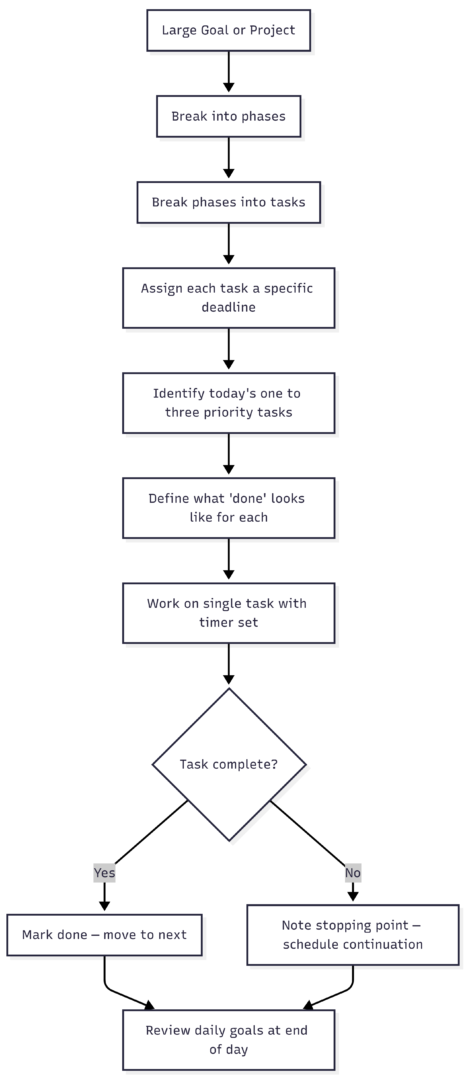
Daily goal-setting practice:
At the start of each work session, write down three to five specific tasks — not categories — you will complete. Not “work on presentation” but “draft slides 4 through 8 of the Q3 presentation.” Not “respond to emails” but “respond to the three flagged emails from this morning.”
The specificity forces you to think through the task before starting it, which eliminates false starts and the common problem of sitting down without knowing what to actually do next.
5. Apply the Two-Minute Rule
The two-minute rule has two distinct applications, and both address different productivity failure modes.
Application 1: Immediate completion of micro-tasks.
If a task will take two minutes or less to complete, do it immediately rather than adding it to your to-do list. The cognitive overhead of tracking, scheduling, and later returning to a two-minute task is often greater than the time it takes to complete. Small tasks accumulate into a mental weight that exceeds their actual work cost.
Examples: responding to a short message, filing a document, making a quick call, sending a confirmation, delegating a task. Each one is trivially fast. Each one left undone adds to a growing mental load that taxes working memory throughout the day.
Application 2: Overcoming the inertia of large projects.
Large tasks and projects carry psychological weight disproportionate to their actual content. The prospect of writing a 5,000-word report, learning a new software system, or completing a complex analysis feels overwhelming in a way that prevents starting. The two-minute rule reframes this by asking a different question: not “how do I complete this project,” but “what is the smallest possible action I could take in the next two minutes to begin?”
This works because starting is the hardest part. The brain’s resistance to tasks is highest before they begin and drops significantly once you are in motion. A two-minute entry point — write one paragraph, outline the first section, open the file and write a title — removes the activation barrier without requiring any of the willpower associated with committing to a large task.
Two-minute rule in practice:
| Large Task | Two-Minute Entry Point |
|---|---|
| Write a report | Write the first paragraph only |
| Start a workout | Do one set or five minutes |
| Learn new software | Watch the first tutorial section |
| Reorganize files | Sort one folder |
| Prepare a presentation | Write the slide titles |
| Complete a difficult email | Write the subject line and first sentence |
In almost every case, you will continue well past the two minutes. The rule is not about limiting yourself to two minutes — it is about using two minutes to override the resistance to starting.
Building a Productive Daily System
The five strategies above work individually but compound when combined. Here is how they fit together into a daily structure:
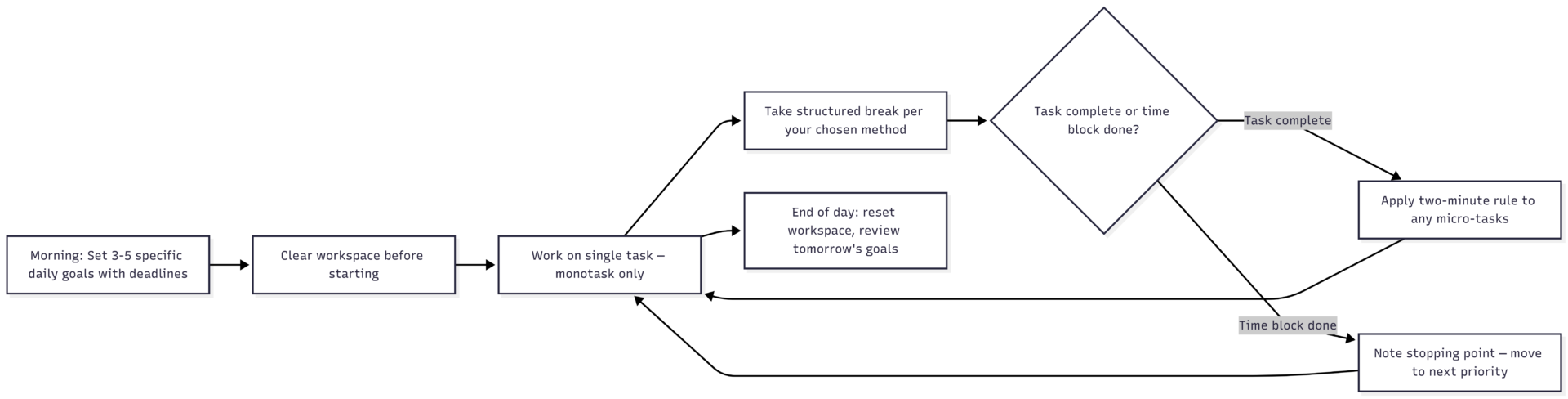
Weekly productivity maintenance:
| Habit | Frequency | Time Required |
|---|---|---|
| Set daily specific goals | Daily | 5 minutes |
| Desk reset | Daily | 5 minutes |
| Break schedule | Every 25–90 min | Built into workflow |
| Weekly goal review | Weekly | 15 minutes |
| Task list audit | Weekly | 10 minutes |
| Deep work block scheduling | Weekly | 10 minutes |
The Underlying Principle: Work With Your Brain, Not Against It
Every strategy in this guide follows a single principle: productivity increases when you design your work around how your brain actually functions rather than how you believe it should function.
The brain focuses best on one thing at a time. So monotask. The brain fatigues on sustained attention. So schedule breaks. The brain processes visual information continuously. So control your environment. The brain responds to urgency and specificity. So set real deadlines on concrete tasks. The brain resists starting more than continuing. So use two-minute entry points.
None of these require exceptional discipline or willpower. They require building the right structures — and then using them.
Start with whichever one addresses your most persistent daily friction point. Implement it consistently for two weeks. Then add the next. Productivity is not built in a day, but the improvements compound quickly once the right habits are in place.
Bonus: Be Honest With Yourself About Unproductive Days
Even well-designed systems fail on some days. Distraction is not a character flaw — it is a normal part of human cognitive function. Every person who has ever been productive has also had unproductive days. The difference between people who sustain high performance over time and those who do not is not the absence of bad days. It is the response to them.
Dwelling on a poor day creates a negative feedback loop that decreases the next day’s performance. Acknowledging it, identifying what disrupted the system, and returning to the structure the next day is the approach that works.
Treat your productivity system like a practice, not a performance. The goal is consistent improvement over time, not perfect execution every day.
Please share this 5 Easy Ways to Increase Productivity in Your Daily Life with your friends and do a comment below about your feedback.
We will meet you on next article.
Until you can read, Set Boundaries: How to Work from Home with Your Family