
Set Boundaries: How to Work from Home with Your Family
Working from home with your family sounds like a privilege until you are 40 minutes into your most important meeting of the week and a toddler is dismantling the living room in the background, your partner needs the printer you are currently using, and the dog is barking at a delivery driver. The boundary between professional and personal life does not blur when you work from home with family — it dissolves entirely unless you deliberately rebuild it.
The challenge is real and the frustration is valid. Research consistently shows that the less defined the boundary between work and home, the higher the work-family conflict. The solution is not rigid hour-by-hour scheduling or asking your family to pretend you are not there. It is building a flexible structure — one that includes clear signals, predictable routines, shared expectations, and smart task management — so that both your work and your family get the quality of attention they deserve.
This guide covers every layer of that structure, from workspace setup and visual cues to shift strategies, child independence training, and the mindset shifts that make it all sustainable.
Why Boundaries Fail Without Structure
The most common mistake remote working parents make is treating boundaries as a conversation rather than a system. You tell your kids you are working. They nod. Twenty minutes later they are back. You get frustrated. They get confused. The cycle continues.
Children — especially young ones — do not respond to abstract instructions about availability. They respond to consistent, visible, and predictable patterns. When they know that the closed door means something specific, when they know exactly when their turn with you is coming, and when they have been set up with something genuinely engaging to do in the meantime, interruptions drop dramatically.
The same principle applies to partners. Without agreed-upon systems for splitting childcare, shared space, and communication, resentment builds quickly — especially when both people are working from home simultaneously.
Structure is not about rigidity. It is about making the rules visible and consistent enough that everyone — including you — can follow them without constant negotiation.
Step 1: Create a Dedicated Workspace
Your physical environment is the foundation of every boundary you will try to set. A workspace that is separate from family living areas, even partially, provides a physical signal that carries far more weight than any verbal instruction.
If you have a room with a door, use it as your primary workspace. The ability to close a door is one of the most practically significant factors in work-from-home success with children. It creates an acoustic barrier, a visual boundary, and a psychological signal for everyone in the household.
If a dedicated room is not available, establish a consistent corner or desk that is recognized as your work zone. The consistency of location matters — it trains your family to associate that space with work mode and you with unavailability.
Workspace boundary checklist:
| Element | Why It Matters |
|---|---|
| Dedicated desk or table | Creates a consistent “work zone” signal |
| Door or divider | Physical barrier reduces interruptions |
| Noise-cancelling headphones | Signals unavailability; reduces distractions |
| Back to the room | Reduces visual stimulus for children |
| Work materials stored here only | Prevents work from spreading into family space |
Step 2: Use Visual Cues Your Children Can Read
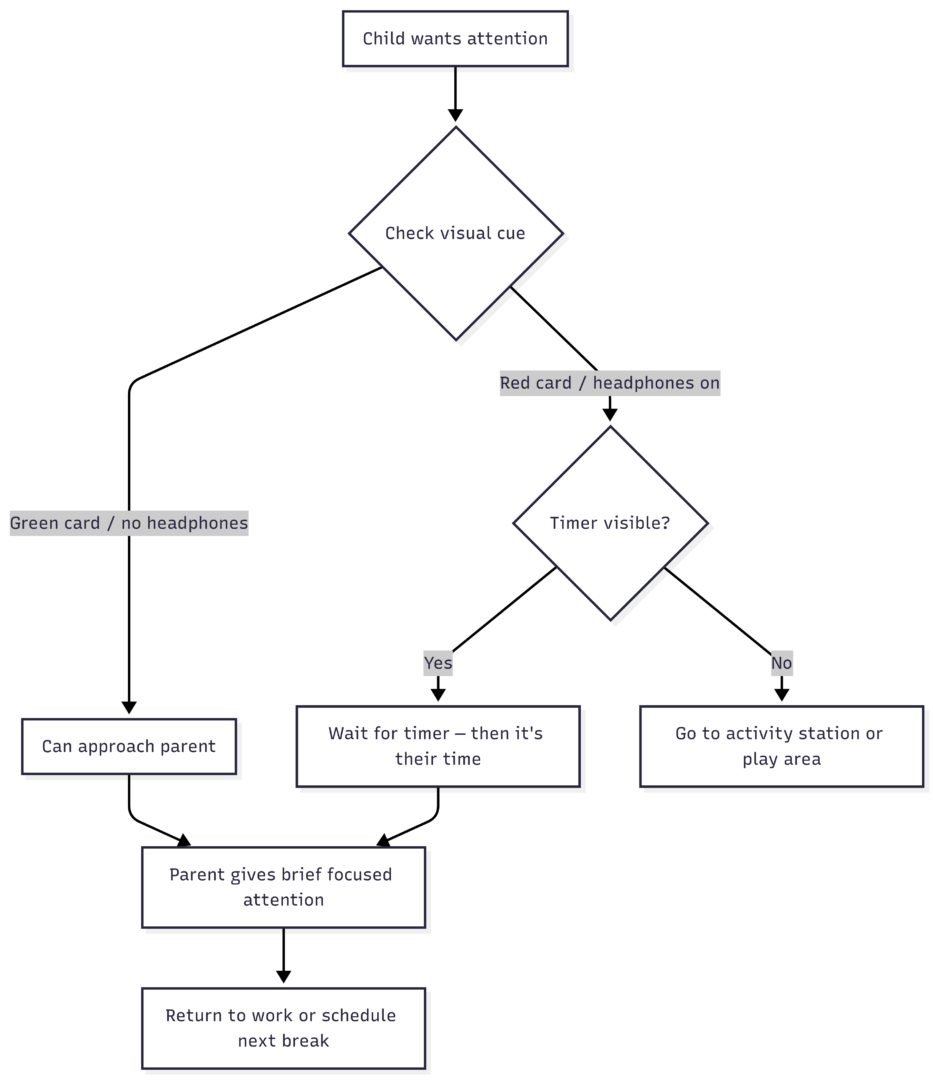
Young children cannot reliably track time or interpret verbal-only rules during the flow of a day. Visual cues solve this by giving them a concrete, immediate signal they can check without needing to ask you.
Effective visual systems:
Traffic light cards. A green card on your door or desk means available. Yellow means wrapping up soon. Red means do not disturb. Children as young as two to three years old can learn and reliably follow this system within a week of consistent use.
Door signs. A laminated sign that reads “Mommy/Daddy is working — back at [time]” gives children a concrete countdown. Pair it with an analog timer they can see counting down.
Headphone rule. Establish a household rule that headphones on means no interruptions. This is fast to implement and immediately visible across ages.
Timer-based access. Tell your child that when the kitchen timer goes off, it is your break and their time with you. This reframes waiting from indefinite to bounded, which children handle far better. When they know attention is coming, they are significantly more patient in the meantime.
Step 3: Build a Flexible Daily Rhythm
A rigid minute-by-minute schedule for a household with children is unrealistic and sets everyone up for daily failure. What works instead is a structured rhythm — a predictable sequence of work blocks, family breaks, and child-directed activities that repeats consistently enough that children internalize it.
The goal is not a perfect schedule. It is predictability. When your child knows that work always starts after breakfast, that a walk or active play always happens at midday, and that the workday always ends at a specific time, they calibrate their expectations accordingly and the hourly negotiations disappear.
Sample daily rhythm for remote parents:
| Time Block | Parent Activity | Child Activity |
|---|---|---|
| 6:00–7:00 AM | Early work block (email, admin) | Sleep or quiet wake |
| 7:00–8:30 AM | Breakfast + morning connection | Breakfast, getting ready |
| 8:30–10:30 AM | Deep work — door closed | Independent play, educational activity |
| 10:30–11:00 AM | Dedicated parent break | Active play or snack with parent |
| 11:00 AM–12:30 PM | Work block | Quiet activities or screen time |
| 12:30–1:30 PM | Lunch break — family time | Lunch + outdoor time |
| 1:30–3:30 PM | Afternoon work block | Nap (young children) or independent activities |
| 3:30–4:00 PM | Wind-down, emails | Screen time or creative play |
| 4:00 PM onward | Work ends — family time | Full parent presence |
Adjust these blocks to fit your specific work requirements and children’s ages. The structure matters more than the exact times.
Step 4: Split Shifts with Your Partner
If both you and your partner are working from home, the most effective strategy is shift coverage — one parent provides focused childcare while the other works without interruption, then you swap.
This sounds simple but requires explicit agreement upfront. Without a clear agreement on who covers which window, both parents end up in a constant half-coverage mode where neither work nor childcare is handled properly.
Shift division model:
- Morning shift (8 AM – 12 PM): Partner A is primary on childcare. Partner B has uninterrupted deep work time.
- Afternoon shift (12 PM – 4 PM): Partner A switches to focused work. Partner B takes primary childcare.
- Evenings (as needed): Catch-up work, if required, shared between both.
Within this model, reserve high-cognitive tasks — writing, analysis, problem-solving, important calls — for your focused shift when the other parent is on duty. Use your childcare shifts for low-cognitive tasks: responding to emails, reviewing documents, administrative work that can tolerate interruption without losing quality.
Communicate your availability windows to your team and manager. You do not need to disclose the specific reason — simply indicating your peak availability hours and noting that your schedule is somewhat flexible manages their expectations without oversharing.

Step 5: Build Your Child’s Independent Play Capacity
One of the most valuable long-term investments a work-from-home parent can make is in their child’s ability to play independently. This is a trainable skill, not a personality trait — and it directly determines how much uninterrupted work time you have access to each day.
Start with short, achievable sessions. Set your child up with a specific activity, set a visible timer for 20–30 minutes, and commit to not checking in unless there is a genuine issue. Gradually extend the window as they build tolerance and confidence.
Activity rotation system:
Keep four to five bins or containers of activities that are not always accessible — only one or two out at a time. Novelty sustains engagement. When a toy or activity has been in use for several days, rotate it out and bring out something that has been stored. This maintains interest without constantly buying new materials.
Activities that support longer independent play windows:
- Building sets and construction toys (LEGO, magnetic tiles, blocks)
- Art and craft supplies (age-appropriate and self-directed)
- Sensory bins with rice, sand, or water (supervised based on age)
- Puzzle sets with progressive difficulty
- Pretend play setups (kitchen, toolbox, dress-up)
- Audiobooks and story podcasts for older children
Strategic screen time: Save educational programming or interactive apps for your most critical work windows — important calls, deadline-driven writing, complex problem-solving. Treating screen time as a reserve keeps it effective as a tool rather than depleting its distraction power through overuse.
Step 6: Give Children Household Responsibilities
Children who are given age-appropriate household tasks feel more capable, more included in family life, and less compelled to seek constant attention from you. The side benefit for you is real help with household maintenance that would otherwise pile up and invade your evening.
This is not about making children do adult work. It is about giving them meaningful participation in the home they live in — which benefits their development and your available time simultaneously.
Age-appropriate task examples:
| Age | Tasks |
|---|---|
| 2–3 years | Put away toys, bring items to the bin, carry lightweight objects |
| 4–5 years | Set and clear the table, sort laundry colors, dust low surfaces |
| 6–8 years | Empty dishwasher, vacuum a room, water plants, fold towels |
| 9–12 years | Prepare simple meals, take bins out, help with younger siblings |
Expect the first few weeks to take longer than doing it yourself. That is the investment period. Within a month, tasks become habitual and self-directed.
Step 7: Protect Connection Time to Reduce Interruptions
Counter-intuitively, the most effective way to reduce the frequency of interruptions during your work blocks is to ensure your children receive genuinely focused attention at predictable times throughout the day.
Children interrupt compulsively when they are uncertain whether attention is coming. When they know — because it has happened reliably — that a focused break is coming at a specific time, they develop the capacity to wait.
These focused connection moments do not need to be long. Ten to fifteen minutes of genuine, phone-down, eye-contact attention during transitions between work blocks often satisfies a child’s connection need for another one to two hours. The quality of attention matters far more than the quantity.
At the end of your workday, make the transition deliberate and visible. Put the laptop away, close the office door, and give your family a clear signal that work is done. This boundary protects your evening and prevents the gradual erosion of family time that happens when work bleeds indefinitely into evenings.
Step 8: Manage Your Team’s Expectations Honestly
You do not need to perform the fiction of a perfectly silent 9-to-5 workday when your reality includes children. Most managers and colleagues — especially those with children themselves — respond far better to honest, upfront communication than to unexplained availability gaps and muted calls.
Tell your team directly: your schedule is flexible, your peak availability windows are X and Y, and occasional background noise or brief delays in response may occur. This manages expectations, prevents misreading of your commitment level, and often opens a conversation that reveals your colleagues are navigating the same reality.
Avoid two failure modes: hiding your situation until it causes a problem, and over-explaining it in ways that undermine your professional credibility. A single clear statement about your working hours and a demonstrated track record of getting work done well is all you need.
The Mindset Foundation: Progress Over Perfection
Every system in this guide will break down at some point. A sick child, a deadline collision, a school closure, a family emergency — these do not represent failure. They represent normal family life intersecting with normal work life.
The goal is not a perfect arrangement. It is a resilient one. A system that accommodates occasional disruption without collapsing, that allows you to recover quickly when a day goes sideways, and that does not require flawless execution every single day to provide value.
Be explicit with your children when you break your own rules. If you check your phone during family dinner or extend your work block because of a crisis, acknowledge it directly. Modeling honest accountability is more valuable to your children than maintaining the appearance of perfect rule-following — and it keeps your household norms from quietly eroding.
The families who sustain productive remote work long-term are not the ones with the most elaborate systems. They are the ones who keep returning to the basics: clear signals, predictable rhythms, connection time that is genuinely protected, and the willingness to keep adjusting as children grow and circumstances change.
Final Thoughts
Setting boundaries when working from home with family is not a one-time conversation. It is an ongoing practice — one that requires physical setup, consistent visual cues, explicit shift agreements, and regular investment in your children’s independence. None of these elements are complicated, but they each require deliberate implementation rather than hopeful improvisation.
Start with the visual cue system and the daily rhythm. Those two changes alone will reduce interruptions and lower household tension within the first week. Build the rest from there, adjusted to your specific children’s ages, your work requirements, and your partner’s schedule.
A home that works for everyone is possible. It just requires designing it that way.
Please share this Set Boundaries: How to Work from Home with Your Family with your friends and do a comment below about your feedback.
We will meet you on next article.
Until you can read, How to Work from Home with Pets