
How to land remote jobs: a checklist you need
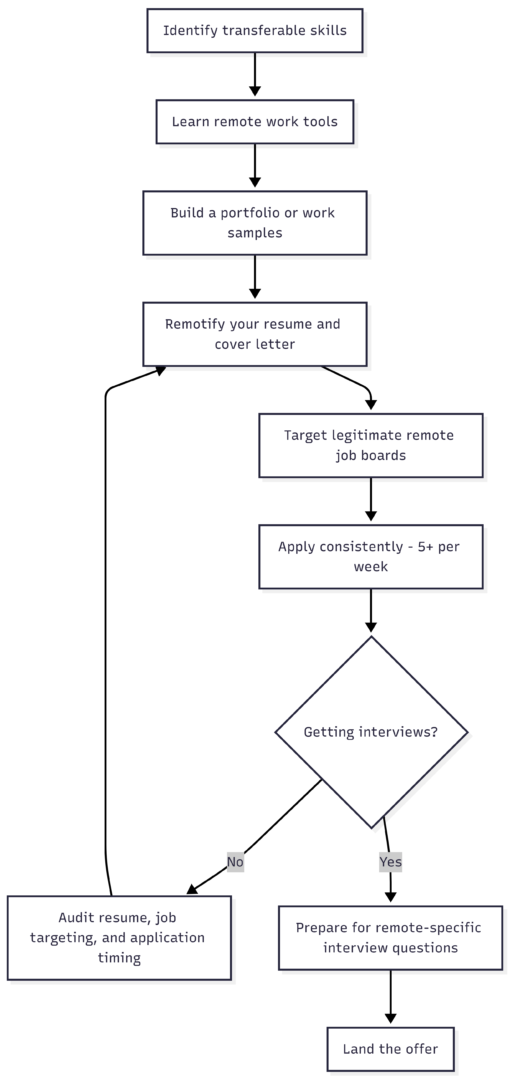
Landing a remote job isn’t about luck or randomly applying to hundreds of listings on LinkedIn. It’s about following a consistent, repeatable process — identifying transferable skills, learning the tools remote teams rely on, tailoring your resume for virtual work, applying through the right channels, and staying consistent long enough for it to pay off.
This guide breaks that process into a clear checklist you can follow from start to finish, along with realistic timelines, common mistakes to avoid, and the job boards actually worth your time.
The Remote Job Search Process at a Glance
Step 1: Identify the Skills You Already Have
A common misconception is that remote work requires entirely new technical skills. Most people already have relevant experience — the real work is recognizing which of their existing skills transfer to a remote environment and how to present them that way.
Roles that are commonly remote-friendly, even for candidates without prior remote experience, include:
| Field | Example Roles | Entry-Level Friendly? |
|---|---|---|
| Customer support | Support agent, chat/email support specialist | Yes |
| Digital marketing | SEO specialist, social media manager, paid ads | Yes |
| Writing/content | Copywriter, content writer, editor | Yes |
| Administrative | Virtual assistant, scheduling coordinator | Yes |
| Programming | Web developer, QA tester | Moderate |
| Design | Graphic designer, UI/UX designer | Moderate |
| Project management | Project coordinator, scrum master | Moderate |
| Data | Data analyst, bookkeeper | Moderate |
If your current experience is office-based, the skills usually transfer directly — project coordination, client communication, and reporting all function the same way remotely; only the tools and communication style change.
Step 2: Learn the Tools Remote Teams Actually Use
You don’t need new technical skills so much as fluency with the tools that let remote teams collaborate. Listing these tools on a resume, even at a basic level, immediately signals that you’re remote-ready.
| Tool Category | Common Platforms | Typical Cost (Employer-Provided) |
|---|---|---|
| Video conferencing | Zoom, Google Meet, Microsoft Teams | Free–$20/user/month |
| Async communication | Slack, Loom | Free–$15/user/month |
| Project management | Asana, Trello, Jira, ClickUp | Free–$25/user/month |
| Documentation | Google Workspace, Notion, Confluence | Free–$15/user/month |
| File sharing | Google Drive, Dropbox, SharePoint | Free–$20/user/month |
Most of these tools have free tiers, so you can practice with them before ever applying — a small time investment that makes a real difference in interviews when asked about remote collaboration experience.
Step 3: Build a Portfolio or Work Sample Set
A resume alone rarely proves you can work independently and deliver results without in-person supervision. A portfolio — even a simple one — does. This applies beyond creative fields:
- Writers/marketers: published samples, case studies, or mock campaigns
- Developers: GitHub repositories, deployed projects, code samples
- Designers: a curated portfolio site with 3–5 strong projects
- Project managers/analysts: process documents, reporting templates, or measurable outcomes from past roles
- Customer-facing roles: performance metrics, testimonials, or process improvements you’ve driven
Freelance or contract work, even short-term, is one of the fastest ways to build this kind of proof while also gaining direct remote work experience to reference in interviews.
Step 4: Remotify Your Resume and Cover Letter
Remote job applications are competitive, and hiring managers are specifically screening for evidence that you can succeed without daily in-person oversight. A resume built for an in-office role won’t necessarily reflect this.
What to Add or Emphasize
- Tools and platforms you’re comfortable with (see the table in Step 2)
- Instances of independent, self-directed project ownership
- Written and asynchronous communication skills
- Any prior remote, freelance, or distributed team experience — even informal
- Measurable outcomes rather than task lists (“reduced response time by 30%” instead of “handled customer inquiries”)
Cover Letter Notes
Most remote roles still request a cover letter, and it’s a chance to directly address the concern every remote hiring manager has: can this person be trusted to work independently?
Use it to briefly demonstrate self-management — a specific example of managing your own schedule, communicating proactively, or completing a project with minimal oversight is more persuasive than a general statement about being “a self-starter.”
Step 5: Target Legitimate Remote Job Boards
General job boards are often flooded with listings that aren’t actually fully remote, or worse, outright scams. Dedicated remote job boards filter for this, saving significant time.
| Job Board | Focus | Notes |
|---|---|---|
| We Work Remotely | General remote roles | One of the largest dedicated remote boards |
| Remote.co | General remote roles | Curated listings across industries |
| RemoteOK | Tech-focused | Strong for developer/design roles |
| FlexJobs | General remote/flexible roles | Paid membership, screens listings for legitimacy |
| Wellfound (AngelList) | Startups | Good for early-stage remote-first companies |
| Dynamite Jobs | General remote roles | Includes recruitment services |
| LinkedIn (filtered) | General | Use the “Remote” location filter, verify listings individually |
Red Flags of Illegitimate Listings
- Requests for payment or personal financial information before hiring
- Vague job descriptions with no clear company name or interview process
- Salary that seems disproportionately high for minimal stated qualifications
- Communication only through chat apps rather than a verifiable company email
Remote-First Companies Are Worth Prioritizing
Companies built around distributed teams from the start (rather than offices that later added remote options) tend to have more mature remote processes: clearer async communication norms, better collaboration tools, and more flexibility around working hours. These companies are generally easier to identify by checking whether remote work is described as core to their operating model, not an added perk.
Step 6: Apply Consistently
Consistency matters more than any single tactic. A reasonable target is around 5 tailored applications per week — enough volume to generate opportunities without spending so much time per application that quality drops.
Application Timing
Applying soon after a job is posted noticeably improves response rates. Older listings, even ones that remain visible for weeks, often indicate the hiring manager has already begun reviewing or interviewing candidates.
Step 7: Prepare for Remote-Specific Interview Questions
Remote interviews often include questions in-office interviews don’t, focused specifically on independent work capability:
- How do you structure your day without in-person supervision?
- How do you handle communication across time zones?
- Describe a time you resolved a misunderstanding through written communication alone.
- What does your home workspace setup look like?
Preparing specific, concrete answers to these — rather than general statements — is one of the most overlooked parts of remote job preparation.
How Long It Actually Takes
| Timeframe | What’s Typically Happening |
|---|---|
| Weeks 1–2 | Skills assessment, resume/portfolio prep, tool familiarization |
| Weeks 3–6 | Active applications begin, first interviews may start |
| Weeks 6–12 | Interview cycles, offer negotiations for early applicants |
| Months 3–6 | Most structured, consistent job seekers land a role in this window |
Candidates who follow a structured approach and apply consistently most commonly land a role within 3–6 months. Searches that extend well beyond this timeframe are usually a sign that something earlier in the process — resume targeting, job board selection, or application volume — needs adjustment rather than a sign to keep repeating the same approach.
Common Mistakes That Slow Down a Remote Job Search
| Mistake | Why It Hurts You | Fix |
|---|---|---|
| Using a generic, non-remote resume | Fails to address remote-specific concerns hiring managers have | Add tools, async communication examples, and independent work evidence |
| Applying only on general job boards | Wastes time on non-remote or low-quality listings | Prioritize dedicated remote job boards |
| Applying to jobs regardless of fit | Lower response rate, wasted effort | Focus on roles matching your actual skill set |
| Skipping the cover letter | Misses a chance to directly address remote-work concerns | Include a brief, specific cover letter for every application |
| Inconsistent application volume | Slows overall progress | Maintain a steady weekly target |
| Applying to old listings | Lower response rate | Prioritize recently posted roles |
Skills in High Demand for Remote Work
If you’re deciding which skill to build or emphasize, these consistently show strong demand across remote job boards:
- Customer service and support
- Digital marketing (SEO, paid ads, content strategy)
- Software development and QA
- Project management and operations
- Copywriting and content creation
- UI/UX and graphic design
- Data analysis and bookkeeping
Picking one area to specialize in, rather than presenting broad, generalist experience, tends to produce stronger results — hiring managers respond more to depth in one relevant area than a wide but shallow skill list.
Freelancing as a Path to Full-Time Remote Work
Freelance or contract work is often underrated as a stepping stone. It provides direct evidence of remote work capability — time management, independent execution, and client communication — that’s difficult to demonstrate otherwise if you’ve only worked in-office roles. It also reduces the perceived risk for an employer considering a fully remote hire without prior remote experience.
Conclusion
Landing a remote job comes down to a repeatable sequence: recognize the skills you already have, learn the tools remote teams use, build proof of independent work, tailor your resume and cover letter specifically for remote roles, apply through legitimate and targeted job boards, and stay consistent with your application volume.
Most job seekers who follow this process land a role within three to six months. If your search has gone on significantly longer than that, the fix usually isn’t more applications — it’s revisiting your resume targeting, the job boards you’re using, and how quickly you’re applying to new postings.
Frequently Asked Questions
No. Most remote-friendly skills transfer directly from in-office roles; the key is presenting them with remote-specific tools and independent work examples.
Around 5 well-targeted applications per week is a reasonable pace that balances volume with the quality of each application.
Dedicated remote job boards typically filter out non-remote and low-quality listings more effectively, saving significant search time compared to general job boards.
Most structured, consistent job seekers land a role within 3 to 6 months.
Yes — it builds direct proof of independent work capability and reduces the perceived risk employers associate with hiring someone without prior remote experience.
Please share this How to land remote jobs: a checklist you need with your friends and do a comment below about your feedback.
We will meet you on next article.
Until you can read, Future-Proofing Your Work-From-Home Setup