Parable of the Prodigal Son: Verse, Meaning & Lesson
Few stories in the Bible capture the human experience as fully as the Parable of the Prodigal Son. In a few short verses, Jesus tells the story of a son who demands his inheritance early, wastes it on reckless living, and returns home broken — only to be met not with punishment, but with a celebration. Found in Luke 15:11-32, this parable is often called one of the greatest short stories ever written, because it speaks to nearly everyone: the rebel, the resentful sibling, and the father who never stops watching the road.
This guide walks through the full text, the meaning behind each character, and the practical lessons this parable holds for anyone wrestling with guilt, resentment, or the question of whether they can still come home.
Quick Overview
| Detail | Information |
|---|---|
| Scripture location | Luke 15:11-32 |
| Speaker | Jesus Christ |
| Audience | Pharisees, scribes, and His disciples |
| Main characters | The father, the younger son, the older son |
| Core theme | Unconditional grace and the danger of self-righteousness |
| Literary type | Parable |
| Related parables | The Lost Sheep (Luke 15:4-7), The Lost Coin (Luke 15:8-10) |
The Setting: Why Jesus Told This Story
This parable doesn’t stand alone. Luke places it as the third in a series of three “lost and found” stories, all told in response to religious leaders who were criticizing Jesus for spending time with tax collectors and sinners (Luke 15:1-2).
First comes a shepherd who leaves ninety-nine sheep to find one lost sheep. Then a woman who sweeps her entire house to find one lost coin. Each of those stories ends with rejoicing. The Prodigal Son is the climax of that pattern — the most personal and costly loss of the three, because a son isn’t property; he’s family.
There’s a clear numerical progression across the three stories: one lost sheep out of a hundred, one lost coin out of ten, and finally one lost son out of two. As the fraction shrinks, the emotional weight of the loss grows. By the time the story reaches a son, Jesus has made His point unmistakable: God pursues and celebrates the return of every individual, no matter how small the odds or how far they’ve strayed.
The Full Text of Luke 15:11-32
“A certain man had two sons. And the younger of them said to his father, ‘Father, give me the portion of goods that falls to me.’ So he divided to them his livelihood. And not many days after, the younger son gathered all together, journeyed to a far country, and there wasted his possessions with prodigal living. But when he had spent all, there arose a severe famine in that land, and he began to be in want.
Then he went and joined himself to a citizen of that country, and he sent him into his fields to feed swine. And he would gladly have filled his stomach with the pods that the swine ate, and no one gave him anything.
But when he came to himself, he said, ‘How many of my father’s hired servants have bread enough and to spare, and I perish with hunger! I will arise and go to my father, and will say to him, “Father, I have sinned against heaven and before you, and I am no longer worthy to be called your son. Make me like one of your hired servants.”‘
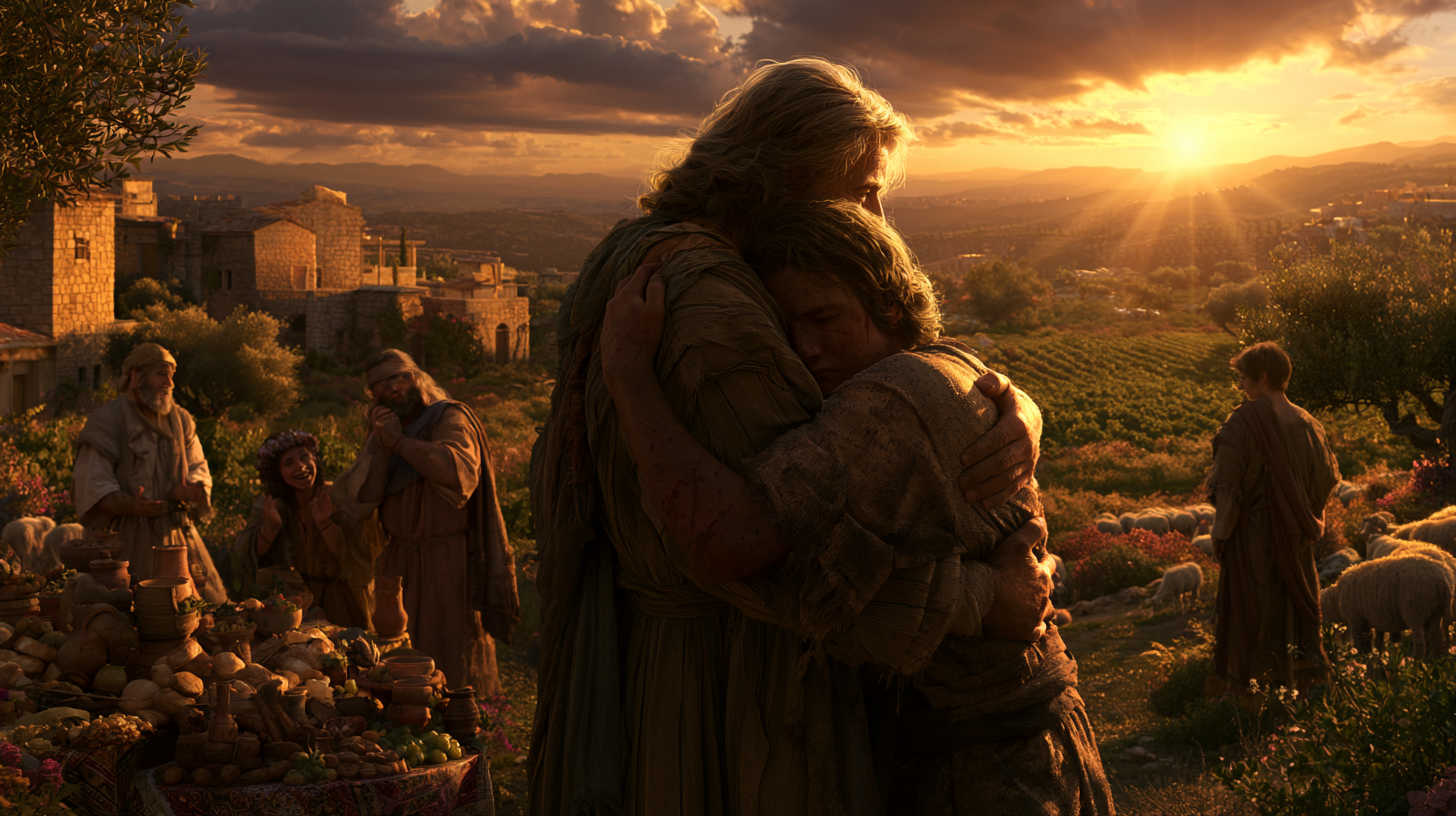
And he arose and came to his father. But when he was still a great way off, his father saw him and had compassion, and ran and fell on his neck and kissed him. And the son said to him, ‘Father, I have sinned against heaven and in your sight, and am no longer worthy to be called your son.’
But the father said to his servants, ‘Bring out the best robe and put it on him, and put a ring on his hand and sandals on his feet. And bring the fatted calf here and kill it, and let us eat and be merry; for this my son was dead and is alive again; he was lost and is found.’ And they began to be merry.
Now his older son was in the field. And as he came and drew near to the house, he heard music and dancing. So he called one of the servants and asked what these things meant. And he said to him, ‘Your brother has come, and because he has received him safe and sound, your father has killed the fatted calf.’
But he was angry and would not go in. Therefore his father came out and pleaded with him. So he answered and said to his father, ‘Lo, these many years I have been serving you; I never transgressed your commandment at any time; and yet you never gave me a young goat, that I might make merry with my friends. But as soon as this son of yours came, who has devoured your livelihood with harlots, you killed the fatted calf for him.’
And he said to him, ‘Son, you are always with me, and all that I have is yours. It was right that we should make merry and be glad, for your brother was dead and is alive again, and was lost and is found.'”
A Simple Summary of the Story
- The younger son asks his father for his inheritance early — effectively treating his father as if he were already dead.
- He leaves for a distant country and squanders everything on reckless living.
- A famine hits, and he ends up feeding pigs, so desperate that he considers eating their food.
- He “comes to his senses,” realizes even his father’s servants live better than he does, and heads home to beg for a servant’s position.
- Before he can even finish his rehearsed apology, his father runs to meet him, embraces him, and throws a lavish celebration.
- The older son, who stayed home and worked faithfully, refuses to join the party out of resentment and jealousy.
- The father gently reminds the older son that everything he has was always his — and that celebrating a lost son’s return is right, not unfair.
Who’s Who in the Parable
| Character | Represents | Key Trait |
|---|---|---|
| The father | God the Father | Patient, watching, radically forgiving |
| The younger son | Sinners and outcasts (the “tax collectors” of Jesus’s day) | Rebellious, then repentant |
| The older son | The self-righteous religious establishment (the Pharisees) | Dutiful but resentful and joyless |
The Meaning Behind Each Character
The Father. The father never chases his younger son down or forces him to stay. He grants the request, even though it’s an insult, because love that isn’t free to be rejected isn’t really love. Yet the text notes he sees his son “while he was still a great way off” — implying he had been watching the road the entire time. His response isn’t measured or cautious; he runs, embraces, and celebrates before a single word of apology is spoken. That immediacy is the point: forgiveness here isn’t earned through a speech or a probation period. It’s freely given the moment the son turns toward home.
The Younger Son. His initial request wasn’t just impulsive — in that culture, asking for an early inheritance was close to declaring your father dead to you. His journey into “reckless living” and eventual collapse into feeding pigs (a job considered ritually unclean under Jewish law) illustrates just how far someone can fall. But his turning point — “he came to himself” — models what repentance looks like: honest self-assessment, followed by action, not just regret.
The Older Son. He never leaves home, never breaks a rule, and yet he is arguably more spiritually lost than his brother by the story’s end. His anger reveals that his obedience was transactional — he saw his relationship with his father as a ledger of service owed and rewards deserved. When grace is extended to someone who “didn’t earn it,” he can’t celebrate; he can only resent. This is Jesus’s pointed message to the religious leaders who were criticizing Him for welcoming sinners.
Two Reactions Compared
| Younger Son | Older Son | |
|---|---|---|
| Relationship with father | Broken by rebellion | Intact, but transactional |
| Core sin | Reckless living, self-indulgence | Pride, self-righteousness, resentment |
| Response to father’s grace | Overwhelmed gratitude | Anger and entitlement |
| Where the story leaves him | Restored and celebrating | Standing outside, unresolved |
The Structure of the Story
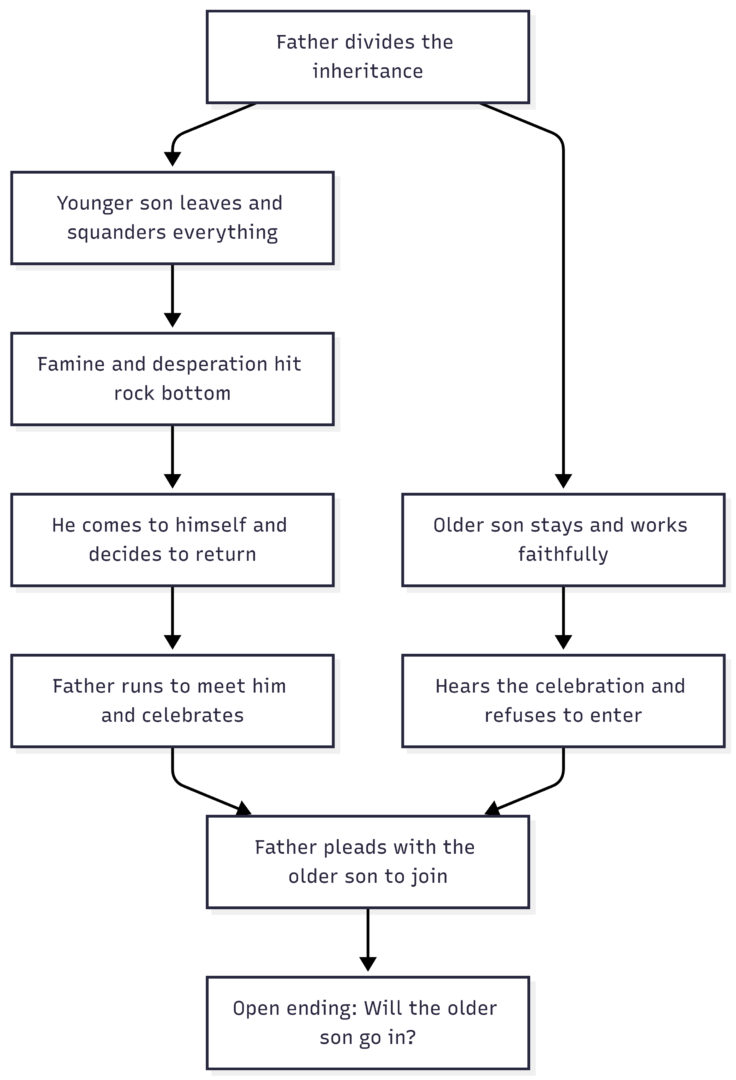
The diagram below shows how the parable moves through two parallel arcs — one for each son — that both converge on the same test: how will each of them respond to the father’s grace?
Symbols in the Father’s Response
Each gift the father gives the returning son carries specific cultural meaning in that era.
| Gift | Cultural Meaning |
|---|---|
| The best robe | Restored honor and dignity, not the status of a servant |
| The ring | A signet of authority and full sonship |
| Sandals | Proof of freedom — servants typically went barefoot |
| The fattened calf | Reserved for rare, significant celebrations; a public declaration of joy |
Why the Parable Ends Without an Ending
Notably, Luke 15 never tells us whether the older brother eventually joins the party. That silence is intentional. Jesus originally told this story to Pharisees and scribes who were offended that He welcomed sinners — He leaves the ending open because He’s really asking them (and every reader since) to answer the question themselves: will you go in, or will you stay outside, nursing your resentment over a grace you didn’t have to earn but that someone else clearly needed?
Core Lessons From the Parable
1. Grace is not something you earn. The younger son rehearses a plea to be treated as a servant. He never gets the chance to finish it as originally planned — the father cuts off any transaction and restores him fully as a son. The lesson: forgiveness in God’s economy isn’t proportional to how well-crafted your apology is or how long you’ve suffered the consequences of your choices.
2. No one is too far gone to return. The younger son hits about as low a point as the original audience could imagine — reduced to feeding animals considered unclean, envying their food. Yet none of that disqualifies him from full restoration. The parable insists that distance from God, however extreme, is never the final word.
3. Self-righteousness is its own form of being lost. The older brother never left home, yet he ends the story standing outside, cut off from the celebration by his own choice. Obedience without love or compassion for others curdles into bitterness. Rule-following can become its own trap when it replaces relationship with resentment.
4. Celebrating someone else’s restoration is a spiritual test. The parable doesn’t just ask “can you receive grace?” It asks “can you rejoice when grace is given to someone else — especially someone you think doesn’t deserve it?” That question is aimed squarely at anyone tempted to gatekeep forgiveness.
5. The Father is always watching for our return. The detail that the father spots his son “while he was still a great way off” suggests ongoing, active waiting, not passive availability. It’s a picture of a God who isn’t reluctantly willing to forgive, but eagerly hoping for the opportunity.
How This Connects to the Other “Lost” Parables
| Parable | What Is Lost | Who Searches | Fraction Lost |
|---|---|---|---|
| The Lost Sheep | One sheep | The shepherd actively searches | 1 out of 100 |
| The Lost Coin | One coin | The woman actively searches | 1 out of 10 |
| The Lost Son | One son | The father waits and watches | 1 out of 2 |
The shift from active searching (sheep, coin) to patient waiting (son) reflects an important truth about human free will: God pursues, but He also respects the choice to leave and the choice to return. The son had to decide to “come to himself” and walk home — grace was ready the moment he turned around, but the turning had to be his.
Applying the Parable Today
- If you relate to the younger son: The parable insists there is no point of no return. Coming to your senses and turning back is never met with a probation period — restoration is immediate and complete.
- If you relate to the older son: Examine whether your faithfulness has quietly become transactional. Ask honestly whether you can celebrate someone else’s turnaround, even if their story looks messier than yours.
- If you’re in a position of leadership or influence: The parable is a warning against gatekeeping grace. Communities that model the father’s response — running toward the returning, rather than demanding proof first — reflect this story’s central message.
- In relationships generally: The story challenges everyone to examine whether love in their own family or community is conditional on performance, or freely given the way the father’s was.
Frequently Asked Questions
Prodigal means wastefully extravagant. It describes the younger son’s reckless spending, not repentance itself — the title refers to his lifestyle before he returns home.
Not exactly a villain — he represents a real spiritual danger: self-righteousness. His resentment reflects the attitude of religious leaders who felt threatened by grace being extended to people they considered undeserving.
In that culture, it was considered undignified for an older, respected man to run in public. The father’s choice to run anyway shows how urgently and joyfully he receives his son back, breaking social convention for the sake of love.
No. The story deliberately ends without resolution, leaving the question open for the listener — will resentment win, or will grace be embraced?
Final Thoughts
The Parable of the Prodigal Son works because it refuses to let anyone off the hook. It confronts the wayward with the truth that they are never too far gone, and it confronts the dutiful with the truth that obedience without grace can leave them standing outside their own family’s celebration.
At its center is a father who represents exactly what the whole story is about: a love that watches the road, runs to meet failure, and throws open the door before a single condition has been met.
Please share this Parable of the Prodigal Son: Verse, Meaning & Lesson with your friends and do a comment below about your feedback.
We will meet you on next article.
Until you can read, Parable of the Persistent Widow: Verse, Meaning & Lesson