Old Testament Books In Order (Canonical Order)
The Old Testament forms the foundational first section of the Christian Bible, comprising 39 books that trace God’s relationship with humanity and the nation of Israel. Organized in canonical order rather than strict chronological sequence, these books are grouped by literary genre and purpose: the Law (Torah), Historical Books, Poetry and Wisdom Literature, and the Prophets.
This arrangement appears consistently in most Protestant Bibles and modern translations. Understanding the Old Testament in canonical order helps readers grasp its theological progression—from creation and covenant, through Israel’s history, to prophetic calls for repentance and promises of redemption.
The Four Main Divisions of the Old Testament
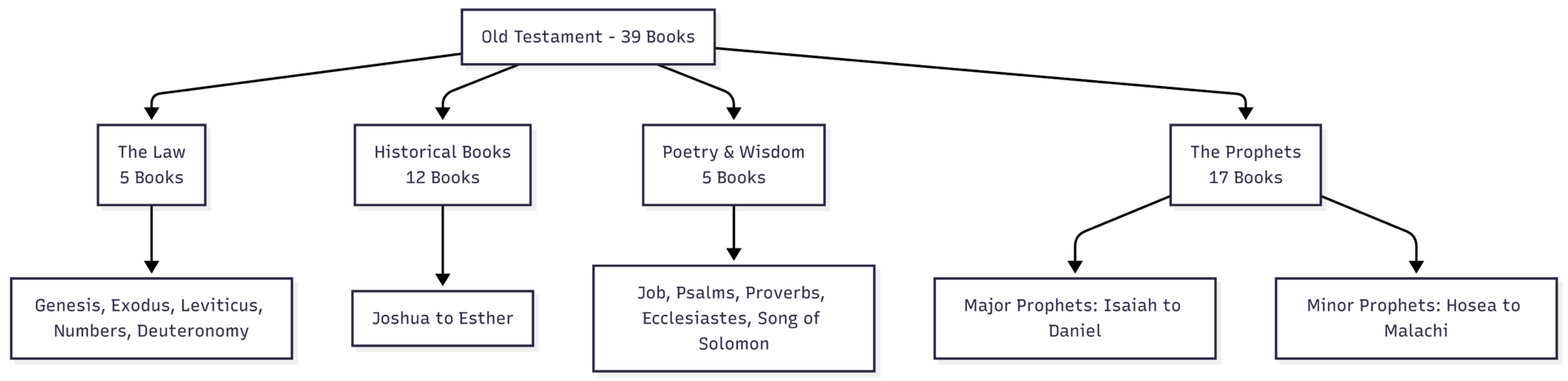
The Old Testament is structured into four primary sections based on content and style:
1. The Law (Pentateuch or Torah)
These five books lay the foundation for Israelite identity, worship, and morality. They cover creation, the patriarchs, the Exodus, and the giving of the Law at Sinai.
2. Historical Books
Twelve books that chronicle Israel’s conquest of Canaan, the rise and fall of the monarchy, exile, and return.
3. Poetry and Wisdom Literature
Five books written largely in poetic form, addressing worship, suffering, daily wisdom, and human experience.
4. The Prophets
Seventeen books divided into Major Prophets (longer books) and Minor Prophets (shorter books). These contain messages of judgment, hope, and future restoration.
Mermaid Diagram of Old Testament Structure:
1. The Law (Pentateuch)
Genesis
Genesis introduces the origins of the universe, humanity, and God’s chosen people. It records creation, the fall into sin, the flood, the tower of Babel, and the lives of Abraham, Isaac, Jacob, and Joseph. The book establishes key themes of covenant, promise, and redemption that echo throughout Scripture.
Author: Traditionally attributed to Moses.
Genre: Narrative
Reading Time: Approximately 135 minutes
Exodus
Exodus recounts God’s deliverance of the Israelites from Egyptian slavery through Moses. It details the ten plagues, the Passover, the crossing of the Red Sea, and the giving of the Ten Commandments at Mount Sinai. The book emphasizes God’s power, faithfulness, and desire for a relationship with His people.
Author: Traditionally attributed to Moses.
Genre: Narrative
Reading Time: Approximately 110 minutes
Leviticus
Leviticus focuses on holiness, worship, and priestly duties. It provides detailed instructions for sacrifices, festivals, purity laws, and ethical living. The repeated phrase “Be holy, for I am holy” captures its central message.
Author: Traditionally attributed to Moses.
Genre: Law
Reading Time: Approximately 80 minutes
Numbers
Numbers continues the wilderness journey, documenting two censuses and the Israelites’ struggles with faith and obedience. It highlights consequences of rebellion while showing God’s continued guidance through trials.
Author: Traditionally attributed to Moses.
Genre: Narrative
Reading Time: Approximately 105 minutes
Deuteronomy
Deuteronomy presents Moses’ final speeches reviewing God’s law and covenant before entering the Promised Land. It stresses love for God, obedience, and the blessings or curses that follow choices.
Author: Traditionally attributed to Moses.
Genre: Narrative / Speeches
Reading Time: Approximately 100 minutes
2. Historical Books
Joshua
Joshua details the military conquest and division of Canaan among the tribes. It showcases themes of courage, faithfulness, and God’s fulfillment of promises.
Author: Joshua (possibly with Phinehas)
Genre: Narrative
Reading Time: Approximately 65 minutes
Judges
Judges describes a repetitive cycle of sin, oppression, repentance, and deliverance through charismatic leaders. It illustrates the consequences of abandoning God’s ways.
Author: Traditionally linked to Samuel
Genre: Narrative
Reading Time: Approximately 65 minutes
Ruth
This short story highlights loyalty, redemption, and providence during difficult times. Ruth, a Moabite woman, becomes an ancestor in the lineage of David and Jesus.
Author: Unknown
Genre: Narrative
Reading Time: Approximately 10 minutes
1 & 2 Samuel
These books cover the transition from judges to kings, focusing on Samuel, Saul, and especially David. They explore leadership, obedience, and the cost of sin alongside God’s mercy.
Authors: Samuel, Nathan, and Gad (traditionally)
Genre: Narrative
Reading Time: 90 + 70 minutes
1 & 2 Kings
The books trace the history of the divided kingdoms of Israel and Judah, evaluating each king by faithfulness to God. They culminate in the fall of both kingdoms to foreign powers.
Author: Unknown
Genre: Narrative
Reading Time: 85 + 80 minutes
1 & 2 Chronicles
Written from a priestly perspective, Chronicles retells Israel’s history with emphasis on the temple, worship, and the Davidic line. It encouraged returning exiles.
Author: Traditionally Ezra
Genre: Narrative
Reading Time: 70 + 90 minutes
Ezra
Ezra records the return from Babylonian exile and the rebuilding of the temple, stressing spiritual renewal and adherence to God’s law.
Author: Ezra
Genre: Narrative
Reading Time: Approximately 25 minutes
Nehemiah
Nehemiah describes the rebuilding of Jerusalem’s walls amid opposition and the subsequent spiritual reforms.
Author: Nehemiah
Genre: Narrative
Reading Time: Approximately 35 minutes
Esther
Esther tells of a Jewish queen who risks her life to save her people from genocide in Persia, demonstrating God’s hidden providence.
Author: Unknown
Genre: Narrative
Reading Time: Approximately 20 minutes
3. Poetry and Wisdom Literature
Job
Job examines profound suffering and the question of why the righteous face hardship. Through dialogue and God’s response, it affirms faith amid mystery.
Author: Possibly Job or an unknown writer
Genre: Poetry / Dialogue
Reading Time: Approximately 55 minutes
Psalms
This collection of 150 songs and prayers covers every human emotion—from praise and thanksgiving to lament and confession. Many are attributed to David.
Authors: David, Asaph, sons of Korah, and others
Genre: Poetry
Reading Time: Approximately 130 minutes
Proverbs
Proverbs offers practical, God-centered wisdom for daily living, covering relationships, work, speech, and character.
Authors: Solomon, Agur, Lemuel
Genre: Wisdom Literature
Reading Time: Approximately 40 minutes
Ecclesiastes
Ecclesiastes explores the meaninglessness of life apart from God, concluding that true purpose comes from fearing the Lord.
Author: Solomon
Genre: Wisdom Literature
Reading Time: Approximately 20 minutes
Song of Solomon
This poetic book celebrates marital love and intimacy, often interpreted as also symbolizing God’s love for His people.
Author: Solomon
Genre: Poetry
Reading Time: Approximately 10 minutes
4. The Prophets
Major Prophets
Isaiah: Rich in messianic prophecies and calls for justice, Isaiah contrasts God’s holiness with Israel’s sin while promising future restoration.
Jeremiah: The “weeping prophet” warns of judgment and urges repentance before the Babylonian invasion.
Lamentations: Poetic laments over Jerusalem’s destruction, expressing grief and hope in God’s mercy.
Ezekiel: Written during exile, Ezekiel uses dramatic visions to call for personal and national renewal.
Daniel: Blends historical narrative with apocalyptic visions, showing God’s sovereignty over empires.
Minor Prophets
Hosea through Malachi deliver powerful, concise messages. Hosea uses his marriage as a symbol of God’s faithful love. Joel speaks of the Day of the Lord. Amos confronts social injustice. Obadiah pronounces judgment on Edom. Jonah shows God’s compassion for all nations. Micah predicts the Messiah’s birthplace. Nahum announces Nineveh’s fall. Habakkuk wrestles with God’s use of evil nations. Zephaniah warns of coming judgment. Haggai and Zechariah motivate temple rebuilding. Malachi closes the Old Testament with a call to covenant faithfulness and a promise of the coming messenger.
Summary Table of Old Testament Books:
| Section | Books | Count | Primary Focus |
|---|---|---|---|
| The Law | Genesis–Deuteronomy | 5 | Origins, Covenant, Law |
| Historical | Joshua–Esther | 12 | Conquest, Kings, Exile, Return |
| Poetry & Wisdom | Job–Song of Solomon | 5 | Worship, Suffering, Daily Wisdom |
| Major Prophets | Isaiah–Daniel | 5 | Judgment, Hope, Visions |
| Minor Prophets | Hosea–Malachi | 12 | Repentance, Restoration |
Why the Canonical Order Matters
The canonical order is intentional. The Law establishes identity. History shows the outworking of obedience or disobedience. Wisdom applies truth to life. Prophets confront sin while pointing to future redemption. This progression creates a cohesive narrative pointing toward the New Testament’s fulfillment in Jesus Christ.
Note on Other Traditions: Roman Catholic and Eastern Orthodox Bibles include additional deuterocanonical books (such as Tobit, Judith, Wisdom, Sirach, Baruch, and Maccabees), but the 39-book Protestant canon remains the standard focus for this guide.
The Old Testament continues to offer timeless wisdom, moral guidance, and spiritual insight. Whether studying for personal devotion, teaching, or deeper theological understanding, approaching these books in their canonical order provides the clearest path through God’s progressive revelation to His people.
Please share this Old Testament Books In Order (Canonical Order) with your friends and do a comment below about your feedback.
We will meet you on next article.
Until you can read, Genesis Chapter Summaries (1-50)