
Setting Up a Company in the UAE: The Ultimate Guide
Ultimate guide to setting up a company in the UAE. Learn about business structures, jurisdictions, costs, and tax benefits for mainland and free zones.
The United Arab Emirates (UAE) stands as a global business hub, attracting entrepreneurs with its strategic location, world-class infrastructure, and business-friendly policies. Despite recent corporate tax reforms, the UAE remains a compelling destination for company formation, offering low tax rates, 100% foreign ownership in certain jurisdictions, and streamlined setup processes. This comprehensive guide explores the steps, costs, and considerations for establishing a business in the UAE, covering mainland, free zone, and offshore options. Whether you’re a startup founder or a seasoned investor, this guide equips you with the knowledge to navigate the UAE’s dynamic business landscape.
Why Choose the UAE for Business Setup?
The UAE’s appeal as a business destination is rooted in its unique advantages:
- Strategic Location: Positioned at the crossroads of Europe, Asia, and Africa, the UAE offers unparalleled access to global markets.
- Robust Infrastructure: State-of-the-art logistics, telecommunications, and digital systems support seamless operations.
- Economic Diversification: Beyond oil, sectors like technology, tourism, and finance drive growth, with the digital economy projected to reach $140 billion by 2031.
- Expat-Friendly Environment: With over 80% of its population being expatriates, the UAE fosters a multicultural, inclusive business community.
- Tax Benefits: Despite a 9% corporate tax introduced in 2023, free zone companies can still achieve 0% tax under specific conditions, and personal income tax remains at 0%.
However, the introduction of corporate tax has shifted the UAE’s reputation as a tax haven. Businesses must now navigate new regulations to optimize tax efficiency, making expert guidance essential.
Understanding UAE’s Business Jurisdictions
The UAE offers three primary jurisdictions for company formation, each catering to distinct business needs:
1. Mainland UAE
- Overview: Mainland companies, registered under the Department of Economy and Tourism (DET), can operate across the UAE and internationally without restrictions.
- Advantages:
- Flexibility to trade within the UAE market and globally.
- Access to a broader range of business activities.
- Challenges:
- Subject to 9% corporate tax on taxable income above AED 375,000 (~USD 102,000).
- Higher setup and compliance requirements compared to free zones.
2. Free Zones
- Overview: Free zones are designated areas offering specialized infrastructure and incentives for specific industries, such as technology, media, or logistics.
- Advantages:
- 100% foreign ownership.
- 0% corporate tax for qualifying free zone persons with eligible income.
- Streamlined setup processes and tax exemptions on imports/exports.
- Challenges:
- Restrictions on trading directly with the UAE mainland market.
- Complex criteria for maintaining 0% tax status.
3. Offshore Companies
- Overview: Offshore companies are typically used for asset protection, international trade, or holding purposes, registered in jurisdictions like Ras Al Khaimah (RAK) or Jebel Ali.
- Advantages:
- 100% foreign ownership and no requirement for a physical office.
- Tax exemptions for activities conducted outside the UAE.
- Challenges:
- Limited to non-resident businesses; cannot operate within the UAE.
- No access to UAE residence visas.
Comparison Table: UAE Business Jurisdictions
| Jurisdiction | Ownership | Tax Rate | Market Access | Setup Time | Visa Eligibility |
|---|---|---|---|---|---|
| Mainland | 100% Foreign | 9% (if >AED 375,000) | UAE & Global | 2-8 weeks | Yes |
| Free Zone | 100% Foreign | 0% (if qualifying) | Global, Limited UAE | 1-3 weeks | Yes |
| Offshore | 100% Foreign | 0% (outside UAE) | Global, No UAE | 1-2 weeks | No |
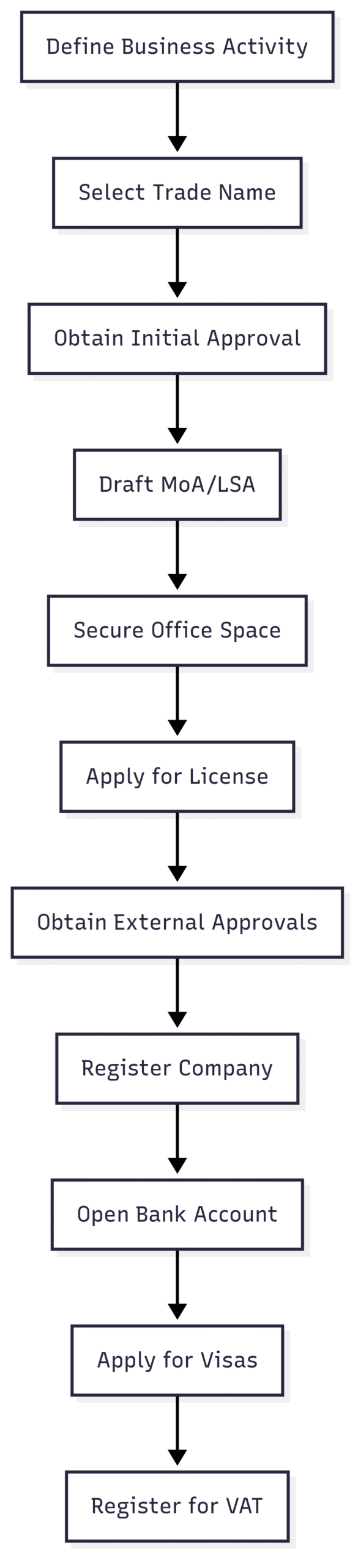
Step-by-Step Process for Setting Up a Company in the UAE
Establishing a business in the UAE involves a structured process, varying slightly by jurisdiction. Below is a detailed guide to the key steps.
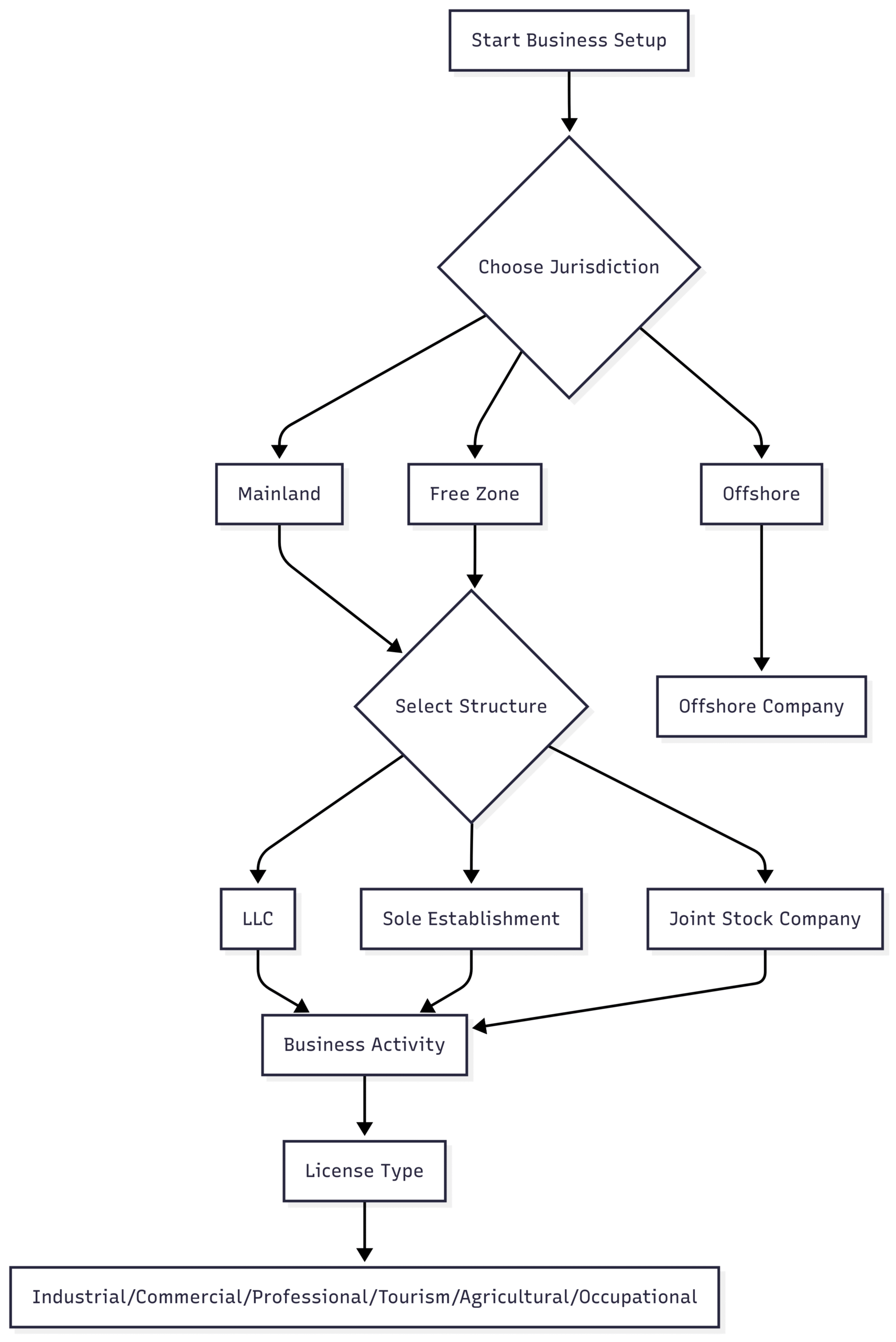
Step 1: Define Business Activity and Structure
Your business activity determines the type of license and legal structure required. The UAE offers over 2,000 business activities across six license types:
- Industrial: Manufacturing and processing.
- Commercial: Trading goods.
- Professional: Service-based businesses (e.g., consulting).
- Tourism: Travel and hospitality.
- Agricultural: Farming and related activities.
- Occupational: Skilled trades.
Legal Structures include:
- Limited Liability Company (LLC): Common for small to medium businesses.
- Sole Establishment: For single-owner businesses.
- Public/Private Joint Stock Company: For large-scale operations.
- Free Zone Company: For businesses in designated zones.
Chart: Business Structure Decision Flow
Step 2: Select a Trade Name
Your trade name must comply with UAE regulations:
- Reflect the business activity and legal form (e.g., LLC).
- Avoid religious, political, or offensive terms.
- Be unique and not previously registered.
The Department of Economic Development (DED) or free zone authority approves the name.
Step 3: Obtain Initial Approval
Submit an application to the DET (mainland) or free zone authority, including:
- Trade name reservation.
- Business activity details.
- Shareholder information.
Initial approval signals government consent to proceed but does not grant a license.
Step 4: Draft Legal Documents
- Memorandum of Association (MoA): Required for LLCs, partnerships, and joint stock companies, outlining ownership and operations. Must be notarized by UAE authorities.
- Local Service Agent (LSA) Agreement: For professional licenses on the mainland, an LSA (UAE national) acts as a liaison without ownership stakes.
Step 5: Secure Office Space
All UAE companies require a registered address:
- Mainland: Physical office or warehouse, with a notarized lease agreement.
- Free Zone: Flexi-desks, virtual offices, or dedicated spaces provided by the free zone.
- Offshore: No physical office required.
Step 6: Apply for a Business License
Submit the following to the DED or free zone authority:
- Initial approval receipt.
- MoA or LSA agreement.
- Lease contract (attested by RERA for mainland).
- Additional approvals (if applicable).
Pay the license fee within 30 days to avoid application cancellation.
Step 7: Obtain External Approvals
Certain activities require approvals from specific entities, such as:
- Ministry of Interior: Transport, security, or fire safety.
- Ministry of Justice: Legal services.
- Telecommunications Regulatory Authority: Telecom activities.
Step 8: Register the Company
Complete registration with the DED (mainland) or free zone authority, receiving a commercial license and registration certificate.
Step 9: Open a Corporate Bank Account
Choose a UAE bank (e.g., Emirates NBD, HSBC) and provide:
- Business license.
- MoA or LSA agreement.
- Shareholder passports and visas.
- Proof of address.
Step 10: Apply for Visas
Mainland and free zone companies can sponsor investor and employee visas, subject to quotas based on office size and license type.
Step 11: Register for VAT
If your annual turnover exceeds AED 375,000, register for VAT (5%) with the Federal Tax Authority.
Chart: Company Setup Process
Costs of Setting Up a Company in the UAE
Costs vary by jurisdiction, business activity, and additional requirements. Below is a breakdown:
Mainland Company
- Setup Costs: AED 15,000–35,000 (~USD 4,100–9,500).
- Breakdown:
- License fee: AED 10,000–20,000.
- Name reservation: AED 1,000–2,000.
- MoA notarization: AED 2,000–5,000.
- Office lease: Varies (AED 20,000–100,000 annually).
- Visa fees: AED 3,000–5,000 per visa.
- Ongoing Costs: Annual license renewal, office rent, and compliance fees.
Free Zone Company
- Setup Costs: AED 12,500–25,000 (~USD 3,400–6,800).
- Breakdown:
- License fee: AED 5,000–15,000.
- Registration fee: AED 2,000–5,000.
- Office/flexi-desk: AED 5,000–20,000 annually.
- Visa fees: AED 2,500–4,000 per visa.
- Ongoing Costs: Annual license and office renewals.
Offshore Company
- Setup Costs: AED 10,000–20,000 (~USD 2,700–5,450).
- Breakdown:
- Registration fee: AED 5,000–10,000.
- Agent fee: AED 2,000–5,000.
- Ongoing Costs: Annual renewal fees.
Cost Comparison Table
| Expense | Mainland (AED) | Free Zone (AED) | Offshore (AED) |
|---|---|---|---|
| License Fee | 10,000–20,000 | 5,000–15,000 | 5,000–10,000 |
| Name Reservation | 1,000–2,000 | 500–1,500 | 500–1,000 |
| Office Space (Annual) | 20,000–100,000 | 5,000–20,000 | None |
| Visa Fee (Per Visa) | 3,000–5,000 | 2,500–4,000 | N/A |
| Total Setup Cost | 15,000–35,000 | 12,500–25,000 | 10,000–20,000 |
Timeframe for Business Setup
- Mainland: 2–8 weeks, depending on approvals and activity complexity.
- Free Zone: 1–3 weeks, due to streamlined processes.
- Offshore: 1–2 weeks, as no physical presence is required.
Navigating UAE’s Corporate Tax Landscape
The UAE’s corporate tax reform, effective from 2023, introduced a 9% tax on taxable income exceeding AED 375,000. However, free zone companies can maintain 0% tax by meeting strict criteria:
- Qualifying Free Zone Person: Must derive income from qualifying activities (e.g., trading with non-UAE entities, certain services).
- Adequate Substance: Maintain a physical presence, employees, and economic activity in the free zone.
- Non-Qualifying Income: Income from UAE mainland clients or non-qualifying activities is taxed at 9%.
Tax Rate Comparison Table
| Jurisdiction | Taxable Income Threshold | Tax Rate |
|---|---|---|
| Mainland | >AED 375,000 | 9% |
| Free Zone | Qualifying Income | 0% |
| Free Zone | Non-Qualifying Income | 9% |
| Offshore | Income Outside UAE | 0% |
Innovative Tools for Business Setup
The UAE government supports entrepreneurs with digital platforms:
- Basher Service: Enables company setup in 15 minutes via an online portal linking federal and local entities.
- Dubai Virtual Commercial City: Allows global investors to establish virtual companies without UAE residency.
- Abu Dhabi Business Centre: Offers instant licenses for online setup.
These tools reflect the UAE’s commitment to simplifying business formation.
Ongoing Compliance and Support
Post-setup, businesses must adhere to UAE regulations:
- License Renewal: Annual renewal with updated documents and fees.
- Financial Reporting: Mainland companies and certain free zones require audited financial statements.
- VAT Compliance: File returns if registered for VAT.
- Immigration Rules: Monitor visa quotas and renewals.
Engaging business setup consultants, like Nomad Capitalist, can streamline compliance and tax optimization, especially for free zone companies aiming for 0% tax.
Is the UAE Still a Tax Haven?
While the UAE’s tax-free status has evolved, its 9% corporate tax remains among the world’s lowest. Free zones offer a pathway to 0% tax, but complex criteria necessitate expert advice. For non-residents, alternative jurisdictions like Cyprus (12.5% corporate tax) or Malta (effective 5% with rebates) may offer comparable benefits with fewer residency requirements.
Pros and Cons of UAE Business Setup
| Pros | Cons |
|---|---|
| Low corporate tax (0%–9%) | Complex free zone tax criteria |
| 100% foreign ownership | Higher mainland setup costs |
| Strategic global location | Limited mainland trading for free zones |
| Expat-friendly, multicultural hub | Residency needed for optimal tax benefits |
| Fast setup with digital tools | Additional approvals for some activities |
Conclusion: Is the UAE Right for Your Business?
Setting up a company in the UAE offers access to a thriving economy, strategic location, and competitive tax regime. While mainland companies provide flexibility, free zones cater to tax-conscious investors, and offshore entities suit international operations. The choice depends on your business goals, target market, and tax strategy. With costs ranging from AED 10,000–35,000 and setup times as short as one week, the UAE remains an attractive destination. However, navigating tax reforms and compliance requires professional expertise to maximize benefits.
For entrepreneurs seeking a holistic approach, combining UAE free zone benefits with residency or exploring alternative jurisdictions may optimize tax efficiency. Consult with specialists to tailor a strategy that aligns with your vision, ensuring your business thrives in the UAE’s dynamic market.
Please share this Setting Up a Company in the UAE: The Ultimate Guide with your friends and do a comment below about your feedback.
We will meet you on next article.
Until you can read, Top 10 Best Countries for Homeschooling