10 Key Bible Verses on Family
Family is one of the oldest and most repeated themes in Scripture, appearing from the second chapter of Genesis through the closing letters of the New Testament. The Bible doesn’t just mention family in passing — it treats the household as the foundational unit through which faith, character, and legacy are passed from one generation to the next.
This guide breaks down the ten most essential Bible verses on family, organized by theme, along with practical ways to apply them at home.
Why Family Verses Matter
Long before any nation, church, or institution existed in the biblical narrative, family already did. That order matters. Scripture consistently treats the home as the first place character is formed, the first place faith is modeled, and the first community a person belongs to.
Understanding what the Bible says about family isn’t just a matter of tradition — it shapes how households handle conflict, raise children, care for aging parents, and build something that outlasts any one generation.
The 10 Core Verses on Family
| # | Reference | Theme |
|---|---|---|
| 1 | Genesis 1:28 | Family as part of God’s creation design |
| 2 | Genesis 2:24 | Marriage as the foundation of family |
| 3 | Exodus 20:12 | Honoring parents |
| 4 | Matthew 19:4–6 | The permanence of marriage |
| 5 | Ephesians 6:1–4 | Mutual duties of children and parents |
| 6 | Psalm 127:3–5 | Children as a heritage |
| 7 | Proverbs 22:6 | Raising children in the right direction |
| 8 | Proverbs 17:6 | Grandparents and generational bonds |
| 9 | 1 Timothy 5:8 | Providing for family |
| 10 | Joshua 24:15 | Family commitment to shared faith |
Family as Part of God’s Design
The Bible’s teaching on family begins at creation, not as an afterthought but as part of the original plan for humanity.
Genesis 1:28 (KJV) — “And God blessed them, and God said unto them, Be fruitful, and multiply, and replenish the earth, and subdue it.”
This blessing is repeated at several points across Genesis, tying family growth directly to divine blessing rather than treating it as a purely biological event. The verse also frames raising the next generation as part of humanity’s broader responsibility to care for and develop the world, not a separate or lesser task.
Genesis 2:24 (KJV) — “Therefore shall a man leave his father and his mother, and shall cleave unto his wife: and they shall be one flesh.”
This is the Bible’s founding statement on marriage, and it’s quoted again by Jesus in the Gospels. The word translated “cleave” is used elsewhere in Scripture to describe covenant faithfulness — the same kind of loyalty expected between God and His people — which is part of why marriage is treated throughout the Bible as a covenant relationship rather than simply a legal or social arrangement.
Matthew 19:4–6 (KJV) — Jesus affirms this same teaching directly, adding: “What therefore God hath joined together, let not man put asunder.” This passage reinforces marriage as a permanent bond, established by God rather than merely agreed upon by two people.
Honoring Parents and Raising Children
The relationship between parents and children receives more direct instruction in Scripture than almost any other family dynamic, and it runs in both directions.
Exodus 20:12 (KJV) — “Honour thy father and thy mother: that thy days may be long upon the land which the Lord thy God giveth thee.”
This is the only one of the Ten Commandments that comes with an attached promise, which signals how seriously it’s treated. “Honor” here means more than polite behavior — it includes providing for parents in old age and treating them with ongoing respect, not just obedience during childhood.
Ephesians 6:1–4 (KJV) — “Children, obey your parents in the Lord: for this is right… And, ye fathers, provoke not your children to wrath: but bring them up in the nurture and admonition of the Lord.”
This passage is notable because it doesn’t place the entire burden on children. Parents are given an equally direct instruction: raise children without provoking them to anger, and instruct them with intention rather than leaving their formation to chance. The responsibility runs both directions.
Proverbs 22:6 (KJV) — “Train up a child in the way he should go: and when he is old, he will not depart from it.”
One of the most quoted parenting verses in Scripture, this proverb reflects a broader biblical pattern: proverbs describe general tendencies, not ironclad guarantees. The verse is best understood as an encouragement toward intentional, consistent formation — not a promise that removes a child’s own choices later in life.
Children as a Heritage, Not a Burden
Psalm 127:3–5 (KJV) — “Lo, children are an heritage of the Lord: and the fruit of the womb is his reward… Happy is the man that hath his quiver full of them.”
This psalm frames children as a gift rather than an obligation, using the image of arrows — useful, purposeful, and eventually sent out into the world on their own. The psalm’s closing image, of a father standing alongside his grown children when facing opposition, points to family as a source of long-term strength, not just short-term responsibility.
Proverbs 17:6 (KJV) — “Children’s children are the crown of old men; and the glory of children are their fathers.”
This verse extends the theme across generations, framing grandparents and grandchildren as mutually honoring one another — a relationship the Bible treats as valuable in its own right, not simply as a byproduct of parenting.
Providing for Family: A Spiritual Responsibility
1 Timothy 5:8 (KJV) — “But if any provide not for his own, and specially for those of his own house, he hath denied the faith, and is worse than an infidel.”
This is one of the strongest statements in the New Testament connecting practical provision to spiritual integrity. Caring for one’s household — financially, physically, and emotionally — isn’t treated as separate from faith; it’s presented as a direct expression of it.
Family Unity and Shared Commitment
Joshua 24:15 (KJV) — “As for me and my house, we will serve the Lord.”
This declaration, spoken by Joshua near the end of his life, has become one of the most quoted verses about family commitment because it frames faith as a household decision, not merely an individual one. It’s frequently used as a personal or family motto for exactly that reason.
Several additional verses reinforce this theme of unity:
- Psalm 133:1 (KJV) — “Behold, how good and how pleasant it is for brethren to dwell together in unity!”
- Colossians 3:14 (KJV) — “And above all these things put on charity, which is the bond of perfectness.”
- Ecclesiastes 4:12 (KJV) — “And if one prevail against him, two shall withstand him; and a threefold cord is not quickly broken.”
Redefining Family Around Shared Faith
One passage complicates a purely biological view of family, and it’s worth including precisely because it challenges assumptions:
Matthew 12:48–50 (KJV) — Jesus, told that his mother and brothers were waiting to see him, responds: “Who is my mother? and who are my brethren?… For whosoever shall do the will of my Father which is in heaven, the same is my brother, and sister, and mother.”
This passage doesn’t diminish biological family — Jesus affirms family bonds elsewhere, including from the cross (John 19:26–27). Instead, it expands the definition of family to include a spiritual dimension: shared devotion to God creates a bond comparable to blood relation. For many households, this becomes a lens for including extended community — close friends, church family, or mentors — as genuine family, not just biological relatives.
Family Strength by Category
Different seasons call for different verses. The table below groups additional family-strength verses by the specific challenge they speak to.
| Challenge | Verse | Core Message |
|---|---|---|
| Feeling disconnected | Ecclesiastes 4:9–10 | Two are better than one; mutual support |
| Facing conflict | Colossians 3:13 | Forgive as you have been forgiven |
| Parenting fatigue | Isaiah 41:10 | God provides strength and help |
| Wanting a lasting legacy | Psalm 78:4–6 | Tell the next generation what God has done |
| Building daily rhythm | Proverbs 24:3–4 | A house is built through wisdom and knowledge |
| Marriage struggles | 1 Corinthians 13:4–7 | Love is patient, kind, and not easily angered |
A Simple Framework for Practicing These Verses at Home
Reading a verse once rarely changes a family’s culture. What works is a repeatable rhythm that turns Scripture into a shared habit rather than an occasional event.
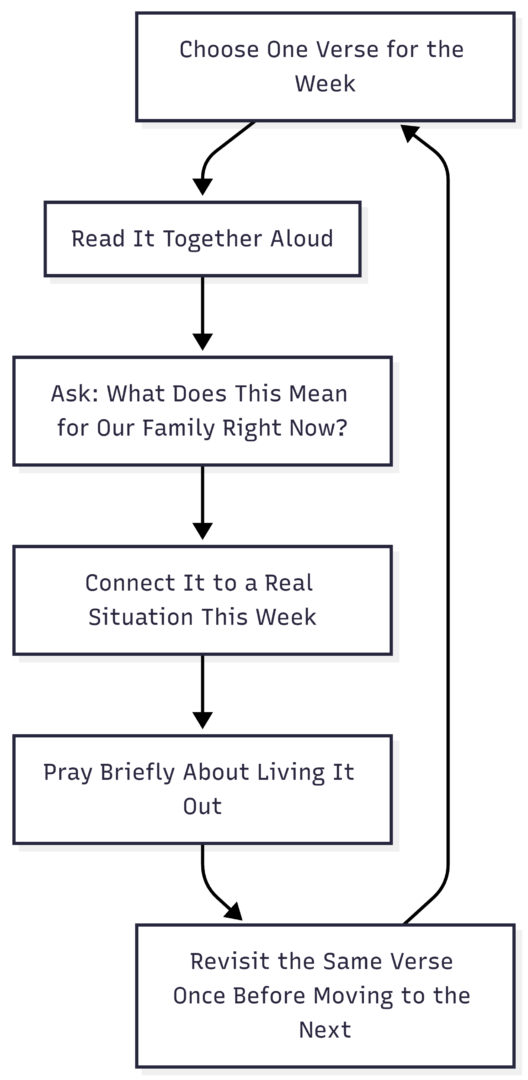
This cycle works whether it’s practiced by a couple over morning coffee, a family at the dinner table, or a parent and child at bedtime. The key is consistency: a short, repeated practice over months builds a household rhythm far more effectively than a single long conversation.
Practical Ways to Apply Family Verses
- Pick a weekly verse. Choose one from the list above and let it anchor conversations for the week rather than trying to cover several verses at once.
- Tie it to a real moment. A verse about patience lands differently when it’s connected to an actual disagreement from that week, rather than discussed in the abstract.
- Keep it short. Five minutes of shared reading and conversation, done consistently, builds more lasting change than an occasional hour-long study.
- Include all ages. Younger children can participate through simple paraphrasing, even if they can’t recite a verse word-for-word.
- Revisit, don’t just move on. Returning to a verse from a previous week — especially during a related situation — reinforces it far more than reading something new every single time.
Frequently Asked Questions
Joshua 24:15 (“As for me and my house, we will serve the Lord”) is among the most quoted family verses, largely because it frames faith as a household-wide commitment rather than an individual one.
While Scripture’s core teaching centers on the marriage-and-children household, Matthew 12:48–50 broadens the definition of family around shared devotion to God, which many blended and extended families draw on when biological ties alone don’t capture their full household.
Most biblical scholars read Proverbs as capturing general wisdom and likely outcomes rather than absolute guarantees. It’s best understood as strong encouragement toward intentional parenting, not a formula that removes a grown child’s own choices.
Start with one short verse a week rather than a long passage, keep the discussion to a few minutes, and focus on one practical question: what does this mean for us right now? Consistency matters far more than length or theological depth.
Building a Family Rooted in Scripture
The Bible doesn’t present family as something that simply happens — it presents family as something built, deliberately, verse by verse and season by season. From the earliest chapters of Genesis to the closing instructions of the New Testament, the pattern is consistent: honor between generations, provision within the household, unity through shared commitment, and a legacy passed forward rather than kept to oneself. Choosing even one verse from this list to anchor your household this week is a practical, low-effort way to start putting that pattern into practice.
Please share this 10 Key Bible Verses on Family your friends and do a comment below about your feedback.
We will meet you on next article.
Until you can read, What Does the Bible Say About Faith?