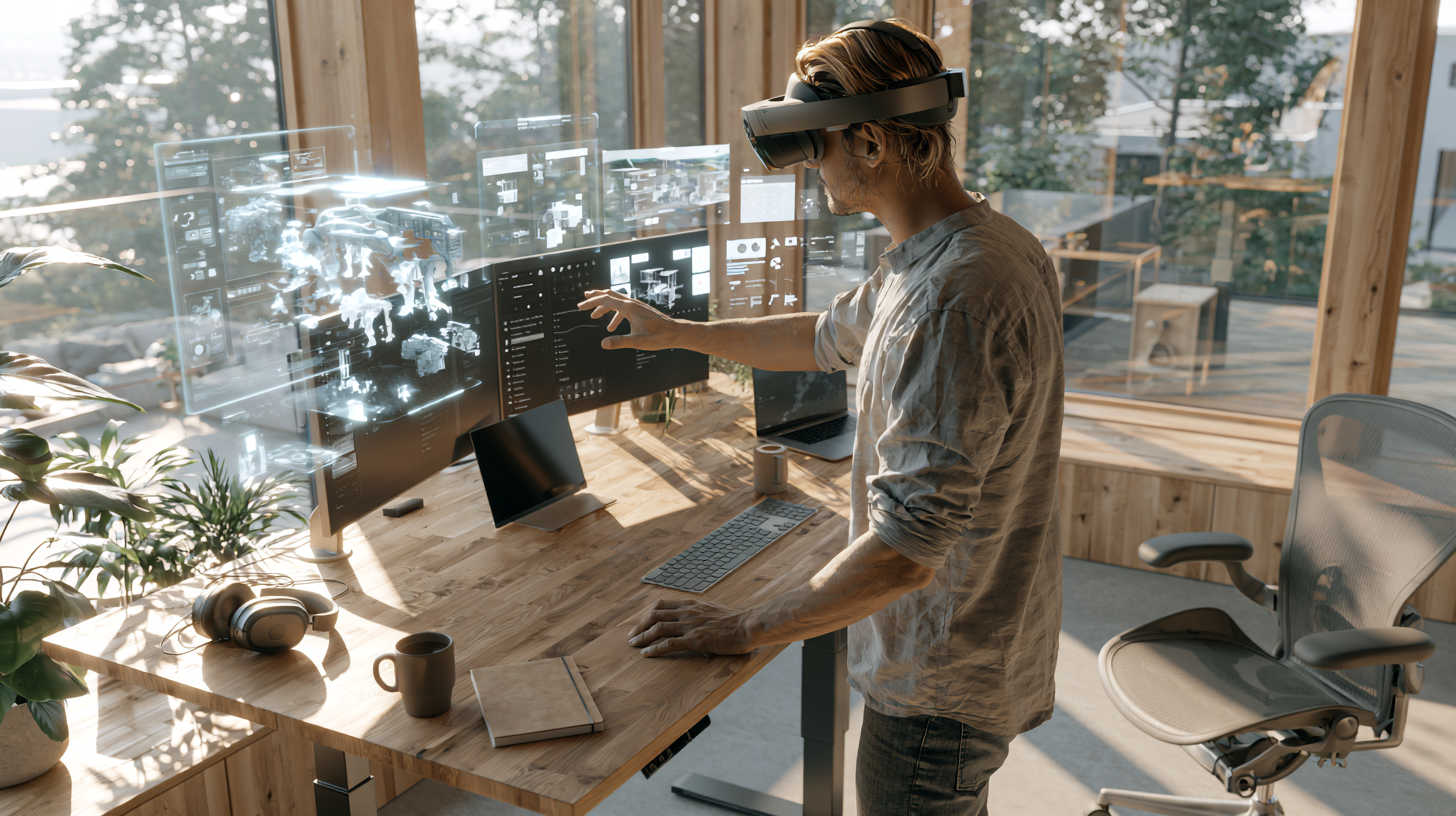
Using Virtual Reality When You’re Working From Home
Working from home solves the commute problem but introduces a new one: distractions. Pets, deliveries, family members, and the general clutter of a living space compete constantly with focused work.
Virtual reality offers a genuinely different fix — instead of blocking distractions with noise-cancelling headphones, it replaces your entire visual environment with a controlled, distraction-free workspace that can include as many virtual monitors as you want.
This guide covers how VR actually works as a remote-work tool, the leading headsets and apps, real specs and pricing, and the practical setup changes that make extended VR sessions comfortable rather than exhausting.
How VR Works for Remote Work
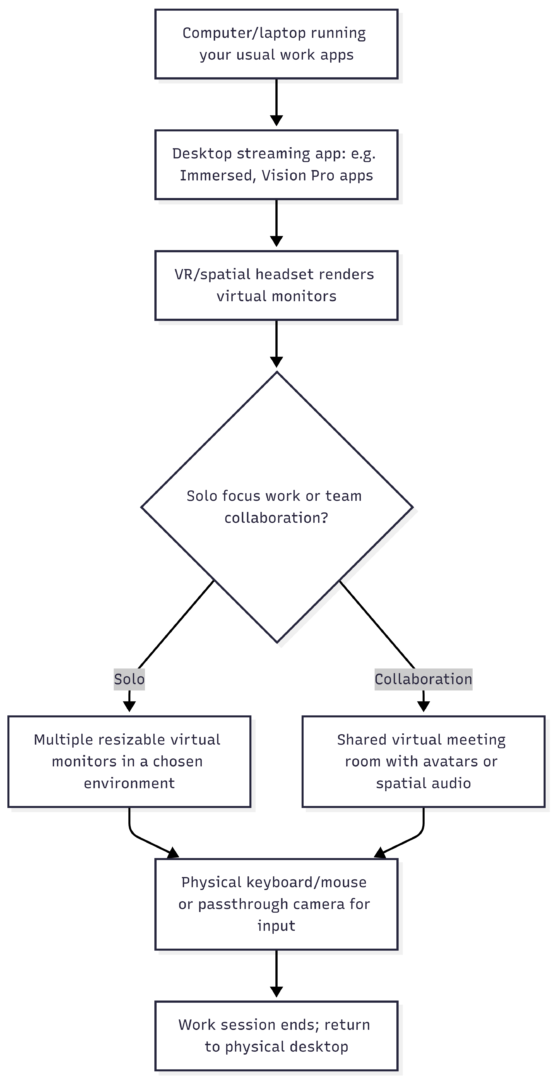
At its core, working in VR means streaming your computer’s desktop into a headset rather than looking at physical monitors. Dedicated productivity apps — not the headset’s native interface — handle this, projecting your screen (or several virtual screens) into a 3D space you can arrange however you like: side by side, curved around you, or scattered across a virtual room.
Leading VR and Spatial Computing Platforms for Work
Immersed
Immersed is built specifically for solo focused work. It projects your existing computer screen into VR and lets you create up to five resizable virtual monitors, along with a virtual keyboard overlay so you can see your hands and keys while typing. It also includes shared “coffee shop”-style environments for people who want ambient background presence without a full meeting.
Meta Horizon Workrooms
Workrooms is built around team collaboration rather than solo productivity. It supports spatial audio (so voices sound like they’re coming from the direction of each avatar), a persistent virtual whiteboard for brainstorming, and the ability for colleagues without a headset to join the same meeting via webcam on a laptop.
Apple Vision Pro
Apple’s spatial computing headset takes a different approach than traditional VR — its 4K micro-OLED displays are sharp enough to genuinely replace physical monitors, and its passthrough cameras let you overlay work apps directly onto your real surroundings rather than replacing them entirely. This makes it better suited to people who want a hybrid of real and virtual workspace rather than full immersion.
Meta Quest Line (Quest 2 / Quest 3)
The Quest series is a standalone headset — no PC connection required — making it easy to switch between a laptop and headset throughout the day. It’s generally considered the most accessible entry point for people trying VR work for the first time.
HTC Vive Pro 2
The Vive Pro 2 requires a PC connection and is aimed at more advanced VR users who want higher display fidelity and are willing to manage the additional hardware setup that a tethered headset requires.
Headset Comparison: Specs and Pricing
| Headset | Connection Type | Display | Typical Price Range | Best For |
|---|---|---|---|---|
| Meta Quest 2 | Standalone (PC optional) | LCD, up to 1832×1920 per eye | Roughly $250–$300 | Beginners, easy laptop/headset switching |
| Meta Quest 3 | Standalone (PC optional) | LCD, up to 2064×2208 per eye | Roughly $500 | Improved passthrough, sharper display, mixed reality |
| Apple Vision Pro | Standalone (Apple ecosystem) | Micro-OLED, ~4K per eye | Roughly $3,500 | High-fidelity spatial computing, passthrough-based hybrid work |
| HTC Vive Pro 2 | PC-tethered | LCD, 2448×2448 per eye | Roughly $800–$1,400 (headset + accessories) | Advanced users prioritizing display fidelity |
Prices fluctuate by region and bundle, so treat these as general reference ranges rather than exact current pricing.
The Real Benefits of Working in VR
A distraction-free field of view. Once the headset is on, the cluttered desk, the TV, and the person walking past in the background all disappear, replaced by whatever environment you choose — a plain focus room, a beach, or a mountain view.
Unlimited virtual monitor space. Rather than being limited to the physical monitors on your desk, VR productivity apps let you arrange several resizable virtual screens around you, useful for anyone who regularly works across multiple windows, spreadsheets, or reference documents at once.
A stronger sense of “leaving” home while staying in it. One of the more interesting psychological arguments for VR at work is that it can recreate the mental transition a commute used to provide. Academic researchers examining pandemic-era remote work have suggested that VR could function as a kind of “second place” — letting the mind perceptually leave the home environment for a defined block of time even though the body stays put, which may help re-establish the work/life boundaries that WFH tends to blur.
Team presence beyond a video grid. Apps like Horizon Workrooms and Microsoft’s Mesh for Teams aim to recreate a sense of shared physical space rather than a grid of video tiles, using spatial audio and shared virtual objects like whiteboards to make remote collaboration feel less flat.
The Real Limitations
Comfort during extended use. Most current headsets aren’t designed to be worn for a full eight-hour workday. Face and scalp pressure from default straps, eye strain from close-focus displays, and general fatigue are common complaints, even among people enthusiastic about the technology.
Typing and physical input. Working in VR still generally requires a physical keyboard and mouse for serious productivity, since virtual typing solutions remain slower and less accurate than touch-typing on real hardware.
Bandwidth and latency sensitivity. Streaming a desktop into a headset in high resolution requires a strong, low-latency connection — a weak Wi-Fi signal can introduce lag that contributes directly to motion sickness, which is a bigger risk in VR than with a normal monitor.
Adoption resistance. Many remote workers are skeptical that VR solves a problem regular noise-cancelling headphones and a closed door don’t already solve more simply and comfortably, and that skepticism is a real adoption barrier for teams considering the technology.
Setting Up a Comfortable VR Workspace
Use a Physical Keyboard and Mouse
Touch-typing on a real keyboard while wearing a headset is faster and more accurate than any current virtual input method. Headsets with passthrough cameras let you glance down at your physical keyboard without removing the headset, which helps bridge the gap.
Upgrade the Strap and Facial Interface
Default headset straps are frequently the biggest source of discomfort during long sessions. Aftermarket ergonomic head straps and softer facial interfaces distribute weight more evenly and reduce pressure points on the forehead and back of the skull.
Prioritize a Strong Wireless Connection
A 5 GHz Wi-Fi connection, or ideally Wi-Fi 6, is close to a requirement for streaming a desktop smoothly into a headset. Latency and dropped frames during desktop streaming are one of the most common causes of VR-induced motion sickness, so a stable connection isn’t optional for serious use.
Get Prescription Lens Inserts
For anyone who wears glasses, magnetic prescription lens inserts that snap into the headset remove the discomfort of wearing glasses under a headset and eliminate the fogging that often occurs when glasses are squeezed against a facial interface.
Choose Seated or Standing Deliberately
A standing VR setup provides the same ergonomic benefits as a standing desk, while a seated setup paired with a Bluetooth keyboard and mouse feels closer to a traditional desk experience. Neither is objectively better — the choice should match personal preference and how the rest of a workday is structured.
A Practical Hybrid Approach
Wearing a headset for a full workday isn’t realistic for most people today, given current comfort limitations. A more practical model is a hybrid one: use VR for one or two hours of deep, focused work in the morning, or for a specific meeting that benefits from a stronger sense of shared presence, then switch back to a traditional laptop and monitor setup for the rest of the day. This captures the distraction-elimination and immersive-focus benefits of VR without pushing past the comfort threshold current hardware allows.
VR vs. Traditional Remote Work Tools
| Factor | Traditional Setup (Laptop + Monitors) | VR/Spatial Setup |
|---|---|---|
| Visual distractions | Present unless mitigated with layout/lighting | Eliminated by full immersion |
| Screen real estate | Limited to physical monitors owned | Effectively unlimited, several virtual screens |
| Comfort for full 8-hour day | High | Currently limited; best in shorter sessions |
| Setup cost | Existing hardware, no extra cost | $250–$3,500+ depending on headset |
| Team meeting presence | Video grid | Spatial audio, shared avatars, virtual whiteboards |
| Bandwidth requirement | Standard video call bandwidth | Higher; low-latency Wi-Fi strongly recommended |
| Learning curve | None | Moderate, especially for input methods |
Frequently Asked Questions
No. A standalone headset like the Meta Quest series, priced well under $500, is enough to try VR productivity apps like Immersed without needing a PC connection or a more expensive spatial computing device.
Yes, most people touch-type on a real physical keyboard while in VR, and headsets with passthrough cameras let you glance down at your hands and keyboard without removing the headset.
Extended sessions can cause eye strain and general fatigue, which is why a hybrid approach — one or two focused hours in VR combined with traditional screen time — tends to work better than trying to use VR for a full workday.
Yes. A strong 5 GHz or Wi-Fi 6 connection is important, since desktop streaming into a headset needs low latency to avoid lag, which is one of the more common causes of motion sickness in VR.
Some researchers studying pandemic-era remote work have proposed that VR can recreate part of the psychological transition a commute used to provide, letting someone perceptually “leave” the home environment for a defined work session even while staying physically at home.
Traditional VR headsets like the Quest or Vive fully replace your visual field with a virtual environment, while Vision Pro emphasizes passthrough, overlaying work apps onto your real surroundings rather than replacing them, which suits people who want a hybrid rather than fully immersive workspace.
VR isn’t ready to replace the traditional home office setup for most people, but as a supplement, it solves a real problem: the visual distraction that no amount of noise-cancelling can fix. Used deliberately, for focused solo sessions or specific team meetings rather than an entire workday, it can meaningfully change how a remote workday feels — and as headset comfort and display quality continue to improve, that use case is only likely to expand.
Please share this Using Virtual Reality When You’re Working From Home with your friends and do a comment below about your feedback.
We will meet you on next article.
Until you can read, Why You Should Use a Contactless Digital Business Card