
16 Ways to Boost Remote Employee Engagement
Engaged teams are more productive, stay longer, and report higher satisfaction — but engagement gets noticeably harder once a team goes remote. Survey data on distributed workers has repeatedly shown a decline in how connected remote employees feel to their organization’s mission, and that decline tends to compound quietly, since disengaged remote workers can look perfectly fine on a video call while mentally checked out.
Without a shared office, there’s no hallway conversation, no accidental desk visit, no ambient sense of what’s going on. Communication has to be intentional, culture has to be built rather than absorbed, and recognition has to be scheduled rather than spontaneous. The good news: none of this requires elaborate programs. It requires consistency. Below are 16 practical ways to build real engagement into a distributed team’s routine, organized by what they actually solve.
What Remote Employee Engagement Actually Means
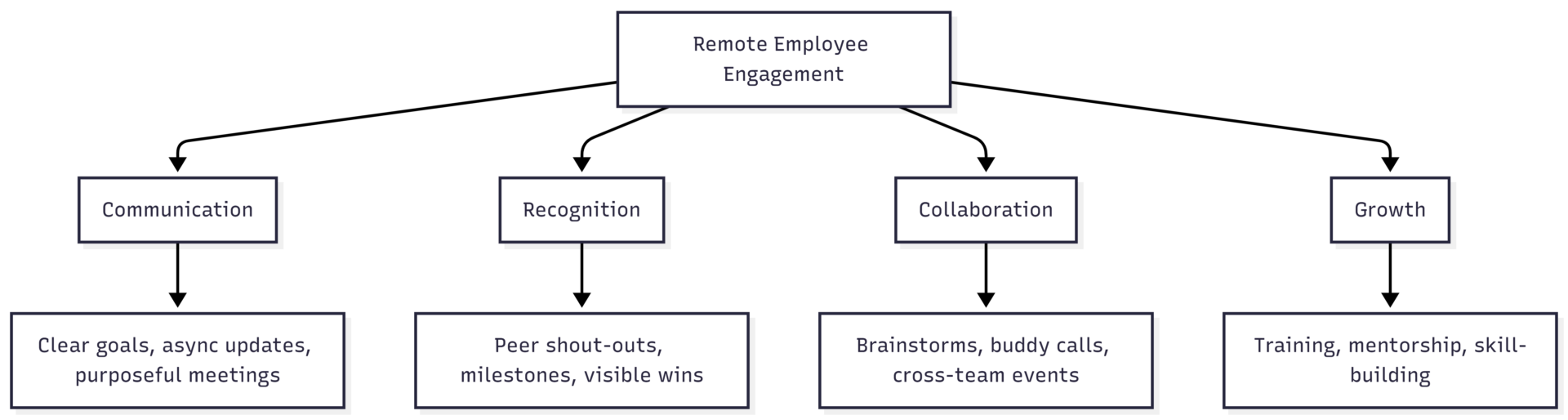
Remote employee engagement is the deliberate effort to keep distributed employees emotionally connected, motivated, and aligned with company goals despite physical distance. It isn’t a calendar of virtual events — it’s a repeatable system built on four pillars: communication, recognition, collaboration, and growth. If any one of those pillars is missing, engagement becomes accidental and uneven across the team.
Why This Matters More Than It Used to
Disengagement is expensive, and it’s harder to catch in a remote setting than in an office. A remote employee who stops speaking up in meetings, stops contributing ideas, or starts responding slower isn’t always flagged as a problem — sometimes it just looks like a quiet week. Left unaddressed, that pattern turns into silent attrition: the employee leaves mentally long before they submit a resignation.
Organizations that treat engagement as a system rather than a perk tend to see stronger collaboration, faster problem-solving, and noticeably better retention. The inverse is also true — teams that only address engagement reactively, after someone quits, are usually managing a symptom instead of the actual cause.
16 Ways to Boost Remote Employee Engagement
1. Set Clear Goals and Expectations
Ambiguity is the fastest way to disengage a remote worker. Without a manager physically nearby to clarify priorities in passing, unclear goals sit unresolved for days. Define roles, deliverables, and success criteria explicitly, and revisit them regularly rather than assuming they’re understood after one onboarding conversation.
2. Balance Synchronous and Asynchronous Communication
Not every update needs a meeting, and not every complex discussion should happen over chat. Use quick async messages for status updates and reserve live video calls for topics that genuinely need real-time back-and-forth — brainstorming, sensitive feedback, or complex problem-solving.
3. Avoid Meeting Fatigue
Recurring meetings that outlive their usefulness quietly erode morale. Keep routine meetings short, give them a clear purpose, and cancel any meeting that could have been a message. A team that trusts its calendar tends to engage more fully in the meetings that remain.
4. Host Virtual Coffee Breaks or Team Lunches
Give people a version of the water cooler conversation they’re missing. Keep groups small — three to five people — with no agenda, and rotate who’s paired together so relationships form beyond people’s immediate team.
5. Run Virtual Icebreakers for New Hires
New remote hires face a steeper climb to feeling like part of the team, since they haven’t built any in-person context yet. A short icebreaker in their first weeks — sharing hobbies, hometowns, or a “two truths and a lie” round — accelerates that sense of belonging.
6. Set Up Virtual Mentoring
Employees with mentors report higher confidence and stronger engagement. Pair mentors and mentees deliberately, and give the relationship structure — recurring one-on-ones, goal setting, and light accountability — so it doesn’t quietly fade after the first meeting.
7. Create a Dedicated Recognition Channel
A shout-out channel — where colleagues can publicly credit specific work — gives remote teams a visible, low-effort way to recognize each other. The key detail is specificity: “great job” fades into background noise, while “you caught that pricing error before launch” actually lands.
8. Run Virtual Town Halls
Quarterly (or more frequent) sessions with leadership keep distributed teams aligned on strategy and progress. Structure them as two-way conversations rather than broadcasts — collect questions in advance, allow anonymous submissions, and answer with real specifics instead of talking points.
9. Try TED-Style Talks
Set up a recurring session where employees present on a topic they’re genuinely interested in — industry trends, a skill they’ve picked up, a project retrospective. It surfaces expertise that would otherwise stay hidden and gives quieter team members a platform.
10. Start a Book Club
A monthly or biweekly book club, built around either industry topics or general interest, gives remote employees a recurring reason to connect outside of work tasks. It’s low-cost, easy to run, and tends to build cross-functional relationships that wouldn’t otherwise form.
11. Pair People with Buddy Calls
Randomly pair employees who don’t normally work together for a brief, informal call — work chat optional. This is one of the simplest ways to break up team silos, which form naturally once people stop bumping into colleagues outside their immediate group.
12. Provide Remote Working Perks
Office-based perks don’t translate automatically to a home setup. Consider sending a workstation upgrade, a wellness stipend, or a small home-office allowance — tangible reminders that the company is investing in a remote employee’s day-to-day experience, not just their output.
13. Celebrate Birthdays and Anniversaries Publicly
It’s easy for personal milestones to slip by unnoticed without an office to mark them in. A quick note in a shared channel — or something more tangible for bigger anniversaries — keeps these moments from disappearing entirely.
14. Run Fitness or Wellbeing Challenges
A lightweight, opt-in challenge — a step goal, a “90 minutes of deep work” streak, or a shared meditation habit — introduces some friendly competition while genuinely supporting wellbeing. Keep participation voluntary and the format inclusive so it doesn’t just reward people who were already active.
15. Send Out Regular Pulse Surveys
Short, frequent surveys (one or two questions, not a 40-item annual review) let you catch friction early. Ask about communication quality, workload, or tool effectiveness, and allow anonymous responses to get honest signal rather than polite answers.
16. Invest in Online Training and Development
Remote employees often get meaningfully less access to learning opportunities than their office-based counterparts, simply because development conversations happen less naturally without in-person context. A dedicated learning platform with personalized paths closes that gap and directly supports long-term engagement, since access to growth is consistently one of the strongest engagement drivers across every team size.
Engagement Activities by Company Size
Different team sizes need different approaches — what works for a 12-person startup will feel bureaucratic at 5,000 employees, and what works at enterprise scale will feel like overkill for a small team.
| Company Size | Primary Challenge | Best-Fit Activities |
|---|---|---|
| Small (under 50) | Disengagement spreads fast; few structural layers to catch it | Virtual water cooler moments, kudos channels, skill-sharing sessions |
| Medium (50–500) | Alignment gets harder; silos form between departments | Cross-department networking, values-based recognition, pulse surveys |
| Large / Enterprise (500+) | Communication fragments; recognition can feel political or invisible | Structured town halls, global recognition standards, modular learning pathways |
Building a Sustainable Engagement System
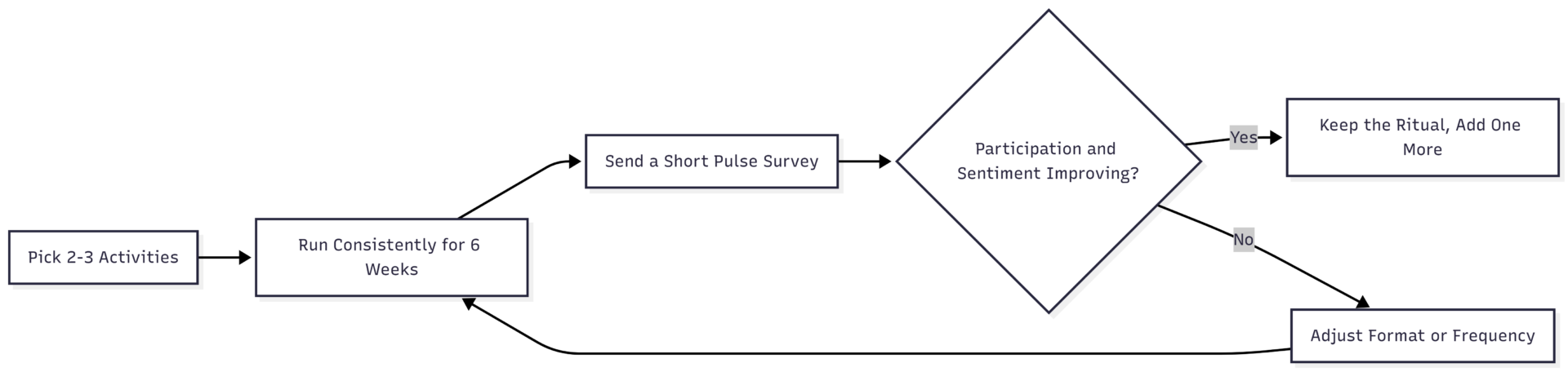
The mistake most teams make is treating engagement as a series of one-off events instead of an ongoing rhythm. A single virtual happy hour doesn’t move the needle — a recurring, low-friction ritual does. The most effective approach is to pick a small number of activities, run them consistently for at least six weeks, and measure participation before adding anything new.
Common Signals of Remote Disengagement
Spotting disengagement early is harder without physical cues, but a few patterns tend to show up consistently across distributed teams:
| Signal | What It Often Means |
|---|---|
| Camera consistently off in meetings | Reduced comfort or connection with the team |
| Delayed or minimal async responses | Possible overload, disengagement, or unclear priorities |
| Declining participation in optional events | Early sign of isolation or burnout |
| Fewer questions or pushback in discussions | Disengagement from decisions or reduced psychological safety |
| Missed recognition of contributions | Employee feels invisible relative to peers |
If a manager notices two or more of these signals persisting over several weeks, it’s worth a direct, low-pressure check-in rather than waiting for a formal review cycle.
The Manager’s Role in Remote Engagement
Tools and rituals only work if managers reinforce them consistently. A few habits make the biggest difference:
- Hold weekly team check-ins covering priorities, blockers, and a brief personal catch-up — not just status updates.
- Schedule regular one-on-ones with each direct report, protected from cancellation, focused on both work and career growth.
- Set explicit communication norms — which channel to use for urgent matters, which for routine updates, and expected response times — so employees aren’t guessing.
- Tie individual goals to business goals so remote employees understand why their work matters, not just what’s due.
- Model the behavior — a manager who never turns their camera on or never uses the kudos channel undermines the ritual faster than any policy.
Frequently Asked Questions
Weekly for lightweight rituals (coffee breaks, kudos channels) and monthly for larger events (town halls, skill-building workshops) tends to strike the right balance without causing meeting fatigue.
Short pulse surveys — one or two questions sent every few weeks — give faster, more honest signal than a lengthy annual survey, especially when responses are anonymous.
They work when participation is optional and the format is genuinely low-pressure. Mandatory, agenda-heavy “fun” tends to backfire; small, casual, opt-in gatherings consistently perform better.
Rotate meeting times so the same group isn’t always inconvenienced, lean on asynchronous formats for anything that doesn’t require real-time discussion, and make sure recognition and information are posted somewhere everyone can access on their own schedule.
Regular peer recognition and clear goal-setting consistently show the strongest connection to engagement, since both directly address the two things remote employees miss most — visibility and clarity.
Final Thoughts
Boosting remote employee engagement isn’t about adding more meetings or planning bigger events — it’s about building small, consistent moments of connection, recognition, and clarity into the normal rhythm of work.
Pick three or four activities from this list that fit your team’s size and culture, commit to running them consistently for six weeks, and use a short pulse survey to see what’s actually landing. Engagement built this way tends to stick, because it becomes part of how the team works rather than something layered on top of it.
Please share this 16 Ways to Boost Remote Employee Engagement your friends and do a comment below about your feedback.
We will meet you on next article.
Until you can read, How Remote Work Can Change Your Career Growth