
How Remote Work Can Change Your Career Growth
For most professionals, remote work starts as a search for flexibility — skipping the commute, working from home, or finally getting some control over the day. But the real impact of remote work isn’t where you sit. It’s what it does to the trajectory of your career.
Over the past several years, remote work has reshaped how companies hire, how professionals build skills, and how careers actually grow. Talented people can now reach opportunities that used to be locked behind geography, local job markets, and traditional office hierarchies. For a growing share of the workforce, remote work isn’t just a different way to work — it’s a genuinely different path to career growth.
The Career Opportunities You Can’t Access Locally
Career growth used to be tied tightly to location. If the strongest companies in your field weren’t hiring in your city, your options were limited by default. Moving up often meant relocating, accepting a longer commute, or settling for fewer choices. Remote work breaks that link.
Research tracking tens of millions of job transitions has found that workers who moved into remote-eligible roles saw stronger wage growth and greater upward mobility than comparable workers who stayed in fully on-site positions. The same research found that remote work meaningfully expanded access to opportunities beyond local labor markets.
A professional based in a mid-sized city can now work for a company headquartered somewhere else entirely, gaining exposure to industries, tools, and business practices that may not exist in their local market at all. The talent pool has gone global — and increasingly, so has the opportunity pool.
Remote Work Accelerates Skill Development
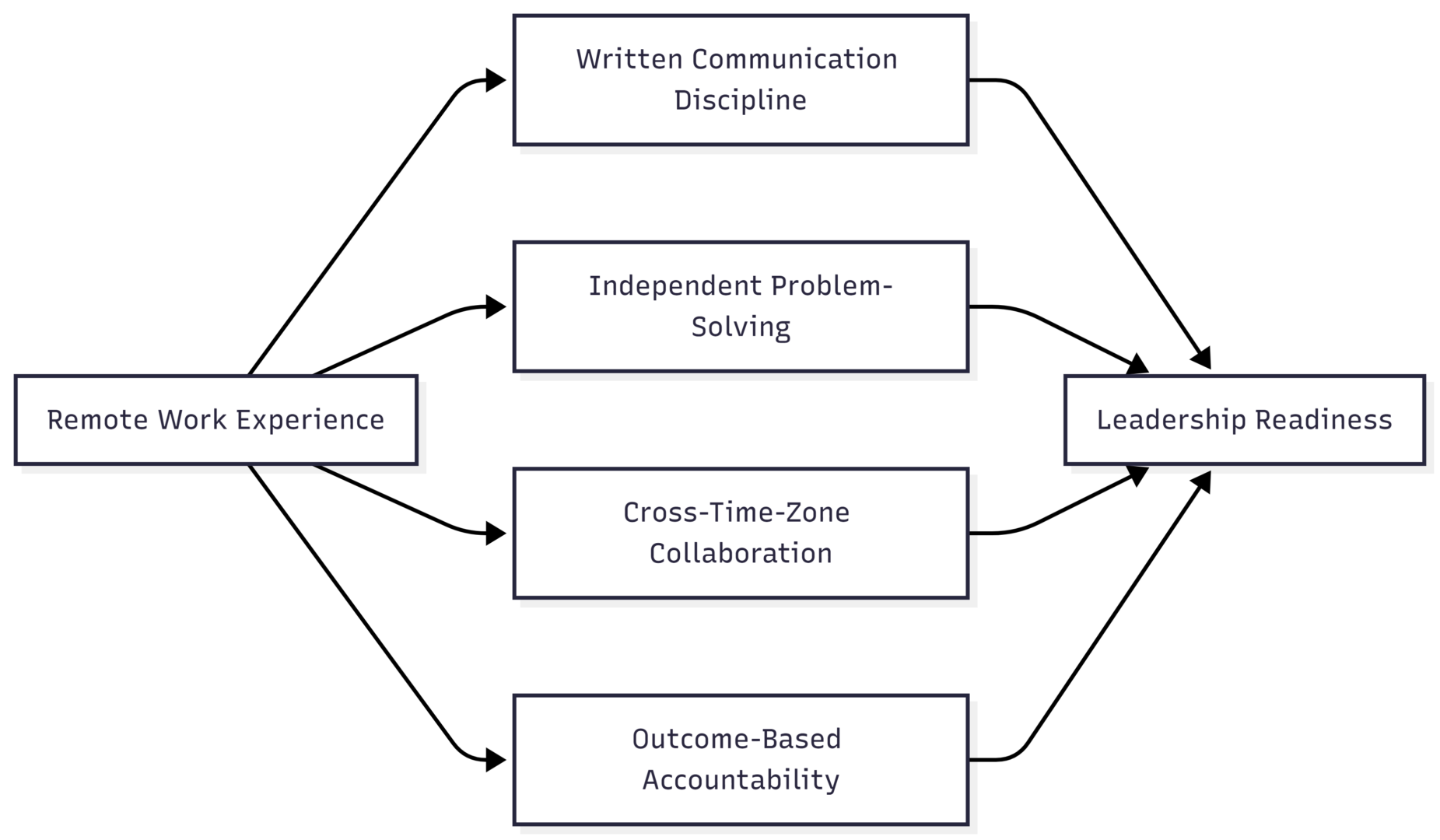
One of the most underrated effects of remote work is how fast it forces skill growth. Remote employees are expected to communicate clearly in writing, manage their own time, solve problems without someone looking over their shoulder, and collaborate across teams with no hallway conversations to fall back on. These aren’t remote-specific skills — they transfer to virtually any career path.
Workplace learning research consistently shows organizations placing growing weight on adaptability and continuous skill development as work itself keeps changing. Companies want people who can learn quickly, adjust to new tools, and stay productive through change — and remote work builds exactly that muscle by necessity, not by choice.
Professionals who succeed in remote roles tend to come out the other side as stronger writers, better organizers, and sharper problem-solvers — all of which compound into long-term career advantage.
Core Skills Remote Work Builds Fastest
| Skill | Why Remote Work Accelerates It |
|---|---|
| Written communication | Async updates replace verbal alignment, so clarity becomes non-negotiable |
| Self-management | No direct oversight means output has to speak for itself |
| Digital fluency | Daily reliance on collaboration and project tools builds fluency fast |
| Cross-cultural collaboration | Global teams mean working across time zones and norms regularly |
| Independent problem-solving | Slower response times push people to solve more before escalating |
Career Growth Then vs. Career Growth Now
| Traditional Career Path | Remote Career Path |
|---|---|
| Opportunities limited by location | Access to global opportunities |
| Growth tied to local employers | Growth tied to skills and performance |
| Smaller professional network | International professional exposure |
| Fewer industry options | Access to multiple industries at once |
| Limited flexibility | Greater control over career choices |
| Slower access to global experience | Faster exposure to international teams |
Your Network Becomes Global
Career growth is frequently a function of who you know. In the traditional model, that network was built through local events, office relationships, conferences, and industry meetups tied to a specific city. Remote work stretches that network well past geographic limits.
Working remotely usually means collaborating with managers, clients, and colleagues across different cities, states, and countries as a matter of routine, not exception. Over time, that builds a wider professional network and exposes people to perspectives, industries, and opportunities they’d never have encountered locally.
Those relationships — built over shared projects rather than shared office space — often become the source of future roles, referrals, and partnerships that wouldn’t have existed inside a purely local network.
Remote Experience Is Becoming a Credential of Its Own
As remote work becomes more common rather than less, employers increasingly value candidates who already know how to operate in a distributed environment. Flexibility continues to be a major factor in engagement and retention research, and professionals who show strong communication and self-management skills remain consistently in demand.
Remote experience signals more than technical competence. It demonstrates accountability, independent organization, and the ability to deliver without constant supervision — qualities that, for many hiring managers, matter just as much as direct industry background.
The Confidence That Comes From Global Experience
Professionals often underestimate how much confidence comes from working across borders. Sitting in meetings with international clients, managing projects that span multiple time zones, collaborating with colleagues from different professional cultures, and using globally standard business tools all add up to a kind of experience that’s hard to replicate in a purely local role.
The more of that exposure someone accumulates, the more comfortable they get handling unfamiliar situations, communicating with a wider range of stakeholders, and taking on bigger responsibility. Career growth isn’t only about acquiring new skills — it’s also about building the confidence to apply them in more complex, less predictable environments.
What Remote Work Actually Teaches You
Remote work teaches lessons that go well past any single job description. It builds discipline, sharpens communication, and increases accountability for outcomes rather than hours logged. It also forces adaptability, since tools, processes, and team structures keep shifting under remote-first companies.
Over time, this combination — discipline, independence, and comfort with ambiguity — is exactly what employers look for when deciding who gets promoted into leadership and management roles.
Why Companies Are Rethinking Structure Around Remote Work
Many organizations that scaled up remote arrangements during the pandemic have since faced pressure to reverse course, and return-to-office mandates have pulled some employees back into physical offices. Even so, a large share of businesses remain committed to remote or hybrid models — some have gone as far as giving up underused office space entirely to reinvest in digital infrastructure instead.
Leaders who continue backing remote and hybrid work argue it gives them access to stronger, more committed teams regardless of where those people live. There’s also a case that remote hiring — not in-person interviewing alone — improves cultural fit, simply because a larger, more diverse applicant pool increases the odds of finding the right match for a role.
Key Benefits Driving the Shift
- Access to a global talent pool. Skill gaps are a persistent problem across industries, and remote hiring removes the geographic ceiling that used to limit how companies closed them.
- Lower overhead. Reduced need for physical office space, utilities, and on-site support frees up budget that can go toward technology or professional development instead.
- Higher reported productivity and satisfaction — when managed well. Fewer office distractions, more autonomy, and greater perceived trust tend to correlate with stronger output, provided management adapts its style to match.
- Lower environmental impact. Cutting commute-driven emissions is one of the most measurable sustainability wins available to a distributed organization, and it scales directly with headcount working remotely.
The Real Challenges Businesses Still Face
Remote arrangements aren’t without friction, and ignoring the downside doesn’t help anyone build a durable career strategy around it.
- Team cohesion takes deliberate effort. Office interactions that feel incidental in person — a hallway comment, a shared lunch — actually carry real weight in building trust. Distributed teams have to recreate that intentionally instead of relying on proximity.
- Communication delays are real. Poor connections, software issues, and the loss of nonverbal cues can slow collaboration meaningfully. Miscommunication is consistently cited by remote professionals as one of their top day-to-day frustrations.
- Security risk increases. Home networks generally lack the protections built into corporate infrastructure, which makes remote workers a more attractive target for phishing and ransomware attempts.
Building a Career Strategy Around Remote Work
None of this works passively — the professionals who benefit most from remote work treat it as a strategy, not just a location preference.
- Set clear personal deliverables. Remote careers reward output, not visible effort. Define what “done well” looks like for your role and hold yourself to it consistently.
- Invest in async communication skills. Since verbal alignment in a shared room isn’t available, written clarity becomes the primary signal of competence. Treat every update, message, and document as a chance to demonstrate judgment.
- Protect your own boundaries. Without a commute or a closing office door, work can quietly expand to fill every hour. Set explicit working hours and defend them — burnout erodes the exact skills that make remote work valuable in the first place.
- Build your network deliberately. Since spontaneous office relationships don’t happen on their own, remote professionals need to seek out cross-team conversations, industry communities, and informal check-ins intentionally.
- Keep upskilling. Digital tools evolve quickly, and comfort with the current stack (video conferencing, project management, AI-assisted workflows) is a baseline expectation, not a differentiator anymore.
The Future of Career Growth Is Skills-First, Not Location-First
Remote work is no longer a temporary arrangement — projections point to tens of millions of workers continuing in remote roles, representing a significant and durable share of the workforce. As companies grow more comfortable hiring regardless of location, professionals who know how to operate effectively in distributed environments will keep gaining access to opportunities their location alone would never have offered.
The direction is clear: career growth is becoming less dependent on where you live and more dependent on the skills, discipline, and adaptability you bring to the table.
Your Career Can Be Bigger Than Your Location
One of the most significant advantages of remote work is that it removes the ceiling that location used to place on growth. Your career is no longer defined by which companies happen to operate in your city or which industries are represented nearby.
Instead, it’s shaped by your skills, your adaptability, and your willingness to keep learning. Remote work doesn’t guarantee career success on its own — but for professionals willing to invest in the skills that make distributed work effective, it opens doors that would have been very difficult to reach even a few years ago.
Frequently Asked Questions
Evidence points toward stronger wage growth and greater upward mobility for workers in remote-eligible roles compared to similar workers in fully on-site positions, largely because remote work expands access to opportunities beyond local markets.
Written communication, self-management, digital fluency, and independent problem-solving consistently rank as the highest-value skills for remote professionals, since they replace the informal oversight and verbal alignment common in office settings.
Prioritize cross-team conversations, industry communities, and regular check-ins that wouldn’t happen automatically. Remote networks form through deliberate effort rather than spontaneous proximity, so treat networking as a scheduled priority.
Increasingly, yes. Remote experience signals accountability, independent organization, and self-direction — qualities many employers now weigh as heavily as direct industry background.
Blurred boundaries and burnout. Without a commute or a physical end to the workday, work can expand to fill all available time unless you set and enforce clear working hours.
Final Thoughts
Remote work isn’t just a flexible alternative to office life — it’s a structurally different path to career growth, built on global access, faster skill development, and a wider professional network. The professionals who benefit most aren’t the ones who simply work from home; they’re the ones who treat remote work as a deliberate strategy for building skills, visibility, and confidence that a purely local career path could never offer at the same scale.
Please share this How Remote Work Can Change Your Career Growth your friends and do a comment below about your feedback.
We will meet you on next article.
Until you can read, 10 Best Collaboration Tools for Remote Teams