
A Strategic Guide for Managing Hybrid and Remote Teams
Hybrid work isn’t a transitional phase anymore — it’s the default operating model for most remote-capable employees. Work location patterns have held remarkably stable for years despite constant return-to-office headlines, which means the real question facing leaders isn’t whether hybrid work will persist. It’s how to manage it well.
The data on this is unusually clear: management quality, not physical location, is the single biggest driver of whether a distributed team thrives or quietly disengages. This guide breaks down what the research actually shows about hybrid and remote work — collaboration, trust, burnout, culture — and translates it into a practical playbook for leading distributed teams effectively.
What Is Hybrid Work?
Hybrid work is an arrangement where employees split their time between remote work and on-site work, distinct from fully remote roles (performed entirely outside a traditional office) and fully on-site roles (performed entirely in person).
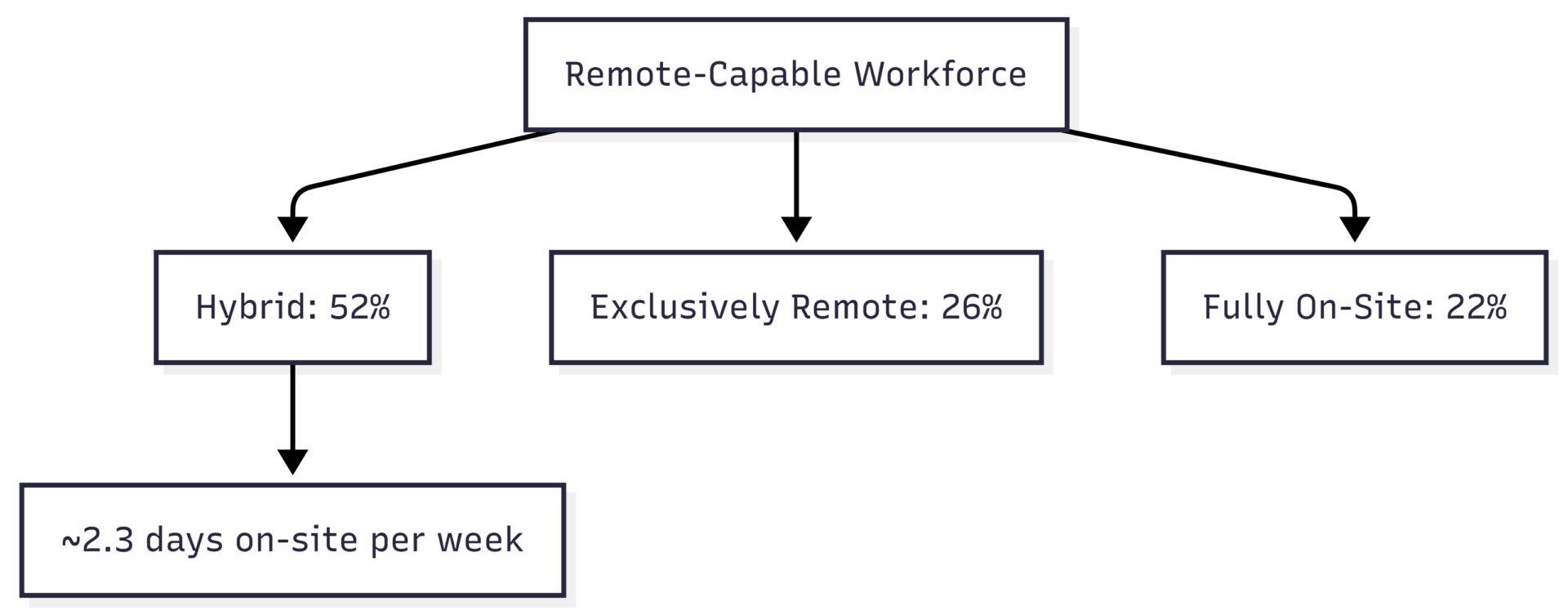
Among remote-capable employees — roughly half the U.S. workforce — hybrid work is the clear majority preference and practice:
| Work Arrangement | Share of Remote-Capable Employees |
|---|---|
| Hybrid | 52% |
| Exclusively remote | 26% |
| Fully on-site | 22% |
| Prefer hybrid | ~60% (6 in 10) |
| Prefer fully on-site | Under 10% |
Hybrid employees spend an average of 46% of their workweek on-site — roughly 2.3 days. Despite years of prominent return-to-office announcements, overall work-location patterns have stayed largely stable, which suggests hybrid work has settled into a durable structural feature of the modern workplace rather than a temporary accommodation.
The Top Challenges of Managing Distributed Teams
Managing hybrid and remote teams introduces five recurring challenges. Each one is a leadership and coordination problem more than a technology problem — and each one gets substantially worse without a deliberate plan.
1. Collaboration and Coordination Complexity
Hybrid teams have to coordinate across locations, overlapping schedules, and asynchronous channels — and many simply haven’t figured out how. Nearly half of hybrid workers report their team has never discussed a formal or informal plan for collaborating effectively. Leaders feel this too: communication and collaboration consistently rank as the top hybrid management challenges cited by managers.
The payoff for solving this is large. Teams with a defined hybrid collaboration plan are more than twice as likely to say their hybrid policy has a strongly positive impact on team collaboration, 66% more likely to be engaged at work, and 29% less likely to report burnout.
2. Cultural Disconnection and Weakened Belonging
Hybrid and remote employees consistently report feeling less connected to organizational culture than fully on-site employees. This risk is especially pronounced for younger employees, who report higher rates of loneliness and lower overall life satisfaction than older cohorts — meaning showing up to an office without meaningful interaction doesn’t actually deliver the cultural benefit leaders assume it does. Physical presence alone doesn’t sustain culture; it has to be reinforced intentionally, regardless of where people are sitting.
3. Trust and Accountability Gaps
Trust is one of the most fragile elements of distributed work. Only about 54% of managers overseeing remote employees strongly agree they trust their team to be productive without direct oversight, and only about 57% of employees strongly agree they feel trusted by their manager. That gap directly limits how much autonomy managers are willing to extend — and autonomy is exactly what makes hybrid work valuable in the first place.
4. Burnout and Boundary Strain
Hybrid work tends to improve work-life balance on average, but autonomy without structure introduces new risk. Employees with fully self-determined schedules — no team-level coordination at all — are considerably more likely to report burnout, reduced work-life balance, and difficulty meeting customer or team needs than employees operating under agreed-upon norms.
5. Performance Visibility and Proximity Bias
Distributed work strips away the informal visibility managers relied on in fully on-site settings. Left unaddressed, this creates a real risk of proximity bias — rewarding employees for being seen rather than for what they actually deliver. The fix is redesigning performance management around explicit expectations, regular conversations, and outcomes rather than attendance.
Why Managers Are the Deciding Factor
Across every one of these five challenges, one variable shows up again and again: management quality. Research consistently finds that managers account for roughly 70% of the variance in team-level engagement — more than any other single factor, including work location itself.
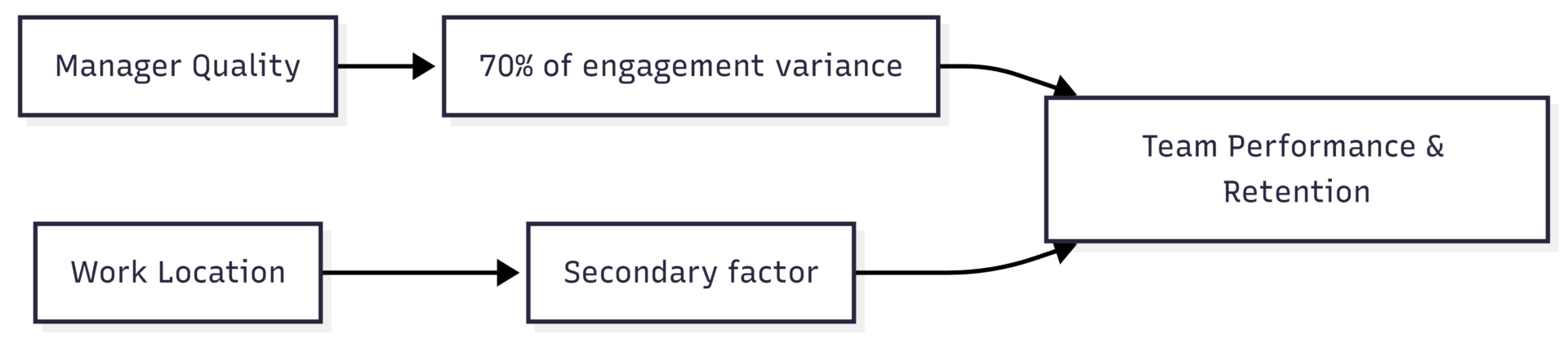
That number reframes the entire hybrid-work conversation. The debate over remote versus in-office attendance gets far more attention than it deserves; the leadership discipline applied to either arrangement matters more.
The Advantages of a Distributed Workforce
Despite the coordination challenges, remote and hybrid arrangements deliver real structural advantages when managed with intention.
- Broader talent access. Removing geographic constraints lets organizations hire the strongest candidate for a role, not just the strongest candidate within commuting distance. This isn’t just a hiring nicety — flexibility has become a genuine retention lever. Roughly 6 in 10 exclusively remote workers say they’d be highly likely to look for a new job if remote flexibility were taken away.
- Improved wellbeing and work-life balance. Roughly 76% of hybrid workers cite improved work-life balance as one of the model’s biggest benefits, alongside more efficient use of time and greater autonomy over both hours and location.
- Higher engagement — with a caveat. Hybrid and remote employees often report higher engagement than fully on-site workers, but that gain depends heavily on whether managers are holding regular, meaningful conversations and clarifying expectations. Flexibility supports engagement; it doesn’t replace management.
- Stable productivity despite fewer hours. Remote employees are working somewhat fewer hours on average than before large-scale remote adoption, without a corresponding drop in output — likely reflecting better matching between employee strengths and role design, since a wider talent pool makes better-fit hiring easier.
Engagement and Wellbeing by Work Arrangement
| Work Location | Engaged | Thriving |
|---|---|---|
| Hybrid | 34% | 54% |
| Exclusively remote | 37% | 52% |
| On-site (remote-capable role) | 29% | 49% |
| On-site (non-remote-capable role) | 28% | 46% |
| All full-time U.S. employees (average) | 31% | 47% |
Two patterns stand out. First, both hybrid and fully remote employees outperform on-site employees on engagement — flexibility itself appears to help. Second, engagement and thriving wellbeing don’t move in lockstep: remote workers report the highest engagement but slightly lower thriving than hybrid workers, which points to a real risk worth naming directly.
Why Wellbeing Can Lag Even When Engagement Is High
- Physical distance creates mental distance. Without shared meals, informal conversation, or ambient camaraderie, remote work can start to feel like “just work” — isolating even when performance stays strong.
- Autonomy carries cognitive load. The same flexibility that boosts engagement also requires employees to manage their own time and coordinate digitally, which adds a layer of mental overhead office life doesn’t require.
- Coordination friction adds up. Remote work built around heavy digital coordination is measurably harder than remote work that’s largely independent — more tools, more channels, more room for miscommunication.
How to Build Trust on a Distributed Team
Trust doesn’t build itself simply because a team has been working together for a while. It’s a direct product of four specific management behaviors, and closing the trust gap consistently improves the numbers above.
| Trust-Building Practice | What It Looks Like |
|---|---|
| Clarify expectations | Explicit, measurable goals tied to outcomes, not hours logged |
| Communicate consistently | One meaningful one-on-one conversation per week, minimum |
| Hold everyone accountable equally | Same performance standard regardless of location; no reward for visibility alone |
| Reinforce community deliberately | Coordinate in-office time around actual collaboration, not just attendance |
Reinforcing these fundamentals consistently has been shown to raise employee trust by close to 30 percentage points — a meaningful shift given how directly trust ties to psychological safety, the willingness to speak up, ask questions, and admit mistakes without fear of penalty.
One detail worth calling out specifically: teams that design their own hybrid schedule together report far higher perceived fairness (around 91%) than teams operating under a schedule set entirely by leadership (around 73%). Involvement in the decision matters almost as much as the decision itself.
How to Manage Remote and Hybrid Teams Day to Day
Remote employees need the same engagement fundamentals as on-site employees — the difference is that those fundamentals require far more intentional delivery when there’s no shared physical space to fall back on. Four elements matter most.
1. Connect Work to Purpose
Purpose fades quickly in remote settings without active reinforcement. Managers need to explicitly and repeatedly connect daily tasks to team goals, customer impact, and the broader mission — not assume the connection is obvious.
2. Prioritize Development
Lack of career growth is consistently one of the top reasons employees leave, and remote employees are especially vulnerable to being overlooked for stretch opportunities simply because they’re less visible. Development conversations won’t happen organically in a distributed setting — they have to be scheduled and protected.
3. Be a Present, Caring Manager
Small, human moments of connection happen naturally in an office. They don’t happen automatically online — they need structure: brief check-ins, regular one-on-ones, and coaching conversations that go beyond status updates.
4. Focus on Individual Strengths
Engagement rises when people get to do what they’re genuinely good at every day. In remote settings, strengths-based conversations do double duty — they clarify expectations and strengthen the manager-employee relationship at the same time, which matters more when in-person rapport-building isn’t available.
Communication Is the Multiplier
The data here is sobering: only around 27% of U.S. workers strongly agree their supervisor keeps them informed about what’s happening across the organization, and only around 22% strongly agree they received meaningful feedback in the past week.
Remote environments amplify both weaknesses. Frequent, accurate, timely communication isn’t a courtesy in a distributed team — it’s a baseline performance requirement.
Building a Positive Remote Work Culture
Culture in a distributed organization is a system, not an accident. It’s built through consistent alignment between what leaders say and what leaders actually do — across three areas:
- Leadership and communication: Leaders must repeatedly explain why the organization exists and how each team’s work contributes, since managers translate that message into daily practice more than any other channel.
- Values and rituals: Recognition moments, team traditions, and decision-making conversations need to deliberately include remote employees, not default to whoever happens to be in the room.
- Work and team structure: How work gets organized signals what actually matters. If collaboration or innovation are named priorities, team structure needs to reflect that — not contradict it.
- Performance and recognition: Fairness requires that outcomes, not proximity, determine who gets recognized and promoted.
Preventing Burnout in Distributed Teams
Burnout risk in hybrid work climbs sharply when autonomy exists without any team-level structure. Employees with fully self-determined schedules are considerably more likely to cite burnout, reduced work-life balance, and difficulty meeting team or customer needs as their top challenge, compared with employees working under agreed team norms.
Practical steps that reduce burnout risk:
- Define measurable goals and revisit priorities explicitly, rather than assuming shared understanding
- Build (and actually use) a team-level collaboration plan, since teams with one are 66% more likely to be engaged and 29% less likely to be burned out
- Hold weekly, substantive one-on-one conversations covering workload, obstacles, and wellbeing — not just status
- Set clear norms for response times and after-hours availability, and have managers model those norms themselves
- Evaluate performance strictly on outcomes, since burnout climbs whenever employees feel they need to be constantly visible to be seen as productive
Quick-Reference: The Leadership Checklist for Hybrid Teams
| Focus Area | Manager Action |
|---|---|
| Coordination | Build an explicit, team-designed hybrid collaboration plan |
| Trust | Clarify expectations; hold everyone to the same outcome-based standard |
| Culture | Include remote employees deliberately in rituals and recognition |
| Development | Schedule career conversations; don’t let visibility gaps limit growth |
| Burnout prevention | Set availability norms and evaluate output, not online presence |
| Communication | Hold one meaningful conversation per employee per week, minimum |
Frequently Asked Questions
Data shows hybrid and fully remote employees both report higher engagement than on-site employees, though fully remote workers report slightly higher engagement and slightly lower thriving wellbeing than hybrid workers — suggesting a mix of independent and in-person time may offer the most balanced outcome.
Management quality. Managers account for roughly 70% of the variance in team-level engagement, which outweighs the specific work arrangement itself.
Teams that design their own hybrid norms report dramatically higher perceived fairness than teams operating under schedules dictated entirely by leadership — involvement in the decision matters nearly as much as the schedule itself.
No. Employees with fully self-determined schedules and no team-level coordination report higher burnout and lower work-life balance than employees working under agreed team norms. Flexibility works best paired with structure, not left entirely to individual discretion.
At minimum, one substantive one-on-one conversation per week per direct report, covering progress, obstacles, workload, and wellbeing — not just task status.
Final Thoughts
Hybrid work has moved past the point of being an open question — the data shows it’s a stable, structural part of the modern workforce. What separates the organizations that get real value from it from those that don’t isn’t the ratio of remote to in-office days.
It’s whether managers build explicit collaboration norms, hold trust and accountability consistent across locations, and treat engagement as something that has to be actively built rather than assumed. Get the leadership fundamentals right, and location becomes a secondary detail rather than the deciding factor.
Please share this A Strategic Guide for Managing Hybrid and Remote Teams your friends and do a comment below about your feedback.
We will meet you on next article.
Until you can read, 6 Reasons Why Remote Work Is Here To Stay