
Why Working From Home is Making You Lazy
Working from home removes the structure that used to make productivity automatic: a commute, a dress code, colleagues watching, a clear line between “work” and “home.”
Without that structure, many remote workers notice motivation quietly draining away — more procrastination, more scrolling, more days where the bare minimum gets done and nothing more. This isn’t a character flaw. It’s a predictable response to environment, and it’s fixable with the right routines.
This article breaks down why remote work erodes discipline for so many people, what the data actually shows about remote productivity, and the specific habits that reverse the slump.
Why Remote Work Triggers Laziness
The Loss of Environmental Structure
An office imposes structure by default: a wake-up time tied to a commute, a dress code, visible colleagues, and physical separation between “work mode” and “rest mode.” At home, all of that collapses into a single space and a single set of clothes. Without external cues signaling that work has started, the brain doesn’t switch into focus mode the same way — leading to slower starts, more procrastination, and blurred boundaries between work and rest.
Reduced Social Accountability
In an office, visible effort carries social weight — colleagues notice who’s engaged and who isn’t. At home, that accountability disappears almost entirely. It becomes far easier to do the bare minimum unnoticed, and for some people, the absence of that social pressure is exactly what causes motivation to quietly decline over time.
Decision Fatigue From Constant Boundary-Setting
Remote workers have to consciously decide, dozens of times a day, whether to focus or drift toward a distraction sitting a few feet away — a TV, a game console, a pet, a snack. In an office, most of these decisions are made for you simply by not being physically present near them. At home, every one of those decisions falls on personal willpower, and willpower is a finite resource that depletes over the course of a day.
Blurred Rest and Work Spaces
When the same room, or even the same desk, is used for both working and unwinding, the brain has a harder time fully switching off — or fully switching on. This is part of why so many remote workers report simultaneously feeling like they’re always working and never quite working at full capacity.
What the Data Actually Says About Remote Productivity
It’s worth separating perception from measured outcomes, because they don’t always match. Self-reported feelings of laziness and measured output are two different things.
| Factor | Common Perception | What Studies Tend to Show |
|---|---|---|
| Hours worked | Remote workers assume they work less | Many remote employees report working the same or longer hours, with blurred start/end times |
| Output per hour | Feels lower due to distraction and guilt | Controlled studies (including the well-known Ctrip/Stanford research) found measurable productivity gains of roughly 13% for remote staff |
| Focus quality | Assumed to be worse due to home distractions | Mixed — deep, uninterrupted focus time often increases, but so does susceptibility to informal distractions |
| Motivation | Frequently reported as lower | Strongly tied to whether a person has structure and routine, not remote work itself |
| Burnout risk | Assumed to be lower without a commute | Often higher, due to blurred boundaries and difficulty “switching off” |
The takeaway: remote work doesn’t inherently make people lazy. It removes the external scaffolding that used to enforce productivity automatically, and without replacing that scaffolding with new personal habits, motivation and discipline tend to slip.
The Habit Loop Behind the WFH Slump
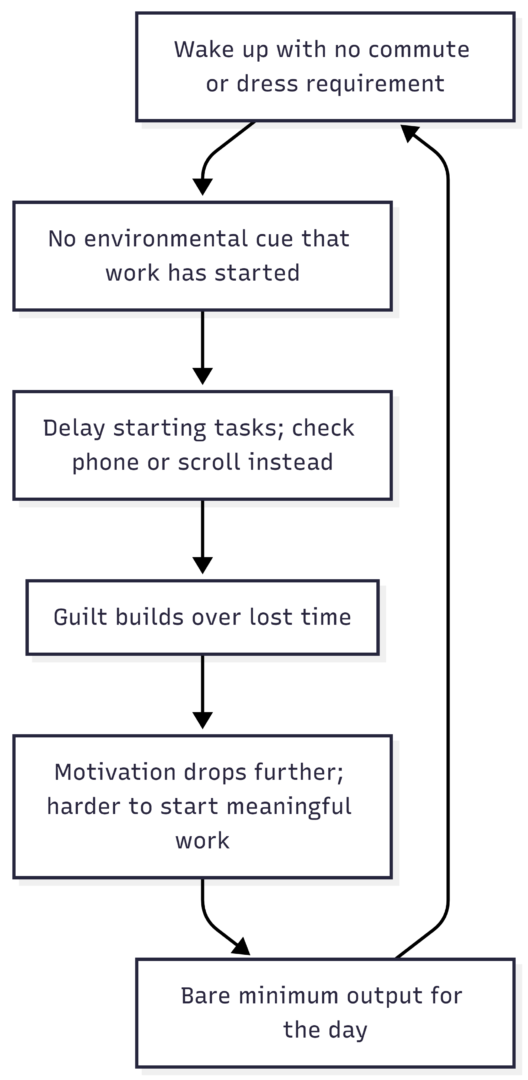
Breaking this loop requires interrupting it at the earliest possible point — before the day even starts drifting — rather than trying to force motivation once it’s already gone.
Practical Fixes That Actually Work
Rebuild a Fake Commute
A short walk, even five to ten minutes, before and after the workday recreates the mental transition a commute used to provide. It signals to the brain that “work mode” is starting or ending, without needing an actual office to travel to.
Get Dressed for Work, Not for Bed
Wearing real, comfortable clothes rather than sleepwear is a small but effective cue that shifts the brain out of rest mode. It doesn’t need to be formal — the point is a deliberate contrast between “day clothes” and “night clothes.”
Use the Two-Minute Rule to Build Momentum
When motivation is at zero, starting with one extremely small task — replying to a single email, clearing one item off a list — creates enough momentum to carry into larger tasks. The goal isn’t the task itself; it’s breaking the inertia of not having started at all.
Apply Structured Work Intervals
Time-boxed work cycles, such as 50 minutes of focused work followed by a 10-minute break, or the classic 25/5 Pomodoro pattern, replace the structure an office used to provide automatically. The fixed rhythm reduces the number of moment-to-moment willpower decisions.
Separate a Dedicated Workspace
Working from a couch or bed blurs the line between rest and work more than almost any other single factor. A dedicated desk or room — even a small corner used consistently only for work — helps the brain treat that space as a work-mode trigger.
Change Location Periodically
Working from a coffee shop, library, or shared workspace for part of the week reintroduces some of the social accountability and environmental structure that a home office lacks, without requiring a full return to a traditional office.
Set Hard Start and Stop Times
Structured boundaries prevent both underworking and overworking. Remote employees who don’t set clear stop times are prone to work creeping into evenings, which increases burnout risk even though total output may look similar or higher.
Comparing WFH Structure Approaches
| Strategy | Effort to Implement | Impact on Motivation | Best For |
|---|---|---|---|
| Fake commute (short walk) | Low | Moderate | Anyone struggling to “start” the day |
| Dedicated workspace | Low–Medium | High | People working from small living spaces |
| Pomodoro / timed intervals | Low | High | Task-based or deadline-driven work |
| Getting dressed for work | Low | Moderate | Anyone experiencing low daily motivation |
| Changing location periodically | Medium | Moderate–High | People feeling isolated or unaccountable |
| Hard start/stop times | Low | High | Preventing burnout and overwork |
Is It Really Laziness, or Missing Structure?
A useful reframe: the issue usually isn’t personal laziness — it’s the absence of the invisible scaffolding an office used to provide for free. People who struggle with motivation at home are often just as capable of high performance; they’re simply missing the environmental cues that used to do half the work of staying disciplined.
This distinction matters because it changes the fix. Trying to force more willpower rarely works for long. Rebuilding structure — a fake commute, a dedicated space, timed work blocks, and clear boundaries — tends to restore motivation far more reliably than self-criticism ever does.
It’s also worth noting that critiques framing all remote workers as inherently unproductive tend to conflict with measured data. Productivity research, including large-scale controlled studies, has repeatedly found comparable or higher output among remote employees when structure is in place. The slump is real for many people, but it’s a solvable environmental problem, not evidence that remote work fundamentally doesn’t work.
Signs You’ve Slipped Into the WFH Slump
Before applying fixes, it helps to recognize the pattern clearly. Common warning signs include:
- Starting the workday significantly later than planned, most days of the week
- Doing only the bare minimum required to avoid standing out, rather than genuine engagement with the work
- Feeling guilty about lost time but not changing behavior the next day
- Working from bed or the couch more often than a dedicated desk or table
- Losing track of what day it is, or noticing weekdays and weekends have started to blur together
- Checking work messages sporadically at odd hours instead of during set working hours
- Feeling isolated, with little to no informal social contact during the workday
None of these signs mean someone is fundamentally lazy or unsuited to remote work. They’re signals that the environmental structure has quietly disappeared, and that’s a fixable, mechanical problem rather than a character issue.
The RTO Debate: Is the Office Really the Fix?
Return-to-office mandates are often framed as the solution to declining remote productivity, but the evidence is mixed. Companies that pushed hardest for full-time office returns haven’t consistently shown better performance than those that stayed remote or hybrid, and several large organizations posted strong results throughout periods of fully remote operation. This suggests location isn’t the deciding factor — structure, accountability, and individual habits are.
That doesn’t mean offices provide no value. In-person work still offers easier spontaneous collaboration, stronger onboarding for junior employees, and social contact that’s harder to replicate remotely. But for experienced employees with clear goals and self-discipline, a well-structured remote routine can match or exceed office-based output without requiring a return to a commute.
Frequently Asked Questions
Without a commute, dress code, or visible colleagues, the brain loses the automatic cues that used to signal “work mode has started.” That structural gap, not the extra time itself, is usually the real cause of the motivation drop.
Controlled research generally shows the opposite — remote employees often match or exceed in-office productivity when they have adequate structure and a dedicated workspace. Perceived laziness and measured output frequently diverge.
Start with one extremely small task to build momentum, known as the two-minute rule, rather than trying to tackle the hardest item on your list first.
Not necessarily. Many remote workers regain lost productivity by rebuilding structure at home — a dedicated workspace, timed work intervals, and a fake commute — without needing to return to a physical office.
Often, yes, because the boundary between work and rest blurs more easily at home. Setting hard start and stop times is one of the most effective ways to prevent work from creeping into personal time.
There’s no fixed timeline, but consistently applying even one or two structural changes — a dedicated workspace and timed work blocks, for example — typically produces a noticeable difference within one to two weeks.
Working from home doesn’t have to erode motivation. The slump most people feel isn’t a personality problem; it’s the predictable result of losing the structure an office used to provide automatically. Rebuild that structure deliberately, and the discipline and productivity that seemed to disappear tend to come right back.
Please share this Why Working From Home is Making You Lazy with your friends and do a comment below about your feedback.
We will meet you on next article.
Until you can read, What Is Gigabit Internet and How Does It Work?