Parable of the Wise and Foolish Builders: Verse, Meaning & Lesson
The Parable of the Wise and Foolish Builders closes the Sermon on the Mount in Matthew 7:24-27, with a parallel version appearing in Luke 6:46-49. It is a deliberately blunt conclusion to Jesus’s longest recorded teaching: hearing good instruction is not the same as living by it, and the difference only becomes visible when trials arrive.
This guide walks through the full text of the parable in both Gospel accounts, its historical and geographic background, its symbolic meaning, and the practical lessons it offers for building a stable life. A summary table and FAQ section are included for quick reference.
The Verse: Matthew 7:24-27
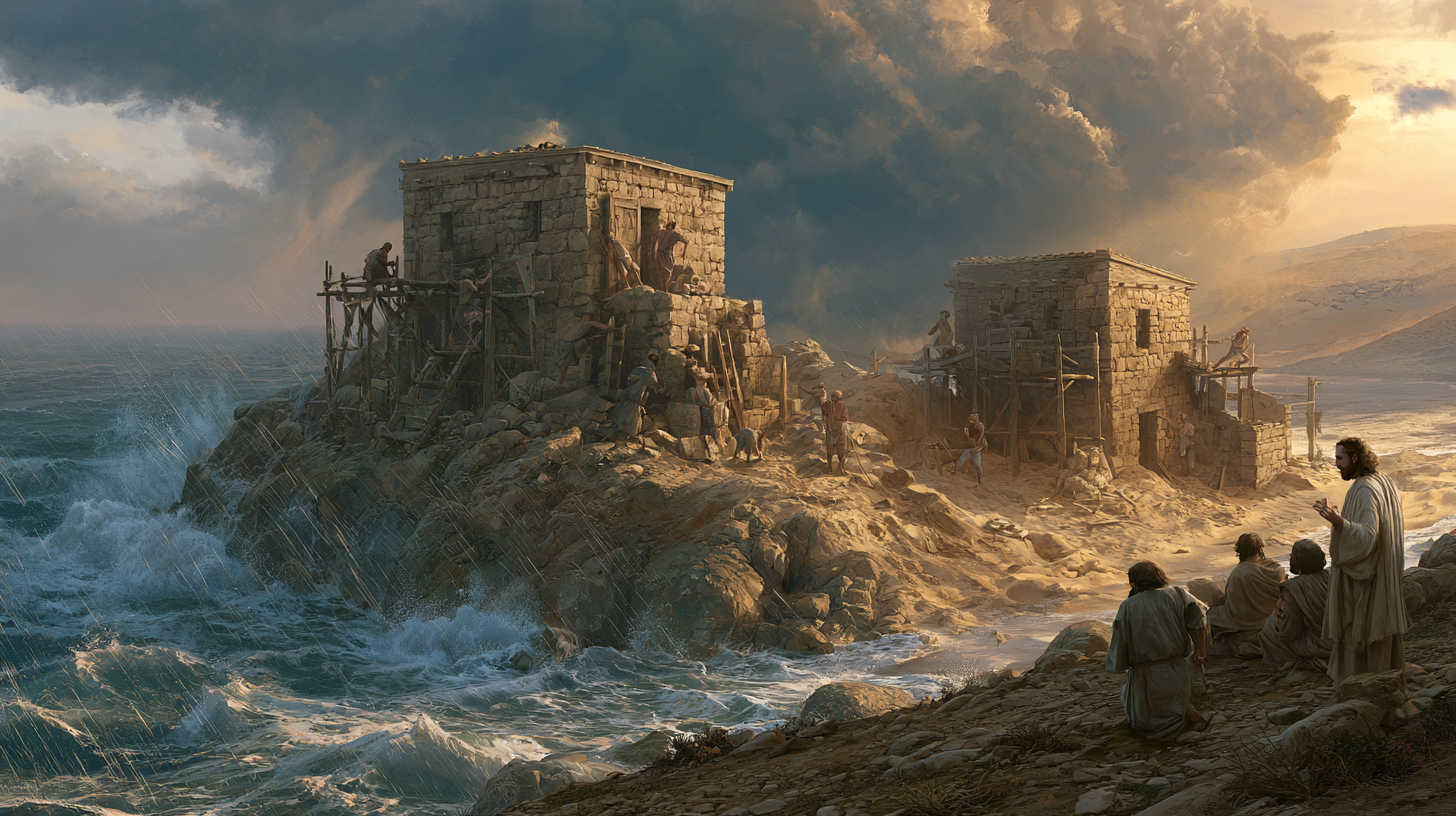
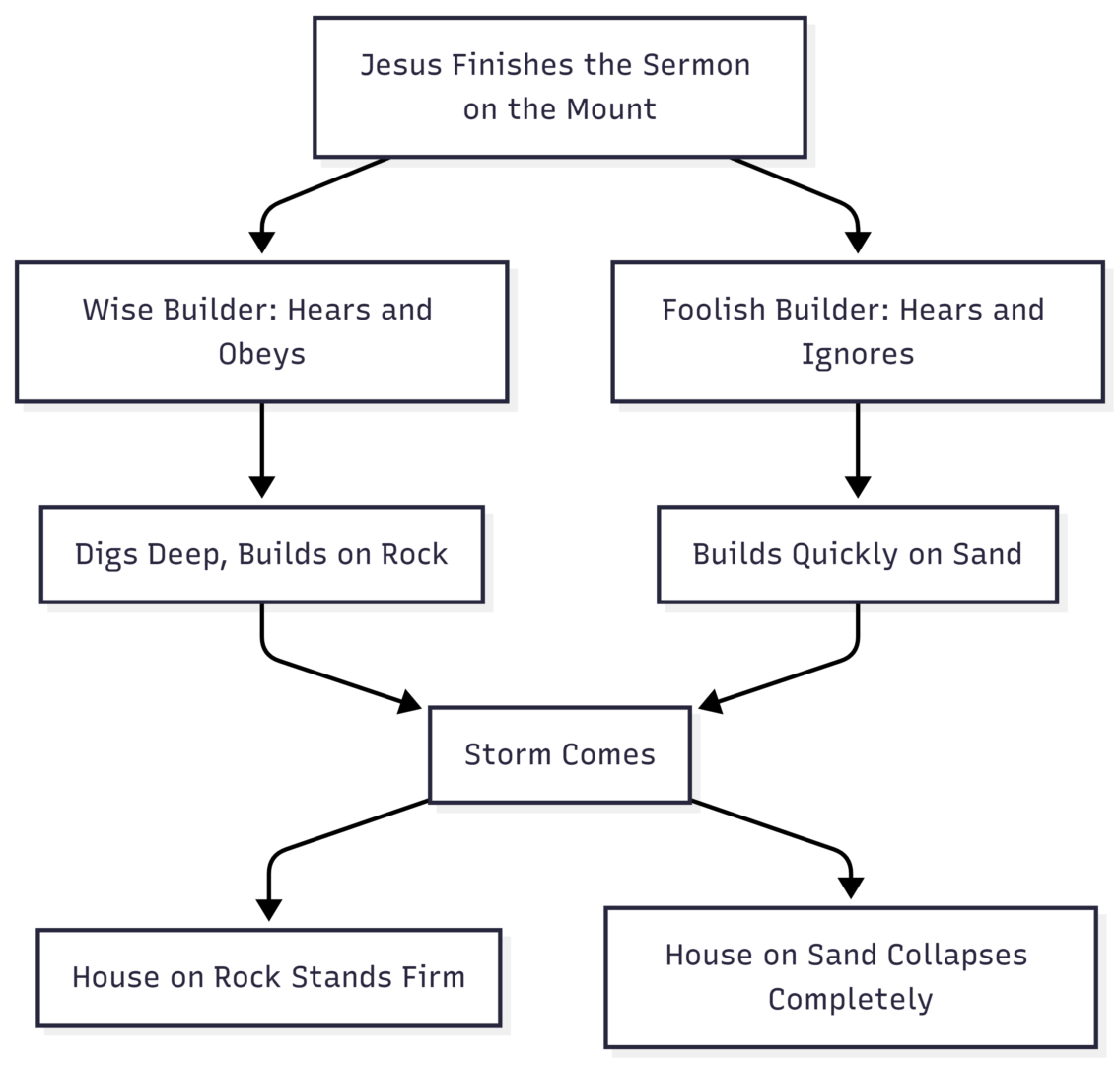
“Therefore everyone who hears these words of mine and puts them into practice is like a wise man who built his house on the rock. The rain came down, the streams rose, and the winds blew and beat against that house; yet it did not fall, because it had its foundation on the rock.
But everyone who hears these words of mine and does not put them into practice is like a foolish man who built his house on sand. The rain came down, the streams rose, and the winds blew and beat against that house, and it fell with a great crash.”
The Parallel Verse: Luke 6:46-49
Luke’s version opens with a direct question that frames the entire teaching: “Why do you call me ‘Lord, Lord,’ and do not do what I say?” Jesus then describes a builder who “dug deep and laid the foundation on the rock,” so that when a flood struck, the torrent could not shake the house because it was well built. By contrast, the one who hears and does not act is compared to someone who built a house directly on the ground, without any foundation at all — a house that collapses immediately and completely when the flood hits.
Both accounts deliver the same core message, though Luke’s opening question sharpens the point: claiming allegiance to Jesus without acting on his teaching is a contradiction the parable is specifically designed to expose.
Historical and Geographic Context
This parable would have carried immediate, practical weight for its original audience. Jesus delivered the Sermon on the Mount in Galilee, a region in northern Palestine where the terrain includes valleys, hills, and dry riverbeds that could transform into raging torrents during seasonal rains. Building a structure that could survive these seasonal floods required real foresight, not just convenience.
Archaeological work in the region has found that homes from this period sometimes had foundations dug as deep as ten feet through sandy soil until reaching bedrock. This was not a minor construction detail; it represented significant additional labor and cost. A builder could construct a house far more quickly and cheaply directly on the sand, and for much of the year, that house would look identical to one built on rock. The difference only became apparent when the rains came and the ground gave way.
This historical detail reframes the parable: it is not primarily about choosing the right location to build, but about the intentional, costly effort required to establish a foundation that will actually hold under pressure — effort that is invisible until tested.
The Meaning of the Parable
The Builders Represent Everyone Who Hears Jesus’s Teaching
Both figures in the parable hear the same words — Jesus’s teaching, delivered in the same sermon, to the same crowd. The distinction is not in exposure to truth but in response to it. This detail matters: the parable is not contrasting believers with unbelievers in a general sense, but specifically addressing those who have heard clear instruction and must decide whether to act on it.
The Rock Represents Obedient Application
The “rock” foundation symbolizes active, sustained obedience to what has been heard, not simply mental agreement or admiration. Throughout the preceding sermon, Jesus delivers demanding, specific instruction — to hunger for righteousness, to turn the other cheek, to love enemies, to stop judging others.
The wise builder is the person who takes these specific commands and puts in the effort to build them into daily life, much like digging through sand to reach bedrock rather than settling for a shortcut.
The Sand Represents Passive Hearing Without Action
The foolish builder is not someone who rejects Jesus outright or never listens to his teaching. The parable’s tension comes precisely from the fact that both builders hear the same words.
The foolish builder’s failure is one of follow-through: agreeing with the teaching in principle while never doing the harder work of applying it. From the outside, both houses can look identical for a long time, which is part of what makes this parable a warning rather than a simple contrast of good versus bad people.
The Storms Represent Inevitable Trials
Both builders face the exact same storm. Rain falls on both houses; wind and rising water strike both structures equally.
This detail rules out the idea that following Jesus exempts a person from hardship. The parable does not promise an easier life to the obedient builder — it promises a stable one. Difficulty, loss, and testing come to everyone; the foundation determines what survives them.
Key Lessons from the Parable
| Lesson | Description | Supporting Verse |
|---|---|---|
| Obedience matters more than hearing alone | Genuine faith is demonstrated through action, not just agreement | Matthew 7:24, James 1:22 |
| Storms come to everyone | Following Jesus does not exempt anyone from hardship | Matthew 7:25, 27 |
| Foundations are invisible until tested | Two houses can look identical until pressure reveals the difference | Matthew 7:24-27 |
| Love for Jesus is shown through obedience | Genuine devotion is measured by keeping his commands | John 14:21 |
| Delayed effort produces lasting stability | The costlier, harder work of digging deep pays off under pressure | Luke 6:48 |
Symbolism Breakdown
| Symbol | Represents |
|---|---|
| The house | A person’s life, built over time through choices and habits |
| The rock | A firm, unchanging foundation — obedient application of Jesus’s teaching |
| The sand | A shifting, unstable foundation — hearing without acting |
| The storm (rain, streams, wind) | The trials, hardships, and testing every life eventually faces |
| The wise builder | Someone who hears Jesus’s words and puts them into consistent practice |
| The foolish builder | Someone who hears Jesus’s words but does not apply them |
| The collapse | The consequence of a life not grounded in obedient faith when tested |
Comparing Matthew and Luke’s Versions
| Feature | Matthew 7:24-27 | Luke 6:46-49 |
|---|---|---|
| Setting | Conclusion of the Sermon on the Mount | Conclusion of the Sermon on the Plain |
| Opening framing | States the comparison directly | Opens with a pointed question: “Why do you call me ‘Lord, Lord’?” |
| Description of foundation-laying | Building “on the rock” | Explicitly “dug deep” before laying the foundation |
| Description of foolish builder | Built “on sand” | Built “on the ground without a foundation” |
| Emphasis | Contrast between two types of ground | Emphasis on the absence of foundational effort altogether |
Practical Application Today
This parable challenges the gap between agreeing with good teaching and actually living it out. A few practical applications:
- Distinguish agreement from obedience. It is possible to fully agree with biblical teaching, even admire it, without ever putting in the work of applying it consistently. The parable specifically targets this gap.
- Expect hardship regardless of faithfulness. The wise builder’s house is still struck by the same storm as the foolish builder’s. Obedience is not a guarantee against difficulty; it is what determines whether a life holds together through it.
- Recognize that foundational work is often invisible. Digging ten feet through sand to reach bedrock produces no visible difference in the short term. Long-term stability often comes from effort that offers no immediate, visible reward.
- Examine consistency, not isolated moments. A single act of obedience does not constitute a foundation any more than a single shovel of dirt constitutes a ten-foot foundation. The parable describes ongoing practice, not a one-time decision.
- Use specific teaching as a measuring stick. The sermon Jesus just finished delivering included concrete commands — love your enemies, stop judging, seek righteousness. The parable invites a direct self-check against these specific instructions, not vague spiritual sentiment.
Frequently Asked Questions
The parable teaches that hearing good teaching is not sufficient on its own; only those who put teaching into consistent practice build a life that can withstand hardship.
This detail emphasizes that following Jesus does not exempt anyone from difficulty or trials. The distinguishing factor is not whether storms come, but whether the foundation can withstand them.
The rock represents a firm, obedient response to Jesus’s teaching — actively applying his words to daily life rather than simply agreeing with them intellectually.
Yes, though the wording differs slightly between the two accounts. Matthew’s version appears at the end of the Sermon on the Mount, while Luke’s parallel version closes a similar sermon and opens with the pointed question, “Why do you call me ‘Lord, Lord’?”
Archaeological evidence from the region suggests builders sometimes dug foundations up to ten feet deep through sandy soil to reach bedrock. This extra effort and cost produced no visible benefit until a flood tested the structure, illustrating the value of unseen, foundational work.
The parable is less concerned with how salvation is earned and more focused on demonstrating that genuine faith produces consistent action. Elsewhere in Scripture, obedience is described as evidence of authentic faith and love for Jesus (John 14:21) rather than a means of earning standing with God.
Final Thoughts
The Parable of the Wise and Foolish Builders delivers a direct challenge at the close of Jesus’s most extensive recorded teaching: agreement without action produces a life that looks fine until it is tested, and then collapses completely.
The storms are guaranteed for every builder; the outcome depends entirely on the foundation laid before they arrive. Read against its historical backdrop — a real, costly construction decision familiar to its original audience — this parable remains one of the clearest calls in Scripture to move from simply hearing good teaching to actually living by it.
Please share this Parable of the Wise and Foolish Builders: Verse, Meaning & Lesson with your friends and do a comment below about your feedback.
We will meet you on next article.
Until you can read, Parable of the Weeds: Verse, Meaning & Lesson