Why working from home should be standard practice
The debate over whether remote work belongs in the modern workplace has been settled by the data. Employees are more productive at home, more satisfied with their jobs, and far less likely to quit. Companies spend less on office space, access larger talent pools, and see measurable improvements in performance. The case for keeping employees in offices five days a week is not built on productivity data — it is built on habit, real estate investment, and a management culture that equates visibility with output.
This article makes the evidence-based case for why working from home should not be a perk, an exception, or a pandemic holdover. It should be the standard model of work for every role where physical presence is not operationally required.
The Research That Changed the Conversation
The most rigorous study on remote work productivity was conducted by Stanford University economics professor Nicholas Bloom in partnership with James Liang, CEO of Ctrip — China’s largest travel agency with over 16,000 employees.
Bloom and Liang ran a randomized controlled trial with more than 500 call center employees. Half were selected to work from home four days per week; the other half remained in the office as a control group. The experiment ran for nine months — long enough to eliminate novelty effects and capture genuine behavioral patterns.
The results were decisive:
- Remote workers were 13.5% more productive than their in-office counterparts — equivalent to gaining an extra full day of work per employee per week.
- Attrition rates dropped by 50% among the remote group compared to those in the office.
- Ctrip saved approximately $1,900 per remote employee over the study period in reduced office space costs alone.
- Remote employees reported fewer sick days, shorter breaks, and higher job satisfaction.
Bloom had expected the results to roughly break even. The magnitude of the gains — across productivity, retention, and cost — surprised even the researchers. “To our amazement, the work-from-home employees were far from goofing off,” Bloom noted. “That’s like getting an extra day’s work from each employee.”
This was not a survey or a self-reported estimate. It was a controlled experiment measuring actual work output. The results have since been replicated and expanded by subsequent research across multiple industries and countries.
The Core Arguments for Remote Work as Standard
Productivity Is Higher at Home for Most Knowledge Workers
The assumption that offices are productive environments is largely untrue for focused, independent work. Open-plan offices — the dominant design in modern workplaces — are particularly damaging. Research from the University of California Irvine found that it takes an average of 23 minutes to fully regain concentration after an interruption. In an open office, interruptions happen constantly: conversations, noise, movement, impromptu meetings, and social obligations that are difficult to decline in person.
Remote workers, by contrast, control their environment. They can create conditions optimized for the specific type of work they are doing — quiet for deep analytical work, music or background noise for creative tasks, silence for writing. This environmental control is a significant driver of the productivity premium Bloom’s research captured.
Employee Retention Improves Dramatically
The 50% reduction in attrition that Ctrip observed is not an outlier. Studies across multiple industries consistently show that flexible work arrangements are among the top factors in employee retention decisions — often ranking above compensation increases for mid-career professionals.
The cost of employee turnover is frequently underestimated. When accounting for recruitment costs, onboarding time, training, lost institutional knowledge, and reduced team productivity during the transition period, replacing an employee typically costs between 50% and 200% of their annual salary depending on the role. For skilled or specialized positions, the cost is at the higher end of that range.
Offering genuine remote work flexibility reduces this cost significantly. Employees who can manage their own schedules, eliminate commutes, and work from locations they choose are demonstrably more satisfied and more likely to remain with their employers long-term.
Geographic Boundaries No Longer Need to Define Talent Acquisition
Requiring physical office presence limits hiring to candidates who live within commutable distance of a specific location — or who are willing to relocate. In practice, this constraint is most damaging in cities where the cost of living has grown to the point where many qualified candidates cannot afford to live near major employment hubs.
Remote hiring eliminates this constraint entirely. Organizations can recruit from any geography, access specialized skills that may not exist in their local market, and build teams that reflect broader perspectives and experiences. Companies that adopted remote hiring at scale during the pandemic consistently reported improvements in the quality of their applicant pools.
This also has a compounding effect on talent retention. Employees who cannot afford rent in major cities no longer need to choose between their career and their financial stability. They can work for organizations they are well-suited to from locations where their salary provides a genuinely good standard of living.
The Cost Savings Are Substantial for Both Employers and Employees
Employer cost reduction:
| Cost Category | Reduction with Remote Work |
|---|---|
| Office space per employee | 30–50% (hybrid) to 100% (fully remote) |
| Utilities and facilities maintenance | Proportional to space reduction |
| Office equipment and supplies | Significant reduction |
| Employee attrition costs | Up to 50% reduction |
| Recruitment geographic restrictions | Eliminated |
Employee cost reduction:
The average commuting employee in a major metropolitan area spends between 200 and 400 hours commuting per year. At the median U.S. wage, this represents between $10,000 and $20,000 of time cost annually — time that generates no income and often produces significant physical and psychological stress.
Direct financial costs compound this: transportation, fuel, vehicle wear, parking, professional clothing, and purchased lunches add between $5,000 and $10,000 per year for the typical office commuter. Remote work effectively provides a significant compensation increase without the employer paying a dollar more in salary.
The Real Barriers to Remote Work Adoption
If the evidence for remote work is this strong, the question becomes: why is it not already standard? The honest answer involves several factors that have little to do with productivity.
Commercial Real Estate Obligations
Many large organizations signed long-term office leases — typically 10 to 25 years — before the viability of remote work at scale was demonstrated. These leases represent significant fixed costs. Returning employees to offices is a financial decision to justify existing real estate expenditure, not a decision based on performance data.
As these leases expire, organizations will face a genuine choice without the sunk cost pressure. Many are already choosing to downsize or eliminate office space entirely upon renewal.
Management Culture and Visibility Bias
A documented cognitive bias called “proximity bias” causes managers to rate employees they can physically observe more favorably than those they cannot see — independent of actual performance. This bias is deeply embedded in management culture that developed during decades of office-based work.
The result is a feedback loop: managers who cannot observe remote employees feel less comfortable with them, rate them lower regardless of output, and advocate for return-to-office policies that restore the visibility they are accustomed to using as a proxy for performance.
Addressing this requires shifting management systems from time and presence metrics to output and results metrics — a genuine cultural shift that many organizations have not made.
Isolation and the Social Dimension of Work
The Ctrip study surfaced an important nuance: more than half of the remote volunteers, despite performing better, chose to return to the office at the study’s end. The reason was social isolation, not dissatisfaction with work-from-home productivity.
This finding points toward the optimal model for most workers — not fully remote or fully in-office, but a structured hybrid that provides the focus benefits of remote work for individual tasks and the connection benefits of in-person interaction for collaboration, mentorship, and team cohesion.
The Optimal Model: Structured Hybrid Work
The evidence supports a hybrid-first model as the standard — not an exception or a benefit, but the default structure for knowledge work.
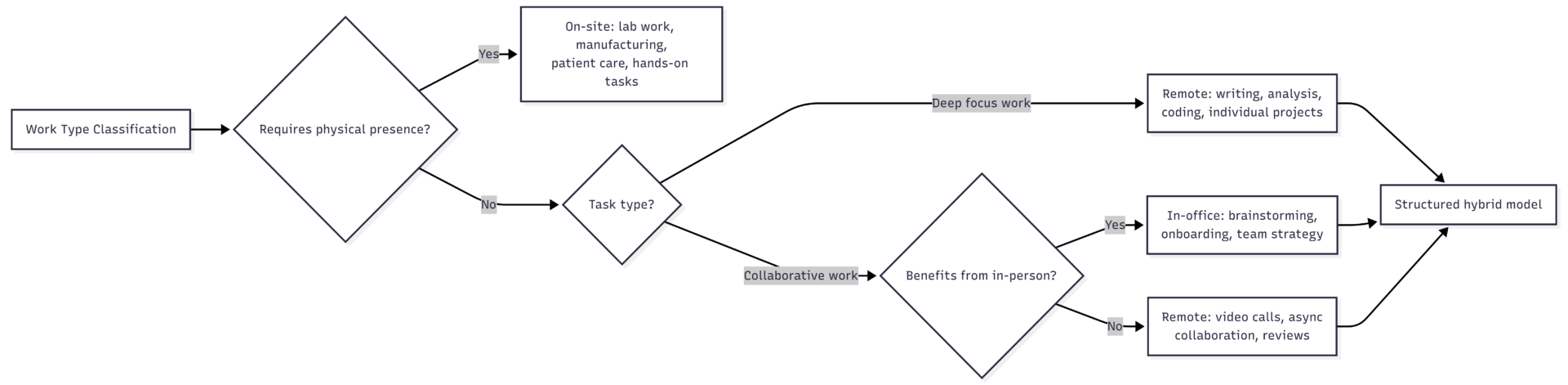
What structured hybrid looks like in practice:
| Work Mode | Days | Purpose | Activities |
|---|---|---|---|
| Remote | 3–4 days/week | Deep focus, independent contribution | Writing, analysis, coding, client work |
| In-office | 1–2 days/week | Intentional collaboration | Team meetings, onboarding, strategy sessions |
| Flexible remote | As needed | Async contribution | Communication, reviews, documentation |
Bloom’s own recommendation — one to two days per week in office — reflects this balance. Beyond that threshold, team cohesion and mentorship begin to suffer. Below it, individuals miss the social and collaborative dimension that in-person interaction facilitates more efficiently.
How Organizations Can Implement Remote Work Effectively
Transitioning to remote-first or hybrid-first operation requires more than a policy change. It requires rebuilding the systems, norms, and management practices that office-based work made invisible.
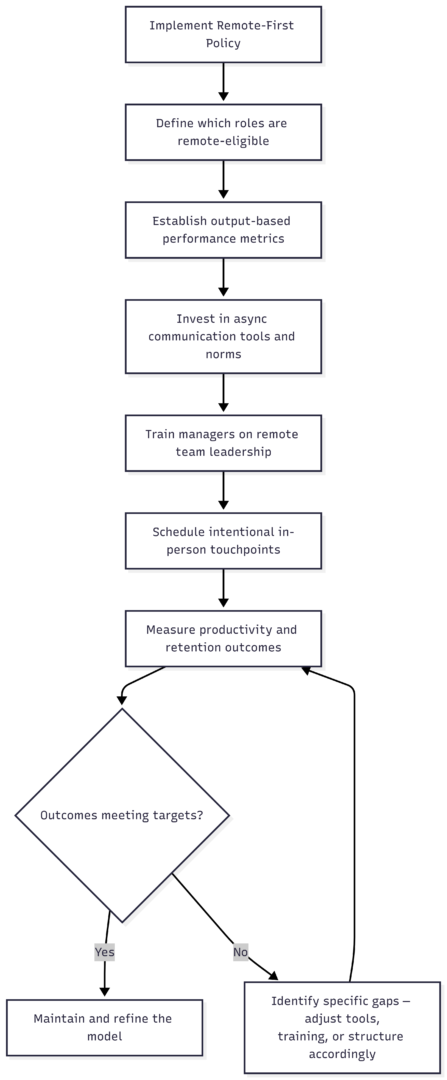
Critical implementation factors:
Output over activity. The single most important shift is moving from measuring hours and presence to measuring deliverables and results. This requires defining what good performance looks like for each role in concrete terms — not “works hard” but “ships X per quarter” or “maintains Y client satisfaction score.”
Asynchronous communication as the default. Remote teams that default to synchronous communication (constant video calls) eliminate much of the productivity benefit of remote work. Documenting decisions, using shared project management tools, and communicating via written channels allows individuals to do focused work without constant interruption.
Intentional in-person time. Remote-first does not mean never in-person. The most effective distributed teams schedule regular in-person gatherings — quarterly or semi-annually — for activities that genuinely benefit from physical presence: relationship building, complex problem-solving, and strategic planning.
Manager training. Managing remote teams requires different skills than managing in-person ones. Organizations that invest in this training see significantly better outcomes than those that simply extend office management practices to a distributed context.
The Generational and Structural Shift Already Underway
The workforce is voting with its feet. Workers who can choose remote or hybrid roles are declining in-office-only positions at rates employers are finding difficult to ignore. Organizations that have mandated return-to-office without data-based justification have reported increased voluntary attrition, disproportionately among high performers who have more options.
The long-term direction is clear. As long-term office leases expire, as management culture evolves with generational leadership change, and as the productivity and retention data continues to accumulate, the economic pressure on organizations to offer genuine flexibility will only increase. Companies that resist this trajectory are systematically disadvantaging themselves in the competition for talent.
Remote work as standard practice is not a utopian aspiration. It is an evidence-based operational model that delivers better outcomes for employees and employers simultaneously. The data has been in for years. The question is no longer whether remote work is effective — it is how quickly the remaining structural and cultural barriers will give way to what the evidence already shows.
Final Thoughts
The five-day office workweek was designed for a world of physical production and analog communication. It was never designed for knowledge work. The fact that it became the default for cognitive roles is a legacy of industrial-era management practice, not a conclusion anyone ever drew from evidence.
The evidence we now have points unambiguously in the other direction. Remote work, structured as a hybrid-first model with intentional in-person touchpoints, produces better productivity, better retention, better access to talent, and lower operating costs than mandatory office attendance.
Making it standard practice is not radical. It is the rational response to what we have learned.
Please share this Why working from home should be standard practice with your friends and do a comment below about your feedback.
We will meet you on next article.
Until you can read, 5 Easy Ways to Increase Productivity in Your Daily Life