Parable of the Two Debtors: Verse, Meaning & Lesson
The Parable of the Two Debtors is a short but pointed story Jesus told in Luke 7:41-43, teaching that the depth of a person’s love and gratitude toward God grows in direct proportion to how clearly they recognize how much they’ve been forgiven. Jesus used the story to contrast a self-assured religious leader who believed he had little need for grace with a repentant woman who understood exactly how much she owed.
This parable is brief, only a few verses long, but it sits inside one of the richest character studies in the Gospel of Luke. Understanding the setting, the characters, and the details of the story unlocks a lesson that remains just as relevant to modern readers as it was to the dinner guests who first heard it.
The Verse: Luke 7:41-43
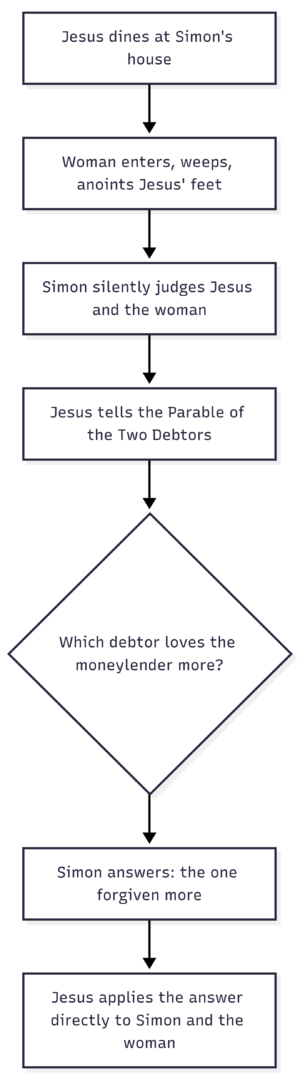
In the story, a certain moneylender had two debtors. One owed him five hundred denarii, and the other fifty. Neither man had the money to repay what he owed, so the moneylender freely forgave both debts. Jesus then asked His host a direct question: which of the two men would love the moneylender more? The host answered that it would be the one who had been forgiven the larger amount, and Jesus told him he had judged correctly.
A denarius represented a single day’s wage for a common laborer in the first century. That means the first debtor owed roughly a year and a half’s worth of income, an amount he had virtually no realistic way of repaying, while the second owed about two months’ wages, a debt that was still significant but far more manageable. Both debts, however, shared the same fatal problem: neither man could pay what he owed. The size of the debt differed, but the total inability to repay it did not.
The Setting: A Dinner at Simon’s House
Jesus told this parable while dining at the home of a Pharisee named Simon. Pharisees were respected religious leaders in Jewish society, known for their strict devotion to the law and their public reputation for righteousness. In the customs of the time, a host was expected to greet an honored guest with a kiss, provide water so the guest could wash the dust from his feet, and anoint the guest’s head with oil. Simon offered Jesus none of these customary courtesies.
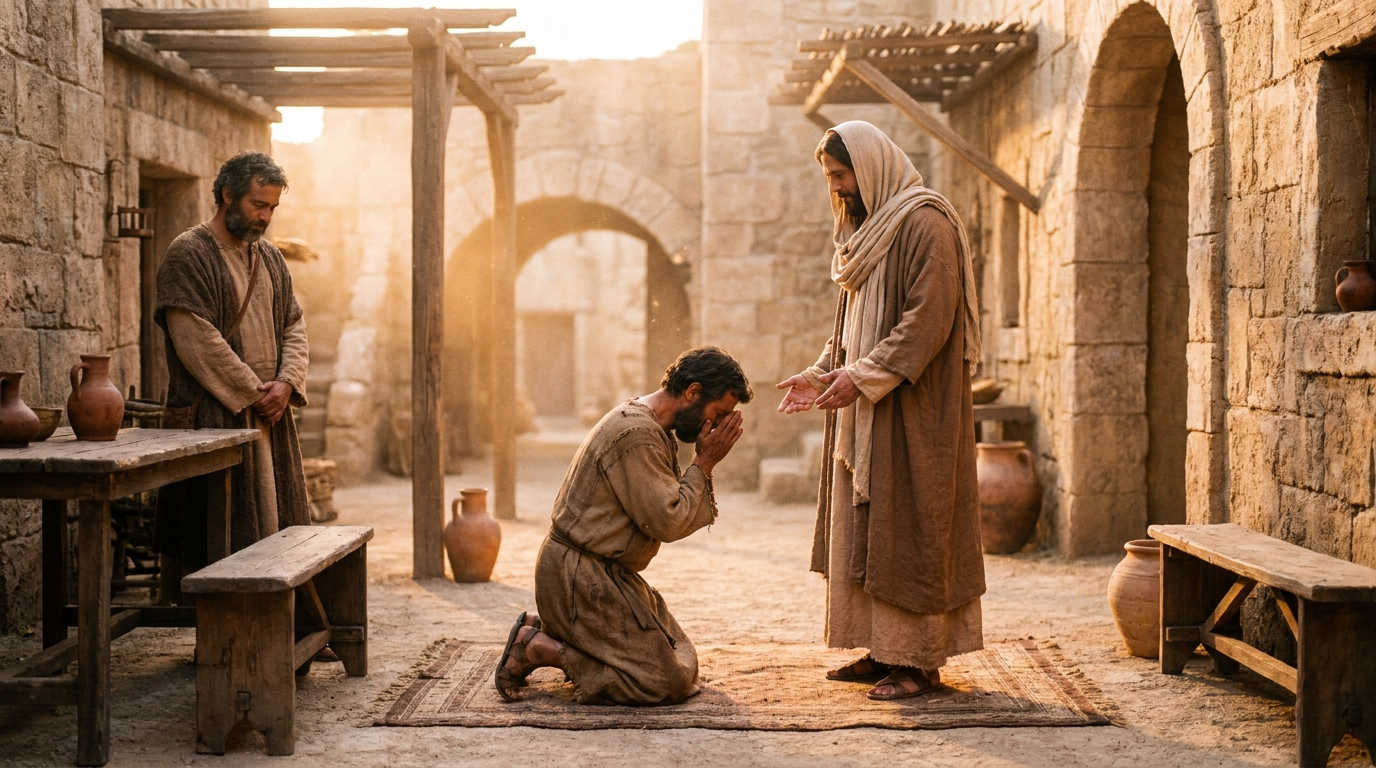
While Jesus reclined at the table, an uninvited woman, described in the text only as “a sinner,” entered the house. She began to weep at Jesus’ feet, washing them with her tears, drying them with her hair, kissing them, and anointing them with expensive perfume. This was a scandalous act by the standards of the culture, since it was considered shameful for a woman to let down her hair in public, let alone touch and kiss the feet of a rabbi in front of onlookers.
Simon reacted with silent judgment, reasoning to himself that if Jesus were truly a prophet, He would know what kind of woman was touching Him and would refuse to allow it. Jesus, aware of Simon’s unspoken thoughts, responded by telling him the parable of the two debtors, using Simon’s own assumptions to reveal the condition of his heart.
What the Parable Means
Every element of the parable carries symbolic weight. The moneylender represents God, who holds the ultimate claim over every person’s moral debt. The two debtors represent two different types of people: those who are keenly aware of the depth of their own sin, and those who underestimate or minimize it. Neither debtor could repay what he owed on his own, which mirrors the core biblical teaching that no one, regardless of how their sins compare to someone else’s, can earn forgiveness through personal effort.
The parable’s central point is this: forgiveness that is deeply understood produces deep love and gratitude, while forgiveness that is assumed or taken for granted produces little response at all. Simon, who saw himself as already righteous, showed Jesus no special hospitality. The woman, keenly aware of her own brokenness, poured out extravagant love without concern for how she appeared to others in the room.
Comparing Simon and the Woman
The contrast between these two figures is the engine that drives the entire passage. Their differences highlight exactly what Jesus wanted His host to understand.
| Simon the Pharisee | The Woman |
|---|---|
| Believed he had little need for forgiveness | Recognized her deep need for forgiveness |
| Sins were hidden and internal | Sins were public and well known |
| Extended no customary hospitality to Jesus | Extended extravagant, costly devotion to Jesus |
| Judged the woman and, implicitly, Jesus | Humbled herself before Jesus without concern for reputation |
| Represents the danger of self-righteousness | Represents the freedom found in honest repentance |
Simon’s failure was not a lack of religious knowledge or discipline; by every visible measure, he lived an outwardly moral life. His failure was an inward one: he compared his sin to other people’s sin rather than measuring himself against God’s holiness, and in doing so, he never recognized his own need for grace.
The Weight of the Debt
The specific numbers in the parable are not incidental. Five hundred denarii represented an enormous, life-altering sum for an ordinary laborer, while fifty denarii, though smaller, was still a debt no one could easily walk away from. Both amounts illustrate a debt that could not be self-funded.
| Debtor | Amount Owed | Approximate Modern Equivalent* | Ability to Repay |
|---|---|---|---|
| First debtor | 500 denarii | Roughly 1.5 years of wages | None |
| Second debtor | 50 denarii | Roughly 2 months of wages | None |
*Modern equivalents are approximate and vary depending on how a “denarius” is calculated against contemporary wages, but the relative proportion between the two debts, ten to one, remains the clearest takeaway.
The parable never suggests that the second debtor’s smaller debt made his situation less serious. Both men were equally bankrupt in the moneylender’s eyes; the only real difference was in how aware each man was of his own inability to pay.
Four Core Lessons From the Parable
Everyone carries a debt. The parable does not divide people into those who owe and those who don’t. It divides people into those who owe a lot and those who owe a little, but every single person in the story is in debt. This mirrors the broader biblical teaching that no one is without sin, regardless of how their choices compare to someone else’s.
No one can repay the debt on their own. Both debtors lacked the resources to settle what they owed. This detail underscores that forgiveness, by definition, cannot be earned. If either man could have repaid his debt through personal effort, the moneylender’s forgiveness would have been unnecessary rather than an act of grace.
Forgiveness is costly, not free for the one who grants it. When the moneylender canceled both debts, he personally absorbed the loss. In the same way, forgiveness offered by God carries a real cost. The parable, read in the context of the wider New Testament, points toward the idea that reconciliation with God was made possible through significant sacrifice, not simply overlooked or waved away.
Awareness of forgiveness shapes the depth of love shown in return. The central question Jesus asked, and the one Simon answered correctly, is that greater awareness of forgiveness produces greater love. This is the parable’s most practical application: a life of gratitude and devotion flows naturally from clearly understanding how much one has been forgiven, while self-righteousness quietly starves that same gratitude before it can grow.
Why Simon Missed the Point
Simon’s mistake was subtle rather than obvious. He was not a hypocrite in the sense of secretly living a scandalous life; he was, by outward appearances, a disciplined and respectable religious leader. His blindness came from measuring his own righteousness against other people rather than against a holy standard. Because he judged himself favorably compared to the woman, he assumed he had little to be forgiven for, and as a result, he offered little in the way of love, hospitality, or humility.
This is the trap the parable warns readers to avoid: assuming that because someone else’s failures are more visible or dramatic, one’s own quieter shortcomings are less serious. The parable insists there is no sliding scale that exempts anyone from needing grace, only a difference in how aware each person is of that need.
Frequently Asked Questions
It is recorded in Luke 7:41-43, within the larger narrative of Luke 7:36-50, which describes Jesus’ dinner at Simon the Pharisee’s house.
The parable teaches that the person who is forgiven a greater debt will love the one who forgave them more than someone who was forgiven a smaller debt, illustrating that gratitude and love are proportional to one’s awareness of being forgiven.
The moneylender represents God, while the two debtors represent people with differing levels of awareness of their own sin, one who is fully aware of their need for grace and one who underestimates it.
Jesus told the parable in response to Simon’s silent judgment of the woman anointing His feet, using the story to reveal that Simon, despite his religious status, had failed to show Jesus the same love and hospitality the woman freely offered.
A denarius was equivalent to roughly one day’s wage for a laborer in the first century, meaning the debts of fifty and five hundred denarii represented about two months and roughly a year and a half of income.
The parable challenges readers to avoid comparing their own sins to others’ as a measure of how much grace they need, and instead to recognize their own need for forgiveness fully, since doing so is what produces genuine gratitude, humility, and love.
The Lasting Takeaway
The Parable of the Two Debtors compresses a profound spiritual truth into a handful of verses: forgiveness that is truly understood transforms the way a person loves, worships, and treats others.
Simon’s outward religious devotion could not substitute for genuine humility, while the woman’s socially shameful reputation could not disqualify her from receiving and responding to grace. The parable ultimately asks every reader the same question it asked Simon: how aware are you of what you’ve been forgiven, and does your life reflect that awareness?
Please share this Parable of the Two Debtors: Verse, Meaning & Lesson with your friends and do a comment below about your feedback.
We will meet you on next article.
Until you can read, Beatitudes In the Bible: Verses & Meanings Explained