27 Bible Games for Kids: Spark Faith & Learning Through Play
Learning about the Bible doesn’t have to feel like a classroom exercise. When kids are laughing, moving, competing, and creating, the stories and lessons they encounter stick far longer than anything written on a worksheet. Bible games turn abstract concepts into lived experience — and the best ones feel like pure play even as they build genuine scriptural knowledge.
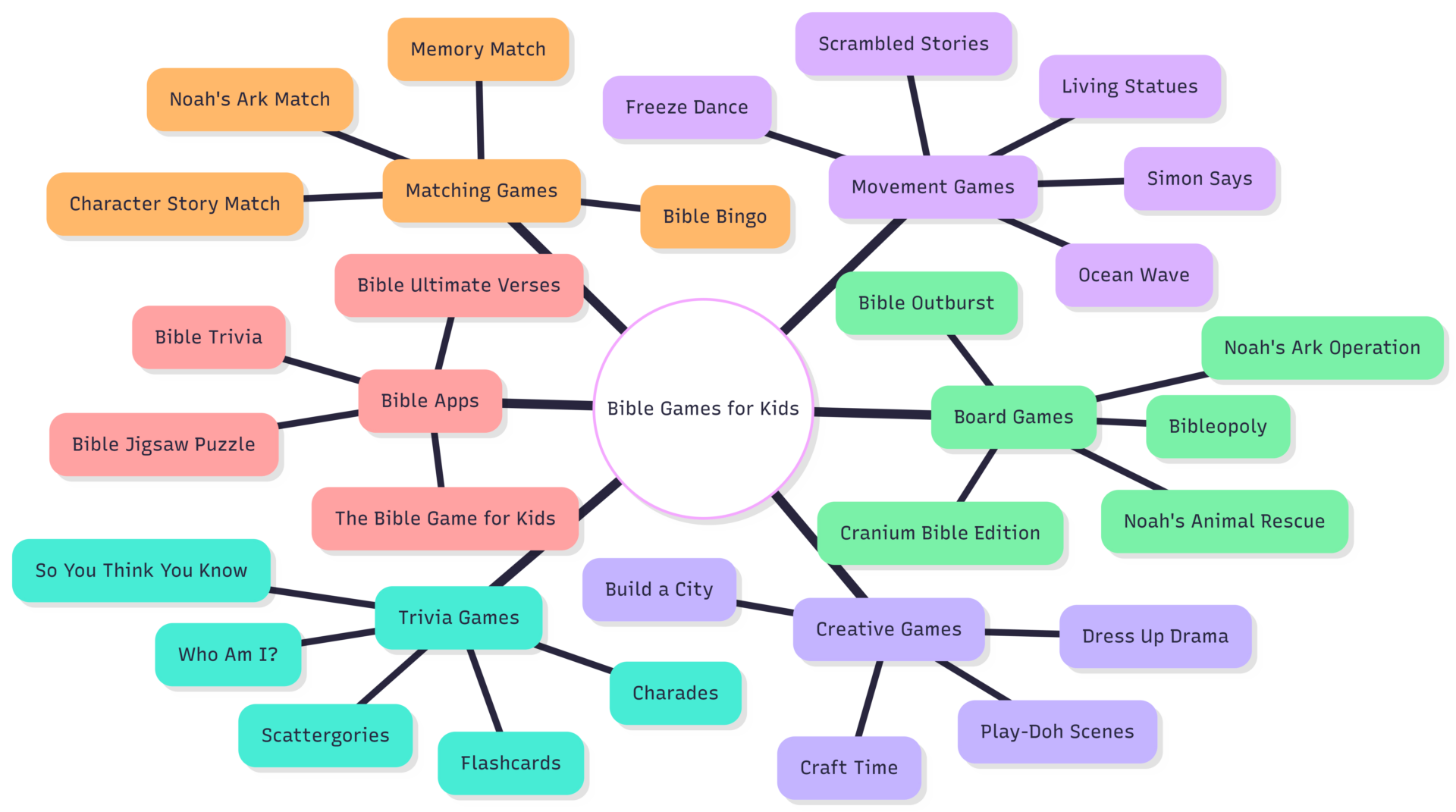
This guide covers 27 of the best Bible games across six categories: trivia, matching, movement, board games, creative play, and apps. Whether you’re planning a Sunday school session, a family game night, or a Vacation Bible School activity, you’ll find something here that fits.
Bible Games by Category
Bible Trivia Games
Trivia games are the backbone of Bible learning because they test retention while keeping energy high. These work well for family game nights, Sunday school review sessions, and anywhere kids need a competitive outlet.
1. Bible Trivia Flash Cards
The simplest and most flexible trivia format. Write questions on one side of an index card and answers on the other. Cover Bible characters, famous places, key verses, and major events. The real advantage is customization — you can calibrate difficulty for a five-year-old or a teenager without buying a new product. Play for points, play in teams, or simply draw cards at dinner.
2. So You Think You Know the Bible?
A commercially produced card game suited for ages 10 and up. Questions span multiple categories, and action cards introduce surprise elements that keep older kids engaged. It’s a strong option for families who want a polished product rather than a DIY approach.
Recommended for: Ages 10+ | Family game night | Sunday school older classes
3. Bible Charades
Take the classic party game and replace movie titles with Bible stories and characters. Kids act out Noah building the ark, Moses parting the Red Sea, or Jonah inside the whale — without speaking. Larger groups work best. It builds comprehension and recall in a distinctly physical way.
4. Scattergories: Bible Edition
Create a list of 10–12 Bible-themed categories (Miracles, Old Testament Kings, Bodies of Water, Animals in the Bible). Set a two-minute timer. Players race to fill in one Bible word per category — and only unique answers score. The pressure of the clock sharpens memory and rewards broad scriptural knowledge.
5. Who Am I? Bible Characters
Write a Bible character’s name on a sticky note and place it on each player’s forehead. Players take turns asking yes/no questions to figure out their identity. “Am I in the Old Testament?” “Did I perform miracles?” “Am I a woman?” This game rewards both questioners and answerers, and it generates natural discussion about character traits and story details.
Bible Matching Games
Matching games excel with younger children because they teach through repetition and visual recognition rather than reading ability. Each flip of a card is a small act of recall.
6. Memory Match
The classic concentration format with a biblical twist. Create pairs of picture cards featuring Bible characters or scenes, or purchase a pre-made set. Kids flip cards to find matches, absorbing names and details with every attempt. The game scales naturally — fewer pairs for toddlers, more for older children.
7. Noah’s Ark Matching Game
Find or create animal picture cards in pairs. Lay them face down and take turns flipping two at a time. The pairing mechanic reinforces the core detail of Noah’s story — two of every kind — making the game thematically coherent rather than just decoratively biblical.
8. Character and Story Match Up
Create two separate card decks: one with Bible characters (David, Daniel, Esther), one with associated story elements (slingshot, lion’s den, royal banquet). Players draw one card from each deck and determine whether they logically pair. When they do match, encourage kids to tell what they know about that story. When they don’t, it opens conversation about who belongs with what.
9. Bible Bingo
Bingo cards with Bible words, verses, or images in each square replace the standard number grid. The caller reads clues (“Someone who walked on water”) rather than calling terms directly. Kids mark the corresponding square. For younger children, replace words with images entirely. The first to complete a row wins — but the real value is in the clue-response cycle that builds scriptural association.
Free printable Bible Bingo cards are available at Bible Games Central.
Bible Movement Games
Children — especially younger ones — retain information better when their bodies are involved. These games pair physical activity with scriptural content.
10. Simon Says: Bible Edition
Pair instructions with factual Bible statements. “Simon Says pat your head if Goliath was the giant David fought.” If the statement is true, kids follow the command. False statements are traps. The game rewards biblical knowledge alongside the traditional listening focus, and it accelerates naturally to challenge attentive players.
11. Scrambled Stories
Print a short Bible story and cut each sentence into a strip. Scatter the strips and have children work together to reassemble the narrative in order. Racing against another team adds energy. This is particularly effective for stories with clear cause-and-effect sequences — the feeding of the five thousand, the birth of Jesus, the crossing of the Red Sea.
12. Freeze Dance: Bible Style
Play upbeat music while kids act out Bible scenes. When the music stops, everyone freezes. Call out a character name — whoever is in the most fitting pose for that character earns a point. The game rewards both movement and imagination.
13. Living Statues
Each child is assigned a Bible character or scene before the music starts. While music plays, they move around depicting their character. When it stops, they freeze in a pose and others guess who they are. Works well as a quieter alternative to Freeze Dance with more emphasis on interpretation.
14. Ocean Wave: Location Relay
The leader calls out a biblical location and the group performs the matching action:
| Location | Action |
|---|---|
| Red Sea | Jump over a designated line |
| Jordan River | Walk slowly across a sheet on the floor |
| Walls of Jericho | March in place loudly |
| Burning Bush | Crouch low and shiver |
| Den of Lions | Roar like lions |
This game introduces biblical geography in a fully embodied way. Adjust the location list to match the stories your group has recently studied.
15. Ten Commandments Hot Potato
Pass an object around the circle while music plays. When the music stops, the child holding the object recites one of the Ten Commandments. The game continues until all ten have been named. It turns memorization into a communal achievement rather than an individual test, and the unpredictability of who holds the object keeps every player alert.
Bible Board Games
Commercial Bible board games combine familiar gameplay structures with scriptural content, making them easy to introduce to families who already have a game night tradition.
| Game | Ages | Players | Key Feature | Where to Find |
|---|---|---|---|---|
| Bible Outburst | 10+ | 2–6 | Fast-association categories | Cactus Games |
| Cranium Bible Edition | 8+ | 2–6 | Multi-format challenges | Cactus Games |
| Bibleopoly | 8+ | 2–6 | Monopoly-style board with Bible locations | Amazon |
| Noah’s Animal Rescue | 4+ | 2–4 | Cooperative, younger children | Amazon |
| Noah’s Ark Operation | 6+ | 1–4 | Dexterity-based, fine motor skills | Amazon |
16. Bible Outburst
A rapid-fire word association game where players race to name items fitting a Bible-themed category before time runs out. Best for families with older children and teenagers who can handle the pace. Encourages broad scriptural vocabulary and quick retrieval.
17. Cranium Bible Edition
Combines acting, sculpting with clay, drawing, and trivia — all with biblical themes. Because the challenges vary, it engages different learning styles in a single game. Stronger readers, creative kids, and trivia experts all get moments to shine.
18. Bibleopoly
The Monopoly format — buying properties, paying rent, managing resources — applied to a board of biblical locations. Players acquire plots like the Garden of Eden or the Promised Land. The familiar structure removes the learning curve of the rules, letting the scriptural content be the new element.
19. Noah’s Animal Rescue
A cooperative game for younger children (ages 4+) where players work together to collect animal pairs before the flood. The cooperative structure means no child loses alone, making it ideal for preschool-aged groups. It reinforces both the Noah narrative and early lessons about teamwork.
20. Noah’s Ark Operation
The Operation format with a Noah’s Ark theme. Players use tweezers to remove items from the ark without triggering the buzzer. Develops fine motor control and hand-eye coordination in children ages 6 and up, wrapped around a familiar Bible story.
Creative Bible Games
Creative activities anchor Bible learning in sensory and imaginative experience. These aren’t passive — they require kids to reconstruct and interpret stories through their own hands.
21. Craft Time: Story Builds
Match crafts to the biblical story being studied. Younger children can build Noah’s Ark from cardboard boxes or make a crown for a king. Older children might create a comic strip depicting a chosen Bible story, panel by panel — which requires them to sequence events, identify key moments, and make visual choices about what matters.
22. Play-Doh Bible Scenes
Sculpting scenes from Bible stories engages spatial reasoning and narrative understanding simultaneously. A child who models the Last Supper table must think about who was there, where they sat, and what was significant. The tactile, open-ended format works for a wide age range.
23. Dress Up Drama
Raid a dress-up box and assign children to Bible characters. Let them improvise scenes or prepare short performances. Drama-based recall is one of the most effective memory tools — embodying a character’s choices creates a far deeper impression than reading about them.
24. Build a City
Use building blocks, LEGO, or any construction toy to build a biblical city — Jerusalem, Nazareth, Capernaum. As children build, discuss what happened there: where the Temple stood, where Jesus walked, what the streets would have looked like. The construction process becomes a conversation scaffold.
Bible App Games
For screen time that serves educational purposes, these apps provide structured Bible learning through game formats children already enjoy.
25. The Bible Game for Kids
Features interactive games, quizzes, and activities covering Bible stories, characters, and values. Varied format keeps the experience fresh across multiple sessions.
26. Bible Jigsaw Puzzle
A collection of jigsaw puzzles built around religious imagery, Bible passages, and scenes depicting Jesus. Players choose the number of pieces, making it adaptable for different ages and attention spans.
27. Bible Ultimate Verses
Designed specifically for scripture memorization. Takes children through an interactive gaming adventure structured around learning key Bible verses, using game mechanics to reinforce retention rather than rote drilling.
All apps are available on the Apple App Store and Google Play Store.
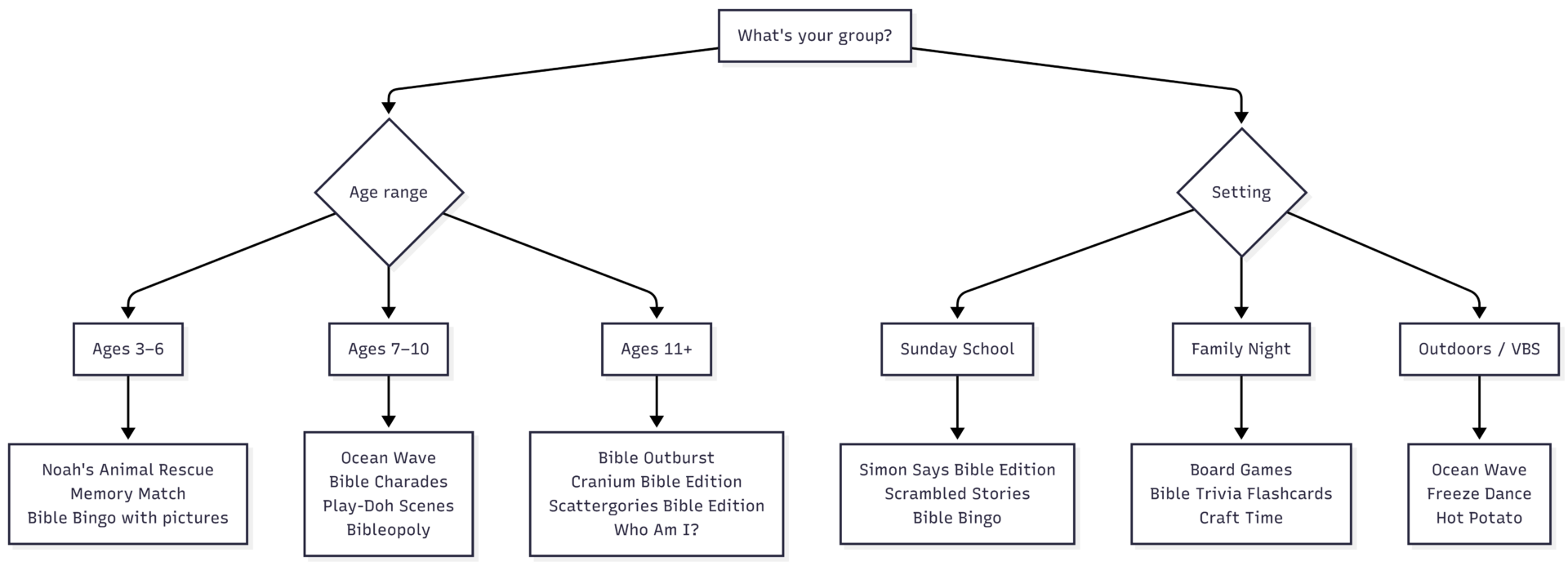
Choosing the Right Game: A Quick Guide
How Play Builds Biblical Literacy
The case for Bible games isn’t just about keeping kids entertained. Research in educational psychology consistently shows that game-based learning improves retention, motivation, and the ability to transfer knowledge to new contexts. When a child physically jumps over a line to represent the Israelites crossing the Red Sea, that kinesthetic anchor creates a memory trace that a verbal explanation alone cannot match.
Different game types serve different learning objectives:
| Game Type | Primary Learning Outcome | Best For |
|---|---|---|
| Trivia | Fact recall, scripture knowledge | Review and reinforcement |
| Matching | Associative memory, character recognition | Early learners |
| Movement | Embodied learning, narrative sequence | Kinesthetic learners, high-energy groups |
| Board Games | Strategy, sustained engagement, social learning | Family and group settings |
| Creative | Narrative comprehension, personal expression | Deep story engagement |
| Apps | Self-paced review, verse memorization | Independent practice |
No single format does everything. A complete Bible education program for children uses multiple types across the week — brief trivia to open a session, movement games to break up sitting time, creative projects for extended engagement, and app games to extend learning at home.
Getting the Most From These Games
A few practical principles make any Bible game more effective:
Match the game to the lesson. When you’re teaching a specific story or theme, choose games that center on that content rather than pulling from across the whole Bible. The connection between the game and the lesson reinforces both.
Don’t over-explain before you play. Let kids discover the biblical content through gameplay rather than front-loading information. The discovery moment — “Oh, that’s where Jonah went!” — is more memorable than a prior explanation.
Discuss after. The game itself creates natural conversation hooks. After Ocean Wave, ask: “Why did the walls of Jericho fall down? What did the Israelites have to do first?” A short debrief extends the learning without breaking the mood.
Let kids lead when possible. Older children can run Bible Trivia for younger ones, lead a round of Charades, or set up the Matching game. Teaching reinforces learning more than almost anything else.
Bible games are not a substitute for scripture reading, prayer, or direct teaching — but they are one of the most effective tools for making the content of those practices live in a child’s memory and imagination. The goal is a child who reaches adulthood not just knowing Bible facts, but having warm associations with the stories, characters, and values of scripture. Play is one of the most reliable ways to build that.
Pick the games that fit your setting, your kids, and your current topic — and start playing.
Please share this 27 Bible Games for Kids: Spark Faith & Learning Through Play with your friends and do a comment below about your feedback.
We will meet you on next article.
Until you can read, What is the best online bank for travelling?