
Various Bible Translations and Versions
Walk into any Christian bookstore and you’ll find shelves lined with dozens of Bible editions — King James, New International, English Standard, New Living, and many more. For new believers and seasoned readers alike, this variety can feel overwhelming. Which version is “the real one”? Why do the words sometimes sound so different from one Bible to the next?
The truth is that every English Bible is a translation, and translation is both an art and a science. Behind each version stands a team of scholars who made deliberate choices about how closely to follow the original wording versus how clearly to convey the original meaning. Understanding those choices — and the history behind them — can help you select a translation that matches your goals, whether that’s serious study, daily devotion, group teaching, or reading aloud to children.
Where the Bible Came From: A Quick Look at the Original Texts
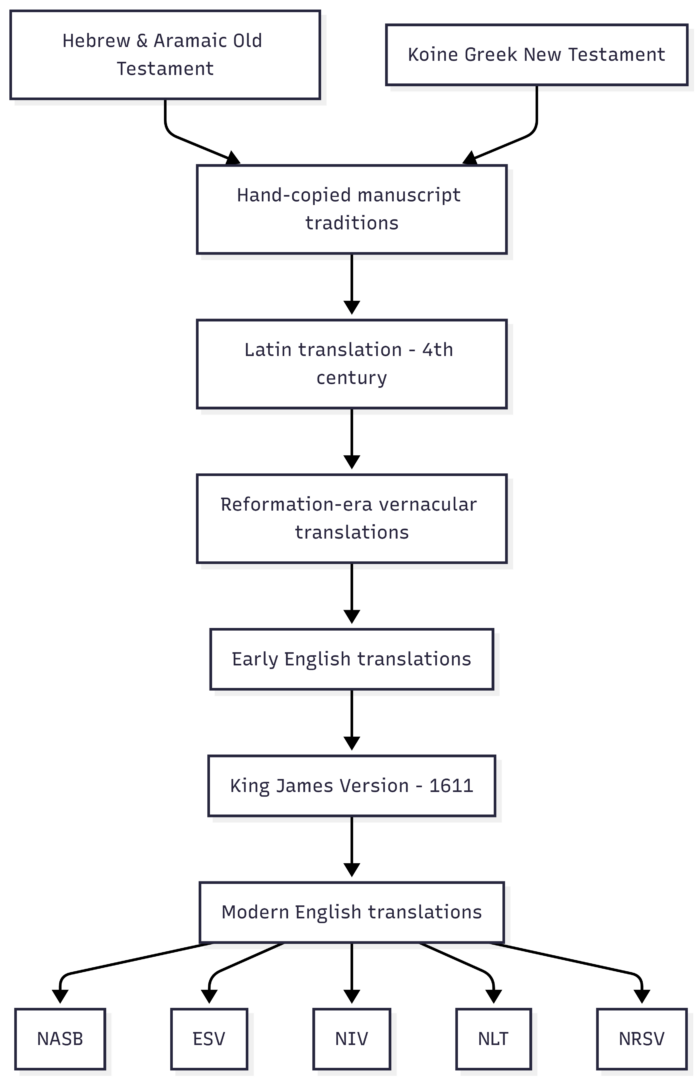
Before any English translation existed, the Bible was written in three ancient languages. The Old Testament was composed mostly in Hebrew, with a handful of passages in Aramaic, while the New Testament was written in Koine Greek — the common trade language of the eastern Mediterranean during the first century.
For more than a thousand years, these texts were preserved and copied entirely by hand. Because copying was a manual process, small variations naturally crept into different manuscript families over time. Scholars today compare thousands of surviving manuscripts, fragments, and ancient translations to reconstruct the most reliable possible version of the original wording — a discipline known as textual criticism.
The first major translation effort came in the late fourth century, when a Latin version became the standard biblical text used by the Western church for over a thousand years. It wasn’t until the Reformation period that translators began producing Bibles in everyday European languages, opening up Scripture to ordinary readers for the first time. That wave of vernacular translation work eventually led to the King James Version in English and, much later, to the dozens of modern translations available today.
Why Translations Differ: Three Approaches to Rendering Scripture
Every translator faces the same fundamental tension: stay as close as possible to the exact wording of the original language, or prioritize making the meaning clear to a modern reader? Translation teams generally fall somewhere along a spectrum between three broad approaches.
Formal equivalence translations, often described as “word-for-word,” aim to preserve the original sentence structure, grammar, and vocabulary as closely as the target language allows. These translations are valuable for detailed study because they let you see, as much as possible, exactly what the original text says — including ambiguities and figures of speech that other approaches might smooth over.
Dynamic equivalence translations, sometimes called “thought-for-thought,” prioritize conveying the meaning and intent of a passage in natural, contemporary language, even when that means restructuring sentences or replacing idioms with modern equivalents. These versions tend to read more smoothly and are often easier for newer readers to follow.
Paraphrase translations go a step further, rephrasing entire passages in conversational language to capture the overall feel and message of the text. These are generally not recommended as a primary study Bible, but they can be useful for devotional reading or for getting a fresh perspective on familiar passages.

A Closer Look at Major English Translations
King James Version (KJV)
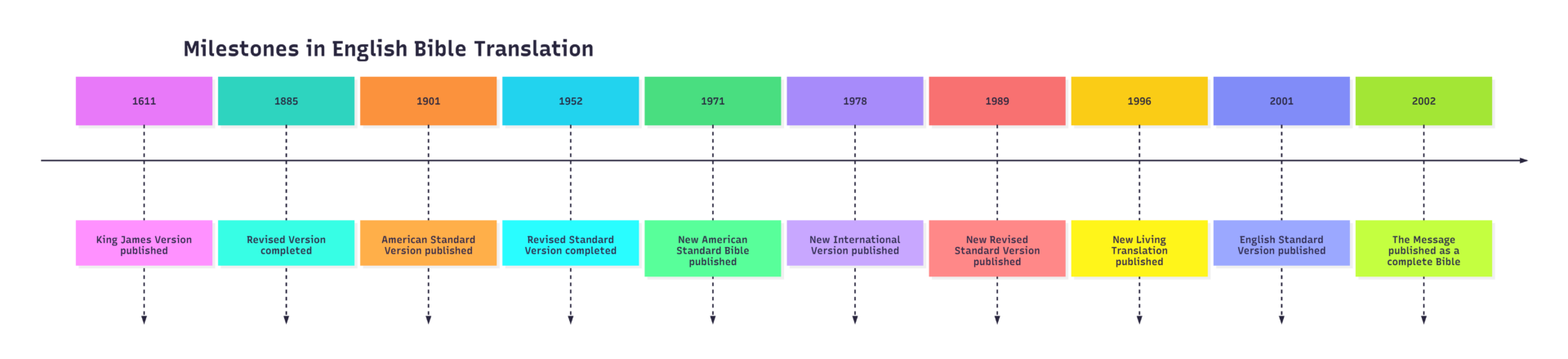
Originally completed in 1611, the King James Version has had an enormous influence on English literature and worship language for more than four centuries. Its formal, word-for-word approach and stately phrasing remain beloved, particularly in traditional and liturgical settings. However, its centuries-old vocabulary and sentence structure can be a real barrier for readers encountering certain passages for the first time.
New American Standard Bible (NASB)
Known for its rigorous commitment to formal equivalence, the NASB is often favored by students, pastors, and seminarians who want a translation that mirrors the grammar and word order of the Hebrew and Greek texts as closely as possible. Its precision makes it an excellent companion for word studies, though its sentence structure can occasionally feel stiff in English.
English Standard Version (ESV)
The ESV blends a strong commitment to literal accuracy with attention to readable, contemporary English. It has become a popular choice across many denominations for both personal study and pulpit use, striking a balance that appeals to readers who want accuracy without sacrificing too much fluency.
New International Version (NIV)
One of the best-selling English translations of all time, the NIV uses a dynamic equivalence approach designed to communicate the original meaning in natural modern English. Its readability has made it a staple in churches, small groups, and personal devotions worldwide, though some scholars note that its smoother phrasing occasionally moves further from the original word order than more literal translations.
New Living Translation (NLT)
The NLT leans further toward thought-for-thought translation, aiming for clear, conversational English that flows naturally when read aloud. It’s a popular choice for new believers, younger readers, and anyone who wants Scripture to feel approachable rather than academic.
New Revised Standard Version (NRSV)
Widely used in academic, interfaith, and many mainline church settings, the NRSV is valued for careful scholarship and for its attention to inclusive language where the original text supports that reading. It sits closer to the formal end of the spectrum while remaining accessible to general readers.
Amplified Bible
The Amplified Bible takes a distinctive approach by inserting bracketed words and alternate phrasings directly into the text to highlight shades of meaning present in the original Hebrew and Greek. This can be especially helpful for readers curious about the nuances behind a particular word, though the added text can interrupt the natural flow of reading.
The Message
At the paraphrase end of the spectrum, The Message renders Scripture in vivid, informal contemporary language. Many readers find it refreshing for devotional reading precisely because it sounds so different from traditional Bible language — though it’s generally not recommended as a sole source for in-depth doctrinal study.
Comparing Translations at a Glance
| Translation | Abbreviation | First Published | Approach | Reading Level | Best Used For |
|---|---|---|---|---|---|
| King James Version | KJV | 1611 | Formal equivalence | Advanced | Traditional worship, literary study |
| New American Standard Bible | NASB | 1971 (rev. 2020) | Formal equivalence | Advanced | Word studies, in-depth research |
| English Standard Version | ESV | 2001 | Formal equivalence | Intermediate–Advanced | Study and pulpit use |
| New International Version | NIV | 1978 (rev. 2011) | Dynamic equivalence | Intermediate | General reading, small groups |
| New Revised Standard Version | NRSV | 1989 | Formal–Dynamic blend | Intermediate–Advanced | Academic and interfaith study |
| New Living Translation | NLT | 1996 (rev. 2015) | Dynamic equivalence | Easy | New believers, devotional reading |
| Amplified Bible | AMP | 1965 (rev. 2015) | Expanded literal | Intermediate | Exploring word nuance |
| The Message | MSG | 2002 (complete) | Paraphrase | Easy | Fresh perspective, devotional reading |
A Timeline of Major English Bible Translations
How to Choose the Right Translation for Your Needs
With so many solid options available, the “best” translation really depends on what you’re trying to accomplish. The flowchart below offers a simple starting point based on your primary goal.

If you’re new to Bible reading, starting with a dynamic equivalence translation like the NIV or NLT can make it easier to follow the overall narrative without getting stuck on unfamiliar phrasing. As you grow more comfortable with the text and want to dig into the meaning of specific words and verses, a formal equivalence translation such as the ESV or NASB becomes a valuable second tool.
Using Multiple Translations Together
Many experienced Bible readers don’t rely on a single translation at all. Instead, they use one version — often a formal equivalence translation — as their primary study Bible, and consult one or two others for comparison when a passage seems unclear or particularly significant.
Reading the same verse in a formal translation and a dynamic translation side by side can highlight where translators made interpretive choices, giving you a fuller picture of the possible meanings behind the original text. Many study Bibles, apps, and websites make this kind of side-by-side comparison easy, allowing you to switch between translations with a single tap.
This approach can be especially helpful for small group leaders and teachers, who may want to present a passage in an easy-to-understand translation while referencing a more literal translation to address questions about specific wording.
Practical Tips for Comparing Translations Side by Side
If you decide to compare translations rather than commit to just one, a few simple habits can make the process more useful. Start with a passage that already matters to you — a favorite psalm, a verse you’ve memorized, or a passage you’re studying for a lesson — rather than picking at random. Familiar passages make it easier to notice where wording differs and why.
Pay attention to footnotes and marginal notes, especially in formal equivalence translations. These often flag alternate readings, manuscript variations, or literal renderings of idioms that the main text smooths over for readability. A footnote can sometimes tell you as much about a verse as the main translation itself.
When a passage feels ambiguous, try reading it in a formal translation first to see the structure of the original sentence, then in a dynamic translation to see how translators interpreted that structure for a modern audience. If the two versions land on noticeably different meanings, that’s often a sign the original text contains some genuine ambiguity worth exploring further with a study guide or commentary.
Finally, resist the temptation to treat translation differences as contradictions. In almost every case, differences come down to translation philosophy — how literally to render a word, how to handle an idiom, or how to format a verse — rather than disagreement about what happened or what was taught.
Frequently Asked Questions
Accuracy depends on what you’re measuring. Formal equivalence translations like the NASB and ESV are generally considered closer to the word order and structure of the original Hebrew and Greek.
Dynamic equivalence translations like the NIV and NLT aim for accuracy in conveying meaning, even when the wording differs more from the original structure. Both approaches are produced by qualified scholars and are considered reliable by the vast majority of Christian denominations.
Some verses present in the King James Version are absent or marked as footnotes in newer translations because they do not appear in the oldest available manuscripts that scholars have access to today. Modern translation teams generally prioritize the earliest and most reliable manuscript evidence available.
Translations that use a dynamic equivalence or simplified approach, such as the NLT, tend to be easier for younger readers to follow. Many publishers also offer dedicated children’s editions of popular translations with simplified vocabulary and added illustrations.
A paraphrase can be a useful supplement for devotional reading or for seeing a passage from a fresh angle, but because paraphrases prioritize tone and readability over precise wording, they’re generally best used alongside — rather than instead of — a more literal translation.
The major translations covered here are produced by teams of qualified scholars working from the same body of ancient manuscripts, and they agree on the core teachings of the Christian faith. Differences between translations are mostly a matter of wording, phrasing, and translation philosophy rather than disagreement about fundamental doctrine.
Most major translations are periodically revised to reflect updates in manuscript scholarship, archaeological discoveries, and changes in the English language. Revision cycles vary, but many popular translations have been updated at least once since their original publication.
Final Thoughts
There’s no single “correct” Bible translation for every reader or every purpose. The King James Version offers literary majesty and historical significance; the NASB and ESV provide precision for serious study; the NIV and NLT offer clarity and accessibility for everyday reading; and translations like the NRSV and Amplified Bible serve specialized academic and word-study needs.
Many readers find that the most rewarding approach is to choose one translation as a primary study Bible and to keep a second, stylistically different translation on hand for comparison. Whichever version you choose, the goal remains the same: engaging with Scripture in a way that’s both accurate and meaningful to you.
Please share this Various Bible Translations and Versions with your friends and do a comment below about your feedback.
We will meet you on next article.
Until you can read, The 20 Most Popular Bible Verses for Death of a Loved One