21 Fun Bible Games for Teens and Youth Groups
Getting teenagers genuinely engaged with scripture is one of the most rewarding — and honestly challenging — tasks in youth ministry. Teens respond to challenge, competition, creative expression, and authentic conversation. They disengage from anything that feels like a lecture dressed up as fun.
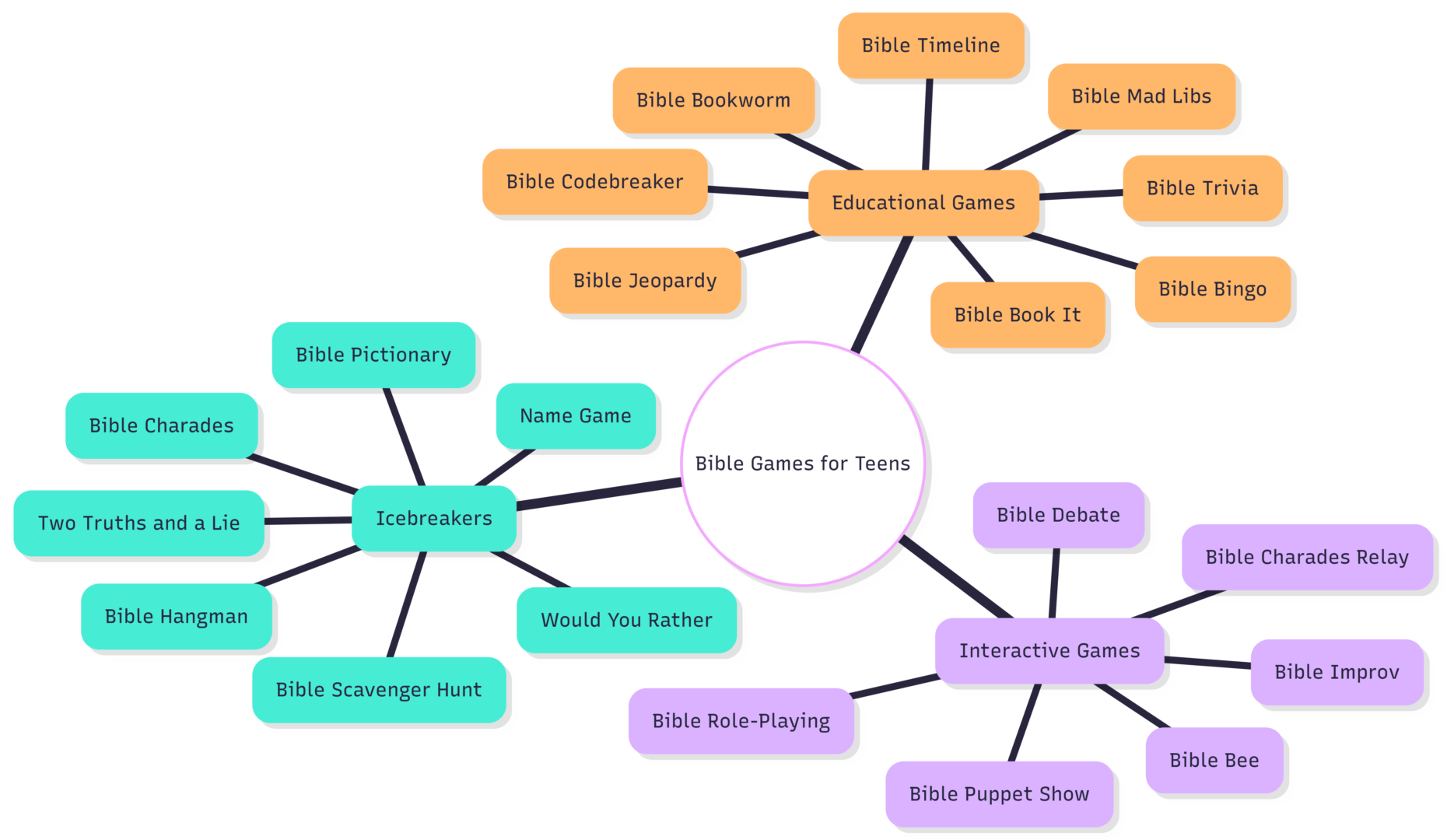
The games in this guide are built around what actually works: activities that create energy, demand real biblical knowledge, and open doors for meaningful discussion. Organized by purpose — icebreakers, educational games, and interactive formats — this list covers 21 options you can run with minimal preparation.
Games at a Glance
Icebreaker Games
The opening of any youth session sets the tone. Icebreakers serve a specific function: they lower social defenses, introduce participants to each other, and create the psychological safety that makes deeper discussion possible later. These seven work well for new groups, first-time visitors, and mixed-age gatherings.
1. Bible Charades
Objective: Guess Bible characters, stories, or verses from silent acting.
How to play: Cut small slips of paper and write one Bible character, story, or verse on each. Divide into two or more teams. One person draws a slip and acts it out — no speaking, no pointing at objects — while their team guesses within a set time limit. Rotate actors each round. The team with the most correct guesses wins.
Leader tip: Organize slips by difficulty — easier entries for younger or newer participants, harder ones (specific minor prophets, less-known parables) for experienced players. This lets you calibrate on the fly.
2. Two Truths and a Lie
Objective: Identify the false statement among three personal claims.
How to play: Each person shares three statements — two true, one false. The rest of the group votes on which statement is the lie. The person then reveals the truth.
Leader tip: Add a biblical twist by requiring one statement to relate to a Bible verse, character, or story the person connects with personally. This naturally invites testimony and creates discussion hooks.
3. Name Game
Objective: Learn names and connect them to scripture.
How to play: Players sit in a circle. The first person states their name and a favorite Bible verse. The next person repeats the previous person’s name and verse, then adds their own. Continue around the circle. For groups larger than 15, break into smaller circles to keep it manageable.
Leader tip: After the full round, ask two or three people why they chose their verse. Brief as those responses are, they’re often the most genuine moments of the session.
4. Bible Scavenger Hunt
Objective: Complete Bible-related challenges across multiple stations.
How to play: Set up clue stations throughout the room or building. Each station contains a Bible question, a verse to look up, or a short activity (name three of the twelve apostles, find Habakkuk in the Bible without using the index). Clues at each station lead to the next. The first team to finish all stations wins.
Leader tip: Build one station around a practical skill — navigating the table of contents, understanding chapter and verse structure — to mix trivia with Bible literacy.
5. Bible Hangman
Objective: Guess a Bible word or phrase before the drawing is completed.
How to play: Follow standard Hangman rules but limit words and phrases to biblical terms — names, places, book titles, famous verses. Draw blanks for each letter. Players call out letters one at a time; correct guesses fill in blanks, incorrect guesses add body parts to the hanged figure. First to guess the full word wins; a completed drawing means the word wins.
Leader tip: Use categories to add structure: “Bible places,” “Books of the Bible,” “Names of Jesus.” Category-specific rounds work well as a warm-up for a lesson on that theme.
6. Would You Rather: Bible Edition
Objective: Spark discussion through hypothetical biblical choices.
How to play: Pose “Would you rather…?” questions built around Bible characters, situations, and teachings. Examples:
- Would you rather face Goliath with David’s slingshot or cross the Red Sea with Moses?
- Would you rather spend a night in the lions’ den like Daniel or three days in a whale like Jonah?
Each person answers and briefly explains why. There are no wrong answers — the goal is discussion, not a winner.
Leader tip: Prepare follow-up questions in advance. “What does that say about what you value?” or “What does the Bible tell us about how that character handled fear?” These take a lighthearted game into genuine reflection.
7. Bible Pictionary
Objective: Guess Bible words or phrases from drawings.
How to play: Prepare cards with Bible-related words and phrases. Divide into teams. One person draws their card’s content on a whiteboard or large paper while their team guesses — no letters, numbers, or spoken clues. Set a time limit per turn (90 seconds works well). Teams earn points for correct guesses within time.
Leader tip: Abstract concepts (grace, covenant, redemption) are harder to draw than characters and make for more energetic rounds. Mix both types.
Educational Games
Once the group is warmed up, these games shift toward structured biblical content — trivia, research, decoding, and sequencing. They build genuine knowledge rather than just familiarity with Bible names.
8. Bible Trivia
Objective: Test biblical knowledge across difficulty levels.
How to play: Prepare 30–50 questions ranging from straightforward (“How many books are in the New Testament?”) to challenging (“Who was the father of Methuselah?”). Divide into teams. Teams alternate answering questions. Use multiple formats: multiple choice, true/false, and open-ended. Points for correct answers; bonus points for hardest questions.
Leader tip: Pull questions from different parts of the Bible rather than clustering around Genesis and the Gospels. Minor prophets, epistles, and wisdom literature are underrepresented in most trivia sets — and teens who know those sections will feel genuinely recognized.
9. Bible Jeopardy
Objective: Answer Bible questions in the Jeopardy format.
How to play: Build a 5×5 grid with five categories (Old Testament Kings, Parables, Bible Geography, Women of the Bible, Famous Verses) and five point values per category (100–500). Teams take turns selecting a category and value. Read the “answer” (clue) aloud; the team responds with the correct “question.” Correct answers earn points; wrong answers deduct them. Include a Final Jeopardy round where teams wager their accumulated points.
The free tool JeopardyLabs.com allows you to build a custom game board quickly and project it on a screen.
Leader tip: Design the 500-point questions around content covered in recent lessons. It rewards consistent attendance and reinforces what you’ve been teaching.
10. Bible Bingo
Objective: Complete a bingo card by matching Bible items to called clues.
How to play: Create cards with Bible terms, characters, or book names in each square (each card should be unique — no two identical cards). Call clues that correspond to the terms (“The prophet who was swallowed by a whale” = Jonah). Players mark matching squares. First to complete a row, column, or diagonal wins.
Leader tip: Use Bingo Card Creator (bingocardcreator.com) to generate unique cards at scale. For large groups, this saves significant preparation time.
11. Bible Timeline
Objective: Build a visual chronological map of Bible events.
How to play: Provide a long piece of butcher paper or a whiteboard. Give teams a set of Bible events written on index cards (Creation, the Flood, the Exodus, the building of the Temple, the birth of Jesus, Pentecost, etc.). Teams must place events in chronological order on the timeline. Compare results across teams and discuss discrepancies.
Leader tip: Include events that most teens don’t know the sequence of — like when specific prophets lived relative to the kings of Israel. The errors generate the best learning moments.
12. Bible Mad Libs
Objective: Create humorous stories by filling blanks in Bible narratives.
How to play: Prepare templates based on familiar Bible stories, removing key nouns, verbs, and adjectives. Without showing the story, ask players to supply words for each blank. Read the completed result aloud. Purchase ready-made Christian Mad Libs on Amazon, or write your own templates for stories your group is currently studying.
Leader tip: Use this as an introduction to a serious lesson — the laughter lowers defenses, and then you read the actual passage. The contrast is instructive.
13. Bible Codebreaker
Objective: Decode messages using Bible-based cipher keys.
How to play: Create a coded message by substituting letters with Bible references (A = John 3:16’s first word, B = Genesis 1:1’s third word, etc.) or by using a simple number-to-letter substitution based on the order of Bible books. Provide the cipher key. Teams race to decode the message, which should be a verse, a character name, or a key phrase from your lesson theme.
Leader tip: Start with simpler ciphers and work up to multi-layered ones across several sessions if your group enjoys this format.
14. Bible Bookworm
Objective: Progress through a game board by correctly answering questions about Bible books.
How to play: Create a linear game board where each space corresponds to a book of the Bible. Players roll dice to advance, then answer a question about the book they land on (main characters, key themes, major events). Correct answers let you stay; wrong answers move you back two spaces. First to reach Revelation wins.
Leader tip: Structure questions so that landing on a book early in the game (Genesis, Exodus) is easier, while landing on Ecclesiastes or Revelation requires more nuanced knowledge.
15. Bible Book It
Objective: Name the Bible book associated with a given character, event, or verse.
How to play: The leader reads a clue — a character name, a story summary, or a verse excerpt. Players buzz in and name the book of the Bible the clue comes from. For characters referenced in multiple books, the rule is the first book of their appearance. Play in rounds with point tracking.
Leader tip: Include New Testament references to Old Testament figures (Hebrews’ hall of faith, for example) to make the game richer and reward cross-Testament knowledge.
Interactive Games
These games prioritize group participation, creative expression, and collaborative learning. They work best when the group has an established baseline of trust — generally after icebreakers and at least one educational activity.
16. Bible Puppet Show
Objective: Retell a Bible story through original puppetry.
How to play: Divide into groups of three to five. Each group chooses a Bible story and has 15–20 minutes to make simple puppets (paper bags, socks, cardboard) and write a short script. Perform for the full group. Discussion follows each performance: What did this story show about God’s character? What would you have done differently than the character?
Leader tip: Assign the same story to two different groups and compare how they told it. The variation reveals genuine interpretive differences worth discussing.
17. Bible Improv
Objective: Spontaneously act out scenes combining random Bible elements.
How to play: Write Bible characters on one set of cards, locations on another, and situations on a third. Draw one card from each set and give a team two minutes to improvise a scene combining all three. (“Paul, the Garden of Gethsemane, a misunderstanding about directions.”)
Leader tip: The more unexpected the combinations, the more engaging the improv. Don’t correct theological inaccuracies during play — save those for a debrief conversation.
18. Bible Role-Playing
Objective: Develop empathy for Bible characters through embodied perspective-taking.
How to play: Choose a specific Bible narrative. Assign roles to participants (for the feeding of the five thousand: disciples, crowd members, a child with five loaves, Jesus). Provide brief character notes. Allow five minutes of preparation. Perform the scene — but stop at key decision moments and ask in character: “What are you thinking right now? What do you want to do?”
Leader tip: Works especially well for morally complex stories — Joseph and his brothers, Peter’s denial, the prodigal son’s older brother. Freeze moments open conversations direct questions never could.
19. Bible Debate
Objective: Examine multiple perspectives on significant biblical topics.
How to play: Choose a substantive topic with legitimate room for discussion (the nature of faith and works, predestination and free will, the role of the church in social justice). Divide into two teams assigned opposing positions. Allow 10 minutes of research time using their Bibles. Conduct a structured debate: opening statements (2 minutes each), rebuttals (1 minute each), closing statements (1 minute each). Debrief as a full group afterward.
Leader tip: Assign positions randomly rather than by personal belief. Arguing a position you don’t hold is an excellent way to understand it — and to stress-test your own views.
20. Bible Charades Relay
Objective: Complete a full set of charades faster than the opposing team.
How to play: This is charades with a relay format. Each team has a stack of 10–15 Bible cards. One person acts out the top card for their team. When teammates guess correctly, the next person grabs the next card and acts. Teams race to get through their entire stack. The team that finishes first — with all guesses verified — wins.
Leader tip: The relay format eliminates downtime and keeps the whole group engaged throughout. Use it when energy is flagging mid-session.
21. Bible Bee
Objective: Recite scripture verses in sequence until only one person remains.
How to play: Each player must quote a Bible verse from memory. Play proceeds around the circle. Anyone who cannot recall a verse — or quotes the same verse already used — is eliminated. The last person standing wins.
Leader tip: Announce this game a week in advance so participants can prepare. It drives personal scripture memorization more effectively than any in-session activity.
Choosing the Right Game for Your Session
| Session Goal | Best Games |
|---|---|
| Build community | Two Truths and a Lie, Name Game, Bible Scavenger Hunt |
| Teach Bible content | Bible Jeopardy, Bible Timeline, Bible Book It, Bible Bookworm |
| Spark discussion | Would You Rather, Bible Debate, Bible Role-Playing |
| High energy | Bible Charades Relay, Bible Improv, Bible Bee |
Game Format Reference
| Game | Group Size | Prep Required | Biblical Skill Targeted |
|---|---|---|---|
| Bible Charades | 6–30 | Low | Story recall, character knowledge |
| Two Truths and a Lie | 4–20 | None | Personal scripture connection |
| Bible Scavenger Hunt | 8–30 | Medium | Navigation, broad knowledge |
| Bible Trivia | 6–40 | Medium | Fact retention, breadth |
| Bible Jeopardy | 6–30 | High | Categories, depth of knowledge |
| Bible Bingo | 8–40 | Medium | Associative recall |
| Bible Timeline | 6–20 | Low | Chronology, historical sequence |
| Bible Codebreaker | 4–20 | Medium | Book familiarity, verse structure |
| Bible Bee | 6–20 | None (individual prep) | Verse memorization |
| Bible Debate | 8–30 | Low | Theological reasoning, exegesis |
| Bible Role-Playing | 6–20 | Low | Character empathy, narrative depth |
| Bible Improv | 6–25 | None | Creative engagement |
| Bible Charades Relay | 8–30 | Low | Energy, broad story knowledge |
Making Games Work in Youth Ministry
Games are a means, not an end. The most effective youth leaders use them deliberately — connecting game content to the session’s teaching theme, following high-energy activities with reflective moments, and treating laughter as a doorway rather than a destination.
Anchor games to the lesson. Teaching forgiveness? Use Bible Role-Playing with Joseph and his brothers. Covering Paul’s missionary journeys? Build a Scavenger Hunt around Acts geography. The connection reinforces both the game and the lesson.
Use competition carefully. Competition raises energy, but it can alienate teens with less Bible background. Mix team formats with individual formats. Design some activities where participation matters more than winning.
Debrief out loud. After games with theological content — debates, role-playing, Would You Rather — take five minutes to surface what emerged. “What surprised you?” and “What does this story tell us about who God is?” are enough to move from entertainment to formation.
Vary the format. A session built entirely on competitive trivia selects for the same confident voices every week. Rotate through movement-based, creative, and discussion-oriented formats to include different kinds of learners.
The goal is simple: a teenager who leaves slightly more curious about scripture, slightly more connected to the people in the room, and slightly more willing to come back next week.
Please share this 21 Fun Bible Games for Teens and Youth Groups with your friends and do a comment below about your feedback.
We will meet you on next article.
Until you can read, 27 Bible Games for Kids: Spark Faith & Learning Through Play