The 20 Most Popular Bible Verses for Encouragement
When life feels heavy, whether from anxiety, grief, uncertainty, or simple exhaustion, Scripture has long been one of the most trusted sources of strength for believers seeking to steady their hearts. Biblical encouragement is different from generic positivity or motivational self-talk.
It doesn’t simply tell a person to think happier thoughts; it points them toward the character and promises of God as the actual foundation for courage. This guide walks through the 20 most widely referenced Bible verses for encouragement, organized by theme, along with their meaning and practical ways to apply them.
Quick Reference: 20 Verses at a Glance
| # | Reference | Category | Core Message |
|---|---|---|---|
| 1 | Joshua 1:9 | Courage | God’s presence removes the need for fear |
| 2 | Deuteronomy 31:8 | Courage | God goes ahead and never abandons His people |
| 3 | Isaiah 41:10 | Strength | God strengthens and upholds those who trust Him |
| 4 | Isaiah 41:13 | Strength | God holds His people by the hand through hardship |
| 5 | Philippians 4:13 | Strength | Strength for any circumstance comes through Christ |
| 6 | Philippians 4:6-7 | Peace | Prayer replaces anxiety with God’s peace |
| 7 | Matthew 11:28-30 | Rest | Jesus offers rest to the weary and burdened |
| 8 | 1 Peter 5:6-7 | Peace | Anxiety can be handed over because God cares |
| 9 | Psalm 55:22 | Peace | Burdens cast on God will be sustained |
| 10 | Jeremiah 29:11 | Hope | God has a purposeful plan for the future |
| 11 | Romans 8:28 | Hope | God works all circumstances toward good |
| 12 | Romans 15:13 | Hope | Trust produces overflowing joy and peace |
| 13 | Proverbs 3:5-6 | Trust | Trusting God over self leads to clear direction |
| 14 | Psalm 34:4-5, 8 | Trust | Seeking God removes fear and brings refuge |
| 15 | Isaiah 43:2 | Endurance | God’s presence carries His people through trials |
| 16 | John 16:33 | Endurance | Peace is possible despite ongoing hardship |
| 17 | Romans 15:4 | Scripture’s Purpose | Scripture itself is written to produce hope |
| 18 | 1 Thessalonians 5:11 | Community | Believers are called to build each other up |
| 19 | Hebrews 10:25 | Community | Regular fellowship strengthens faith |
| 20 | Revelation 21:4 | Future Hope | A future free of pain and sorrow is promised |
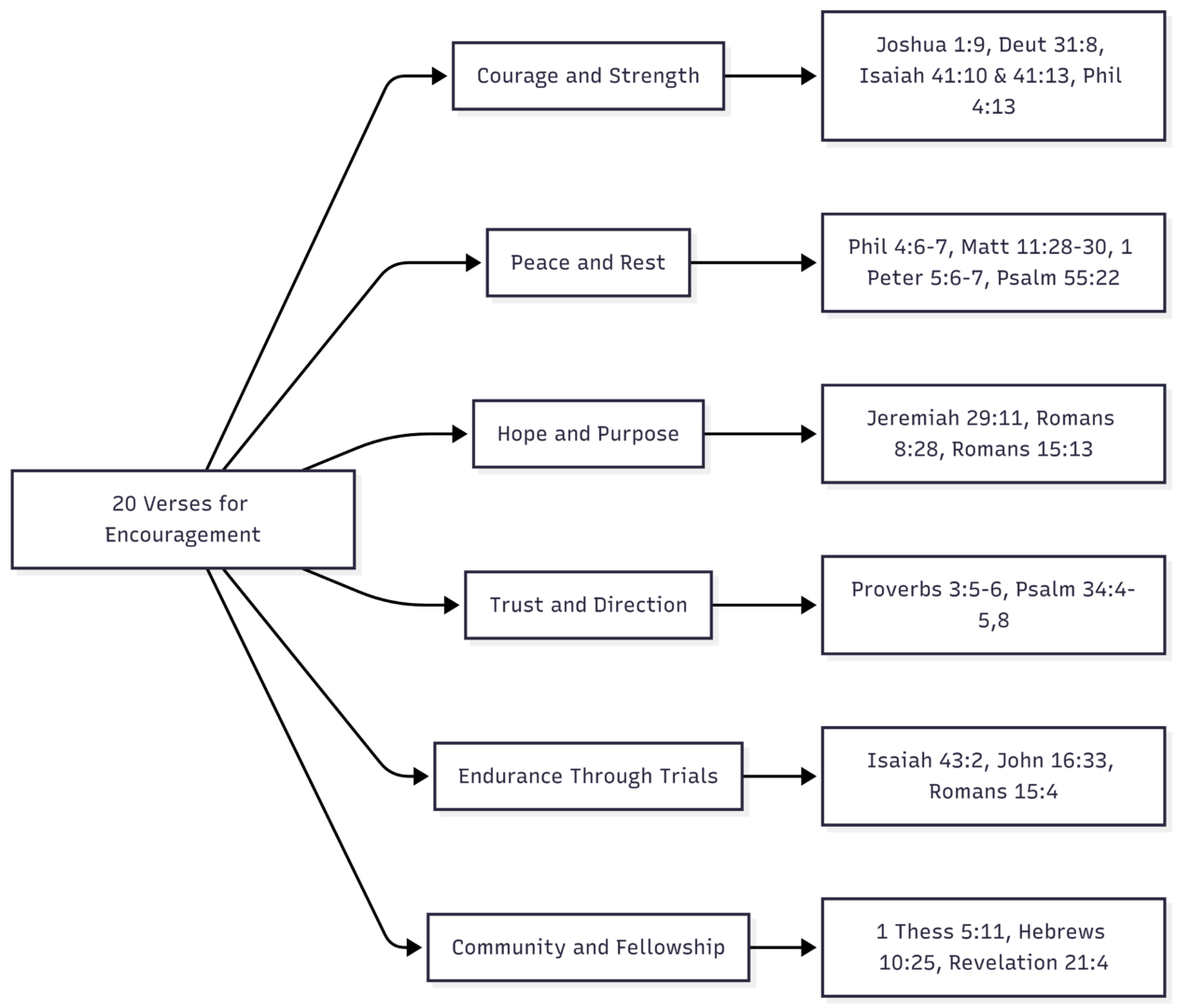
For Courage and Strength
Joshua 1:9 was spoken to Joshua as he prepared to lead Israel into the Promised Land after Moses’ death. The command to be strong and courageous is directly tied to a promise: God’s presence would go with him wherever he went. This verse remains one of the most quoted in Scripture because it links courage not to self-confidence, but to the certainty of God’s nearness.
Deuteronomy 31:8 carries a nearly identical promise, assuring that God goes ahead of His people and will never leave or abandon them. Read together, these two verses form a foundation for facing new, uncertain, or intimidating situations without being paralyzed by fear.
Isaiah 41:10 and Isaiah 41:13 both come from a passage where God reassures Israel during a time of exile and uncertainty. The imagery of God upholding His people with His right hand and holding their hand through difficulty paints a picture of active, ongoing support rather than distant sympathy.
Philippians 4:13 is one of the most widely quoted verses in the entire Bible, often taken out of its original context of contentment in both abundance and hardship. Paul wrote this while explaining that he had learned to be at peace whether he had plenty or little, crediting that steadiness to the strength Christ provided, not to personal willpower.
For Peace and Rest
Philippians 4:6-7 offers a direct alternative to anxiety: prayer paired with gratitude, resulting in a peace described as beyond ordinary understanding, one that guards both heart and mind. This verse is frequently cited in conversations about anxiety because it doesn’t just forbid worry, it provides a specific replacement practice.
Matthew 11:28-30 records Jesus’ invitation to the weary and burdened to find rest in Him, using the image of a yoke, a farming tool used to pair two animals together for shared labor. The imagery suggests partnership rather than simply relief from work altogether.
1 Peter 5:6-7 encourages humility paired with the act of casting anxiety onto God, grounded in the reassurance that He genuinely cares about the details of a person’s life.
Psalm 55:22 predates the New Testament by centuries but carries the same core idea: burdens can be handed over to God, with the promise that He will sustain those who do so.
For Hope and Purpose
Jeremiah 29:11 is one of the most popular encouragement verses, though it’s often quoted without its original context. It was written to Israelites in exile in Babylon, assuring them that God’s plans for their future were rooted in welfare rather than harm. While the verse was originally addressed to a specific historical situation, it continues to resonate as a broader statement about God’s intentions toward His people.
Romans 8:28 reassures believers that God works all circumstances, including painful or confusing ones, toward good for those who love Him. This verse doesn’t promise that every individual event will feel good, but that God is actively weaving circumstances toward a larger purpose.
Romans 15:13 is often used as a benediction or closing prayer, asking that believers would be filled with joy and peace through trust, resulting in hope that overflows through the Holy Spirit’s power.
For Trust and Direction
Proverbs 3:5-6 is one of the most frequently memorized verses in the Bible, calling for trust in God rather than reliance on personal understanding, with a promise that doing so leads to clear direction.
Psalm 34:4-5, 8 describes the personal experience of seeking God and being delivered from fear, followed by an invitation to “taste and see” God’s goodness firsthand rather than simply hearing about it secondhand.
For Endurance Through Trials
Isaiah 43:2 promises God’s presence through water and fire, symbols of overwhelming and destructive circumstances, with the assurance that neither will completely overtake those who belong to Him.
John 16:33 is unique among these verses because it doesn’t promise the absence of trouble. Jesus openly tells His followers that they will face tribulation in the world, but pairs that honesty with the assurance that He has already overcome the world. This verse is often cited specifically because it doesn’t minimize hardship while still offering genuine hope.
Romans 15:4 explains the very purpose of Scripture itself: it was written to provide instruction and encouragement so that believers might have hope through endurance.
For Community and Fellowship
1 Thessalonians 5:11 calls believers to actively encourage one another and build each other up, framing encouragement as a communal responsibility rather than something to seek only in private devotion.
Hebrews 10:25 reinforces this by urging continued gathering together, especially as circumstances grow more difficult, rather than withdrawing from community during hard seasons.
Revelation 21:4 closes out this list with a future-focused promise: a coming reality where every tear is wiped away and pain, mourning, and death no longer exist. This verse is frequently used at funerals and during seasons of grief because it points beyond present suffering toward a permanent resolution.
How These Verses Work Together
Reading these verses in isolation is helpful, but grouping them reveals a fuller picture of how the Bible frames encouragement. Courage verses address fear before it happens. Peace verses address anxiety in the moment. Hope verses address the future. Trust verses address decision-making. Endurance verses address prolonged hardship. Community verses address the ongoing, daily practice of encouragement between people rather than treating it as a one-time event.
| Life Situation | Most Relevant Verses |
|---|---|
| Starting something new or uncertain | Joshua 1:9, Deuteronomy 31:8 |
| Feeling anxious or overwhelmed | Philippians 4:6-7, 1 Peter 5:6-7, Psalm 55:22 |
| Facing exhaustion or burnout | Matthew 11:28-30 |
| Uncertain about the future | Jeremiah 29:11, Romans 8:28 |
| Making a difficult decision | Proverbs 3:5-6 |
| Enduring an extended trial | Isaiah 43:2, John 16:33 |
| Supporting someone else going through hardship | 1 Thessalonians 5:11, Hebrews 10:25 |
| Grieving a loss | Revelation 21:4, Psalm 34:4-5,8 |
Practical Ways to Apply These Verses
Simply reading a verse in a moment of stress provides temporary comfort, but many people find lasting benefit from memorizing key verses so they can recall them without needing to look them up. Writing a verse on a card, setting it as a phone background, or journaling about how a specific verse applies to a current situation are all common practices among people who find these verses genuinely useful long-term rather than only in the moment they first read them.
It also helps to read a verse within its surrounding chapter rather than in isolation. Many of these verses, particularly Jeremiah 29:11 and Philippians 4:13, are frequently misapplied when separated from their original context. Reading the full passage typically deepens rather than diminishes the encouragement, since it reveals how these promises were originally understood by their first audience.
Frequently Asked Questions
Philippians 4:13 and Jeremiah 29:11 are consistently cited among the most quoted verses for encouragement, though Joshua 1:9 and Romans 8:28 are also extremely common.
Biblical encouragement points to the character and promises of God as the source of courage, rather than relying purely on self-generated positivity or willpower.
No. Several of these verses, including John 16:33, specifically acknowledge that trouble and hardship will still occur; the encouragement comes from God’s presence and promises within that hardship, not from an absence of difficulty.
Philippians 4:6-7 and 1 Peter 5:7 are among the most frequently referenced verses specifically addressing anxiety, both encouraging believers to hand their worries over to God through prayer.
While the verse was originally addressed to a specific historical situation, many readers find its underlying principle, that God’s intentions are for welfare rather than harm, meaningfully applicable to their own circumstances, as long as it’s not treated as a guarantee of specific personal outcomes.
Sending a specific verse relevant to a friend’s current situation, along with a brief personal note, is a common and meaningful way to offer support during a difficult season, particularly verses focused on God’s presence, peace, and future hope.
Final Thoughts
These 20 verses represent some of the most enduring sources of comfort and courage found throughout Scripture, spanning both the Old and New Testaments and addressing nearly every major category of hardship a person might face: fear, anxiety, exhaustion, uncertainty, grief, and the need for ongoing community support.
Whether read individually during a hard season or studied together as a broader picture of what biblical encouragement actually means, these passages consistently point toward the same underlying truth: real courage is found not in denying difficulty, but in trusting the presence and promises of God within it.
Please share this The 20 Most Popular Bible Verses for Encouragement with your friends and do a comment below about your feedback.
We will meet you on next article.
Until you can read, Parable of the Unforgiving Servant: Verse, Meaning & Lesson