Parable of the Unforgiving Servant: Verse, Meaning & Lesson
The Parable of the Unforgiving Servant, found in Matthew 18:21-35, tells the story of a king who cancels a servant’s astronomical, unpayable debt out of pure mercy, only to watch that same servant refuse to forgive a much smaller debt owed to him by a peer. Jesus told this parable in response to Peter’s question about how many times a person should forgive someone who sins against them, and the answer, both in Jesus’ words and in the story that follows, is that forgiveness should be limitless.
This is one of the most direct and least ambiguous parables Jesus ever told. Unlike some of His other stories, which require significant unpacking, the point of this one is unmistakable: those who have been forgiven an enormous debt have no excuse for withholding forgiveness over comparatively small offenses.
The Verse: Matthew 18:21-35
Peter approaches Jesus and asks how many times he should forgive someone who sins against him, offering seven times as what he assumes is a generous number. Jesus responds that the number is not seven, but seventy-seven, a figure meant to signal forgiveness without a running tally rather than a literal ceiling.
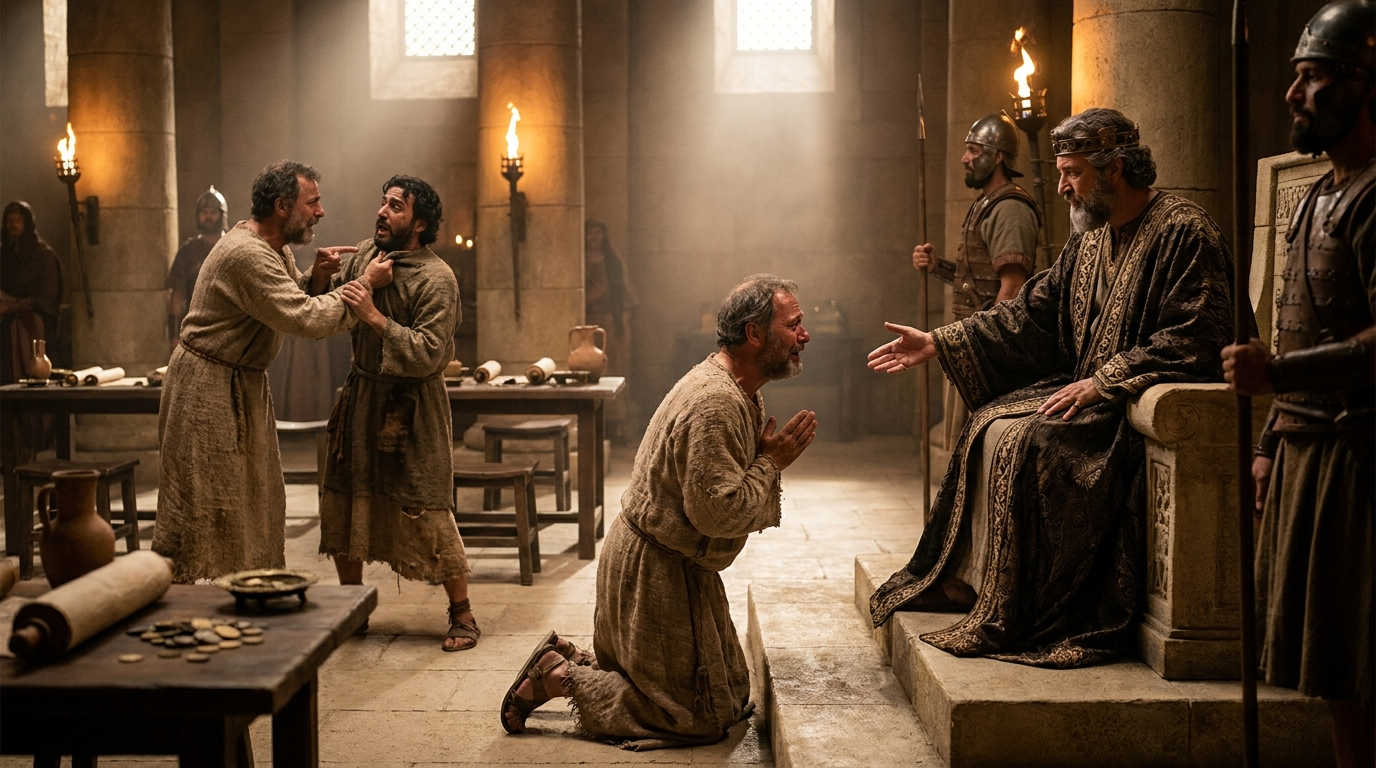
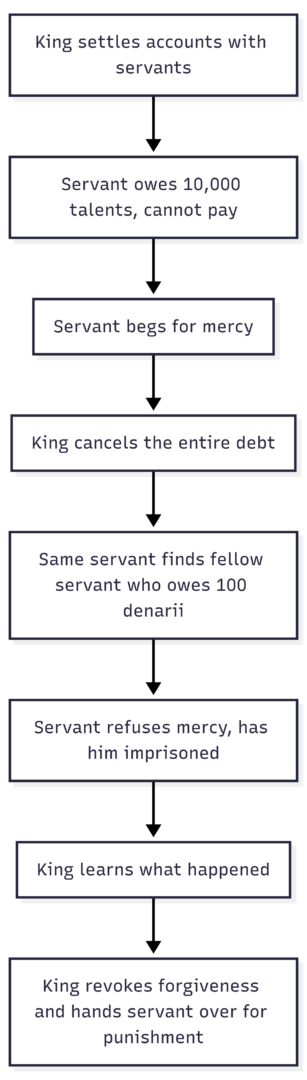
Jesus then illustrates the point with a parable. A king decides to settle accounts with his servants and discovers one who owes him ten thousand talents, a debt so large it was effectively impossible to repay in a single lifetime. Unable to pay, the servant begs for patience and mercy. Moved with compassion, the king cancels the entire debt and lets him go free.
That same servant then finds a fellow servant who owes him a hundred denarii, a real but comparatively modest sum. Rather than extending the same mercy he had just received, he grabs the man by the throat, demands repayment, and has him thrown into prison when he cannot pay. When the king hears what happened, he is furious, revokes his earlier mercy, and hands the unforgiving servant over to be punished until the original debt is paid in full. Jesus closes the parable with a sobering warning: this is how God will treat anyone who refuses to forgive others from the heart.
Understanding the Scale of the Debts
The numbers in this parable are not arbitrary. Jesus deliberately chose figures so disproportionate that the comparison becomes almost absurd, and that absurdity is the entire point.
| Detail | First Debt (Servant to King) | Second Debt (Fellow Servant to Servant) |
|---|---|---|
| Amount | 10,000 talents | 100 denarii |
| Unit value | A talent was a measure of precious metal worth roughly 15-20 years of an ordinary worker’s wages | A denarius was a single day’s wage |
| Approximate scale | Well over 150,000 years’ worth of wages | About three to four months’ worth of wages |
| Ability to repay | Completely impossible | Difficult but conceivable |
| Ratio between debts | Roughly 600,000 times larger | Baseline for comparison |
Even using conservative estimates, the first servant’s debt was worth hundreds of thousands of times more than the second. There was no realistic path for the first servant to ever pay back what he owed, which is exactly why the king’s decision to cancel it outright was such a dramatic act of grace. By contrast, the hundred denarii owed to the servant, while genuinely significant to an ordinary worker, was a debt that could plausibly be repaid over time.
What the Parable Means
Each element of the story carries direct symbolic meaning. The king represents God, who holds the ultimate authority over every person’s moral debt. The first servant represents any person who has received God’s forgiveness, an unpayable debt canceled entirely out of grace rather than merit. The ten thousand talents represents the weight of human sin against God, a debt so large that no amount of good behavior could ever settle it. The hundred denarii represents the comparatively minor offenses other people commit against us, real but proportionally small when measured against what we have already been forgiven. The prison and the torturers at the end of the story represent the emotional and spiritual bondage that comes from choosing bitterness and unforgiveness over grace.
The central irony driving the entire parable is that the forgiven servant had just witnessed and personally experienced the extraordinary mercy of having an impossible debt erased, yet moments later showed none of that same mercy to someone who owed him a fraction of the amount. His failure was not simply an unkind act; it revealed that he had never truly internalized the scale of the grace he had received.
Comparing the Two Debts and Their Outcomes
| Element | First Servant’s Debt | Fellow Servant’s Debt |
|---|---|---|
| Owed to | The king (representing God) | The forgiven servant |
| Size | Astronomical, unpayable | Modest, repayable over time |
| Response of the creditor | Full, immediate cancellation out of compassion | Harsh demand, physical aggression, imprisonment |
| Result | Servant set completely free | Fellow servant thrown into prison |
| Consequence for the unforgiving servant | Original mercy revoked, handed over for punishment | N/A |
The parable’s final twist, the king reversing his earlier mercy, underscores that forgiveness received is meant to change behavior. Grace that does not produce a more generous, forgiving heart has not actually been understood or received the way it was intended.
Why Peter’s Question Matters
Peter’s opening question sets up the entire parable. In first-century Jewish tradition, some rabbinic teaching held that a person was only obligated to forgive an offender up to three times. By suggesting seven, Peter was more than doubling the expected standard and likely believed he was being unusually generous.
Jesus’ response, seventy-seven times, was not meant to set a new numeric limit but to eliminate the idea of counting altogether. The number itself is less important than the underlying principle: forgiveness offered by someone who has received infinite grace should not be rationed or tracked.
Key Lessons From the Parable
Forgiven people are expected to forgive. The parable’s core message is straightforward: because God has canceled an unpayable debt, withholding forgiveness over comparatively minor offenses reveals a failure to grasp the scale of the grace already received.
Forgiveness is not about what the offender deserves. The first servant did nothing to earn the cancellation of his debt beyond asking for patience. In the same way, forgiveness extended to others is an act of grace rather than a reward for good behavior or genuine repentance.
Unforgiveness creates a personal prison. The servant’s punishment at the end of the story mirrors the emotional reality of holding onto bitterness. Refusing to forgive does not punish the offender nearly as much as it traps the person holding the grudge in ongoing resentment and anger.
Grace that isn’t shared reveals a heart that hasn’t truly changed. The forgiven servant’s harsh treatment of his fellow servant shows that outward relief from consequences does not automatically produce inward transformation. Genuine gratitude for forgiveness naturally overflows into showing that same mercy to others.
Forgiveness must come from the heart, not just words. Jesus specifically says the standard is forgiving “from your heart,” distinguishing between a surface-level, technical acknowledgment of forgiveness and a genuine release of resentment.
Practical Ways to Apply This Parable
Forgiveness is often described as a decision rather than a feeling, meaning it does not require the absence of hurt but does require a deliberate choice to release the offense rather than continuing to hold it against the other person. This typically involves choosing not to dwell on the incident, not using it as ammunition in future conflicts, and not allowing it to permanently define the relationship going forward.
It’s worth noting that forgiveness does not always mean removing every consequence of an offense. Reconciliation and restored trust often take time to rebuild, and in some cases, healthy boundaries remain appropriate even after forgiveness has genuinely taken place. The parable is focused specifically on releasing the internal debt of resentment, not on erasing every practical outcome of wrongdoing.
Frequently Asked Questions
It is recorded in Matthew 18:21-35, following Peter’s question to Jesus about how many times he should forgive someone who sins against him.
The parable teaches that because God has forgiven an unpayable debt of sin, believers are expected to extend generous forgiveness to others, even for real and painful offenses, since those offenses are comparatively small next to what has already been forgiven.
The specific units highlight the massive gap between the two debts. A talent represented years of wages, while a denarius represented a single day’s wage, making the first servant’s debt many thousands of times larger than the second.
It is not meant as a literal limit but as a way of removing the idea of counting forgiveness altogether, calling for forgiveness that is essentially limitless rather than capped at a specific number.
Yes, it is sometimes referred to as the Parable of the Unmerciful Servant, the Unforgiving Creditor, the Ungrateful Servant, or the Wicked Servant.
The parable’s warning is a serious one about the relationship between receiving and extending grace, illustrating that genuine reception of forgiveness should produce a forgiving heart toward others, and that refusing to forgive reflects a failure to truly grasp the grace already given.
It closely echoes the line “forgive us our debts, as we also have forgiven our debtors,” reinforcing that forgiveness given and forgiveness received are meant to be directly connected in a believer’s life.
The Lasting Takeaway
The Parable of the Unforgiving Servant confronts readers with an uncomfortable but clarifying truth: it is far easier to receive mercy than to extend it. The servant in the story walked away from an impossible debt completely free, yet within moments demonstrated that he had not internalized what that freedom actually cost or meant.
The parable challenges every reader to measure their own willingness to forgive others against the far greater debt they have already had canceled, and to recognize that holding onto bitterness ultimately imprisons no one more than the person refusing to let go.
Please share this Parable of the Unforgiving Servant: Verse, Meaning & Lesson with your friends and do a comment below about your feedback.
We will meet you on next article.
Until you can read, Parable of the Two Sons: Verse, Meaning & Lesson