Matthew Bible Trivia Quiz — 50 Questions & Answers
Bible Trivia
Matthew Bible Trivia Quiz 50 Questions & Answers
Test your knowledge of the Gospel of Matthew — from the genealogy of Christ to the Great Commission
50 QuestionsGospel of MatthewAll Difficulty LevelsInteractive Quiz Included
SEO Meta Description: Matthew Bible trivia quiz — 50 questions and answers covering the Gospel of Matthew’s parables, miracles, teachings, and key events.
The Gospel of Matthew is the first book of the New Testament and one of the most richly structured documents in all of Scripture. Written by the tax-collector-turned-apostle, it opens with a royal genealogy tracing Jesus to both Abraham and David, delivers the greatest sermon ever preached on a mountainside, records more parables of the Kingdom than any other Gospel, and closes with a commission that has sent believers to every corner of the earth for two thousand years. Whether you study Scripture daily or are encountering Matthew for the first time, this quiz will challenge and deepen your knowledge of this foundational Gospel.
This guide contains 50 carefully crafted questions across four categories — Genealogy & Birth, The Ministry of Jesus, Teachings & Parables, and Miracles & Events — with full answers and scripture references for every question. An interactive 10-question practice quiz is also included. Use these questions for personal study, small group discussion, Sunday school review, or friendly competition.
50Total Questions
100Max Points
2Points Each
28Chapters Covered
How to Score Your Quiz
Each correct answer is worth 2 points. Calculate your score by multiplying your correct answers by 2. The table below shows what each score range means for your knowledge of the Gospel of Matthew.
Score Range
Correct Answers
Knowledge Level
What It Means
90–100%
45–50 correct
Scholar
Exceptional command of the Gospel of Matthew
75–89%
38–44 correct
Advanced
Strong knowledge; a few gaps to fill
60–74%
30–37 correct
Intermediate
Good foundation; regular reading recommended
40–59%
20–29 correct
Beginner
Key stories known; deeper study will reward you
0–39%
0–19 correct
Explorer
Great time to start a Matthew reading plan
📖
Before You Begin
All answers are drawn directly from the 28 chapters of the Gospel of Matthew in the New International Version (NIV). Scripture references are provided with each answer so you can verify and study further. True/False questions are clearly marked.
The Full Quiz
I
Genealogy & Birth of Jesus
Q 1–10
✦
False. Matthew 1:1 opens: “A record of the genealogy of Jesus the Messiah the son of David, the son of Abraham.” The lineage is traced to both Abraham and David.
Matthew 1:1–17
✦
Mary. She was pledged to be married to Joseph when she was found to be with child through the Holy Spirit.
Matthew 1:18–25
✦
Matthew does not specify a number. The text mentions wise men (Magi) who brought three types of gifts — gold, frankincense, and myrrh — which led to the traditional depiction of three wise men.
Matthew 2:1–12
✦
David first, then Abraham. Matthew 1:1 reads “son of David, the son of Abraham” — though the list itself moves chronologically forward from Abraham to David to Jesus.
Matthew 1:1–17
✦
Jeremiah. Matthew quotes: “A voice is heard in Ramah, weeping and great mourning, Rachel weeping for her children” (Jeremiah 31:15).
Matthew 2:16–18
✦
Nazareth. Joseph, Mary, and Jesus settled in Nazareth after returning from Egypt, fulfilling the word of the prophets: “He will be called a Nazarene.”
Matthew 2:23
✦
Isaiah. Matthew 3:3 quotes Isaiah 40:3 — “A voice of one calling in the wilderness, Prepare the way for the Lord, make straight paths for him.”
Matthew 3:3; Isaiah 40:3
✦
True. Jesus came from Galilee to the Jordan to be baptized by John. When He came up out of the water, the Spirit of God descended like a dove and a voice from heaven said, “This is my Son, whom I love.”
Matthew 3:13–17
✦
A dove. The Spirit of God descended like a dove and alighted on Jesus as He came up out of the water.
Matthew 3:16
✦
Carpenter. The townspeople of Nazareth asked: “Isn’t this the carpenter’s son?” — identifying Jesus by Joseph’s trade.
Matthew 13:55
II
The Ministry of Jesus
Q 11–22
✦
Locusts and wild honey. John’s clothing was made of camel’s hair with a leather belt around his waist — his entire manner of life deliberately recalled the prophet Elijah.
Matthew 3:4
✦
Three temptations over 40 days. The devil tempted Jesus to turn stones to bread, to throw Himself from the temple, and to worship him in exchange for all the kingdoms of the world. Jesus refused each with Scripture.
Matthew 4:1–11
✦
Tax collector. Jesus saw Matthew sitting at his tax collector’s booth and simply said, “Follow me.” Matthew got up and followed immediately.
Matthew 9:9
✦
Twelve. Matthew 10:2–4 names them: Simon Peter, Andrew, James son of Zebedee, John, Philip, Bartholomew, Thomas, Matthew the tax collector, James son of Alphaeus, Thaddaeus, Simon the Zealot, and Judas Iscariot.
Matthew 10:1–4
✦
False. Peter, Andrew, James, and John were fishermen. Matthew was a tax collector. The occupations of the remaining seven disciples are not specified in Matthew.
Matthew 4:18–22; 9:9
✦
“You are the Messiah, the Son of the living God.” Jesus responded that this was revealed to Peter by the Father and declared He would build His church on this confession.
Matthew 16:16–18
✦
Walking on water. Jesus came toward the disciples walking on the Sea of Galilee during a storm. They cried out in fear, thinking He was a ghost, until He identified Himself.
Matthew 14:25–27
✦
John the Baptist, Elijah, Jeremiah, or one of the prophets. Each name reflected a different expectation about who the coming prophet would be.
Matthew 16:13–14
✦
“Is it lawful to pay the imperial tax to Caesar or not?” Jesus responded by asking whose image was on the coin and saying, “Give back to Caesar what is Caesar’s, and to God what is God’s.”
Matthew 22:17–21
✦
Love the Lord your God with all your heart, soul, and mind; and love your neighbor as yourself. Jesus said all the Law and the Prophets hang on these two commandments.
Matthew 22:37–40
✦
Leaving the Temple. Jesus made this prophecy about the destruction of the Temple as He and His disciples were walking away from its courts.
Matthew 24:1–2
✦
The sun and the moon. “Immediately after the distress of those days, the sun will be darkened, and the moon will not give its light; the stars will fall from the sky.”
Matthew 24:29
III
Teachings & Parables
Q 23–36
✦
On a mountainside. Seeing the crowds, Jesus went up on a mountainside where He sat down and began to teach His disciples.
Matthew 5:1
✦
“Blessed are the poor in spirit, for theirs is the kingdom of heaven.” Jesus opens His most famous teaching with this unexpected reversal of the world’s values.
Matthew 5:3
✦
Salt of the earth and light of the world. Salt preserves and flavors; light exposes and guides. Both describe the nature and function of disciples in the world.
Matthew 5:13–14
✦
True. Matthew 6:11 contains this petition as part of the full prayer Jesus taught His disciples, also known as the “Our Father.”
Matthew 6:9–13
✦
Also forgive them. Jesus states this as a direct principle immediately after the Lord’s Prayer — the two are inseparably linked in His teaching.
Matthew 6:14
✦
God and money. “You cannot serve both God and money.” Jesus was teaching about where a person’s ultimate allegiance and trust rests.
Matthew 6:24
✦
“By their fruit you will recognize them.” A good tree bears good fruit and a bad tree bears bad fruit. The inner character of a teacher is revealed in the long-term outcomes of their ministry.
Matthew 7:16
✦
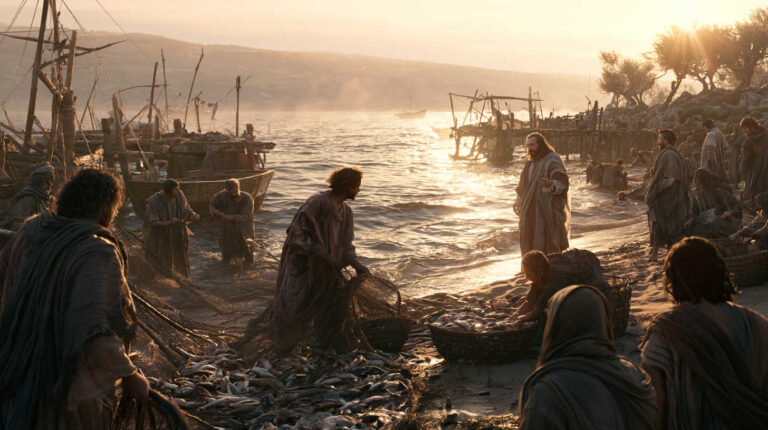
A net (dragnet). The Kingdom of Heaven is like a net let down into the lake that catches all kinds of fish. When full, the fishermen sort the good into baskets and throw the bad away.
Matthew 13:47–48
✦
The people of the evil one. Jesus explains that the one who sows the good seed is the Son of Man, the field is the world, the wheat are the people of the kingdom, and the weeds are the people of the evil one.
Matthew 13:36–43
✦
Treasure hidden in a field. When a man found it, he hid it again, then went and sold all he had to buy that field. The Kingdom is worth everything a person possesses.
Matthew 13:44
✦
They expected more pay than latecomers. All workers received the same wage regardless of when they were hired. The early workers felt this was unfair, but the landowner reminded them he paid exactly what was agreed.
Matthew 20:1–16
✦
Extra oil. The wise virgins took extra oil for their lamps when going to meet the bridegroom. The foolish virgins did not, their lamps ran out, and they missed the bridegroom’s arrival while buying more.
Matthew 25:1–13
✦
False. The Parable of the Good Samaritan is found exclusively in the Gospel of Luke (10:25–37). Matthew contains many unique parables, but this is not among them.
Luke 10:25–37
✦
“I never knew you. Away from me, you evildoers!” External religious activity — even miraculous — is not the same as genuine relationship with the Father through His will.
Matthew 7:21–23
IV
Miracles, Passion & Resurrection
Q 37–50
✦
Five loaves of bread and two fish. After blessing and breaking them, Jesus fed the entire crowd of five thousand men (plus women and children) with twelve basketfuls left over.
Matthew 14:17–21
✦
“Lord, save me!” When Peter took his eyes off Jesus and noticed the wind, he was afraid and began to sink. Jesus immediately reached out His hand and caught him.
Matthew 14:30
✦
Riding on a donkey. This fulfilled Zechariah 9:9 — “See, your king comes to you, gentle and riding on a donkey.” The crowds spread their cloaks and cut branches, crying “Hosanna to the Son of David!”
Matthew 21:7–9; Zechariah 9:9
✦
Gethsemane. Jesus went there with His disciples after the Last Supper, withdrew a little distance, and prayed, “My Father, if it is possible, may this cup be taken from me. Yet not as I will, but as you will.”
Matthew 26:36–46
✦
Thirty pieces of silver. This fulfilled Zechariah 11:12–13. Judas later returned the money in remorse, but the chief priests used it to buy the potter’s field.
Matthew 26:15; 27:3–10
✦
Pontius Pilate. Pilate found no basis for the charges, attempted to release Jesus, but ultimately handed Him over for crucifixion after the crowd’s insistence.
Matthew 27:1–2, 24–26
✦
“This is Jesus, the King of the Jews.” The written charge placed above His head was the formal accusation for which He was crucified.
Matthew 27:37
✦
The curtain of the Temple. It was torn from top to bottom — symbolizing that the barrier separating God from humanity had been removed through Christ’s sacrifice.
Matthew 27:51
✦
True. When Judas saw that Jesus was condemned, he was seized with remorse, returned the thirty silver coins, and went and hanged himself. Matthew records his is the only death of a disciple in this Gospel.
Matthew 27:3–5
✦
Mary Magdalene and the other Mary. They came to look at the tomb and encountered the risen Jesus, who told them to go tell His brothers to go to Galilee.
Matthew 28:1–10
✦
True. When the eleven disciples saw Jesus on the mountain in Galilee, they worshiped Him — but some doubted. Matthew records this honest detail before Jesus gives the Great Commission.
Matthew 28:17
✦
That Jesus’ disciples came during the night and stole the body while the guards slept. The chief priests bribed the soldiers with a large sum of money and promised to protect them from the governor’s punishment.
Matthew 28:11–15
✦
Go and make disciples of all nations, baptizing them in the name of the Father, Son, and Holy Spirit, and teaching them to obey everything Jesus commanded.Matthew 28:19–20
✦
False. Matthew ends with Jesus giving the Great Commission and promising “I am with you always, to the very end of the age.” The ascension is not recorded in Matthew; it appears in Luke 24:51 and Acts 1:9.
Matthew 28:20; Luke 24:51; Acts 1:9
Interactive Challenge
Interactive Practice Quiz
Put your knowledge to the test with this 10-question multiple-choice challenge drawn from the Gospel of Matthew. Each question has one correct answer. Your score is calculated at the end.
Matthew Bible Quiz — 10 Questions
Select the best answer for each question. Click Next to advance.
Question 1 of 10
Score: 0 / 0
💡
Study Tip
For the deepest understanding of Matthew, read it in one sitting first to grasp the overall narrative, then study chapter by chapter. Matthew is organized around five major discourses: the Sermon on the Mount (chs. 5–7), the Mission Discourse (ch. 10), the Parable Discourse (ch. 13), the Community Discourse (ch. 18), and the Olivet Discourse (chs. 24–25).
Please share this Matthew Bible Trivia Quiz With Questions & Answers with your friends and do a comment below about your feedback.
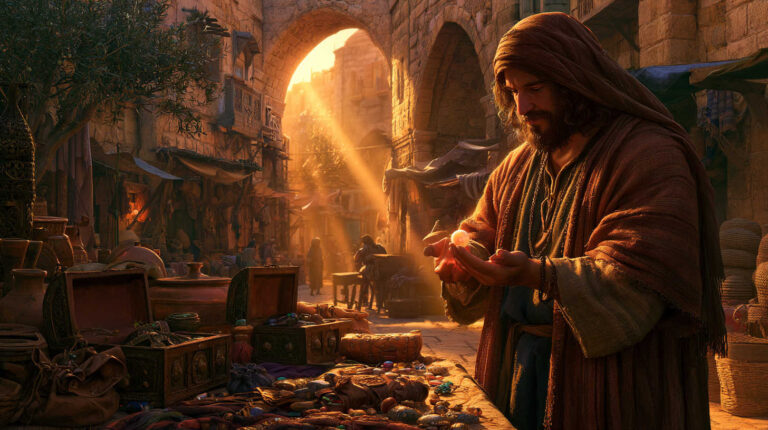
Tucked into Matthew 13, alongside a cluster of short parables about the kingdom of heaven, is a two-verse story about a merchant, a search, and a single pearl valuable enough to give up everything else for. It’s brief — barely two sentences — but it carries one of the most direct statements in the Gospels…
Revelation 1: Introduction & A Vision of Jesus — Full Commentary Book of Revelation Revelation 1Introduction & A Vision of Jesus The unveiling begins — John encounters the glorified Christ on Patmos and receives a commission for the ages Chapter 1 Commentary 20 Verses Seven Churches Vision of Christ SEO Meta Description: Revelation 1 commentary…
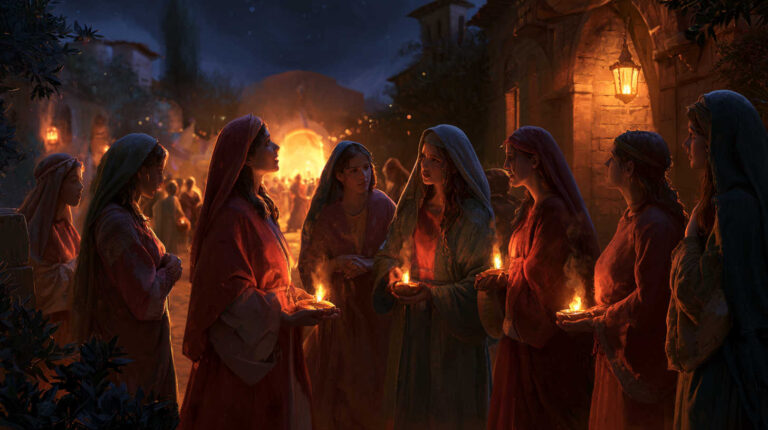
The Parable of the Ten Virgins appears in Matthew 25:1-13, right in the middle of Jesus’ Olivet Discourse — His extended teaching about the end times. Ten bridesmaids wait for a bridegroom to arrive so a wedding procession can begin. Five bring extra oil for their lamps. Five don’t. When the bridegroom finally shows up…
Graduation marks a pivotal transition filled with excitement, uncertainty, and opportunity. For Christian families and believers, Scripture provides timeless wisdom, comfort, and direction for this new chapter. These Bible verses for graduating seniors address common challenges like decision-making, fear of the unknown, identity, purpose, and maintaining faith amid change. This comprehensive guide compiles the 20…
Planning a wedding involves countless details, but selecting the right scripture readings can infuse your ceremony with profound spiritual depth, timeless wisdom, and emotional resonance. Bible verses for weddings often emphasize love, partnership, commitment, and God’s role in marriage, making them ideal for Christian ceremonies, interfaith blends, or couples seeking inspirational readings. These passages remain…
The Parable of the Net, also called the Parable of the Dragnet, closes Jesus’s series of kingdom parables in Matthew 13. Found only in Matthew 13:47-50, it compares the kingdom of heaven to a large fishing net that gathers everything in its path from the sea, leaving the sorting of good from bad until the…