Chronological Order Of New Testament
The 27 books of the New Testament are not arranged in the Bible in the order they were written. They are grouped by literary category — Gospels, history, Paul’s letters, general epistles, and prophecy — organized primarily by length and theological tradition. Reading the New Testament in chronological order, the actual sequence in which the books were composed, opens a dramatically different window into early Christian history, the growth of the church, and the development of core doctrine.
This guide presents the most widely accepted scholarly chronological order of every New Testament book, complete with authorship, approximate dates, and multiple reading strategies to help you study the Bible with greater depth and context.
Why Chronological Order Matters
Reading the New Testament in the sequence it was written rather than the sequence it was printed reveals things that canonical order obscures.
You see the early church in real time. Paul’s letters precede the Gospels by a decade or more. The problems, joys, and theology of living communities like Corinth, Thessalonica, and Rome appear before the written accounts of Jesus’ life were even circulating widely.
You trace the progression of thought. Paul writes to the Thessalonians early in his ministry with urgent end-times language. His later letters to the Ephesians and Colossians show a more developed ecclesiology. Reading in order lets you follow that arc.
You connect letters to historical events. When you read Acts of the Apostles alongside Paul’s letters in the sequence they occurred, the letters stop being abstract theology and become dispatches from a living missionary journey.
You understand context and opposition. Knowing what a writer was responding to — which false teachers were spreading through Galatia, which factions were dividing Corinth — transforms the meaning of a passage entirely.
New Testament Books in Chronological Order
The table below lists all 27 New Testament books in the order most scholars believe they were composed, along with their authors and estimated writing periods. Absolute dates are debated; these represent a well-supported scholarly consensus.
| No. | Book | Date Authored | Author | Category |
|---|---|---|---|---|
| 1 | James | Mid-40s | James, Jesus’ half-brother | General Epistle |
| 2 | 1 Thessalonians | 50–51 | Paul | Paul’s Letter (Church) |
| 3 | 2 Thessalonians | 50–51 | Paul | Paul’s Letter (Church) |
| 4 | Galatians | 55 | Paul | Paul’s Letter (Church) |
| 5 | 1 Corinthians | 55 | Paul | Paul’s Letter (Church) |
| 6 | 2 Corinthians | 56 | Paul | Paul’s Letter (Church) |
| 7 | Romans | 57 | Paul | Paul’s Letter (Church) |
| 8 | Mark | Late 50s–early 60s | John Mark | Gospel |
| 9 | Matthew | Late 50s–early 60s | Matthew | Gospel |
| 10 | Philemon | 61–62 | Paul | Paul’s Letter (Individual) |
| 11 | Colossians | 61–62 | Paul | Paul’s Letter (Church) |
| 12 | Ephesians | 61–62 | Paul | Paul’s Letter (Church) |
| 13 | Luke | 62 | Luke | Gospel |
| 14 | Acts | 62 | Luke | History |
| 15 | Philippians | 62 | Paul | Paul’s Letter (Church) |
| 16 | 1 Timothy | 63–64 | Paul | Paul’s Letter (Individual) |
| 17 | Titus | 63–64 | Paul | Paul’s Letter (Individual) |
| 18 | 1 Peter | 63–64 | Peter | General Epistle |
| 19 | 2 Peter | 65 | Peter | General Epistle |
| 20 | 2 Timothy | 65 | Paul | Paul’s Letter (Individual) |
| 21 | Hebrews | ~68 | Unknown | General Epistle |
| 22 | Jude | Late 60s–early 70s | Jude, Jesus’ half-brother | General Epistle |
| 23 | John | Late 80s–early 90s | John | Gospel |
| 24 | 1 John | Late 80s–early 90s | John | General Epistle |
| 25 | 2 John | Late 80s–early 90s | John | General Epistle |
| 26 | 3 John | Late 80s–early 90s | John | General Epistle |
| 27 | Revelation | Late 80s–early 90s | John | Prophecy |
The Four Phases of New Testament Writing
The composition of the New Testament unfolded across roughly fifty years in four discernible phases.
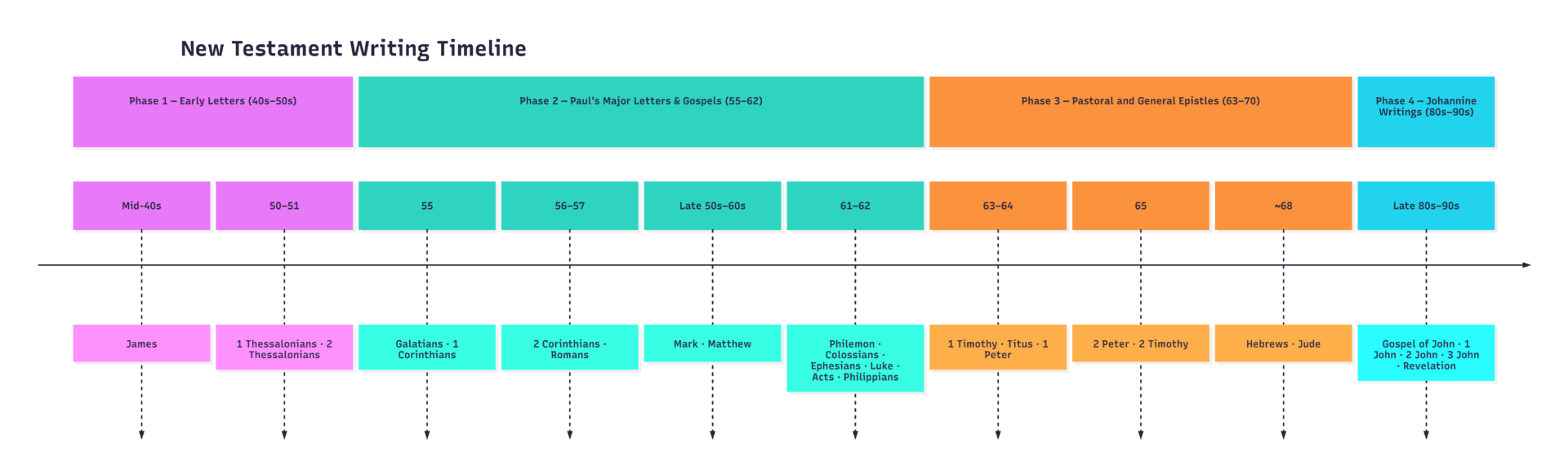
Phase 1 begins not with the Gospels but with practical letters to early Jewish-Christian communities. Phase 2 is the most prolific period, when Paul establishes and writes to churches across the Roman Empire and the first Gospel accounts appear. Phase 3 addresses a maturing church facing persecution and false teaching from within. Phase 4 closes the canon with John’s unique theological vision, written decades after the other books were already circulating.
Canonical Order vs. Chronological Order
Understanding the difference between these two arrangements is foundational for serious Bible study.
The canonical order — the order printed in every Bible — groups books by type: the four Gospels come first, followed by Acts, then Paul’s letters arranged roughly by length, then the general epistles, and finally Revelation. This arrangement is theological and traditional, designed to move from the life of Christ outward to the growth of the church.
The chronological order is historical. It begins not with Matthew but with the letter of James, written perhaps as early as the mid-40s, before Paul had completed a single missionary journey. The Gospels — the accounts of Jesus’ life — were not composed until decades after the crucifixion. This means the earliest Christians learned about Jesus primarily through oral tradition and Paul’s letters, not written narratives.

How the New Testament Is Organized Canonically
Even when studying in chronological order, understanding the canonical structure helps you navigate the text. The 27 books fall into five sections.
The Gospels
Matthew, Mark, Luke, and John are four accounts of the life, ministry, death, and resurrection of Jesus. Despite their placement first in the Bible, three of the four were written after most of Paul’s letters. Mark is widely considered the earliest Gospel. Matthew and Luke drew on Mark and other sources. John’s Gospel is the latest, composed in a distinctly different theological style decades after the others.
History
Acts of the Apostles, written by Luke as a sequel to his Gospel, narrates the spread of the early church from Jerusalem outward through the Roman Empire. It is the only historical narrative in the New Testament and provides the essential backdrop for reading Paul’s letters in context.
Paul’s Letters to Churches
Romans, 1 and 2 Corinthians, Galatians, Ephesians, Philippians, Colossians, and 1 and 2 Thessalonians are addressed to specific Christian communities dealing with specific theological problems, pastoral concerns, and ethical questions. Reading them alongside Acts in the order they were written reveals which missionary journey each letter belongs to and what crisis prompted it.
Paul’s Letters to Individuals
1 Timothy, 2 Timothy, Titus, and Philemon are personal letters. The Pastoral Epistles address church leadership and order in established congregations. Philemon is a brief personal appeal about a runaway slave named Onesimus — one of the most intimate documents in the New Testament.
General Letters and Prophecy
Hebrews, James, 1 and 2 Peter, 1, 2, and 3 John, Jude, and Revelation span the broadest range of dates — from James in the 40s to John’s writings in the 90s — and the widest range of literary forms, from dense theological argument (Hebrews) to apocalyptic vision (Revelation).
Four Approaches to Reading the New Testament in Order
There is no single “correct” reading sequence. The four approaches below serve different goals, from devotional reading to deep historical study.
Approach 1 — The Canonical Order
Start in Matthew and read straight through to Revelation as printed. This is the most familiar approach and the one most Bible reading plans follow. Its strength is accessibility and a coherent theological arc from Christ’s birth to the vision of Revelation. Its limitation is that the back-to-back Gospels can feel repetitive, and Paul’s letters lose historical grounding when read apart from Acts.
Approach 2 — The Gospel-Clusters Order
This approach separates the four Gospels by pairing each with the books most naturally associated with it:
- Matthew → Hebrews → James. These three are deeply Jewish in theological character. James has long been described as the Sermon on the Mount in epistle form.
- Mark → 1 Peter → 2 Peter → Jude. Peter is closely associated with the composition of Mark, and 2 Peter shares significant material with Jude.
- Luke → Acts → Romans through Philemon. Luke and Acts share an author. Since Acts narrates Paul’s ministry, reading all of Paul’s letters immediately after Acts provides natural context for each letter.
- John → 1 John → 2 John → 3 John → Revelation. The Johannine literature shares a distinctive theological vocabulary. Reading it as a unified body reveals a consistent and remarkable worldview.
Approach 3 — The Historically-Grouped Gospel-Clusters Order
This is the most historically rigorous approach, interweaving Acts with Paul’s letters at the point in Paul’s journey when each letter was composed:
- Luke’s Gospel → Acts 1–14 → Galatians (first missionary journey)
- Acts continuing through 18:22 → 1 & 2 Thessalonians (second journey)
- Acts through 21:16 → 1 & 2 Corinthians → Romans (third journey)
- Acts 28 (Roman imprisonment) → Philippians → Ephesians → Colossians → Philemon (Prison Epistles)
- Release and final travels → 1 Timothy → Titus → 2 Timothy (Pastoral Epistles)
Then complete the Matthew, Mark, and John clusters as outlined above. This method transforms Acts from a standalone narrative into a living timeline you are reading alongside the letters it contextualizes.
Approach 4 — Pure Chronological Order
Follow the table above strictly by date of composition. Begin with James, move through Paul’s early letters, encounter the Gospels in the middle of the sequence, and end with John’s writings. This approach is particularly valuable for understanding how Christian theology developed over time and why certain ideas appear, are refined, and eventually codified across different books and authors.

Key Insights the Chronological Order Reveals
Paul Wrote Before the Gospels Existed
The single most important fact the chronological order makes visible is that Paul’s letters are older than the written Gospels. When Paul writes to the Corinthians around 55, no Gospel narrative is yet in circulation. The communities he writes to know Jesus through oral tradition, apostolic preaching, and Paul’s own teaching. This changes how you read 1 Corinthians 15 — Paul’s summary of the resurrection appearances — understanding it as the earliest written account of that tradition, predating Matthew and Luke by at least a decade.
The Gospels Were Written for Specific Communities
Mark’s Gospel, almost certainly the first written, was produced for a Gentile audience unfamiliar with Jewish customs — it explains practices that Matthew assumes readers already know. Matthew’s Gospel, written for a Jewish Christian community, is saturated with Old Testament citations and genealogy. Luke’s Gospel, addressed to a Gentile readership, emphasizes the universality of salvation and the role of women. Knowing when and for whom these were written shapes how you hear them.
John Stands Apart
The Gospel of John and the Johannine letters, composed in the late 80s or early 90s, represent a theological maturity that the earlier books are still building toward. The pre-existent Word (Logos), the “I Am” statements, and a fully developed theology of the Holy Spirit as the Paraclete are uniquely Johannine. Reading John last, after the full sweep of Pauline and Synoptic material, makes the distinctiveness of his vision unmistakable.
Revelation Belongs to a Later Crisis
Revelation is often read as though it belongs to the same historical moment as Acts and Paul’s travels. Chronologically, it comes last — written during a period of intense imperial persecution, perhaps forty years after Paul’s prison letters. Its imagery and urgency make far more sense once you understand it as the church’s response to a specific, desperate historical moment rather than a timeless general prediction.
Final Thought
The New Testament is not a single book written at one moment. It is a fifty-year conversation — between missionaries and congregations, between Jewish and Gentile communities, between the living memory of Jesus and the growing crises of an expanding faith. Reading it in the order it was written is one of the most reliable ways to hear that conversation clearly, follow its development honestly, and encounter the texts as the living, context-dependent documents they actually are.
Whichever reading order you choose, the goal remains the same: to know the story more deeply, understand the people who shaped it, and let the text speak with the full force of its original meaning.
Please share this Chronological Order Of New Testament with your friends and do a comment below about your feedback.
We will meet you on next article.
Until you can read, The 20 Most Popular Bible Verses About Healing