What Is the Meaning of the Parable of the Sower?
The Parable of the Sower is one of the most quoted teachings of Jesus Christ, appearing in three of the four Gospels: Matthew 13:1-23, Mark 4:1-20, and Luke 8:4-15. On the surface, it’s a simple agricultural story about a farmer scattering seed. Underneath, it’s a diagnostic tool for the human heart — a way of explaining why the exact same message produces four completely different outcomes depending on who receives it.
This guide breaks down the parable verse by verse, explains the symbolism behind the sower, the seed, the birds, and the four soils, and unpacks the core lesson Jesus wanted His disciples — and us — to walk away with.
Quick Summary Table
| Soil Type | Represents | What Happens | Outcome |
|---|---|---|---|
| The Path | A hardened, closed-off heart | Seed sits on the surface; evil snatches it away | No growth at all |
| Rocky Ground | Shallow, emotional faith | Fast growth, no roots, withers under pressure | Falls away when tested |
| Thorny Soil | A distracted, divided heart | Grows alongside worry and greed, gets choked out | No fruit produced |
| Good Soil | An open, understanding heart | Takes root, matures, multiplies | 30x, 60x, or 100x return |
The Story Itself
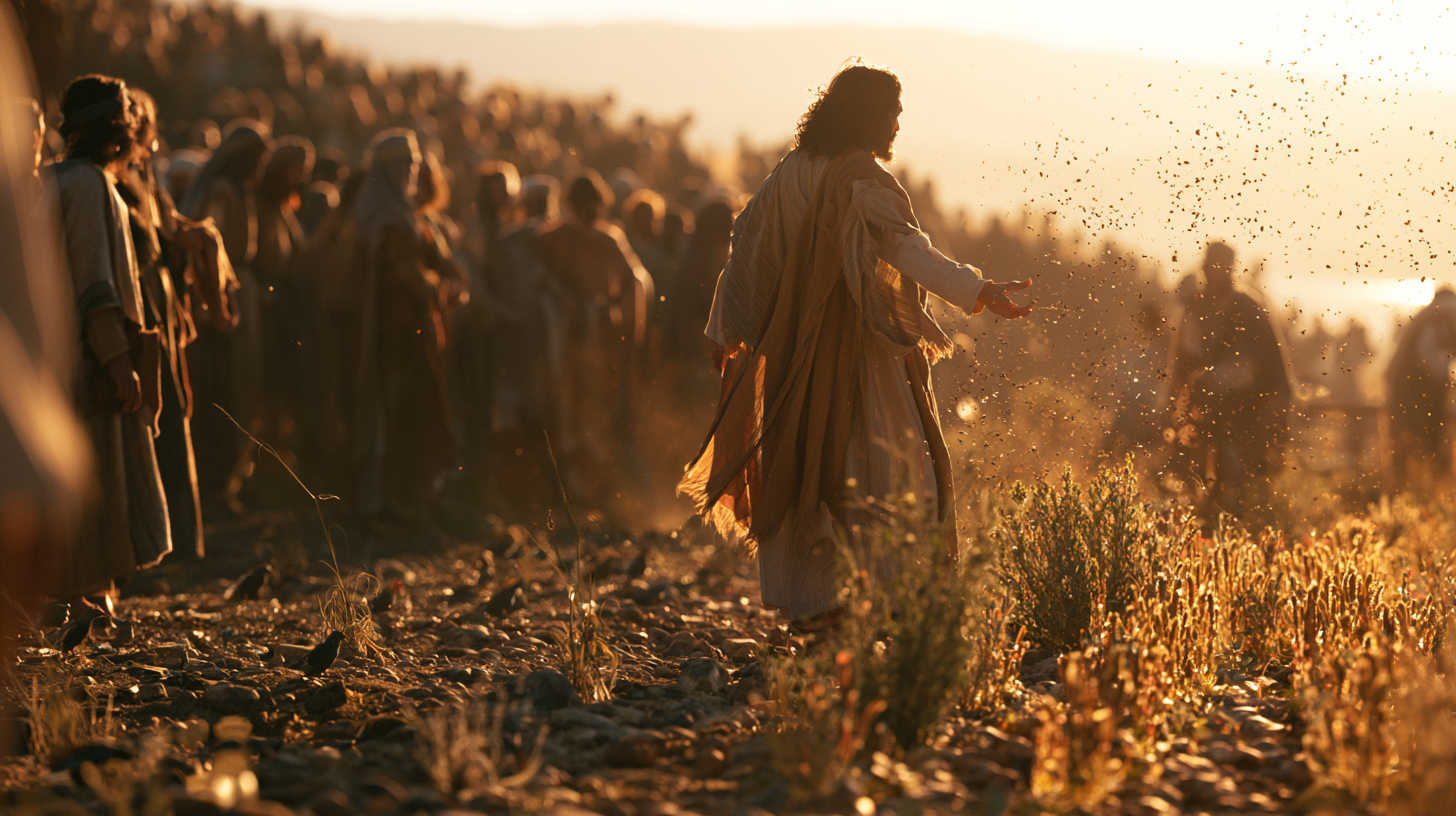
Jesus told this parable to a large crowd gathered by the Sea of Galilee, teaching from a boat just offshore because of the size of the crowd. A farmer goes out to sow seed. As he scatters it by hand — the standard planting method of the time — the seed lands in four different places:
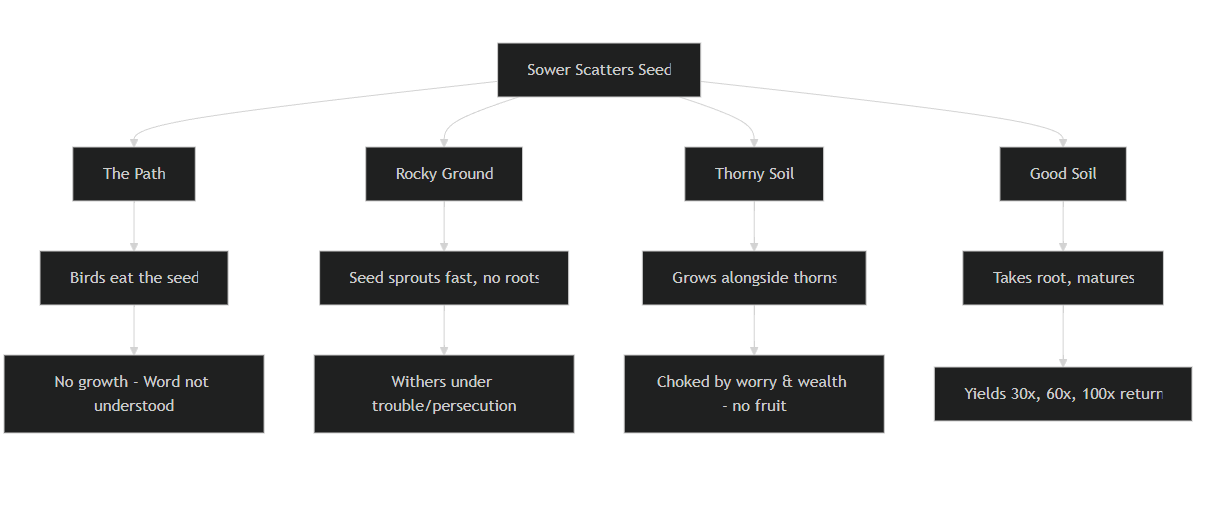
- Along the path, where the ground has been packed hard by foot traffic. Birds swoop in and eat the seed before it can even settle.
- On rocky ground, where a thin layer of soil sits over bedrock. The seed sprouts quickly because there’s no depth to slow it down, but with no root system, the plant is scorched and dies the moment the sun gets hot.
- Among thorns, where the seed grows alongside established weeds. The thorns outcompete the young plant for light, water, and nutrients, choking it before it produces anything.
- On good soil, where the seed takes root, grows undisturbed, and produces a harvest far beyond what was planted — thirty, sixty, or even a hundred times the original amount.
Jesus ends the story with a phrase He repeats often in His teaching: “Whoever has ears, let them hear.” It’s a signal that the story isn’t just a farming anecdote — it’s meant to be decoded.
Visualizing the Four Soils
What Each Symbol Means
Jesus explained His own parable privately to the disciples, which is unusual — most of His parables were left for the audience to wrestle with. This one comes with a built-in answer key:
- The Sower is Jesus Himself (and by extension, anyone who shares God’s message).
- The Seed is the word of the kingdom — the message of the gospel.
- The Birds represent the evil one, actively working to keep the message from taking hold.
- The Soil represents the human heart — specifically, its posture toward truth at the moment it’s received.
The Path: A Hardened Heart
When someone hears the message but doesn’t understand it, the point never has a chance to sink in. Jesus compares this to seed sitting exposed on a footpath — instantly vulnerable, instantly picked off.
This isn’t a person who heard wrong information; it’s someone whose heart is closed before the message even arrives, whether through cynicism, distraction, or flat rejection. There’s no argument or evidence that changes the outcome here, because the problem isn’t the seed — it’s ground that’s been packed too hard to receive anything.
Rocky Ground: Shallow, Emotional Faith
This is arguably the most relatable soil type, because it looks like success at first. The person receives the message “with joy” — genuine excitement, real enthusiasm. But joy alone isn’t the same as depth.
Without roots — without the slow, unglamorous work of building conviction through study, community, and time — the first real test (Jesus specifically names “trouble or persecution”) causes the whole thing to collapse. It’s a warning against mistaking emotional highs for spiritual maturity.
Thorny Soil: A Divided Heart
Here, the seed actually grows. Nothing about this soil looks obviously hostile — there’s no rejection, no early collapse. The danger is slower and less visible: worry about everyday life and the pull of money and possessions grow up right alongside the message and eventually strangle it.
Nothing dramatic happens; the plant just never produces anything. This soil type is a caution against divided attention — trying to grow spiritually while giving equal or greater energy to financial anxiety and material pursuit.
Good Soil: An Understanding Heart
The fourth soil doesn’t just receive the seed — it understands it. In the context of this parable, “understanding” isn’t intellectual; it’s a heart posture that leads to retention and action.
This is the only soil type of the four that produces anything at all, and what it produces is disproportionate to what was planted: a 30x, 60x, or 100x return, numbers that would have stunned a first-century farming audience used to modest harvests.
Good soil isn’t a passive category — it’s the result of a heart that’s been prepared to hear, hold onto, and act on what it’s given.
The Core Lesson
Strip away the agricultural detail, and the parable makes one central claim: the outcome of hearing God’s message depends entirely on the condition of the heart that receives it, not on the quality of the message itself. The seed is identical in all four cases. The sower doesn’t sow differently or hold anything back. The variable is always the soil.
A few supporting ideas run underneath that central point:
- Distraction is as dangerous as outright rejection. The thorny soil doesn’t reject the message — it just lets other things matter more. That’s arguably a more common failure mode than hardened refusal.
- Early enthusiasm isn’t proof of depth. The rocky-ground response looks the most promising in the short term and is often the one that disappoints people most, because the initial reaction seemed so genuine.
- Fruit is the evidence, not the feeling. Across all three Synoptic accounts, the marker of authentic reception isn’t how the message was initially received — it’s whether it eventually produced something.
A Different Angle: The Parable Is About the Sower, Not the Soil
Most readings of this parable focus on self-diagnosis — figuring out which soil describes you and resolving to become “good soil.” That’s a fair and useful application. But it’s worth noticing that Jesus opens the story with “Listen to the parable of the sower” — not “the parable of the soils.” The emphasis, grammatically, sits on the one doing the planting.
Read that way, the story says something about the character of God before it says anything about human effort. A sower who scatters seed on a footpath, on rock, and into a patch of thorns isn’t farming efficiently — no real farmer would waste seed that way.
The generosity is the point. The message goes out indiscriminately, without first screening the ground for worthiness. That doesn’t cancel out the call to be good soil; it reframes it. The invitation to receive comes before any demand to perform.
How the Three Gospel Accounts Compare
| Detail | Matthew 13:1-23 | Mark 4:1-20 | Luke 8:4-15 |
|---|---|---|---|
| Setting | Boat by the sea | Boat by the sea | Traveling, large crowd |
| Reason parables are used | Fulfills Isaiah’s prophecy about a dull-hearted people | Secrets given to insiders, parables for outsiders | Same theme, briefer |
| Description of “good soil” people | Hear and understand | Hear and accept | “Noble and good heart,” persevere |
| Yield described | 100, 60, or 30 times | 30, 60, or 100 times | 100 times (no range given) |
The differences are minor — mostly in ordering and emphasis — but Luke’s version adds a distinctive phrase: good soil belongs to those with “a noble and good heart” who “persevere.” That word, persevere, nudges the parable away from a one-time decision and toward an ongoing posture.
Practical Ways to Cultivate “Good Soil”
If the parable is a diagnosis, it’s also implicitly a set of directions. A few concrete practices map onto each soil weakness:
- Against a hardened heart: Stay in regular contact with the message rather than avoiding it. Hard ground doesn’t stay hard forever — consistent exposure, humility, and honest questions soften it over time.
- Against shallow roots: Build depth deliberately — regular study, community, and accountability rather than relying on emotional peaks. Roots form underground, out of sight, before there’s anything to show for it.
- Against thorns: Name financial worry and materialism directly rather than letting them operate unexamined. Practical steps — budgeting, giving, simplifying — do double duty as spiritual discipline.
- Against complacency: Treat “understanding” as active, not passive. The good soil in the story doesn’t just hold onto the seed; it produces something visible over time.
Frequently Asked Questions
Yes — it’s referred to by both names. The title in the Gospel text is about the sower, but because the story hinges on the different reactions of the soil, many teachers refer to it as the Parable of the Soils.
According to His own explanation in Matthew 13:10-17, parables reveal truth to those ready to receive it while keeping it concealed from those who aren’t — a filtering mechanism rather than a simplification tool.
The birds that eat the seed on the path represent the interference of the evil one, actively working to remove the message before it can settle into a person’s understanding.
No — the parable describes conditions, not permanent identities. Hard, rocky, and thorny ground can all be worked, cleared, and improved; the story is a snapshot of a heart’s current state, not a life sentence.
These figures represent an extraordinary agricultural yield for the time period — a normal harvest might return far less. The exaggerated multiplication underscores how disproportionate the reward is compared to the initial investment once the message truly takes root.
Final Thought
The Parable of the Sower endures because it resists a tidy, comfortable reading. It’s not simply a call to try harder or feel more strongly about faith — it’s an invitation to examine what’s actually competing for space in a person’s attention, and a reminder that the message itself never changes. What changes is the ground it lands on.
Please share this What Is the Meaning of the Parable of the Sower? your friends and do a comment below about your feedback.
We will meet you on next article.
Until you can read, How AI Can Help You Work Better From Home