
Parable of the Unjust Steward: Verse, Meaning & Lesson
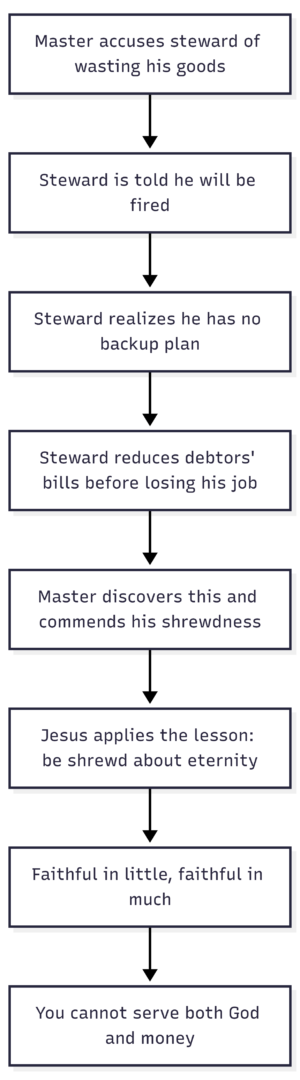
The Parable of the Unjust Steward, found in Luke 16:1-13, is widely considered one of the most puzzling stories Jesus ever told. It describes a dishonest manager who, facing termination for wasting his master’s assets, reduces the debts owed by his master’s clients in order to secure their favor before he loses his job.
Surprisingly, the master commends the steward’s shrewdness rather than condemning his dishonesty. Jesus then uses the story to challenge His followers to be just as strategic and forward-thinking about their eternal future as this dishonest man was about his immediate financial survival.
This parable unsettles readers because its central character is not a moral example to imitate but a cautionary figure whose resourcefulness, not his ethics, becomes the point of the lesson. Understanding the setting, the specific details of the debts involved, and Jesus’ surrounding commentary clarifies exactly what point He was making.
The Verse: Luke 16:1-13
A rich man had a manager who was accused of wasting his employer’s possessions. The master called him in and demanded an account of his management, informing him that he would no longer be permitted to serve as manager. Facing this crisis, the steward reasoned to himself that he lacked the strength for manual labor and was too ashamed to beg.
He devised a plan: he called in his master’s debtors one by one and reduced what they owed. One man’s debt of a hundred measures of oil was cut to fifty; another’s debt of a hundred measures of wheat was reduced to eighty. By discounting these debts, the steward ensured that these men would feel obligated to help him once he was out of a job.
When the master discovered what had happened, he commended the dishonest manager, not for his dishonesty, but for his shrewdness, noting that the people of this world often act more shrewdly in dealing with their own affairs than those who claim to follow a higher calling.
Jesus then applies the story with a series of statements: use worldly wealth to make lasting friendships that welcome you into eternal dwellings; those faithful in small matters will be faithful in large ones, and those dishonest in small matters will be dishonest in large ones; and finally, no one can serve two masters, because they cannot serve both God and money.
The Setting and Audience
This parable appears immediately after the three parables in Luke 15, the Lost Sheep, the Lost Coin, and the Prodigal Son, all addressed to a mixed audience of disciples and Pharisees. Luke’s introduction suggests the audience for the Unjust Steward parable was similarly mixed, and Luke notes shortly afterward that the Pharisees, who “loved money,” reacted to Jesus’ teaching with scorn.
This context matters because it frames the entire parable as a critique of misplaced priorities around wealth. Jesus was not simply telling disciples an abstract lesson about generosity; He was directly confronting an audience that included religious leaders known for valuing money and status while presenting themselves as righteous.
Understanding the Debt Reductions
The specific numbers in this parable reflect real economic practices of the time. Both debts involved staple agricultural goods, oil and wheat, that carried built-in markups reflecting risk, spoilage, and hidden interest charges, since Jewish law technically prohibited charging direct interest on loans.
| Debtor | Original Debt | Reduced To | Approximate Discount |
|---|---|---|---|
| First debtor | 100 measures of olive oil | 50 measures | 50% reduction |
| Second debtor | 100 measures of wheat | 80 measures | 20% reduction |
Olive oil was prone to spoilage and carried higher risk for lenders, which is reflected in the steeper standard markup, commonly around 100%, built into oil-based loans of the period. Wheat, being more stable and less perishable, typically carried a smaller markup, often closer to 20%.
The steward’s reductions closely track these customary markups, suggesting he was not necessarily giving away his master’s principal but rather eliminating the padded interest that had been built into each bill, benefiting the debtors substantially while still leaving the underlying loan technically intact.
This detail helps explain why the master, upon discovering what happened, reacted with grudging admiration rather than outrage. The steward’s actions may have simply exposed and removed a hidden markup rather than stealing outright from the principal, a move clever enough to leave the master with limited grounds for public complaint, especially since exposing the scheme too loudly would have revealed his own participation in inflated, quasi-usurious lending practices.
What the Parable Means
The parable does not celebrate dishonesty. Jesus explicitly warns, in the verses immediately following the story, that those who are dishonest in small matters will be dishonest in large ones, and that no one can serve both God and money.
Instead, the parable functions as what many interpreters describe as an argument from lesser to greater: if even a dishonest, self-serving manager can act with this much foresight and urgency to secure his future, how much more should believers act with foresight and urgency to secure their eternal future?
The steward’s crisis forced him to be honest about his situation (he had no other marketable skills and was too proud to beg), to think ahead rather than remain paralyzed, and to act decisively rather than delay.
Jesus holds up this pattern of clear-eyed self-assessment and prompt action as something believers should apply to their spiritual lives, even while rejecting the steward’s underlying dishonesty as a model to imitate.
The Meaning of “Unrighteous Wealth”
Jesus’ phrase “unrighteous wealth” or “unrighteous mammon” (translated variously across versions) has caused confusion for many readers, since it can sound like Jesus is endorsing using ill-gotten money for good purposes.
The phrase more likely reflects one of several possibilities: the tendency of wealth to be acquired through less than pure means in a fallen world, the way people are tempted to misuse wealth for selfish purposes, or simply the corrupting influence money often has on those who possess it. Wealth itself is not condemned in this parable; rather, the love of money and its potential to become a substitute master for God is the central concern.
Faithfulness in Little Things
One of the parable’s key applications is the principle that faithfulness in small matters demonstrates trustworthiness for larger responsibilities. Jesus draws a direct line between how a person manages relatively modest earthly resources and whether they can be entrusted with what He calls “true riches,” a phrase pointing toward spiritual responsibility and reward in God’s kingdom.
| Category | Example | What It Reveals |
|---|---|---|
| Little / Earthly | Money, material possessions | Trustworthiness with modest resources |
| Much / Heavenly | True riches, kingdom responsibility | Readiness for greater spiritual trust |
| What belongs to another | Wealth entrusted temporarily | Faithfulness as a steward, not an owner |
| What is your own | Eternal reward | The outcome of faithful stewardship |
This principle reframes everyday financial decisions as spiritually significant. How a person handles a modest budget, a small debt, or day-to-day resources becomes, in Jesus’ framing, a meaningful indicator of their readiness for greater responsibility.
You Cannot Serve Two Masters
The parable’s climactic statement, that no one can serve both God and money, sets up an unavoidable choice rather than a balancing act. Jesus does not suggest that wealth and faith can coexist as equal priorities; He states plainly that one master will always be loved and the other despised, one served faithfully and the other neglected. This teaching echoes Jesus’ words in the Sermon on the Mount about not being able to serve both God and money, reinforcing that this was a consistent and central theme in His teaching rather than an isolated comment.
Key Lessons From the Parable
Everything ultimately belongs to God. The steward managed resources that were never truly his. Believers are called to view their own wealth, time, and abilities the same way, as resources entrusted to them rather than personal possessions to be used purely for self-interest.
Faithfulness in small matters matters. How a person handles modest, everyday responsibilities reveals whether they can be trusted with greater ones, both practically and spiritually.
Wealth should be used with eternity in mind. Jesus challenges His followers to use material resources generously and strategically, creating lasting value rather than treating money purely as a tool for personal comfort or security.
Decisive action matters. The steward did not delay or deny his crisis; he acted immediately once he understood the stakes. Jesus points to this urgency, not the steward’s dishonesty, as worth imitating regarding spiritual priorities.
Money and God cannot both be ultimate priorities. The parable’s final and clearest statement leaves no room for a divided loyalty between financial security and devotion to God.
Why This Parable Still Challenges Readers
Part of what makes this parable so difficult is that its central figure is morally compromised throughout the story, and Jesus never pretends otherwise.
Rather than offering a clean, virtuous role model, Jesus uses an uncomfortable example to make a sharper point: if people are willing to go to great lengths and show remarkable resourcefulness to protect their worldly interests, believers should be at least as intentional and urgent about their spiritual and eternal priorities.
The parable’s discomfort is not a flaw in its teaching; it’s the mechanism by which Jesus forces His audience, both then and now, to examine their own priorities honestly.
Frequently Asked Questions
It appears in Luke 16:1-13, immediately following the parables of the Lost Sheep, Lost Coin, and Prodigal Son in Luke 15.
No. Jesus explicitly warns against dishonesty in the verses following the story and states plainly that no one can serve both God and money. The steward’s shrewdness and urgency are commended, not his deceit.
The phrase likely reflects the corrupting influence money can have or the imperfect means by which wealth is often acquired in a fallen world, rather than a literal endorsement of using stolen or ill-gotten money for good purposes.
The master commended the steward’s shrewdness and foresight in securing his future, not his dishonesty. Jesus uses this reaction to highlight how strategically people pursue worldly security compared to how little urgency believers often show about spiritual matters.
They likely reflect the removal of inflated interest built into each bill rather than outright theft of the principal, which may explain why the master reacted with grudging respect rather than outrage.
The parable calls believers to manage their resources, time, and responsibilities with the same intentionality and urgency that people typically apply to protecting their worldly interests, while keeping God, not money, as their ultimate priority.
The Lasting Takeaway
The Parable of the Unjust Steward uses an unlikely and flawed character to deliver one of Jesus’ most direct challenges about priorities. It’s not a story about admiring dishonesty, but about recognizing the same urgency, foresight, and decisive action in spiritual matters that people so readily apply to protecting their financial security.
The parable’s final statement leaves no room for a divided loyalty: every reader must decide whether God or money holds the position of ultimate master in their life, since Jesus makes clear that both cannot occupy that seat at once.
Please share this Parable of the Unjust Steward: Verse, Meaning & Lesson with your friends and do a comment below about your feedback.
We will meet you on next article.
Until you can read, The 20 Most Popular Bible Verses for Healing