
Do Software Engineers Work From Home?
Yes — and at a higher rate than almost any other profession. Industry surveys consistently show that over 80% of software engineers work either fully remote or in a hybrid model. The core work — writing, testing, and deploying code — requires nothing more than a computer, an internet connection, and access to a few cloud-based platforms. This makes software engineering one of the most structurally remote-compatible jobs in the modern economy.
That said, “can work from home” and “will work from home” are not the same question. Company policy, project type, seniority, and security requirements all shape whether a specific role is fully remote, hybrid, or on-site. This guide breaks down the current landscape, what determines your options, and what tools and setup remote engineering actually requires.
How Common Is Remote Work for Software Engineers?
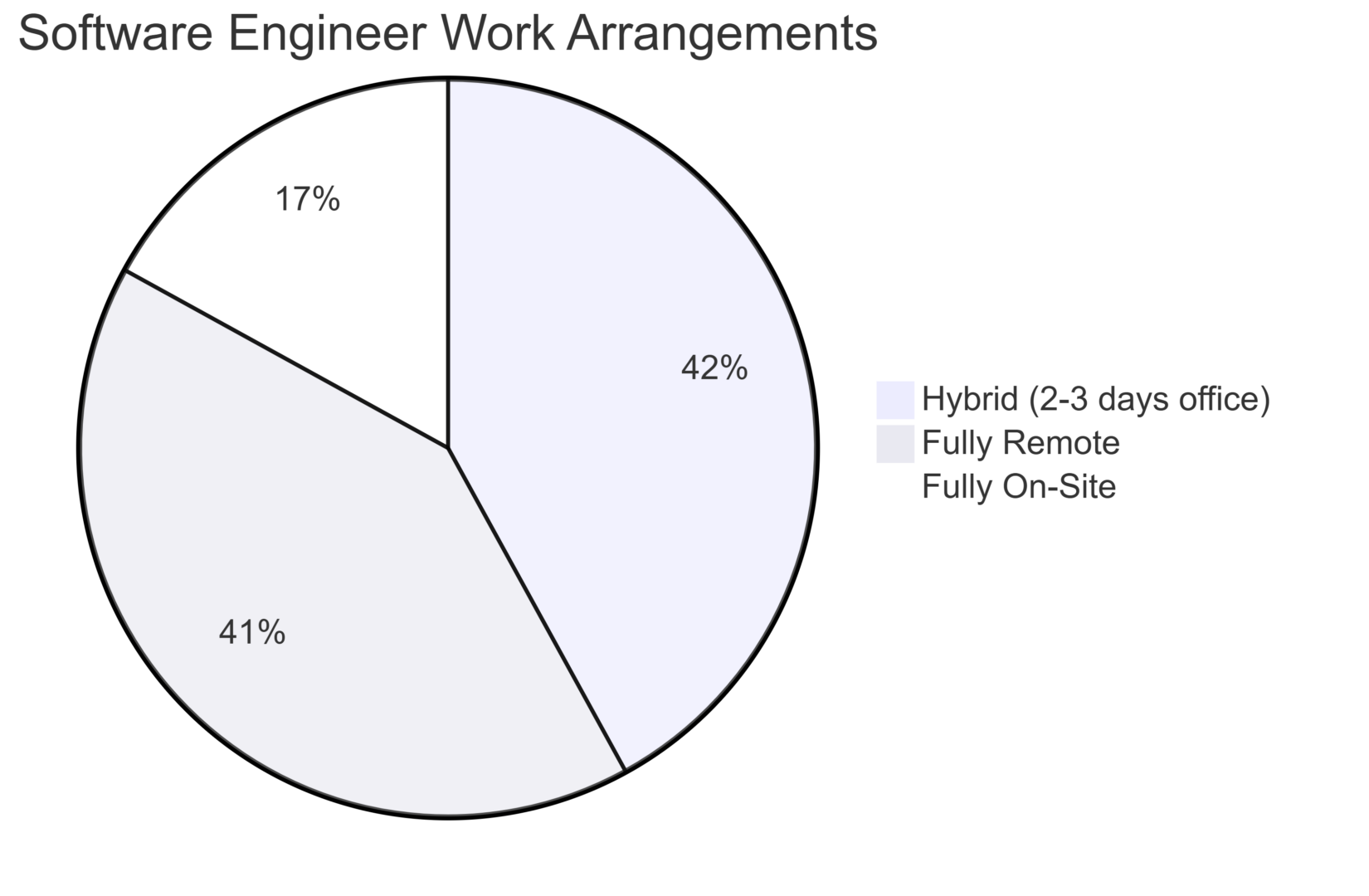
Survey data consistently shows a similar pattern: roughly 4 in 10 software engineers work fully remote, slightly more work hybrid, and a smaller minority work entirely on-site. This represents a dramatic shift from pre-2020 norms, when the vast majority of developers worked from an office full-time and remote arrangements were considered unusual or “complicated” by most respondents.
The shift has been driven by a combination of factors: the pandemic proved distributed teams could maintain productivity, cloud-based development tools matured to support real-time remote collaboration, and companies discovered they could access talent outside expensive tech hubs.
The Three Work Models
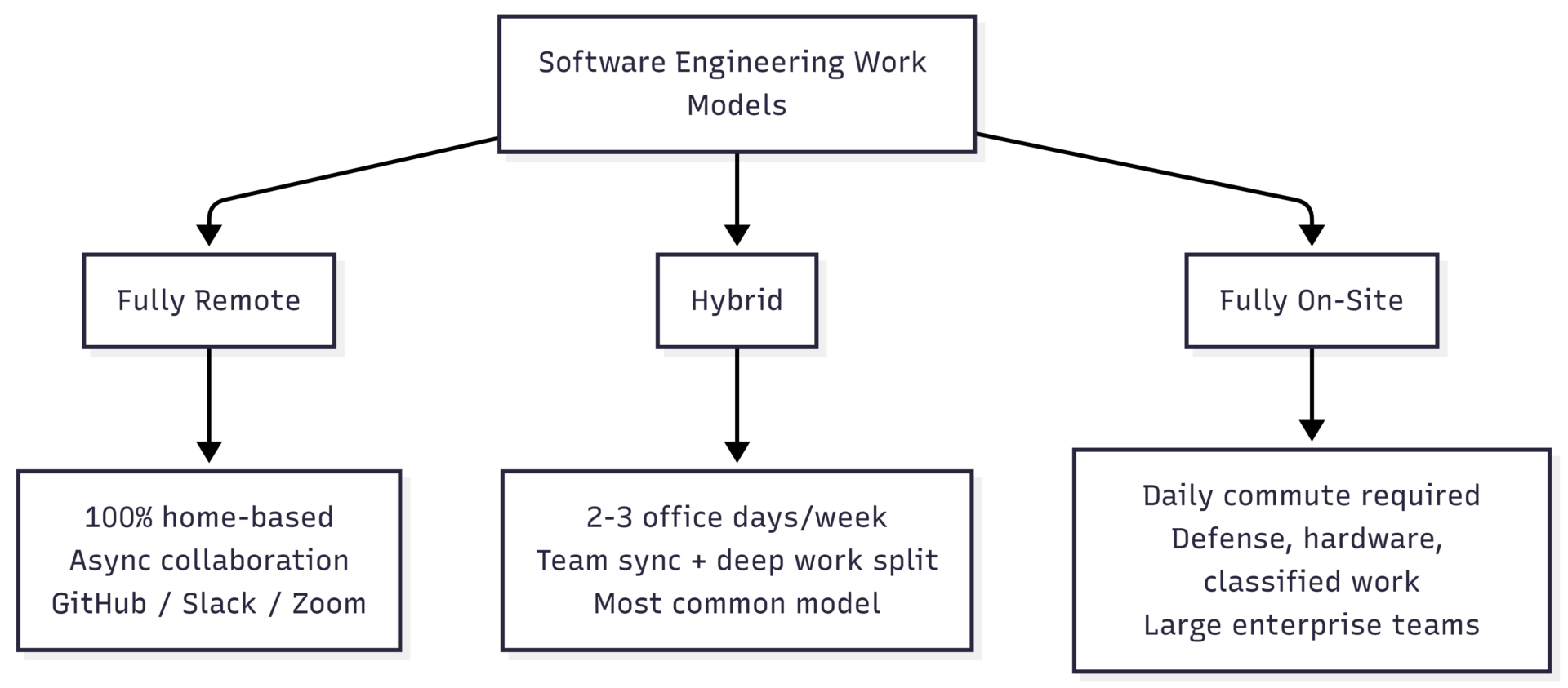
| Model | Description | Typical Companies |
|---|---|---|
| Fully Remote | 100% home-based, async-first collaboration via GitHub, Slack, Zoom | Remote-first startups, distributed SaaS companies |
| Hybrid | 2–3 office days per week, mix of in-person sync and remote deep work | Most mid-size and large tech companies |
| Fully On-Site | Daily office presence required | Defense contractors, hardware-integrated teams, some large enterprises |
Why Software Engineering Is Naturally Remote-Compatible
The job consists almost entirely of digital tasks performed independently on a computer:
- Writing and reviewing code
- Debugging and testing
- Deploying applications and infrastructure
- Documentation and architecture planning
- Code reviews and pair programming (via screen share)
None of these require physical presence. The technology stack that supports remote engineering has matured to the point where distributed collaboration is often indistinguishable from in-office collaboration.
The Remote Engineering Tech Stack
| Category | Common Tools | Approx. Cost |
|---|---|---|
| Version Control | GitHub, GitLab, Bitbucket | Free–$21/user/month |
| Communication | Slack, Microsoft Teams | Free–$12.50/user/month |
| Video Conferencing | Zoom, Google Meet | Free–$15/user/month |
| Project Management | Jira, Linear, Trello, Asana | Free–$15/user/month |
| Cloud Development Environments | GitHub Codespaces, Gitpod | $0.18/hour–$50/month |
| Documentation | Notion, Confluence | Free–$10/user/month |
| CI/CD Pipelines | GitHub Actions, CircleCI, Jenkins | Free–$30+/month |
| VPN / Security | Cisco AnyConnect, NordLayer | $5–$15/user/month |
This stack covers the entire engineering workflow — from writing code to deploying it to production — without requiring physical office infrastructure.
What Determines Whether a Role Is Remote-Eligible?
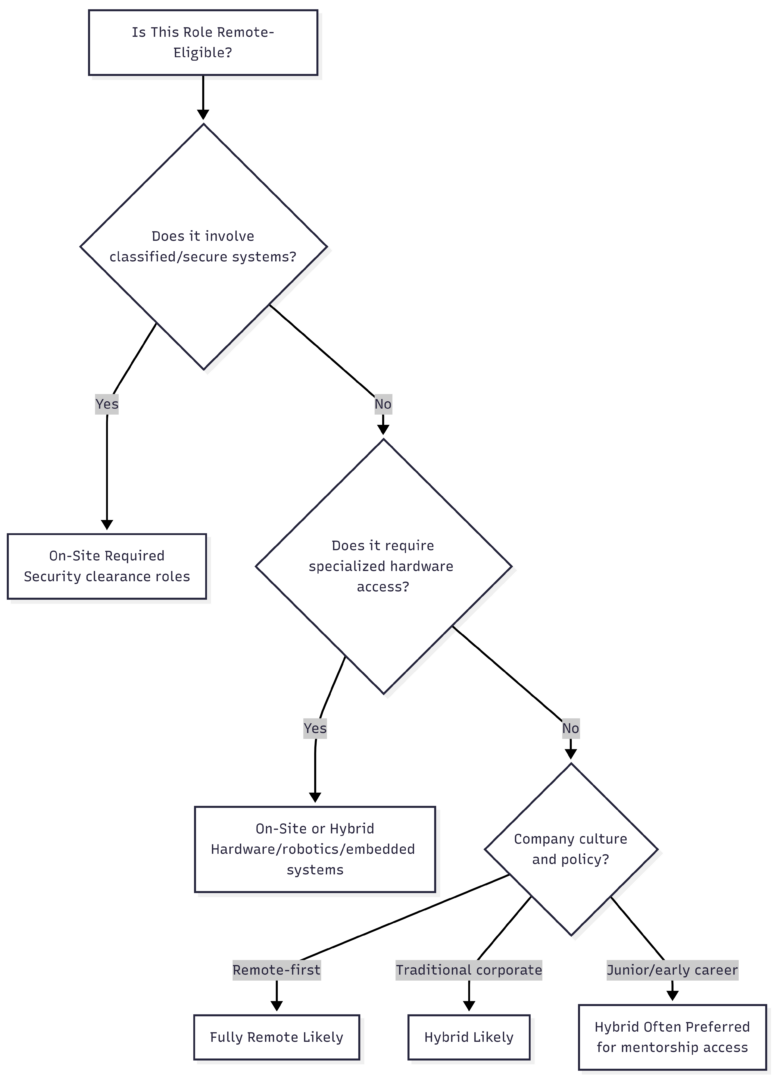
Company culture. Remote-first startups and SaaS companies — particularly those built post-2020 — are structured around distributed teams from the ground up. Traditional enterprises with legacy office infrastructure often default to hybrid policies, partly for collaboration and partly for cultural and management reasons.
Project and security requirements. Roles involving classified government systems require security clearances (such as TS/SCI in the US) and mandatory on-site presence — these positions are explicit about this requirement in job postings. Similarly, engineers working on embedded systems, robotics, trading floor infrastructure, or hardware-integrated software need physical proximity to test and debug.
Experience level. Junior developers face a structural disadvantage in fully remote environments. Mentorship, ad-hoc questions, and pair programming happen more naturally in person. Many companies that allow senior engineers to work fully remote still prefer junior hires to be hybrid or on-site during their first one to two years.
Remote Eligibility by Engineering Specialty
| Specialty | Remote Eligibility | Notes |
|---|---|---|
| Web Development (Frontend/Backend) | Very High | Almost entirely digital, minimal hardware dependency |
| Full-Stack Development | Very High | Standard remote-friendly role |
| DevOps / Cloud Infrastructure | Very High | Cloud-native by definition |
| Data Engineering | Very High | Cloud data platforms support full remote work |
| Mobile App Development | High | Some device testing benefits from in-person lab access |
| QA / Test Engineering | High | Mostly software-based, some hardware testing exceptions |
| Embedded Systems / Firmware | Low–Moderate | Requires physical hardware access |
| Robotics / Hardware Integration | Low | Physical testing environments required |
| Defense / Classified Systems | Very Low | Security clearance mandates on-site presence |
| Game Development (Engine/Tools) | High | Some studios require in-person for asset/hardware testing |
Salary Considerations for Remote Software Engineers
Remote work has had a measurable impact on compensation structures. Companies hiring remotely can recruit outside expensive metro areas, which has both expanded opportunity and introduced regional pay variation.
| Region | Mid-Level Developer Salary (Approx. Annual) |
|---|---|
| San Francisco Bay Area (on-site) | $150,000–$190,000 |
| US Remote (location-independent pay) | $100,000–$150,000 |
| US Remote (location-adjusted pay) | $80,000–$130,000 |
| Western Europe (remote) | €50,000–€90,000 |
| Eastern Europe (remote) | $35,000–$65,000 |
| Latin America (remote) | $50,000–$80,000 |
| South / Southeast Asia (remote) | $25,000–$55,000 |
Companies adopting “location-independent” pay structures pay the same salary regardless of where an employee lives, while “location-adjusted” structures pay based on local cost of living. This distinction has become a significant factor in remote job negotiations — candidates evaluating offers should clarify which model applies.
Benefits of Remote Work for Software Engineers
Deep focus and productivity. Software development benefits significantly from uninterrupted concentration — entering a state of “flow” is central to solving complex technical problems. Remote work removes office interruptions (drop-by conversations, ambient noise, unnecessary meetings) that fragment focus time.
Reduced burnout. Burnout rates among developers are high — surveys report roughly 70% of developers have experienced burnout at some point. Remote work arrangements have been associated with meaningful reductions in both workplace-driven and personal burnout, primarily through improved schedule flexibility and elimination of commute stress.
Geographic and lifestyle flexibility. Engineers can live in lower-cost areas, relocate without changing jobs, or travel while maintaining employment — a significant lifestyle advantage unique to digital-first professions.
Time savings. Eliminating a daily commute reclaims, on average, 30–60 minutes per day — time that can go toward personal life, additional learning, or simply rest.
Challenges of Remote Software Engineering
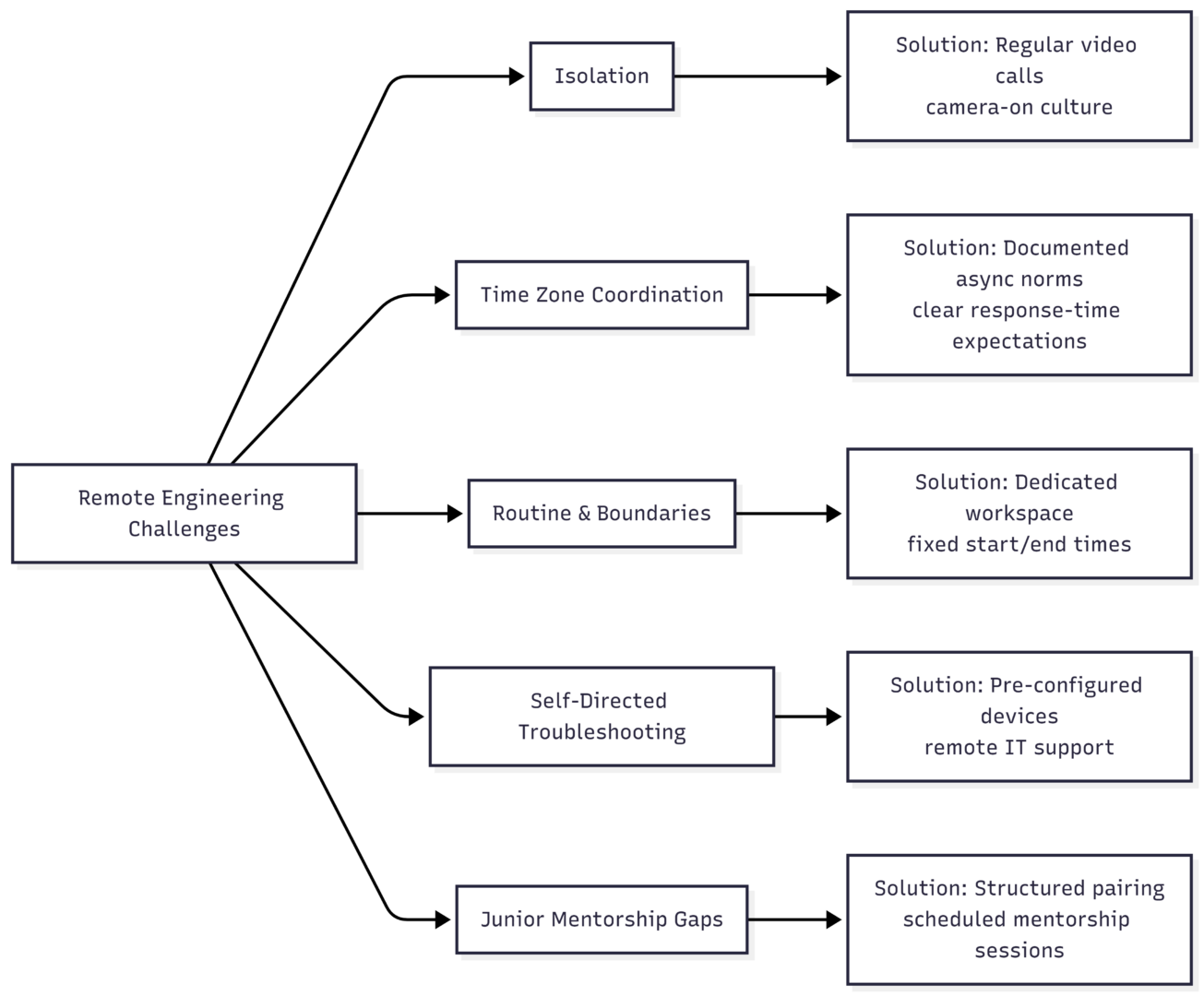
Isolation. Even engineers who prefer independent work benefit from team structure, informal knowledge-sharing, and social interaction. Remote teams need to deliberately recreate these dynamics through regular video calls, camera-on norms, and dedicated social channels.
Time zone coordination. Distributed global teams introduce communication delays. Effective remote engineering organizations establish clear async communication norms — documented decisions, defined response-time expectations, and minimal dependency on real-time replies for non-urgent matters.
Building routines. Without office structure, some engineers default to either overworking (no one notices long hours) or struggling with motivation. Establishing a dedicated workspace and consistent working hours is essential for sustainability.
Self-directed technical troubleshooting. Office environments provide on-demand IT support. Remote engineers need pre-configured equipment, documented troubleshooting processes, and accessible remote IT support to avoid productivity loss from technical issues.
VPN and connectivity. Secure VPN access is standard for remote engineering roles handling proprietary code or sensitive systems. While VPNs can introduce minor latency, modern enterprise VPN solutions are optimized to minimize impact on development workflows.
How Companies Structure Remote Engineering Teams
Organizations that successfully run distributed engineering teams share several common practices:
Documentation-first culture. Decisions, architecture choices, and processes are written down and searchable — reducing dependency on synchronous explanation and supporting onboarding across time zones.
Async-by-default communication. Meetings are minimized in favor of written updates, recorded video walkthroughs, and shared documents. When synchronous meetings are necessary, they are scheduled in advance with confirmed attendance.
Clear role definitions. Distributed teams function best when responsibilities and escalation paths are explicit — engineers know exactly who to contact for specific issues without needing informal office knowledge.
Workflow automation. Automated testing, CI/CD pipelines, and deployment schedules reduce reliance on manual coordination and create predictable team rhythms.
Structured onboarding. New remote engineers ramp up through documented processes, recorded training material, and scheduled pairing sessions — rather than informal desk-side mentorship.
Roles That Remain On-Site or Hybrid
Despite the overall shift toward remote work, certain categories of software engineering roles consistently require physical presence:
- Government and defense contracting — roles requiring security clearances (Confidential, Secret, Top Secret, TS/SCI) mandate on-site work in secure facilities
- Financial trading systems — proximity to trading infrastructure and ultra-low-latency networks for high-frequency trading systems
- Embedded and firmware engineering — direct hardware access for testing and debugging
- Robotics and automation — physical testing environments for hardware-software integration
- Aerospace and automotive control systems — hardware-in-the-loop testing requiring lab access
- Early-career roles at traditional enterprises — many companies prefer junior engineers on-site or hybrid for mentorship during the first one to two years
FAQs
Approximately 80% work either fully remote or hybrid, based on recent industry developer surveys. Roughly 40% report fully remote arrangements, with a similar proportion in hybrid setups.
Yes, though it is more competitive. Many companies prefer hybrid arrangements for junior hires to support mentorship and skill development, but fully remote junior roles do exist, particularly at remote-first companies with structured onboarding programs.
It depends on the company’s compensation model. Location-independent pay structures maintain salary regardless of where the employee lives. Location-adjusted structures pay based on local cost of living, which can result in lower compensation for engineers in lower-cost regions.
Defense and government contracting (due to security clearance requirements), financial trading systems, embedded/firmware engineering, robotics, and aerospace/automotive control systems most commonly require on-site or hybrid arrangements.
The infrastructure supporting remote engineering — cloud development environments, async collaboration tools, distributed version control — is now deeply embedded in how software is built. While individual companies adjust policies, the underlying technical compatibility of the work with remote arrangements remains structurally unchanged.
Conclusion
Software engineering remains one of the most remote-compatible professions, with the large majority of engineers working fully remote or hybrid. The job’s reliance on digital tools — version control, cloud development environments, async communication platforms — means physical location is rarely a technical constraint.
What determines your specific options is less about the profession itself and more about company policy, project security requirements, hardware dependencies, and seniority level. Senior engineers in software-only roles at remote-first companies have the most flexibility. Junior engineers, defense-adjacent roles, and hardware-integrated positions are more likely to require on-site or hybrid arrangements.
For engineers evaluating opportunities, understanding which category a role falls into — and how compensation is structured for remote positions — is more useful than asking whether remote work is possible in the abstract. For the vast majority of software engineering work, it already is.
Please share this Do Software Engineers Work From Home? with your friends and do a comment below about your feedback.
We will meet you on next article.
Until you can read, Is Working From Home a Reasonable Accommodation for Anxiety?