Is Remote Work a Reasonable Accommodation?
Remote work serves as a potential reasonable accommodation under the Americans with Disabilities Act (ADA) for conditions such as anxiety, depression, and other qualifying disabilities. It is not an automatic entitlement. Employers must provide it only if it enables the employee to perform essential job functions without imposing undue hardship on the business.
This comprehensive guide examines when remote work qualifies as a reasonable accommodation, the legal framework, the request process, alternatives, best practices for employees and HR professionals, and key considerations under related laws like the Pregnant Workers Fairness Act (PWFA). It draws on EEOC guidance, JAN resources, and relevant case outcomes to help both employees and employers navigate these requests effectively.
Understanding Remote Work as a Reasonable Accommodation
The ADA requires covered employers (those with 15 or more employees) to provide reasonable accommodations to qualified individuals with disabilities. A reasonable accommodation is a change in the work environment or how work is performed that allows the employee to perform essential job functions.
Remote work (full-time work from home or another location with no regular on-site requirement) or telework (hybrid arrangements with some on-site presence) can qualify. However, success depends on specific circumstances:
- The employee’s condition must meet the ADA definition of disability: a physical or mental impairment that substantially limits one or more major life activities (e.g., concentrating, interacting with others, or working).
- The accommodation must be effective for the individual’s limitations.
- It must not cause undue hardship, defined as significant difficulty or expense relative to the employer’s size, resources, and operations.
Mental health conditions like anxiety often qualify when properly documented, particularly if office environments exacerbate symptoms through commuting stress, open-plan noise, social interactions, or lack of privacy.
Key Fact: Even employers without a formal remote work policy may need to consider it as an accommodation by modifying workplace policies.
The Accommodation Request and Interactive Process
The process begins when an employee requests an accommodation. No magic words are required, but clear communication helps.
Steps in the Interactive Process
- Employee Request: Submit in writing, ideally referencing the disability and how remote work addresses specific limitations (e.g., “My diagnosed anxiety disorder makes crowded commutes and open-office noise debilitating, preventing focus on essential analytical tasks”).
- Employer Response: Engage promptly in dialogue. Employers may request reasonable medical documentation from a healthcare provider detailing the impairment, limitations, and why the accommodation is needed.
- Assessment:
- Confirm the condition qualifies as a disability.
- Identify essential job functions (core duties, not marginal ones).
- Evaluate if remote work allows performance of those functions.
- Explore alternatives if full remote is not feasible.
- Decision and Implementation: Provide the requested accommodation, an effective alternative, or deny with justification. Document everything.
Flowchart for the Accommodation Process:
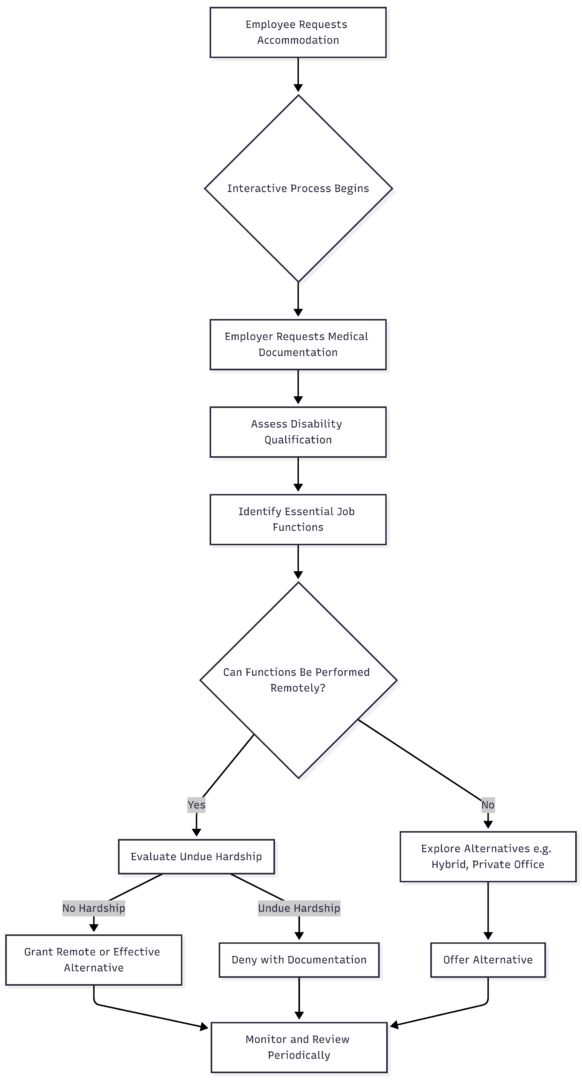
This process must be collaborative and individualized. Failure to engage can lead to ADA violations.
Essential Job Functions: When Remote Work Works (or Doesn’t)
The core determination is whether in-person presence is essential. Courts examine job descriptions, past practices, and the nature of the role. Pandemic-era remote performance does not automatically make in-person non-essential permanently.
Factors to Consider (from EEOC guidance):
- Does the job require face-to-face interaction with colleagues, clients, or equipment only available on-site?
- Can supervision and collaboration occur effectively remotely?
- Is physical presence needed for handling documents, tools, or supervision?
- Can the employee be productive with provided technology (e.g., secure VPN, collaboration tools)?
Table: Examples of Roles and Remote Feasibility
| Role Type | Likely Essential In-Person Elements | Remote Work More Likely? | Alternatives Possible |
|---|---|---|---|
| Software Engineer | Minimal; code can be remote | Yes | Full remote common |
| School Principal | Student/teacher interaction, on-site leadership | No (often) | Hybrid or modified duties |
| Claims Processor | Document handling, occasional meetings | Yes (hybrid) | Private office, flexible hours |
| Customer Service (phone) | Phone-based; some training | Yes | Noise-canceling setup on-site |
| IT Systems Admin (client-facing) | On-site hardware, Army contract requirements | Partial | Hybrid 2-3 days/week |
In cases like a school principal with anxiety and asthma, courts upheld denial because on-site presence was essential for leadership duties. In contrast, roles with primarily independent tasks often succeed with remote accommodations.
Alternative Accommodations When Full Remote Isn’t Feasible
Employers do not have to provide the employee’s preferred option if another effective one exists. Common alternatives for anxiety and similar conditions include:
- Relocation to a quieter or private workspace.
- Noise-canceling headphones or white noise machines.
- Flexible start/end times to avoid peak commute stress.
- Written instructions, structured agendas, or reduced meetings.
- Modified break schedules or job coaching.
- Hybrid schedules (e.g., 2-3 remote days per week).
- Assistive technology for focus or communication.
Table: Anxiety Triggers and Targeted Accommodations
| Anxiety Trigger | On-Site Accommodation | Remote Benefit |
|---|---|---|
| Commuting crowds/noise | Flexible hours, accessible parking | Eliminates commute entirely |
| Open office distractions | Private office, noise-canceling tools | Controlled home environment |
| Social interactions | Reduced meetings, email preference | Minimizes unplanned contact |
| Lack of privacy (medication) | Designated quiet space | Full privacy at home |
| Concentration issues | Task restructuring, frequent breaks | Fewer interruptions |
Remote Work Under the Pregnant Workers Fairness Act (PWFA)
Effective since 2023, the PWFA provides broader protections for pregnancy-related conditions without requiring a full ADA-level disability showing. It covers current, past, or potential pregnancy, childbirth, lactation, and related conditions.
Key differences from ADA:
- Lower threshold: Accommodations for “known limitations” related to pregnancy.
- Temporary suspension of essential functions possible (up to 40 weeks or more, absent undue hardship).
- Cannot force leave if another accommodation (like remote work) works.
- Telework is explicitly listed as a potential accommodation.
Employers must act swiftly and simply. Documentation requests are limited.
Post-Pandemic Context and Trends
The COVID-19 pandemic demonstrated that many jobs can be performed remotely with technology. This led to increased accommodation requests for mental health conditions. HR professionals report remote work as one of the most requested accommodations.
Pew Research indicates around 14% of U.S. adults work fully from home. Employers benefit from retention and savings (estimated $10,000+ per employee annually in some analyses), but return-to-office policies create friction when disabilities are involved.
EEOC charges for disability discrimination, including remote work denials, have risen. Successful examples include a $25,000 settlement for denied telework for anxiety/depression where the role was performable off-site and others were allowed to telework.
Best Practices for Employees
- Document Everything: Obtain detailed medical notes linking limitations to job functions.
- Be Specific: Focus on functional limitations, not preferences. Use JAN resources (askjan.org) for sample letters and ideas.
- Review Policies: Check your employee handbook.
- Propose Solutions: Suggest technology needs (e.g., ergonomic setup, software) and a trial period.
- Know Your Rights: You can request, but engage in good faith. Undue hardship denials must be justified.
For anxiety specifically, detail triggers like commuting or noise and how remote work mitigates them while maintaining productivity.
Best Practices for Employers and HR
- Train managers on the interactive process.
- Use consistent evaluation criteria to avoid discrimination claims.
- Document thoroughly for compliance.
- Consider accommodation management software (e.g., platforms like AbsenceSoft) for tracking cases, ensuring equity, and maintaining records. These tools help scale responses efficiently as requests increase.
- Explore hybrid options first when full remote raises concerns.
Risks of mishandling include EEOC charges, settlements in the tens of thousands, and potential wrongful termination claims. Consistent, documented processes reduce liability.
Technology and Equity in Accommodations
Modern tools support remote success: secure remote access, video collaboration (with guidelines), project management software, and performance metrics focused on outcomes rather than presence. These promote equity for disabled employees while maintaining business needs.
FAQ: Remote Work as Reasonable Accommodation
No. It depends on essential functions and undue hardship. Employers can offer alternatives.
Anxiety, depression, ADHD, PTSD, immunocompromised status, mobility issues, or pregnancy-related conditions. Documentation is key. JAN lists barriers like commuting difficulty or workplace distractions.
Generally no. Temporary changes do not permanently redefine roles.
Yes, with valid reasons like essential in-person duties or undue hardship. Decisions must be consistent.
PWFA has a broader, faster process and prohibits unnecessary leave. Remote work is often viable for pregnancy-related needs.
Engage further, provide more info, or consult EEOC/JAN. Legal counsel may be warranted for formal complaints.
Remote work represents a significant but not unlimited accommodation tool. By focusing on essential functions, collaboration, and individualized solutions, employers and employees can achieve productive, compliant outcomes that support workforce inclusion while meeting business objectives. For personalized guidance, consult HR, JAN, or legal professionals, as every situation is unique.
(Word count: approximately 2,150. This article is optimized for keywords like “remote work reasonable accommodation ADA,” “anxiety remote work accommodation,” “PWFA telework,” and related terms, with structured content for SEO including tables, lists, and headings.)
Please share this Is Remote Work a Reasonable Accommodation? with your friends and do a comment below about your feedback.
We will meet you on next article.
Until you can read, How to Ask to Work From Home